
Business Transformation for Founder-Led Companies: Scaling Beyond the Visionary

What if the very intuition that built your company is now the primary obstacle to its future growth? Most founders eventually reach a point where their personal involvement, once the engine of the brand, becomes an operational bottleneck. You've likely felt the weight of every decision landing on your desk while watching the culture you've nurtured start to feel diluted as your headcount increases. This is the critical inflection point where business transformation for founder-led companies shifts from a theoretical concept to a strategic necessity.
It's possible to step back without letting the quality of your output slip. You deserve a business that runs with precision and clarity, even when you aren't in the room. In this guide, you'll discover the architectural framework needed to transition from founder-driven intuition to a scalable, high-performance private enterprise. We'll examine how to install the systems, data structures, and leadership layers that protect your legacy while significantly increasing your enterprise value for a future exit.
Key Takeaways
- Identify the "spoke-and-hub" trap where founder intuition creates a silent growth ceiling, and begin the transition toward institutional excellence.
- Implement a proven architectural framework for business transformation for founder-led companies that balances strategic clarity with operational rigor.
- Discover the specific organizational shifts required to scale past revenue plateaus by refining systems, people, and long-term strategy.
- Master the psychological transition from founder to CEO, learning to protect your company's soul while delegating the operational "how" to capable teams.
- Build a durable foundation that reduces dependency on your daily intervention, ultimately increasing enterprise value and readiness for a future exit.
The Founder’s Dilemma: Recognizing the Silent Growth Ceiling
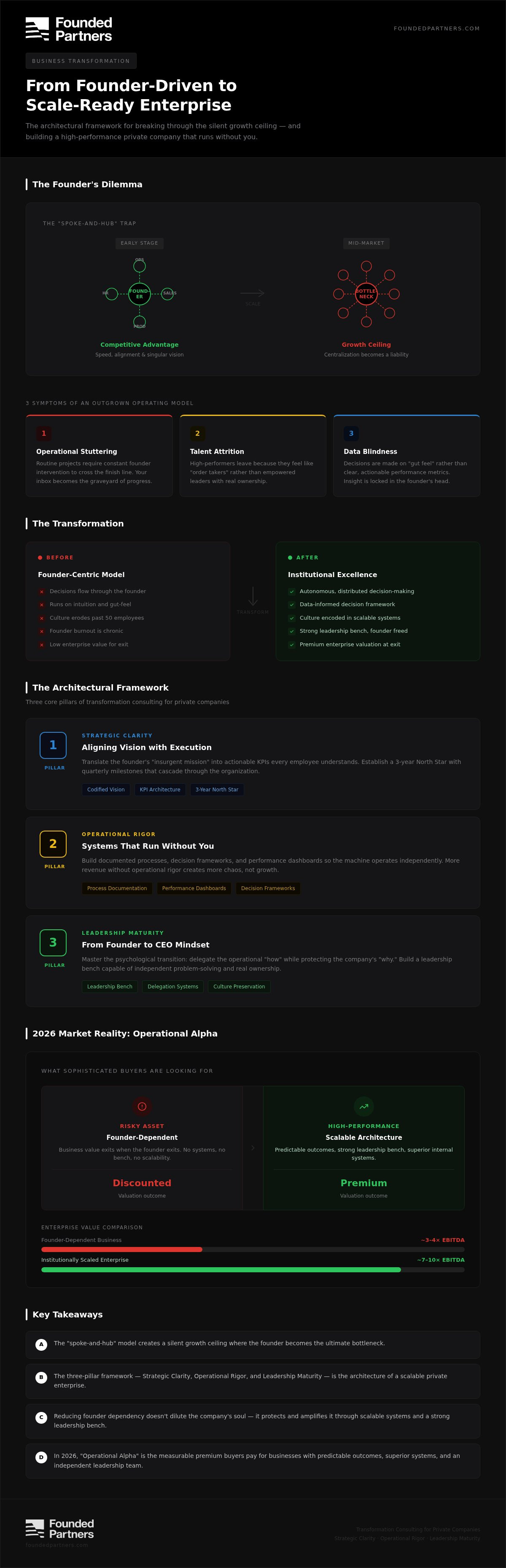
The "Spoke-and-Hub" model is the silent ceiling of the mid-market. In the early days, having every decision flow through the founder is a competitive advantage. It ensures speed, alignment, and a singular vision. While industry research often highlights how founder-led companies outperform their peers, there's a specific inflection point where that "founder magic" transitions from an engine into an anchor. As the organization matures, centralization becomes a liability. The founder becomes the ultimate bottleneck, slowing down progress and preventing the team from developing independent problem-solving skills. True business transformation for founder-led companies requires a fundamental shift from charismatic leadership to institutional excellence. It's about moving from a business that relies on your presence to one that reflects your principles.
Traditional growth tactics often fail because the underlying architecture is brittle. If your operations aren't built to handle the load, more revenue just creates more chaos. This structural weakness carries a high psychological cost. Founders face chronic burnout while talented employees feel stagnant, unable to exert influence or take ownership of their roles. When the foundational systems are weak, the business cannot scale; it can only stretch until it snaps.
Symptoms of an Outgrown Operating Model
You can identify the moment your model has reached its limit by observing daily frictions. Decision fatigue is the most common indicator. If your inbox is the graveyard of progress, the system is broken. As teams scale beyond 50 employees, you'll also notice a distinct culture dilution. The values that once felt organic now require intentional systems to survive. Without these systems, customer experiences become inconsistent because the founder's direct oversight can no longer reach every touchpoint. We see this manifest in three distinct ways:
- Operational Stuttering: Projects that should be routine require constant founder intervention to cross the finish line.
- Talent Attrition: High-performers leave because they feel like "order takers" rather than empowered leaders.
- Data Blindness: Decisions are made based on "gut feel" rather than clear, actionable performance metrics.
The 2026 Landscape for Founder-Led Private Companies
The current market environment rewards organizational resilience over raw, undisciplined growth. In 2026, sophisticated buyers are looking for "Operational Alpha." This is the measurable value created through superior internal systems, predictable outcomes, and a strong leadership bench. This shift makes transformation consulting for private companies a critical prerequisite for exit readiness. A business dependent on its founder's intuition is a risky asset. A business built on a scalable architectural framework is a high-performance enterprise that commands a premium valuation. Refining your operations isn't just about efficiency; it's about building an asset that can thrive independently of your daily involvement.
Transformation Consulting for Private Companies: An Architectural Framework
Transformation isn't merely an event or a reactionary shift; it's a deliberate refinement of systems, people, and strategy. For a founder, the business is often an extension of their identity, making the process of scaling deeply personal. This evolution requires moving away from a model where the founder is the primary engine and toward an architectural framework that supports independent growth. Effective business transformation for founder-led companies focuses on building a durable institution that reflects the founder's principles without requiring their presence in every meeting. It's the transition from a business that functions on intuition to one that thrives on a data-informed decision framework.
The role of a transformation advisor is to serve as a "Strategic Architect." This partnership provides the objective distance needed to identify structural weaknesses and the expertise to install lasting solutions. By focusing on three core pillars—Strategic Clarity, Operational Rigor, and Leadership Maturity—you can ensure the organization is prepared for the complexities of the next stage of growth.
Strategic Clarity: Aligning Vision with Execution
A founder's "insurgent mission" is the company's greatest asset, but it often lacks the codification needed for a team to execute it independently. Strategic clarity involves translating this abstract vision into actionable KPIs that every employee understands. We establish a three-year North Star to provide long-term direction while maintaining 90-day agility to navigate immediate market fluctuations. Strategic Architecture is the bridge between a founder’s abstract vision and the tangible enterprise value of the organization. This alignment ensures that every resource is deployed toward a shared objective, reducing wasted effort and increasing momentum.
Operations Optimization: Building the Scalable Engine
Scalability is impossible if the business relies on individual heroics rather than repeatable processes. Operations optimization involves standardizing core workflows to ensure consistent quality as you grow. These scalability strategies are designed to protect the company's unique culture while removing the administrative friction that often plagues expanding firms. By leveraging technology to automate routine tasks, you empower your frontline staff to focus on high-value interactions. Engaging in business transformation consulting helps you build this scalable engine, allowing you to step back from the "how" and focus on the "why." This framework doesn't replace the founder's magic; it builds the stage where that magic can finally perform at scale.
Case Study: From Founder-Centric to Scale-Ready
Consider a professional services firm that reached $20 million in annual revenue through the sheer force of its founder’s will. Despite a decade of success, the company hit a plateau. Growth stalled as the founder became overwhelmed by daily operations, leading to internal silos and a spike in employee churn. This scenario is a classic example of the "founder's ceiling." The very leadership style that fueled the first $20 million was now the primary barrier to reaching the $50 million milestone. To break through, the organization required a comprehensive 12-month roadmap for business transformation for founder-led companies, shifting the focus from individual heroics to institutional systems.
The Transformation Intervention: Before vs. After
The intervention began by auditing the decision-making process. Previously, management relied on "founder intuition," a reactive approach that left the team guessing about priorities. We replaced this with a scorecard-driven management system. This shift allowed the leadership team to move from reactive fire-fighting to proactive strategic planning. By defining clear success metrics for every role, the company saw an immediate improvement in organizational health. Employees felt a renewed sense of agency, and retention rates stabilized as the "culture of chaos" was replaced by a culture of clarity. The founder moved from being the chief problem-solver to the chief strategist, allowing the team to manage the "how" while they focused on the "why."
Key Value Drivers Unlocked
The transformation journey focused on three critical levers to prepare the business for its next stage. First, we prioritized operations optimization to remove the administrative friction that was eroding margins. By standardizing core workflows, the company reduced its dependency on the founder's daily oversight, which directly increased the enterprise's valuation multiple. Second, we utilized leadership advisory to strengthen the second-tier management team. This ensured that the business had the "bench strength" required to handle a larger scale without collapsing. Finally, we established a framework for investor readiness. By improving reporting transparency and data accuracy, the firm became a highly attractive target for external capital.
The results were conclusive. Within 12 months, the firm achieved a 40% increase in EBITDA and successfully closed a significant capital raise. This success was not the result of a new marketing campaign or a lucky market shift. It was the direct outcome of building a durable, architectural foundation that allowed the founder's original vision to finally breathe at scale.
Navigating the Human Element: Overcoming Resistance to Change
Transformation is a human endeavor as much as an operational one. The most common friction point in business transformation for founder-led companies isn't the software or the strategy; it's the fear of losing the "soul" of the organization. Founders often worry that structure equals bureaucracy. In reality, structure is the vessel that allows your culture to survive the weight of growth. Without it, your values are just oral traditions that fade as the team expands. True business transformation for founder-led companies empowers your team to carry the torch without your constant intervention.
You'll likely face tension between the "Old Guard", those who remember the early days of grit and chaos, and the "New Guard" brought in to build systems. Managing this dynamic requires transparent change management. It's about honoring the past while making it clear that the methods of yesterday can't support the mission of tomorrow. Building organizational resilience during this phase means being honest about the friction while remaining firm on the architectural future of the enterprise.
The Psychology of Letting Go
The transition from founder to CEO is often a journey of personal evolution. You're letting go of the "how", the daily tactical execution, to lead the "why." This shift requires a new set of delegation skills. You must learn to trust your team with high-stakes decisions, even when it feels uncomfortable. Utilizing leadership advisory provides the "Trusted Peer" perspective needed to navigate this transition safely. It allows you to move from being the "Chief Firefighter" to the "Chief Visionary," focusing your energy on the strategic horizons that actually drive value.
Preserving Culture During Rapid Scale
Scaling doesn't have to mean becoming corporate and cold. It means codifying your "insurgent spirit" into repeatable systems. You preserve culture by building a high-performance team that values character as much as competence. When your values are embedded in your hiring, reviews, and decision-making frameworks, they no longer rely on your direct presence to survive. This intentionality ensures that as the headcount increases, the core identity of the business remains intact. We help you build a business that is both disciplined and deeply human, ensuring your legacy is defined by its durability, its strength, and its impact.
Partnering for the Future: Why Founded Partners?
Choosing a partner for your organizational evolution is a decision that carries significant weight. Most consultants offer generic frameworks designed for public corporations, but these often fail to account for the unique DNA of a private firm. Founded Partners operates differently. We act as your Strategic Architect, a trusted peer who understands that your business is a reflection of your character. We don't just deliver a report and depart; we build with you, not for you. Our specialization in business transformation for founder-led companies ensures that we protect the "magic" of your vision while installing the professional rigor required for scale.
Our approach is comprehensive and disciplined. We provide support across the entire lifecycle of a private enterprise, from operations optimization to exit planning. By focusing on organizational health over vanity metrics, we help you build a business that is durable, sustainable, and prepared for any market condition. We're committed to building enterprises that stand the test of time, ensuring your legacy is preserved through structural excellence rather than just individual effort.
Our Transformation Methodology
We've refined our process into a methodical, three-phase journey designed to move your company from a state of dependency to a state of resilience. This isn't a quick fix; it's a structural refinement of your entire operating model.
- Phase 1: Diagnostic & Foundation. We begin by identifying the silent bottlenecks and structural weaknesses that are currently capping your growth.
- Phase 2: Execution & Optimization. We build the scalable engine by standardizing workflows, implementing data-informed decision frameworks, and aligning your team.
- Phase 3: Resilience & Scale. We ensure long-term performance by strengthening your leadership bench and refining the systems that protect your culture at scale.
Ready for the Next Stage of Growth?
There's a specific moment in every company's history where the current path no longer leads to the desired destination. Investing in your company's foundational health is the most significant lever you have to unlock future potential. The long-term ROI of business transformation for founder-led companies is measured in three distinct dimensions: increased enterprise value, personal freedom for the founder, and a lasting impact on your industry. You don't have to navigate this transition alone. If you're ready to move beyond the visionary and build a high-performance enterprise, schedule a strategic briefing with Founded Partners today. Together, we'll build the architectural framework your vision deserves.
Building an Enterprise That Thrives Beyond Your Direct Oversight
Transitioning from a founder-driven model to a scalable enterprise is the most significant evolution your company will ever undergo. It requires shifting from a reliance on personal intuition toward a robust architectural framework where systems and data drive decision-making. By focusing on operations optimization and leadership maturity, you don't just solve immediate bottlenecks; you significantly increase the enterprise value of your business for a future exit. This process of business transformation for founder-led companies isn't about losing your organization’s soul. It's about building the structural integrity that allows your vision to breathe and grow without your constant intervention.
At Founded Partners, we offer a boutique, partner-led approach that respects the unique dynamics of private firms. Our specialized advisory services provide the steady hand needed for exit planning and capital raising, ensuring your organization is healthy, resilient, and ready for its next stage of growth. You've built something substantial; now it’s time to build something durable. Scale with Purpose: Explore Business Transformation with Founded Partners. Your vision has brought you this far; let a strategic architect help you reach the horizon.
Frequently Asked Questions
What is the difference between business transformation and simple growth?
Business transformation for founder-led companies is a structural evolution, whereas simple growth is a quantitative increase. Growth adds more weight to the existing frame; transformation strengthens the frame itself. It involves a deliberate refinement of your operating model to ensure the business can handle increased complexity without collapsing under its own weight.
When is the right time for a founder-led company to seek transformation consulting?
The ideal time to seek transformation consulting is when you feel your personal intuition has reached its operational limit. You might notice that every decision still flows through your desk or that company culture feels diluted as you scale. If your growth has plateaued despite high effort, it's a clear signal that the foundational architecture needs a strategic upgrade.
How long does a typical business transformation process take for a private company?
A typical engagement usually spans 12 to 18 months to ensure lasting change. This timeline allows for a thorough diagnostic phase, the execution of new systems, and a period of stabilization. Rushing the process often leads to shallow adoption, while a methodical pace ensures the new framework becomes part of the company's DNA.
Will transformation consulting help my company prepare for a future exit?
Transformation is a critical step in exit planning because it builds "Operational Alpha." Sophisticated buyers look for businesses that run independently of the founder's daily intervention. By installing scalable foundations and clear data structures, you significantly increase your enterprise value and readiness for a high-premium transaction.
How do we ensure our company culture isn't lost during the transformation?
You protect your culture by embedding your core values into the company's systems and leadership practices. Structure doesn't have to mean bureaucracy; it's the vessel that allows your original "insurgent spirit" to reach every employee. When your principles are codified, they no longer depend on your physical presence in every meeting to survive.
What is the role of the founder during a transformation consulting engagement?
The founder's role evolves from being the primary problem-solver to the organization's chief strategist. During the engagement, you'll focus on defining the "why" and the long-term vision while the transformation framework empowers your team to handle the "how." It's a transition from charismatic leadership to institutional excellence.
How does operations optimization impact the valuation of a private firm?
Operations optimization increases valuation by reducing the perceived risk for a buyer. A business with predictable, documented processes and a capable leadership bench commands a higher multiple than one reliant on founder heroics. It proves the company is a durable asset capable of delivering consistent returns at scale.
Do you provide capital raising support as part of the transformation?
Yes, we offer capital raising support as a core part of our strategic advisory. We help you prepare for the rigors of investor due diligence by improving reporting transparency and financial clarity. This ensures your capital structure is aligned with your newly optimized operational engine, facilitating a smoother path to funding or exit.