
Founder Burnout Prevention Strategies: Building a Sustainable Path to Scale

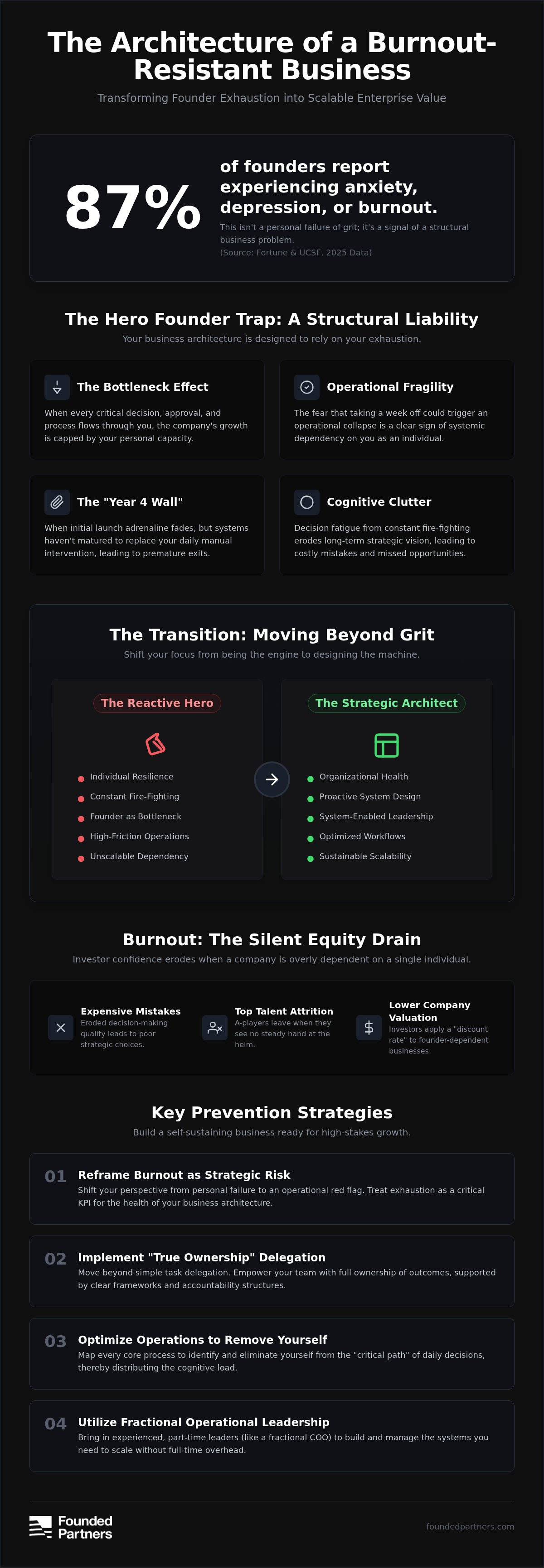
87% of founders report experiencing anxiety, depression, or burnout according to 2025 data from Fortune and UCSF. If you feel the weight of your organization pressing down on you, it is not because you lack grit; it is because your business architecture is currently designed to rely on your exhaustion. You have become the ultimate bottleneck, where cognitive clutter and decision fatigue are the daily price of admission. The fear that taking a week off might trigger an operational collapse is a clear signal that your role as a hero founder has reached its limit.
We understand this pressure because we have helped many leaders navigate it. This article details essential founder burnout prevention strategies designed to help you transition from a reactive fire-fighter to a strategic architect. You will discover how to build a business that runs without your constant intervention, allowing you to reclaim your mental clarity while scaling toward a successful capital raise or exit. We will examine the shift from individual resilience to organizational health, focusing on the act of refining your operations, guiding your team, and strengthening your foundation for the long term.
Key Takeaways
- Reframe burnout as a strategic risk to your company's valuation and longevity rather than a personal failure of grit.
- Transition from a reactive hero founder to a Strategic Architect by designing systems that function independently of your daily input.
- Implement specific founder burnout prevention strategies, such as "True Ownership" delegation frameworks and fractional operational leadership, to reclaim your mental clarity.
- Utilize operations optimization and exit planning as foundational tools to build a self-sustaining business ready for high-stakes capital raises.
The Silent Equity Drain: Redefining Founder Burnout in 2026
In the high-stakes environment of 2026, we must stop viewing exhaustion as a badge of honor. It is, in fact, a silent drain on your company's equity. While Occupational burnout is often discussed in clinical terms, for the founder, it represents a profound strategic risk to the organization's valuation and long-term viability. When you are the sole engine of growth, your fatigue becomes a ceiling for the entire enterprise. This fragility is often masked by the "hero founder" myth, the belief that your personal sacrifice is the only thing keeping the business alive. In reality, this dependency creates a brittle foundation that cannot withstand the pressures of scaling.
Many leaders hit what we call the 'Year 4 Wall'. At this stage, the initial adrenaline of the launch has faded, yet the systems have not matured enough to replace the founder's daily manual intervention. This often leads to premature exits or fire sales, where founders sell their life's work for a fraction of its potential value simply because they can no longer sustain the pace. Effective founder burnout prevention strategies recognize that this exhaustion is an operational red flag. It is a signal that your current business architecture has reached its maximum capacity. It is not a personal weakness; it is a structural liability that requires a strategic transformation.
The True Cost of a Burnt-Out Founder
A burnt-out founder makes expensive mistakes. Decision-making quality erodes as cognitive load increases, leading to a loss of strategic long-term vision. This fatigue trickles down, poisoning organizational culture and driving away top talent who no longer see a steady hand at the helm. With 87% of founders reporting anxiety or burnout according to 2025 Fortune and UCSF data, the issue is clearly systemic. Investors are acutely aware of this risk. They apply a significant 'discount rate' to businesses that are overly dependent on a single individual, knowing that if that person falters, the entire investment collapses.
Identifying the Architectural Flaws in Your Leadership
Scaling requires a shift from high-intensity growth to sustainable systems. You must recognize when your involvement has shifted from being a catalyst to becoming a bottleneck. This is particularly critical during Series A+ scaling, where the complexity of the organization outstrips any one person's ability to manage it. There is a fundamental difference between the healthy intensity of a sprint and the unsustainable friction of a broken model. Founder burnout is the friction between vision and unoptimized operations. By refining your leadership model, guiding your team toward autonomy, and strengthening your operational core, you move from being a reactive hero to a strategic architect.
Moving Beyond Grit: The Architecture of a Burnout-Resistant Business
Resilience is often marketed as a personal trait, something you build through discipline or self-care rituals. While individual wellness matters, true sustainability for a scaling enterprise comes from organizational resilience. If your growth depends entirely on your ability to "tough it out," you haven't built a business; you've built a high-stakes liability. Moving beyond grit requires adopting the mindset of a Strategic Architect. Your primary objective shifts from being the engine of the company to being the designer of a machine that produces value without your constant manual intervention.
The most effective founder burnout prevention strategies aren't found in a vacation policy. They're found in the structural integrity of your operating model. Transitioning from founder-led to system-enabled leadership means your primary job changes. You move from being the most productive individual contributor to being the creator of an environment where your team can thrive autonomously. This transformation ensures that the business can scale without requiring a proportional increase in your personal exhaustion.
The Role of Operations Optimization
True operations optimization is the ultimate preventative measure for fatigue. It begins by mapping every core process to identify where you have become a bottleneck. By removing the founder from the "critical path" of daily decisions, you distribute the cognitive load across your leadership team. This isn't just delegation; it's the intentional design of scalability strategies that allow workflows to function independently. When you refine these systems, you don't just increase efficiency. You buy back the "thinking time" necessary for high-level strategic vision, which is often the first casualty of chronic stress.
Building a Foundation for Leadership Advisory
Scaling creates a psychological isolation that grit alone cannot solve. As the complexity of your organization grows, the distance between you and your team often widens, leaving you without a sounding board for high-stakes decisions. This is why a foundation of Leadership Advisory is essential for long-term health. Having a Trusted Peer provides the psychological security needed to navigate complex transitions, such as capital raising or exit planning, without collapsing under the weight of the responsibility.
The shift from "doing" to "guiding" is a profound identity change. Research into The Silent Equity Drain: Redefining Founder Burnout highlights that without structural support and professional guidance, the founder's nervous system remains in a state of perpetual high-alert. By engaging in structured advisory, you gain the clarity to lead with composure rather than frantic energy. This steady hand is what investors look for, and it's what your business needs to survive the journey from startup to legacy.
Operational Health vs. Personal Resilience: A Comparative Framework
Staycations and self-care apps are the corporate equivalent of applying a bandage to a structural crack in a dam. They provide a temporary reprieve, but they do nothing to address the underlying pressure of an unoptimized business. True founder burnout prevention strategies must distinguish between personal resilience, which is the ability to endure stress, and operational health, which is the ability to eliminate it. While personal wellness is a prerequisite for leadership, it is not a substitute for a scalable business architecture.
The Reactive Founder focuses on recovery. They invest in meditation, prioritize sleep, and take the occasional week off to "unplug." These are necessary human functions, yet they are insufficient for business sustainability. When the founder returns, the same broken processes, decision bottlenecks, and operational fires are waiting for them. The Proactive Founder, by contrast, focuses on architecture. They invest in delegation frameworks, build capital buffers, and establish operational redundancy. This model is the only one that protects enterprise value because it ensures the business can thrive in the founder's absence.
As you move from Seed to Exit, the nature of these strategies must evolve. In the early stages, you are the business. By the time you reach Series A and beyond, you must become the architect of its systems. The ROI of business transformation is not just measured in efficiency; it is measured in the preservation of your most valuable asset: your leadership. Replacing a founder is a high-risk, high-cost endeavor that often destabilizes the entire organization. Investing in structural change is significantly more cost-effective than the total collapse of leadership or a forced exit due to exhaustion.
The Reactive vs. Proactive Prevention Model
The reactive model is built on "powering through." It relies on the founder's nervous system to absorb the shocks of a scaling enterprise. The proactive model builds shock absorbers into the organization itself, moving the burden from the individual to the infrastructure. This shift requires a disciplined approach to how you allocate your time and authority.
- Reactive: Using vacations to recover from 80-hour weeks.
- Proactive: Implementing a True Ownership framework that empowers VPs to make high-stakes decisions autonomously.
- Reactive: Relying on personal grit to navigate the complexities of a capital raise.
- Proactive: Securing strategic leadership advisory to streamline the process and reduce cognitive load.
Scalability as a De-Stressing Mechanism
A scalable foundation is the ultimate de-stressing mechanism. When systems are predictable and workflows are optimized, the frequency of "operational fires" drops dramatically. You gain the peace of mind that comes from knowing that outcomes are the result of a process, not just your personal intervention. Learning How to build a scalable business foundation is the first step toward reclaiming your sanity and your strategic edge. This transition allows you to lead with composure, integrity, and a long-term perspective, ensuring that your business remains a source of value rather than a source of chronic fatigue.
5 Strategic Prevention Strategies to Reclaim Your Leadership Sanity
Transitioning from a hero founder to a strategic leader requires more than a change in schedule. It requires a fundamental redesign of your relationship with the business. These five founder burnout prevention strategies move beyond surface-level wellness to address the structural causes of exhaustion. By refining your operational model and strengthening your leadership foundation, you ensure that growth remains a source of value rather than a source of chronic stress.
The first strategy involves implementing a 'True Ownership' delegation framework. Many founders struggle because they delegate tasks instead of outcomes. This leaves them still mentally responsible for every detail. True ownership means your VPs are accountable for the success of their entire department, allowing you to step back from the granular execution. When your team owns the results, your cognitive load is significantly reduced.
Strategy 2: The Fractional COO and Operations Optimization
Hiring a full-time operator is a significant commitment that many mid-stage startups aren't ready to make. A Fractional COO provides the expertise of a seasoned executive without the overhead of a permanent hire. This role acts as a vital buffer between your high-level vision and the team's daily execution. A COO does not just manage people; they manage the friction of growth. By optimizing workflows and resolving operational bottlenecks, they ensure the machine runs smoothly while you focus on the long-term horizon.
Strategy 3 focuses on building a 'Capital Buffer'. Survival-mode anxiety is a physiological state triggered by thin margins and looming deadlines. By securing a strategic cash reserve, you eliminate the constant fear of operational collapse. This financial runway provides the psychological safety necessary to make composed, strategic decisions rather than reactive ones born of desperation.
Strategy 4: Exit-Readiness as a Daily Operating Standard
Building a business that is ready to sell is the least stressful way to run it. Exit planning is not just a final step; it is a framework for identifying and removing the risk of founder dependency. When you audit your business through the lens of a potential buyer, you quickly see which systems rely too heavily on your personal intervention. Refining these areas creates a valuable, independent asset. There is immense psychological relief in knowing that your business is durable enough to thrive without your constant presence.
Finally, Strategy 5 involves engaging in high-level leadership advisory. The transition from founder to CEO is one of the most difficult shifts in the entrepreneurial journey. A seasoned advisor provides the intellectual and emotional support needed to navigate this transformation. If you are ready to architect a business that scales without sacrifice, consider our Business Transformation Consulting to guide your next stage of growth.
Building the Foundation: How Strategic Advisory Preempts the Breaking Point
Burnout is rarely a sudden event. It's a slow-motion collision between a growing enterprise and an outdated operating model. When the weight of your organization begins to feel unsustainable, it's a clear signal that your current business foundation has reached its absolute limit. Continuing to "push through" only deepens the structural cracks. Effective founder burnout prevention strategies require you to stop acting as the primary support beam and start acting as the architect who designs a more resilient structure.
At Founded Partners, we position ourselves as the architects of that next-stage foundation. We understand that business transformation isn't just about efficiency; it's about founder freedom. By refining your processes and strengthening your leadership team, we help you transition from a role defined by constant intervention to one defined by strategic guidance. This shift is essential before you face high-stakes transitions like capital raising or an exit, where the pressure on the founder is at its peak.
The Founded Partners Approach to Transformation
Our methodology focuses on building durability and sustainability for founder-led firms. We believe that scaling shouldn't be a "grind" that depletes your character or your health. Instead, we guide leadership through complex periods of growth with a sense of calm expertise. Whether you're preparing for a capital raise or mapping out an exit strategy, we provide the steady hand and seasoned perspective needed to navigate high-stakes environments without the frantic energy often associated with the startup world. We prioritize the health of the organization over vanity metrics, ensuring your business is built to last.
Next Steps: From Hero to Architect
The journey toward a sustainable path to scale begins with a single, honest assessment of your current operational health. You must identify the first operational bottleneck that, if removed today, would give you back the most mental clarity. This is the starting point for a comprehensive business transformation audit. We invite you to move beyond the hero founder myth and begin architecting a business that can thrive without your constant presence. Assessing your systems now, before the next major transition, is the most strategic move you can make for your longevity.
To start this journey and secure the future of your enterprise, you can Schedule a leadership advisory session with Founded Partners. Together, we can take the first step toward reclaiming your leadership sanity and building a legacy that doesn't depend on your exhaustion.
From Hero to Architect: Securing Your Enterprise Legacy
The transition from a hero founder to a strategic leader is the most critical pivot you'll make. It's the difference between a business that consumes you and one that empowers you. By shifting your focus from personal endurance to organizational resilience, you protect both your well-being and your company's valuation. Implementing robust founder burnout prevention strategies ensures your business is no longer fragile or dependent on your exhaustion. This structural shift prepares you for high-stakes transactions, whether you're raising capital or planning a definitive exit.
Founded Partners is a boutique advisory led by seasoned partners Adam and Matt. We provide tailored strategies for founder-led organizations, drawing on our deep expertise in operations and high-stakes transactions. We don't just offer advice; we help you refine your foundation so you can lead with clarity and composure. You've built something substantial; now it's time to build something sustainable. We're here to ensure your next stage of growth is defined by strength rather than sacrifice.
Architect a business that scales without you—Explore our Leadership Advisory
Frequently Asked Questions
What are the first signs of founder burnout to look for?
Early warning signs include a persistent sense of decision fatigue and emotional numbness often mistaken for professional toughness. You might find yourself dreading Sunday nights or feeling like the ultimate bottleneck in every operational process. These symptoms indicate that your role has shifted from visionary leader to reactive firefighter, a state that's unsustainable for long-term growth.
How can I delegate effectively when I feel like I'm the only one who knows the business?
Effective delegation requires shifting from assigning specific tasks to delegating full ownership of outcomes. If you feel like the only person who understands the business, it's a signal that your knowledge hasn't been codified into repeatable systems. By using a "True Ownership" framework, you empower your leadership team to manage their departments independently, which is a core component of successful founder burnout prevention strategies.
Does raising more capital actually help prevent burnout?
Raising capital provides a financial buffer that can eliminate survival-mode anxiety, but it often increases performance pressure from investors. Capital alone isn't a solution for exhaustion; it must be paired with operations optimization to ensure the funds are used to build a self-sustaining architecture. Without structural change, more money simply fuels a faster version of an unsustainable fire.
When is the right time to hire a COO or a Fractional COO?
You should consider a Fractional COO when the complexity of daily execution begins to distract you from high-level strategic vision. This usually happens during the transition from Seed to Series A. A COO manages the friction of growth, allowing you to reclaim your thinking time while they focus on refining workflows and guiding the team's operational output.
How does exit planning help if I'm not planning to sell for years?
Exit planning serves as a diagnostic tool that highlights where the business is overly dependent on your personal intervention. By building a business that's "ready to sell" today, you create a more durable and less stressful organization to run. This process forces operational clarity and ensures the company is a valuable, independent asset regardless of when you actually decide to exit.
Can a business transformation consultant help with founder stress?
A business transformation consultant helps reduce stress by identifying and resolving the structural flaws in your leadership model. Instead of offering generic wellness advice, they focus on operations optimization and leadership advisory to remove you from the critical path. This architectural approach provides the psychological security of knowing your business is built on a resilient, scalable foundation.
Is burnout an inevitable part of being a startup founder?
Burnout is not an inevitable part of entrepreneurship; it's a symptom of an unoptimized business architecture. While high intensity is common in startups, chronic exhaustion is a sign that your systems have reached their limit. By implementing proactive founder burnout prevention strategies early, you can maintain a high-performance culture without sacrificing your mental clarity or long-term health.
How do I communicate my burnout to my board or investors?
When communicating with your board, frame your situation as a strategic risk to the organization's longevity rather than a personal failure. Explain that the current operational model has reached its capacity and requires a shift toward system-enabled leadership. Position the need for transformation as a proactive step to protect shareholder value and ensure the company is ready for its next stage of scale.