

Selling the company doesn’t have to mean disappearing from it. The founder’s role after selling the company may continue as CEO or shift to a strategic, advisory, board, or public-facing position. It may also end at closing or after a transition period, depending on the founder’s goals, the company’s need for continuity, and the deal terms.
It’s natural to focus on the sale itself, then wonder what your days and responsibilities will look like afterward. A thoughtful transition can give you room to step back, stay involved in a different way, or pursue a new challenge with intention.
This article explores how to plan your transition, rediscover interests beyond the business, and decide whether to start again. It also looks at advisory and board work, including what these roles involve and how to assess whether one fits your next chapter.
Key Takeaways
- Shape your post-sale transition around the responsibilities you want to retain and the continuity the business needs.
- Build routines and interests beyond the company to create a fuller sense of identity after the sale.
- Give yourself space to decide whether a new venture reflects genuine ambition or simply familiar momentum.
- Assess advisory and board roles by the contribution you can make, the responsibilities involved, and the fit with your next chapter.
Developing interests and identity beyond the business
A sale changes your responsibilities, but it doesn’t erase the skills and values you built as a founder. Start by naming roles you want to carry forward, such as mentor, creator, or parent, separate from your identity as a former owner.
Separating Identity from Business Ownership
Separating identity from ownership means seeing yourself as more than the person who led a particular company. A sale ends your control of that business, not your ability to make decisions, solve problems, or build relationships. Write down qualities you brought to the company, such as persistence, curiosity, or sound judgment. Then consider where each quality already appears outside work, perhaps in a community project or family commitment.
Maintaining Founder Identity After Selling
Maintaining your founder identity after a sale means keeping the parts of entrepreneurship that matter without rebuilding the same job by default. You might mentor emerging leaders, support a nonprofit initiative, or make time for a creative project. A regular walk or exercise routine and a personal reading ritual can add structure to your days while leaving room to discover what genuinely interests you.
Founder Identity and Mental Health
Founder identity and mental health can intersect when the company has provided daily purpose, social contact, and a clear measure of progress. Losing those anchors may leave an unexpected gap, even when the sale was wanted. Notice practical signs such as withdrawing from regular conversations, losing interest in familiar routines, or struggling to plan beyond the business. Rebuild connection deliberately by scheduling regular conversations with a trusted peer and keeping commitments that support sleep, movement, and reflection.
Use a weekly calendar to test what feels sustaining: include a social commitment, an activity unrelated to work, and open time for rest. At the end of each week, note which commitments gave you energy and which felt like obligations. This review can help distinguish a lasting interest from a temporary response to a major change.
Starting another business by choice rather than as a default
Starting again is a strong choice when the work itself still draws you, not simply because entrepreneurship feels familiar. Before committing, describe the problem you want to solve, the people who need a solution, and why you’re suited to build this company. If those answers remain compelling without the founder title, the idea may reflect genuine ambition rather than an automatic return to work.
A practical approach is to wait six months after selling before deciding what comes next, unless you chose a path before the sale. Use that interval to notice which parts of your former role you miss: shaping strategy, developing products, or leading a team. Compare those preferences with the demands of a new venture. The distinction can reveal whether you want another company or a different way to contribute.
Some founders sell companies that are 4-5 years old because they need a break. That pause can help separate fatigue from lasting interest in building. For example, a founder who misses customer discovery but not hiring or fundraising might explore a smaller, more focused venture. Someone who misses the team’s daily collaboration may prefer an operating or advisory role instead.
Before investing deeply in a new concept, test its central assumptions. Speak with prospective customers, define the first problem the product would solve, and consider what would make the business meaningfully distinct. Review the sale agreement’s restrictions and timing as part of your planning. A founder may become a competitor once non-compete restrictions expire, so your next move should account for the agreed terms.
Set a decision point after your initial exploration. Write down the evidence that would justify proceeding, such as repeated customer interest or a clear advantage you can bring. Also name the conditions that would make you stop. These boundaries help prevent momentum, identity, or pressure from turning an untested idea into a default commitment.
If your next move is to reshape an existing company rather than launch one, business transformation consulting can help clarify the strategic direction and strengthen the operating foundation.
Serving in an advisory or board role
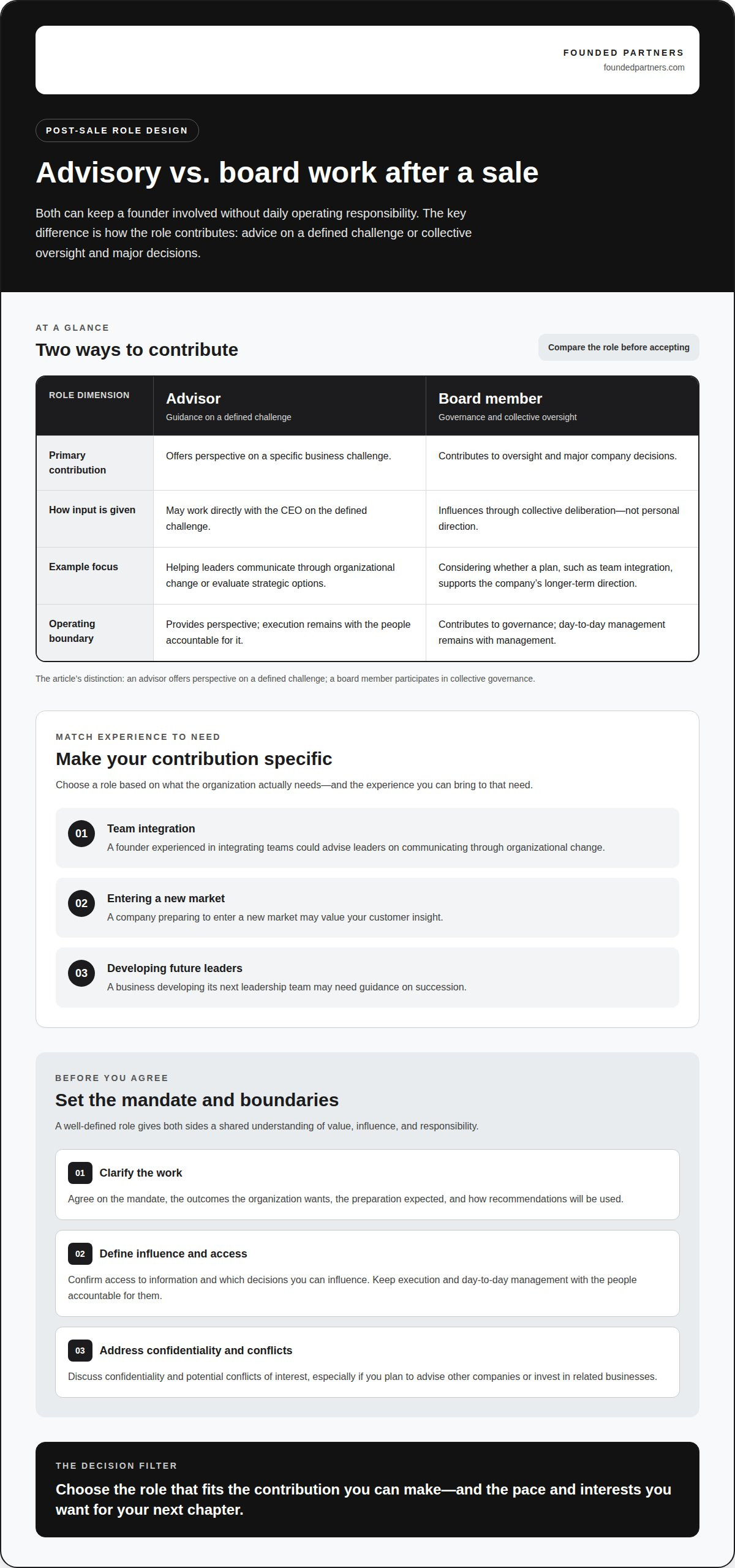
The founder's role after selling the company can continue through advice or governance without daily operating responsibility. An advisor typically offers perspective on defined challenges, while a board member contributes to oversight and major decisions. For example, a founder with experience integrating teams could advise leaders on communicating through organizational change. A director may consider whether the integration plan supports the company’s longer-term direction.
Choose a role by matching your experience to the organization’s actual needs. A company preparing to enter a new market may value your customer insight; a business developing its next leadership team may need guidance on succession. Make your contribution specific, such as helping leaders evaluate strategic options or strengthen decision-making. The role should also leave execution and day-to-day management to the people accountable for them.
Before agreeing, clarify the mandate, access to information, preparation expected, and how recommendations will be used. An advisor may work directly with the CEO on a defined business challenge. A board member participates in collective governance, so their influence comes through deliberation rather than personal direction. Discuss confidentiality and potential conflicts of interest, especially if you plan to advise other companies or invest in related businesses.
A well-defined founder's role after selling the company gives both sides a shared understanding of value and boundaries. Write down the outcomes the organization wants, the decisions you can influence, and the responsibilities that remain with management. Then consider whether the commitment suits your preferred pace and interests. Founded Partners’ Leadership Advisory helps founders assess how their experience can translate into a constructive role, without assuming every post-sale contribution needs to be a board seat.
Does a founder usually stay on as CEO or advisor after an acquisition?
There’s no single post-acquisition path. A founder may remain CEO, move into a strategic or advisory role, or leave at closing or after a transition period. The right arrangement depends on the founder’s goals, the company’s need for continuity, and the deal terms. Staying can make sense when you want to keep operating and the business benefits from your leadership. Stepping back may fit better when a successor is ready and you want a genuine exit.
Discuss responsibilities, compensation, and equity during negotiations, not after expectations have hardened. Acquirers may put 30%-40% of a founder’s consideration at risk to encourage them to stay. That makes it essential to understand what continued involvement requires and what conditions affect that consideration. A founder might stay for 2-3 years when the role and incentives are structured well, but a title alone won’t make the arrangement sustainable.
Define the transition in practical terms. A departing founder’s plan should cover context transfer, operating leadership, customer continuity, team communication, and product-roadmap clarity. For example, document key customer relationships, introduce the successor to essential partners, and explain the reasoning behind major roadmap decisions. These steps give the incoming leader context without leaving employees unsure about authority.
After the handover, an advisory, board, or public-facing role can preserve your contribution without retaining daily operating control. The arrangement works best when decision rights, availability, and reporting expectations are clear. If boundaries remain blurred, the new CEO may struggle to lead while you remain accountable without meaningful authority. Aligning expectations early helps both sides protect continuity and make a clean transition.
For founders weighing continued leadership against a structured handover, explore leadership advisory to clarify the role, responsibilities, and transition priorities.
Founded Partners
Founded Partners helps founders bring structure to decisions about their company’s future and their own next role. If you’re preparing for a sale, exit planning can help clarify transition priorities. After a transaction, Leadership Advisory can support decisions about ongoing responsibilities, succession, and how to contribute without returning to daily operations. For a business still evolving, Strategic Growth & Business Transformation can help align leadership and organizational priorities with its next stage.
The right support depends on where you are in the transition: preparing to sell, defining your role with an acquirer, or deciding what kind of work comes next. A clear discussion can connect those choices to the needs of the business and your goals. Contact Founded Partners to discuss your transition and the decisions ahead.
Choose the Next Chapter with Intention
Your founder’s role after selling the company can be shaped by more than the terms of the transaction. It can reflect the contribution you want to make now, the commitments you want to protect, and the questions you’re ready to pursue. Give those choices room to become clear. A deliberate next step need not be dramatic; it needs to fit the life and work you want to build.
Before moving forward, put your priorities into words. What do you want to remain responsible for? What would you rather leave behind? Which opportunities feel meaningful even without the familiar identity of business ownership? Clear answers create a stronger basis for discussions with an acquirer, a successor, or a potential collaborator.
Founded Partners can help you connect transition decisions with the wider direction of your business and leadership. Contact Founded Partners about your transition to discuss the choices ahead. Your next chapter can be built with the same care and purpose you brought to the company.
Frequently Asked Questions
Want a buyer that works around your transition?
A buyer can plan a founder’s transition around the company’s continuity needs and the founder’s preferred involvement. During discussions, define which responsibilities you’ll retain, who will assume operational leadership, and how customer and team relationships will transfer. A buyer’s willingness to accommodate that plan depends on the proposed role and deal terms. Clear expectations help both sides assess whether the transition supports the business.
What happens if the founder leaves after acquisition?
If a founder leaves, the buyer and company need leadership continuity, preserved operating context, and clear communication with employees and customers. The transition plan can identify who owns key decisions and relationships after departure. Acquirers may also make some or all of a team stay pool forfeitable if the founder leaves. That possibility makes the founder’s departure terms relevant to the wider team, not just the founder.
What roles can a founder take after selling a company?
A founder may continue as CEO, take a strategic role, advise the acquiring company, serve on a board, or represent the business publicly. These roles differ in how closely they connect to daily operations and decision-making. For example, a public-facing role may support customer confidence, while an advisor can share expertise without managing the operating team.
How long do founders typically remain with the company after a sale?
There’s no single standard duration: a founder may leave when the deal closes or stay through an agreed transition. A founder might remain for 2-3 years when the role and incentives are structured well. The practical duration depends on the responsibilities, continuity needs, and agreed terms. A defined end point helps the company plan leadership coverage and helps the founder understand the commitment.
What does a founder's employment agreement or transition period include after a sale?
It should make the founder’s post-sale responsibilities, compensation, equity, and transition expectations clear. For example, it can define whether the founder leads operations, advises the new CEO, or focuses on transferring customer and product context. It should also clarify how the team will receive updates and who takes over key decisions. Specific terms depend on the negotiated agreement and role.
How are founders compensated after selling a company, including earnouts and bonuses?
Compensation can involve sale proceeds and separate payments for continued work, such as salary, bonuses, or an earnout tied to agreed outcomes. These are distinct: an earnout depends on conditions set in the deal, while a bonus rewards specified performance or service. Founders should clarify how each payment is calculated, what responsibilities apply, and which conditions affect eligibility.