

The right advisor isn't simply the firm with the broadest credentials; it’s the one equipped for the decisions your business faces. To choose the right advisory firm, assess its relevant experience, relationships, working culture, and commitment to regulatory standards. A practical starting point is to look for at least five recent comparable deals that show experience with businesses like yours.
It’s reasonable to expect an advisor to bring both sound judgment and a working relationship built on trust. This guide explains how to evaluate expertise, understand the value of an advisor’s network, assess communication and cultural fit, and consider how the firm approaches compliance. Together, these factors can help you identify a partner whose capabilities and principles align with your business and its next stage of growth.
Key Takeaways
- Match an advisor’s skills to your business’s specific challenges and growth priorities, not just its general reputation.
- Look beyond a contact list: understand how an advisor’s relationships could support your strategic goals and potential transactions.
- Assess communication, transparency, and shared values to determine whether the working relationship can support important decisions over time.
- Review how the firm approaches compliance, conflicts of interest, and client data protection before deciding whether its standards fit your needs.
1. Selecting advisors whose expertise fits business needs
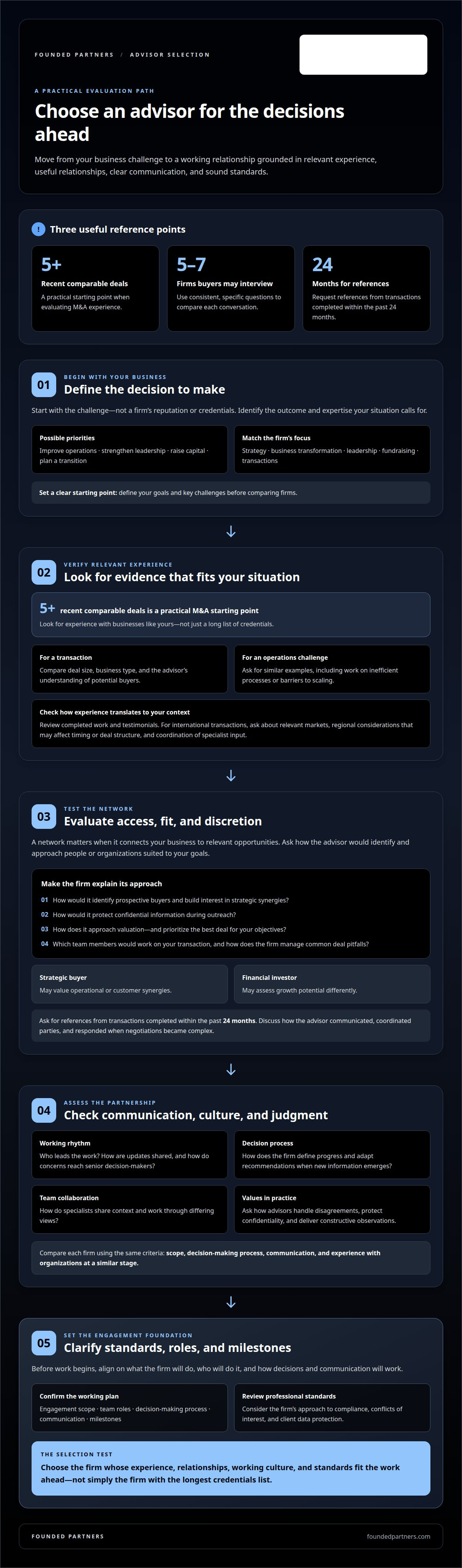
Begin with the decision your business needs to make: improve operations, strengthen leadership, raise capital, or plan for a transition. Advisory firms may focus on strategy, business transformation, leadership, fundraising, or transactions. The right fit depends on your challenge, the expertise required, and the advisor’s ability to guide decisions into action. Understanding how to choose the right advisory firm starts with defining that need.
Credentials can show relevant training, but industry experience reveals how an advisor applies it. For an M&A transaction, look for at least five recent comparable deals and experience with businesses like yours. Consider deal size, business type, and the advisor’s understanding of potential buyers. For an operations challenge, ask for examples of similar organizations and the issues addressed, such as inefficient processes or barriers to scaling.
Experience matters most when it connects to your current situation. An advisor who has guided a company through a leadership transition, growth constraint, or sale can offer practical perspective on decisions and trade-offs. Review testimonials and examples of completed work alongside the firm’s reputation. A useful test for how to choose the right advisory firm is whether its experience demonstrates judgment relevant to your business, not just subject knowledge.
For international transactions, assess whether the firm understands the markets involved and can explain how it approaches regional considerations. Local knowledge may help identify issues that affect timing or deal structure, especially when buyers, sellers, or operations span multiple countries. Ask how the firm coordinates specialist input when regional issues call for it.
To select and onboard a firm, first define your goals and key challenges. Then compare relevant experience, credentials, and the roles of the people who will work with you. Discuss the engagement scope, decision-making process, communication, and milestones before work begins. This creates a shared starting point and clarifies the guidance the firm will provide. Choose the firm whose expertise matches the work ahead, not simply the longest list of credentials.
2. Advisory firm relationships and buyer networks
A strong network matters when it connects your business with relevant opportunities. In a sale, an M&A advisor can help connect buyers and sellers and shape a transaction around your strategic goals. For capital needs, relationships with investors and financial institutions may help identify potential funding sources. The value lies in fit, not simply the size of a contact list.
Buyers may interview five to seven accounting or advisory firms before selecting one. Make each conversation specific: ask how the firm identifies prospective buyers, builds interest in strategic synergies, and protects confidential information during outreach. Ask how it approaches valuation and whether its priority is completing a first deal or pursuing the best deal for your objectives. Clear answers reveal the firm’s process and incentives.
Useful questions also include how many transactions the firm typically handles, which team members would work on yours, and how it manages common deal pitfalls. Request references from transactions completed within the past 24 months. Those conversations can help clarify how the advisor communicated, coordinated parties, and responded when negotiations became complex. A broker’s relationships with industry leaders, potential buyers, sellers, investors, and financial institutions may provide access to relevant expertise and resources.
Assess the network in practical terms. A firm should be able to explain which buyer groups may fit your business, how it would reach them, and how it would maintain discretion. For example, a strategic buyer may value operational or customer synergies, while a financial investor may assess growth potential differently. The outreach plan should reflect those distinctions rather than rely on a generic buyer list.
Strong relationships support sound deal structure, but they don’t replace independent judgment. For leadership teams weighing a transaction or growth decision, leadership advisory can help align priorities and guide the choices involved.
3. Advisor-firm partnership and culture
A firm’s culture shapes how its advisors communicate, collaborate, and handle difficult decisions. Discuss who will lead your work, how you will receive updates, and how concerns reach senior decision-makers. If a relationship lead coordinates the work, ask how that person will keep you informed and bring in relevant expertise. This working rhythm matters when priorities change or you need timely, candid guidance.
To compare services, approach, and client fit, use the same criteria for each firm: scope, decision-making process, communication, and experience with organizations at a similar stage. Ask how the firm defines progress and adapts recommendations when new information emerges. A practical way to understand how to choose the right advisory firm is to consider a growth plan that needs revision after a leadership change. The advisor should explain how it would revisit priorities, involve your team, and clarify trade-offs.
Values show up in specific behavior, not only in stated principles. Ask how advisors handle disagreements, protect confidentiality, and deliver constructive observations. Consider whether the culture encourages collaboration or rewards individual competition. If several specialists support your work, learn how they share context and resolve differing views. These details help reveal whether the firm can act as a genuine partner, not simply deliver recommendations.
If you are evaluating a registered investment adviser (RIA), consider whether its business priorities align with how you want to serve clients. Review public materials, then speak with the firm’s advisors about their approach to client relationships and day-to-day work. Knowing how to choose the right advisory firm also means looking for consistent evidence of ethical practice, clear communication, and support for client relationships.
Before deciding, compare each firm’s strengths and working style against your priorities. Choose the partner whose services, values, and communication approach fit the decisions ahead, not merely the most polished presentation. A clear comparison helps you understand how the relationship may work beyond initial meetings and whether the firm’s culture supports your organization’s needs.
4. Regulatory compliance and professional standards
Distinguish compliance oversight from strategic advice. Compliance focuses on supervisory processes, ethical standards, and protecting client information. An advisory engagement defines the work, responsibilities, and guidance. Before signing, understand what each agreement covers and whether the firm’s support matches the decisions your business needs to make.
For a brokerage firm or SEC-registered investment adviser, prospective clients must receive Form CRS, according to the U.S. Securities and Exchange Commission. Review it for information about disciplinary history, conflicts of interest, and the firm’s required standard of conduct. Client testimonials and industry reputation can provide additional context.
Ask how the firm maintains compliance systems and handles emerging risks, including cybersecurity and client data protection. For example, clarify who oversees internal procedures, how concerns are escalated, and what professional compliance support is available. A firm should explain its approach in practical terms, not rely only on broad statements about integrity. This helps you assess whether its controls support responsible strategic work.
Independence also deserves attention. Ask whether potential conflicts could affect recommendations and how the firm identifies and addresses them. If a financial professional can act in different capacities, clarify which capacity applies to the service and how that shapes the relationship. Clear explanations help you understand the nature of the guidance before deciding.
Compliance support should enable sound work without obscuring accountability. Ask who owns each process, how the firm responds when a concern arises, and what information your team must provide. Those details can reveal whether the firm treats standards as an operating discipline rather than a final review. For strategic decisions involving leadership or growth, discuss your business priorities with an advisor who can help clarify the path forward.
Founded Partners: Leadership Advisory
Founded Partners offers Founder Advisory for leaders facing decisions that affect growth, organizational health, or strategic direction. The firm provides hands-on, founder-focused support to help leaders build alignment, strengthen decision-making, and navigate change.
If the challenge extends beyond leadership, Founded Partners’ Strategic Growth & Business Transformation can support organizational change. The firm also provides capital raising support for businesses pursuing investment aligned with their growth objectives, as well as exit planning for owners preparing for a transition. The right starting point depends on the decision ahead and the work needed to move forward.
If you’re ready to discuss your business priorities, contact Founded Partners.
Turn your next decision into a clear direction
The choice of an advisor can shape more than one project. It can influence how your leadership team approaches growth, change, and future ownership. Use what you’ve learned about how to choose the right advisory firm to define the decision you need help with and the kind of partnership that can move it forward.
For founder-led businesses, the next step may involve preparing for investment, strengthening the organization, or planning an eventual exit. Founded Partners offers capital raising support, Strategic Growth & Business Transformation, and exit planning to address these distinct priorities. The best starting point reflects your organization’s immediate needs and longer-term direction.
Contact Founded Partners to discuss your needs and consider a thoughtful next step for your business. With clear priorities and the right guidance, you can build momentum with confidence.
Frequently Asked Questions
What qualifications and credentials should I look for in an advisory firm?
Look for qualifications relevant to the specific work, then connect them to practical experience. For example, a firm advising on organizational change should explain who will guide implementation, not just present strategic recommendations. Ask which professionals will work directly with your team, what expertise each contributes, and how they handle areas beyond their core capabilities. Credentials matter most when they support the work you need.
How do I evaluate an advisory firm's experience and track record?
Ask the firm to describe engagements that resemble your situation, including its role, the challenge addressed, and how the work proceeded. Focus on the decisions and methods involved, not only the final outcome. Experience is more relevant when the firm can explain what it learned and how that insight applies to your circumstances. References can add perspective on collaboration and follow-through.
How do advisory firms charge, and what are typical fees in the US?
There isn’t one typical fee that applies across advisory work in the US. Ongoing advisory may be structured around a retainer, while other engagements use arrangements tied to scope or transaction work. The signed agreement defines the charges. Compare what each arrangement covers, including deliverables, duration, team involvement, and any additional costs, rather than judging an offer by its headline fee alone.
What conflicts of interest and risks should I watch for when choosing an advisory firm?
Pay attention to incentives that could shape recommendations, such as compensation connected to a particular outcome or a firm’s relationships with transaction participants. Ask how potential conflicts are identified, disclosed, and managed, and who you can approach with concerns. Also clarify how confidential business information will be handled during discussions. Direct, consistent answers help you understand risks before sharing sensitive details or making decisions.
What should an advisory firm engagement agreement include?
An engagement agreement should define the work, the people responsible, the expected deliverables, and how decisions or changes in scope will be handled. It should also explain communication expectations, confidentiality, compensation, expenses, and how either party can end the arrangement. For example, if priorities shift during a transformation project, clear scope-change terms help everyone understand how revised work and responsibilities will be agreed.