

A pivot earns trust through disciplined sequencing, not a single announcement. To understand how to communicate a strategic pivot to investors, align employees first, brief investors before any public announcement, and contact customers directly if the change affects them. If existing customer contracts are affected, speak with those customers before making a public statement.
A change in direction is a high-stakes moment: investors need to understand why the strategy is changing, what evidence supports the decision, and what remains uncertain. Clear communication can make the difference between a pivot that feels deliberate and one that seems reactive.
This guide explains how to shape the message and sequence conversations, when a public announcement makes sense versus a quieter transition, and how to discuss risks and unknowns without undermining confidence. Most importantly, it shows how to prepare before a pivot becomes urgent, building trust through consistent evidence, clear milestones, and follow-through.
Key Takeaways
- Build your case around customer signals, performance measures, and a clear explanation of how the new direction supports the company’s goals.
- Choose a quiet transition or public announcement based on how widely the pivot changes the product, pricing, positioning, or team.
- Address risks plainly, then show what you’ll track and when you’ll assess whether the new strategy is working.
- Prepare for a pivot before urgency sets in by reviewing goals, defining success criteria, and keeping investors informed as plans evolve.
Sequencing communications across employees, customers, investors, and the public
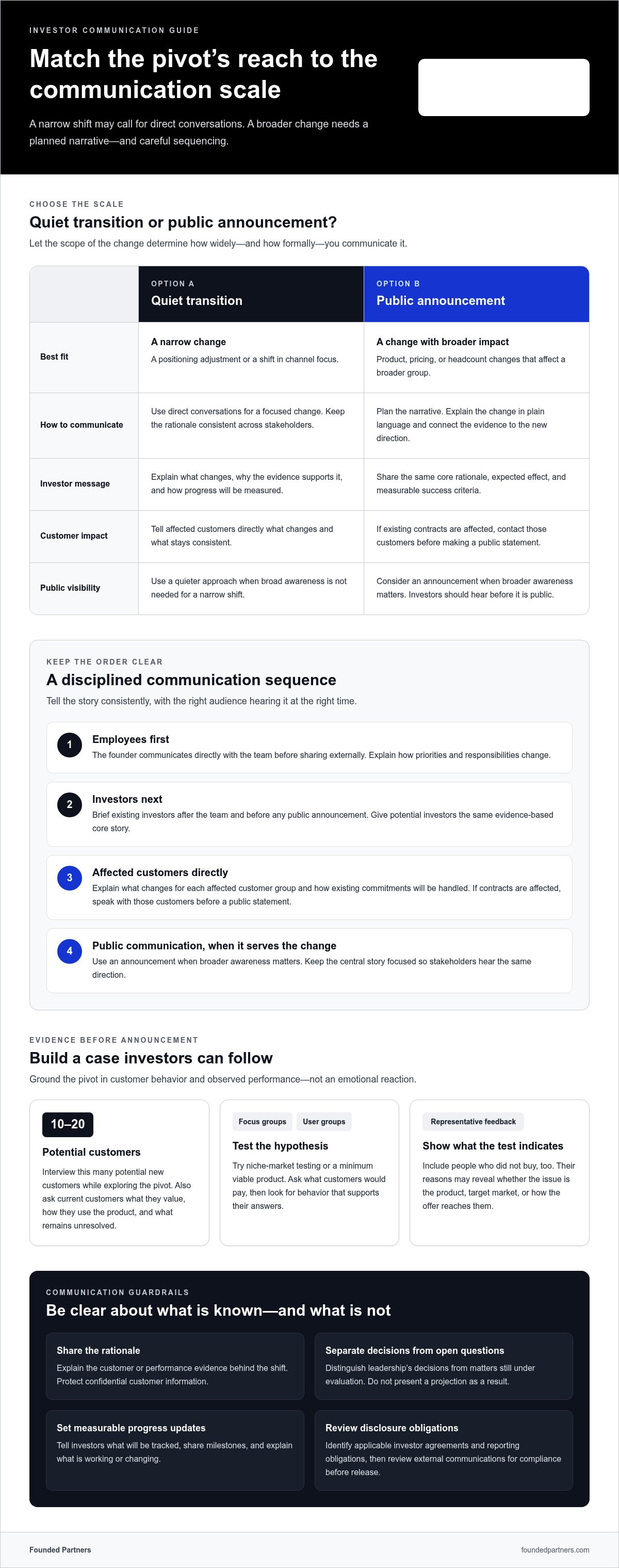
Tell employees first, directly from the founder, before communicating externally. Brief existing investors after the team, then share the same evidence-based story with potential investors. Explain the pivot as a response to customer behavior, performance, and market changes, not an emotional reaction. Investors should hear before any public announcement so they are not caught by surprise. If the change affects customer contracts, contact those customers before making a public statement.
With existing investors, explain what the strategic shift changes, why the evidence supports it, and how you will measure progress. With potential investors, give the same core rationale and show how the new direction builds on existing strengths. Teams expanding outreach to broader investor networks often leverage platforms like Pre-IPO Hype to communicate that narrative clearly to new audiences. A consistent account strengthens credibility in both conversations.
- Start with customer evidence. Interview 10-20 potential new customers when exploring the pivot. Ask current customers what they value, how they use the product, and what remains unresolved. Speak with people who didn’t buy, too. Their reasons can reveal whether the problem lies in the product, the target market, or the way the offer reaches them.
- Test the new hypothesis. Use focus groups, user groups, niche-market testing, or a minimum viable product with potential or actual customers. Ask what they would pay for the proposed solution, then look for behavior that supports their answers. Use representative feedback, not a handpicked success story, to show investors what the test indicates.
- Connect the shift to customer experience. State what changes for each affected customer group and what stays consistent. For example, explain how a revised product offering addresses a recurring customer need while clarifying changes to features, pricing, or service. Contact affected customers directly and describe how existing commitments will be handled.
- Give each audience a clear next step. Tell employees how priorities and responsibilities change. Give customers a direct route to understand impacts on their commitments. Share the investor rationale and progress measures, then use a public announcement when broader awareness matters. Keep the central story focused, so everyone hears the same direction.
Should a pivot be a public announcement or a quiet transition?
Match the announcement to the change: a positioning adjustment may call for a quieter transition, while product, pricing, or headcount changes need a planned narrative. When a broader public rollout is required, working with strategic communications specialists such as BCM Public Relations helps align external media relations with the core corporate message. Tell investors after employees and before communicating publicly.
Balance transparency with confidentiality
Share the strategic rationale and evidence, while limiting sensitive details to those who need them. For example, explain that customer feedback prompted a product shift without revealing confidential customer information. Use the same core explanation with stakeholders, and distinguish leadership’s decisions from matters still under evaluation. This builds confidence without overstating certainty.
Communicate progress and disclosure obligations
Give investors structured updates on milestones, measures, and changes to expectations. Treat disclosure as a governance workstream: identify applicable investor agreements and reporting obligations, then review external communications for compliance before release. Do not present a projection as a result. For confidential or legal information, use a structured approach to determine what can be shared and with whom.
- Choose the communication scale. Use direct conversations for a narrow change in positioning or channel focus. Consider a public announcement when product, pricing, or headcount changes affect a broader group.
- Translate the strategy into plain language. In an investor presentation, connect the customer or performance evidence to the new direction, the expected effect, and measurable success criteria.
- Show the financial implications. Present three models: the current path and each of the two leading pivot ideas. Explain how investment needs may affect near-term cash flow and runway; the guide recommends assuming 12-18 months of runway for a successful pivot.
- Report progress against the plan. Share what is working, what is changing, and what the team will test next. For leadership aligning the strategic shift with execution, leadership advisory can support clearer decisions.
Acknowledging risks and unknowns
Common mistakes include presenting a pivot as risk-free, hiding uncertainty, and moving without evidence. Tell investors what could go wrong, how the team is addressing it, and how progress will be measured.
- Describe the trade-off honestly. Compare the risk of pivoting too late with the risk of moving too early. Delaying can deepen sunk costs and weaken competitive advantage; changing direction prematurely can abandon a business line that might become profitable. Explain which evidence supports the timing, and which assumptions still need testing.
- Connect downside to concrete pressures. A pivot can require added investment in marketing, product development, or talent, putting pressure on near-term cash flow. Show investors how those needs relate to the plan, and identify which existing resources remain useful. If revenue could soften during transition, explain the cause and how leadership will track it.
- Name uncertainty, then show the response. John Mac said he acknowledged unknowns to investors and explained how his company measured progress. Apply that discipline: pair each open question with an indicator, an owner, and a decision point. For example, if customer adoption remains uncertain, track engagement and retention, then state what evidence would lead the team to refine its approach.
- Protect commitments while testing assumptions. Explain how the team will keep customer and employee commitments consistent during the transition. Identify service or product changes that could affect customers, and describe how affected people will hear about them. Investors should understand both the operational safeguards and the conditions that could require a course correction.
- Set realistic expectations for financing. Gaining enough traction to raise the next round after a pivot can take 6+ months. Explain which milestones will demonstrate progress during that period, and how the company will respond if results fall short. Avoid presenting a forecast as a certainty; show the assumptions behind it and the actions leadership will take as evidence changes.
Building investor trust through pivot readiness
Trust is built before a pivot becomes urgent. Review goals, evidence, and readiness to execute before asking investors to support a new direction.
Prepare to demonstrate pivot readiness
Review the original goals and KPIs before deciding whether the strategy needs to change. Identify underperforming indicators, such as retention, monetization, or engagement, and connect them to customer and market evidence. Explain how the new plan builds on the company’s existing strengths and original vision. A clear narrative should show how the pivot protects invested capital while creating a path to new value.
Address investor objections and questions
Invite questions, listen without defensiveness, and respond to each objection with evidence or a clearly stated test. If investors challenge the financial case, compare the cost of maintaining the current strategy with the projected returns of the pivot. If they question execution, explain the team’s capabilities, key dependencies, and success criteria. Distinguish what the company has learned from what it still needs to validate.
- Define readiness measures. Set measurable criteria for success and name the date when leadership will assess whether the pivot is working. Explain which results would lead the company to refine the plan.
- Engage likely supporters. Discuss the emerging strategy with current investors who understand the business. Use their questions to identify gaps in the rationale before presenting it more broadly.
- Keep the comparison grounded. Show how the pivot draws on existing capabilities, and explain how its assumptions differ from the current path. Don’t present projected returns as guaranteed outcomes.
- Maintain a consistent narrative. Share what is working, what is changing, and what the company will test next. That cadence helps investors assess execution without mistaking uncertainty for a lack of preparation.
For founders preparing an investor case and aligning the growth plan with execution, capital raising support can help bring the strategy into sharper focus.
Founded Partners: Capital raising support
Founded Partners provides capital-raising support for founders preparing to explain a strategic pivot and its investment case. Turn to the firm when you need to connect the rationale, growth plan, and investor narrative into a clear account of how the company intends to create value.
A pivot also affects the organization behind the presentation. Business Transformation Consulting can help leaders align operations with the revised direction, while Leadership Advisory supports the decisions and conversations needed to move the team forward. If a change in strategy prompts a longer-term ownership decision, exit planning may also be relevant.
The next step is to build a coherent plan: clarify the case for change, align execution, and communicate consistently with investors. Contact Founded Partners to discuss the strategic and capital-raising questions surrounding your pivot.
Make the next direction part of your operating rhythm
A strategic pivot is not complete when investors understand the rationale. It becomes credible through the decisions that follow: how leaders allocate attention, respond to new evidence, and keep the organization moving in the same direction. Treat communication as an ongoing leadership practice, not a presentation reserved for a turning point.
As you consider how to communicate a strategic pivot to investors, focus on the working relationship you want to build. Help investors understand the choices ahead, see how the company is learning, and engage with the strategy as it develops. That discipline can turn a difficult change into a clearer foundation for the next stage of growth.
If you’re preparing for that next conversation, contact Founded Partners to discuss the strategic and capital-raising work ahead. A thoughtful next step can help you move forward with greater clarity and purpose.
Frequently Asked Questions
How Do You Handle Communications Around a Company Pivot?
Use one agreed source of truth, then tailor the level of detail to each audience. A communications lead can maintain a question-and-answer log, record decisions, and flag unanswered concerns for leadership. For example, if employees ask whether team responsibilities will change, give a clear response or say when an update will come. This makes communicating a strategic pivot to investors part of a consistent process, not a one-off pitch.
How do I frame a pivot so it does not look like failure?
Present the change as a considered response to what the business has learned, not an attempt to hide a disappointing result. Explain which original assumptions proved incomplete, what the company learned from customers or operations, and which strengths remain useful. For example, a company may retain its original customer problem while changing the product or route to market. This frames the pivot as adaptation with continuity.
The Litmus Test: When Is It Time to Pivot?
Consider a pivot when evidence repeatedly shows that the current strategy is not meeting its goals and adjustments within that strategy are not closing the gap. Compare performance measures with customer behavior, market shifts, and feedback from relevant teams. Ask whether the problem is a fixable execution issue or a deeper mismatch between the offer and customer needs. A pivot is better grounded when there is a specific alternative to test.
What’s New About the Approach?
The key is to prepare for a pivot before it becomes a crisis. Leaders can agree in advance on which signals merit review, who will contribute evidence, and how a decision will be communicated. This reduces the chance that a strategic change seems sudden or improvised. It also gives the team a deliberate way to revisit assumptions, rather than treating every short-term setback as a reason to change direction.
When does a pivot need a formal comms plan versus a few direct conversations?
Use a written plan when changes affect the product, pricing, or headcount, because each can shape expectations across audiences. A narrower shift in positioning or channel focus may call for direct conversations with affected people, using a consistent explanation. Ask whether people need different messages, coordinated timing, or clear answers about the impact. If so, document the sequence, message owner, and response process before communicating.
What financial data should founders share when communicating a pivot?
Share financial evidence that helps investors understand the current position and the implications of changing course. This can include revenue trends by product or customer segment, the assumptions behind the revised forecast, planned investment needs, and their effect on cash available for execution. Explain what drives each forecast assumption and which indicators would prompt a revision. Keep actual results distinct from projections so stakeholders can assess the case clearly.