

Accountability breaks down when people are expected to deliver results without clear ownership. Creating a culture of accountability means defining what ownership looks like, assigning responsibility for outcomes, and linking actions to consequences. It also means giving people the information, resources, and feedback they need to follow through.
Clear expectations matter, but they are only the foundation. People also need room to make decisions, candid feedback that supports improvement, and leaders who model the commitments they expect others to keep. This article explains how to define accountable behaviors, clarify who owns each result, and use positive reinforcement alongside developmental feedback. It also explores why leaders can struggle to hold teams accountable and how consistent follow-through can strengthen trust and performance over time.
Key Takeaways
- Describe the everyday behaviors that demonstrate ownership, then make sure leaders model them consistently.
- Assign one clear owner to each important outcome so responsibilities don’t disappear between people or teams.
- Make feedback a regular, two-way practice that recognizes progress and identifies useful next steps.
- When follow-through falters, look for gaps in clarity, resources, or support before deciding how to respond.
Positive reinforcement and developmental feedback
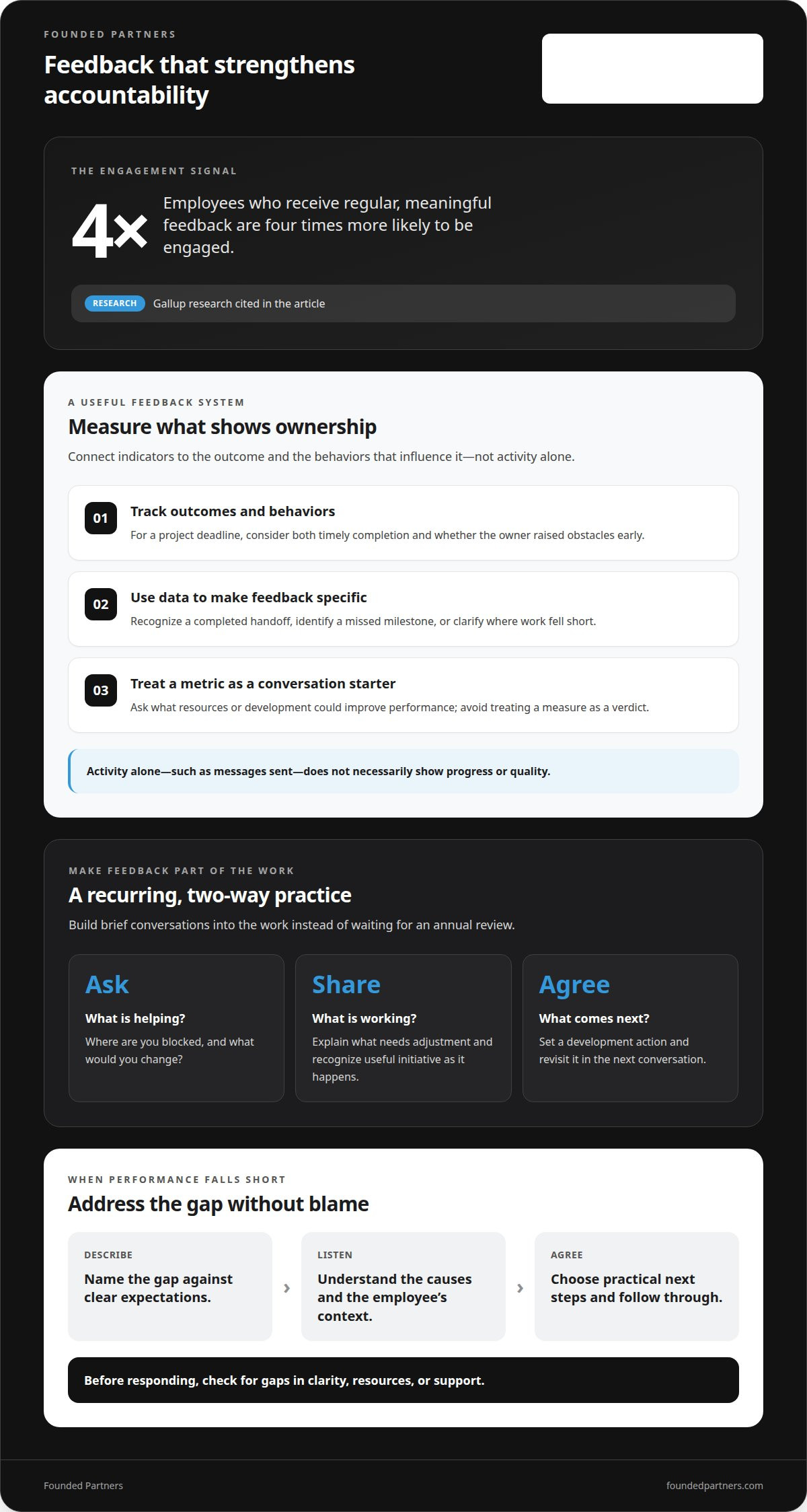
A professional can help organizations encourage accountability by connecting feedback to clear expectations, support, and learning rather than blame. Leaders can address poor performance without undermining trust by describing the gap, listening to its causes, and agreeing on practical next steps.
-
Choose Meaningful Feedback Indicators with a Professional
Start by working with a professional to select indicators tied to the outcome and the behaviors that influence it. For a project with a delivery deadline, assess both timely completion and whether the owner raised obstacles early. Avoid measuring activity alone, such as messages sent, when it doesn’t show progress or quality. Include relevant skills and values so expectations encourage initiative, not just compliance.
-
Review Progress and Performance Data with Advisory Support
Set a regular review point with advisory support, then compare progress with the agreed indicators. Use performance data to make feedback specific: identify a missed milestone, recognize a completed handoff, or clarify where work fell short. Gallup research says employees who receive regular, meaningful feedback are four times more likely to be engaged. Treat a metric as a prompt for discussion, not a verdict; ask what resources or development could improve performance.
-
Establish Frequent Two-Way Feedback
Build brief, recurring conversations into the work instead of waiting for an annual review. Ask employees what is helping, where they are blocked, and what they would change. Managers should also explain what is working and what needs adjustment. This exchange keeps feedback candid and consistent while giving employees a chance to provide context. Encourage leaders to recognize useful initiative as it happens, agree on a development action, and revisit it in the next conversation.
Why are leaders failing at keeping others accountable?
Accountability weakens when leaders set expectations they do not follow themselves. Leadership advisory can help executives align their behavior, employee support, and follow-through.
-
Develop Leaders Who Model Accountability and Personal Growth
Help leaders identify the behaviors they expect from employees, then examine whether their own example reflects those standards. An executive who misses a commitment should acknowledge it, explain what changed, and reset expectations. Build personal growth into leadership development by inviting feedback on how leaders delegate, communicate, and respond to mistakes. Ownership should not be a standard that applies only to the team.
-
Establish Senior Leadership Accountability with Advisory Support
Work with an advisor to make senior leaders responsible for the culture they shape. Set clear expectations for how leaders share information, provide resources, and follow through on commitments. A 360 feedback process can help executives understand whether their actions match the organization’s stated values. Review themes with leaders, then agree on specific changes and revisit progress. Culture cannot depend on managers enforcing standards that senior leadership ignores.
-
Develop Supportive and Authentic Leadership
Coach managers to ask questions before drawing conclusions about a missed outcome. An employee may lack information, resources, or decision-making authority, so first understand the barrier and agree on appropriate support. Authentic leadership also requires executives to reflect on their values, principles, and mission, then act consistently with them. One example is Hamptons Group, where employees exchange regular feedback with managers and, where applicable, direct reports.
-
Apply Accountability Fairly and Consistently with Professional Guidance
Engage a professional to help managers apply shared expectations across roles and situations. Review the facts, hear the employee’s perspective, identify root causes, and agree on a proportionate next step. This approach helps address poor performance without blame or public shaming. It also makes accountability more consistent: similar gaps receive a considered response, while differences in training or resources inform the support offered. Leaders should follow through on the agreed action and document progress.
Planning projects and assigning individual responsibility
Project plans need named owners, defined roles, and clear outcomes. A professional can help managers communicate these expectations so work doesn’t disappear between teams.
-
Set Clear Roles and Responsibilities with Professional Guidance
Begin project planning by mapping each outcome to the roles and skills needed to deliver it. A professional can help identify overlaps, gaps, and decisions that lack a direct owner. For example, if product, sales, and operations all contribute to a launch, define who approves readiness and who coordinates each contribution. Avoid broad assignments such as “the team owns delivery”; they can leave employees unsure who acts when plans change.
-
Distinguish Responsibility from Accountability
Clarify the distinction before assigning work: responsibility means completing a task, while accountability means owning its result. A project coordinator may be responsible for gathering updates, while a designated lead remains accountable for final delivery. Communicate both roles at the outset, including who can make decisions and when an issue should be escalated. This distinction helps contributors understand where their work ends and who owns the overall outcome.
-
Use RACI or RASCI to Clarify Responsibility
Ask a professional to map project activities with RACI: responsible, accountable, consulted, and informed. Use RASCI when the plan also needs to identify a supporting role. For a customer onboarding project, one person might own the overall outcome, while implementation staff complete setup and customer-facing teams provide input. Check that each important activity has a clear accountable owner. Avoid assigning several people equal ownership of one result, which can blur follow-through.
Include responsibility in hiring and role discussions. Ask candidates for an example of a commitment they owned, what they did when obstacles arose, and what they learned. Their response can help managers assess how they communicate, take initiative, and contribute to shared success. Hiring for these behaviors supports positive team norms, but clear roles and decision rights still matter after someone joins.
Defining and modeling desired behaviors
An accountable workplace culture combines clear expectations, individual ownership, access to needed information, and consistent follow-through. Leaders must model these behaviors while giving employees room to learn and respond to challenges.
-
Define Accountability with Professional Guidance
Begin by agreeing on a practical definition leaders can apply across the organization. The University of Minnesota describes accountability as linking a person’s action or inaction to a positive or negative consequence. That consequence can include recognition, coaching, or a change in responsibility. Avoid defining accountability only as punishment; employees need to understand how choices affect shared outcomes and what happens next.
-
Clarify Individual Accountability with Advisory Support
Ask an advisor to help translate the definition into observable individual behaviors. An employee might flag a delay early, explain its impact, and propose a response instead of waiting for a manager to discover it. Individual accountability means owning one’s actions, decisions, and contribution to results. Check that each person has the authority and information needed to act, rather than assigning responsibility without practical control.
-
Define Workplace Accountability with Professional Guidance
Work with a professional to describe how accountability should operate across teams, not only within individual roles. For example, a handoff between sales and operations should include shared expectations for information, timing, and escalation. The University of Minnesota identifies achieving key team or department outcomes as a purpose of accountability. Define how teams learn from missed results and improve their actions, rather than leaving each department to interpret standards differently.
-
Identify Accountable Workplace Elements with Advisory Support
Review workplace practices with an advisor and identify the elements employees need to act with ownership: clear goals, useful information, adequate resources, and a safe way to raise concerns. Leaders should demonstrate these standards by admitting mistakes, listening to dissent, and following through on commitments. Check whether policies foster learning or create barriers. If leaders want those behaviors embedded in daily work, explore Leadership Advisory for support in strengthening leadership practice.
Founded Partners
Founded Partners helps founder-led organizations strengthen the leadership and operating foundations that support clear ownership. When accountability challenges reflect wider issues with roles, decision-making, or organizational change, its Business Transformation Consulting and Leadership Advisory can help bring those elements into alignment. This support can be relevant as a company scales, reshapes how teams operate, or prepares for a significant transition. Expectations are more durable when they fit the organization’s strategy and leaders consistently reinforce them through their actions.
If you’re ready to strengthen ownership across your organization, contact Founded Partners to discuss your priorities.
Make ownership a foundation for what comes next
As an organization grows, roles, decisions, and priorities can shift. Treat those changes as a reason to revisit how accountability works, not as a sign that the culture has failed. Practices that support a close-knit team may need refinement as new leaders join, responsibilities spread, or the business enters a new stage. Creating a culture of accountability is an ongoing commitment to keeping ownership aligned with the organization’s direction.
A useful next step is to identify where unclear ownership is affecting progress today. Is a key decision repeatedly delayed? Are teams working from different assumptions? A focused conversation about these pressure points can help leaders decide where to strengthen alignment first.
Discuss your organization’s priorities with Founded Partners and consider what will help ownership endure as the business evolves.
Steady progress starts with a clear next step. Your leaders can build from there.
Frequently Asked Questions
What is Accountability?
Accountability means accepting ownership for the effects of your decisions and actions, including when the outcome falls short. It involves explaining what happened, addressing the impact, and applying what you learned. For example, if a team member overlooks a customer concern, accountability means acknowledging the miss and helping resolve it, rather than shifting responsibility or concealing the mistake.
What does a culture of accountability mean in the workplace?
A workplace culture of accountability makes ownership part of everyday decisions, not just formal performance reviews. Creating a culture of accountability also means shaping how people respond when priorities change or a decision affects another team. For example, when a customer raises a concern, the employee who receives it knows how to route it and who will close the loop. People can raise risks early and expect a fair response.
How can a professional help leaders model accountability at work?
A professional can help leaders examine whether their daily choices reinforce the standards they communicate. This might include reviewing how an executive responds to a missed commitment, handles disagreement, or explains a change in direction. Structured reflection and candid input can reveal gaps between stated values and visible behavior. Leaders can then choose specific practices to strengthen trust and demonstrate ownership in routine decisions.
What steps can a professional help organizations take to build a culture of accountability?
A professional can help an organization identify where accountability breaks down, then shape an approach suited to its structure and priorities. In creating a culture of accountability, this may begin with listening sessions that surface recurring obstacles, followed by alignment among leaders on desired behaviors. The organization can introduce practical routines, such as decision reviews or learning discussions after setbacks, and assess whether those routines help teams act with greater ownership.
How can a professional help set clear goals, roles, and expectations for accountability?
A professional can help translate a broad priority, such as improving customer retention, into a defined outcome, decision boundaries, and role expectations. Managers can clarify which choices employees may make independently and which require escalation. They can also align goals across functions, so one team’s success doesn’t undermine another’s. This makes expectations easier to apply as priorities shift or teams collaborate.
What are effective ways to measure workplace accountability?
Use a combination of outcome measures and observable behaviors, then review patterns rather than relying on a single incident. For example, consider whether customer issues reach resolution, employees raise risks promptly, and agreed actions are completed. Pair these indicators with employee feedback about barriers and decision clarity. Together, these signals help distinguish a skills or resource gap from unclear ownership or inconsistent leadership.