

Investor confidence is built less by optimistic forecasts than by updates people can understand and trust. Knowing how to manage investor expectations starts with a clear view of financial performance, the assumptions behind projections, the risks ahead, and how invested funds will support the plan.
It’s reasonable to want investors to see your company’s potential. Confidence is easier to sustain, though, when your pitch reflects each investor’s goals and you can explain what growth will require, where progress stands, and what could change the outlook.
This guide explains what financial information to share, how to align your pitch with investor priorities, and how to show that your business can scale. It also covers how steady, fact-based communication can address overconfidence and recency bias, keeping expectations grounded in your strategy and progress.
Key Takeaways
- Share financial updates that connect performance, cash needs, risks, and the use of investment funds.
- Shape each pitch around the investor’s priorities, time horizon, and approach to potential returns.
- Make scalability tangible by explaining how customer economics and operating capacity support growth.
- Keep expectations grounded with consistent updates that distinguish lasting business changes from short-term reactions.
1. Financial information to share with investors
In the United States, disclosure obligations depend on whether a company is public or private, its financing structure, and the statements it makes to investors. Keep fundraising claims supportable, distinguish projections from actual results, and have qualified U.S. securities counsel review formal offering documents before sharing them.
Set a reliable communication cadence and send updates on schedule, even when results are mixed. A monthly operating update can track cash, revenue, spending, and key milestones; a deeper quarterly review can explain changes to strategy or funding needs. Agree on the format and timing with investors, and report material developments promptly rather than waiting for the next scheduled update.
Give investors a coherent financial picture, not just a revenue figure. Include profit and loss statements, cash flow, costs, burn rate, break-even assumptions, and the expected timing of future funding needs. Explain how you’ll use investment funds, such as for hiring, product development, or customer acquisition, and connect each planned expense to an operating milestone.
Build forecasts from explicit assumptions about pricing, customer conversion, retention, delivery capacity, and expenses. A financial model covering 3-5 years can show how revenue and costs might develop, but label the assumptions and explain the downside case. For example, if slower customer acquisition delays revenue, show how that affects cash runway and hiring plans.
When your company misses a target, tell investors what changed, the financial impact, and what management plans to do next. Compare actual performance with the forecast, identify the cause, and revise the outlook only when assumptions have changed. A direct explanation of lower-than-planned sales and their effect on cash needs is more useful than a vague promise to recover.
Public companies should treat earnings guidance as a disciplined forecast, not a promise. Explain the assumptions behind the outlook, use consistent measures, and update guidance when material developments change those assumptions. Keep the language balanced: describe both the factors supporting expected performance and the risks that could push results away from the stated range.
Disclosure obligations vary with a company’s public or private status, financing structure, and statements to investors. Keep fundraising claims supportable, distinguish projections from actual results, and have qualified U.S. securities counsel review formal offering documents.
2. Investor goals and pitch alignment
A strong pitch starts with fit, not a polished deck. Before presenting, study the investor’s portfolio, stated investment preferences, and typical company stage. Then connect your opportunity to priorities they already support, such as entering a new market or building recurring revenue. This preparation helps you avoid presenting the same growth story to every audience.
Clarify the investor’s time horizon and return expectations early. Some venture capital funds expect returns of 3-5 times their investment within 5-7 years, while other investors may prioritize a longer path to durable cash flow. Those goals shape questions about growth, profitability, and an eventual exit. Don’t imply that one outcome suits every capital partner. Knowing how to manage investor expectations starts with understanding what each investor values.
Make the pitch’s central claim specific. If your company plans to expand into a second customer segment, explain why it fits the existing product and what evidence supports the move. Separate validated results from assumptions. You can describe a target market as promising without presenting untested demand as proven traction. That distinction keeps your ambition credible and helps investors assess the opportunity.
Align milestones with the investor’s objectives, then show how each milestone advances the strategy. For example, a plan focused on repeat purchasing should emphasize retention and customer behavior, not only new sign-ups. If the investor is evaluating an exit, explain the strategic path and the conditions that could support it. A realistic startup exit plan within 5-7 years can frame the discussion without treating timing as certain.
Close by naming the questions still open: which assumptions need testing, what progress would change the outlook, and how both sides will assess it. This turns a pitch into a shared decision framework. For founders refining an investor-aligned growth narrative, structured capital-raising planning can help connect the opportunity, milestones, and investor priorities.
3. Demonstrating scalability
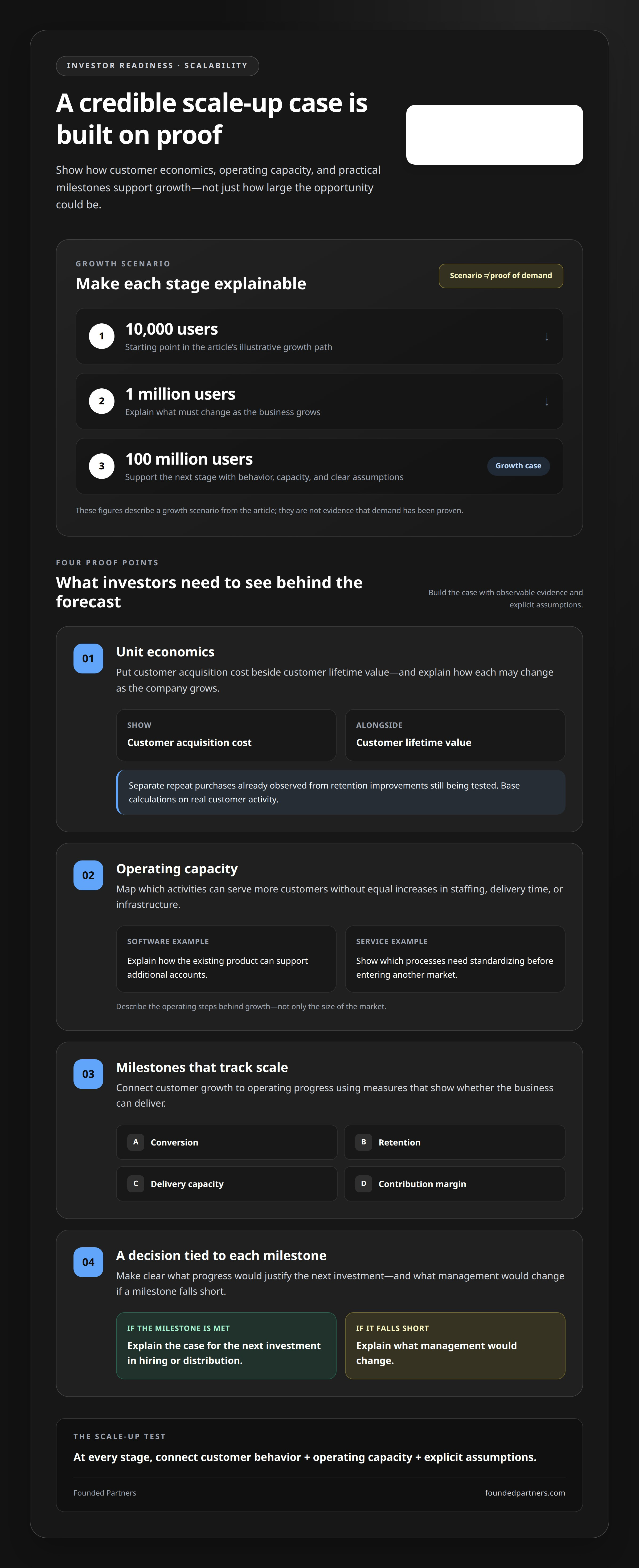
Investors look for evidence that growth can outpace the resources required to deliver it. Show how the business could move from 10,000 users to 1 million, then explain what must change before reaching 100 million. The figures are a growth scenario, not proof of demand. Support each stage with customer behavior, operating capacity, and the assumptions behind expansion.
Start with unit economics. Explain customer acquisition cost alongside customer lifetime value, then show how each changes as the company grows. Low acquisition costs and high lifetime value can support a scalable model, but only when the calculations reflect real customer activity. For example, distinguish repeat purchases already observed from retention improvements still being tested.
Next, map the operating model behind your forecast. Identify which activities can serve more customers without equal increases in staffing, delivery time, or infrastructure. A software company might explain how its existing product supports additional accounts; a service business might show which processes need standardizing before entering another market. Investors need to see the operating steps, not just a large market estimate.
Connect the growth case to practical milestones. Your plan might track conversion, retention, delivery capacity, and contribution margin as the customer base expands. Explain what result would justify the next investment in hiring or distribution, and what management would change if a milestone falls short. This makes the scale-up logic testable rather than purely aspirational.
Some venture investors assess whether a company could become a $500 million business. Treat that figure as an investor’s possible ambition, not a forecast or an expected outcome. Explain the market opportunity, route to customers, and organizational capabilities that could support substantial growth. Then name the constraints, such as slower adoption or rising service demands, and show how they affect the plan. A credible scalability case pairs ambition with the mechanics, economics, and milestones required to pursue it.
4. Investor overconfidence and recency bias
Overconfidence turns a favorable result into an expectation; recency bias makes the latest result seem permanent. In a June 2021 survey, retail investors with more than $100,000 in investable assets largely expected annual portfolio returns of 13% above inflation by year-end. For founders, the lesson is to separate an investor’s optimism from the company’s evidence and operating assumptions.
Common communication mistakes include presenting only the upside, treating a recent win as a lasting trend, delaying bad news, and changing forecasts without explaining why. A strong sales month, for example, doesn’t prove a durable growth rate. Show the underlying driver, such as repeat orders or a temporary promotion, and explain whether it supports the longer-term outlook.
Use a consistent review framework. Compare results with agreed milestones, assess whether business fundamentals have changed, and explain any revised assumptions. For an investor with a five-year outlook, one underperforming quarter shouldn’t trigger panic if fundamentals remain unchanged. Still, acknowledge the quarter and identify what management plans to do next.
Market experience also shows why frequent snapshots can distort judgment. Morningstar research indicates that a representative diversified portfolio would have declined in value 32% of the time over a 50-year period for an investor who checked monthly. That portfolio finding isn’t a forecast for a private company; it illustrates why short-term movements need context. Pair the latest result with operating trends and the original investment rationale.
When discussing venture outcomes, distinguish possibility from expectation. A hypothetical portfolio in which one successful company returns 1000x illustrates the appeal of outsized outcomes, not a promise for any startup. Present the opportunity alongside execution risks, dependencies, and milestones that would support progress. Strengthen your investor communication approach with a disciplined review of assumptions, progress, and risks.
Founded Partners
Founded Partners helps founder-led organizations connect investor communication with the business strategy behind it. When forecasts, growth plans, and investor priorities need a more coherent foundation, the firm’s advisory work can help clarify your direction and strengthen decision-making.
Depending on your challenge, that support may include capital raising support, Business Transformation Consulting, Leadership Advisory, or exit planning. Consider seeking guidance when expectations are becoming disconnected from operating realities, or when leadership needs to align growth priorities before a significant investor conversation. A clearer strategy can help you explain the rationale behind decisions and communicate progress with greater discipline.
If you’re considering how to strengthen your approach, contact Founded Partners to discuss your investor communication needs.
Build an Investor Relationship That Can Grow
Your company’s strategy will evolve, and investors’ understanding should evolve with it. Treat communication as an ongoing leadership practice, not a task reserved for fundraising or difficult moments. Assign clear ownership for preparing updates, explaining decisions, and keeping the company’s direction consistent across conversations.
A useful next step is to assess whether your leadership team can explain the business’s priorities in the same terms. That shared understanding keeps investor discussions connected to decisions inside the organization. In practice, how to manage investor expectations means building a relationship around candor, sound judgment, and a clear view of what comes next.
As your plans develop, the right strategic support can help connect investor conversations with broader business decisions. Contact Founded Partners to discuss investor expectations and consider how to strengthen your approach. Steady, thoughtful communication gives your company room to pursue its ambitions with greater alignment.
Frequently Asked Questions
What does managing investor expectations involve?
It means keeping investors’ understanding aligned with your company’s direction, progress, and decisions. Agree on what success looks like, how you’ll discuss changes, and which decisions require investor input. For example, clarify whether a delayed product launch changes the company’s priorities or only its timing. This shared framework makes conversations more constructive when circumstances shift.
What should an investor update include?
An effective update gives investors context, not just numbers. Alongside company performance, explain notable decisions, progress against current priorities, emerging risks, and where input would be useful. If leadership is weighing two market opportunities, for example, describe the trade-offs and the decision needed. Clear ownership and a consistent format help investors understand what has changed since the previous update.
What financial metrics do investors expect in regular updates?
Useful measures depend on your business model and stage. Investors may look at gross margin, customer retention, revenue concentration, and how efficiently revenue converts into cash. A subscription business could explain whether customers renew and expand; a project-based company could discuss delivery margins and contracted work. Pair each metric with its business meaning so readers can interpret changes.
How can startups manage investor expectations during fundraising?
During fundraising, keep your narrative consistent across meetings, written materials, and follow-up updates. Distinguish capital already committed from discussions still in progress, and explain how the proposed funding supports specific company priorities. If investor interest changes your plan, communicate the operational consequences rather than implying financing is secured. This disciplined approach helps you build trust while fundraising is underway.