
Managing Conflict Within a Leadership Team Through Better Skills

Conflict in a leadership team rarely stays contained to one disagreement. Managing conflict within a leadership team starts with listening to every perspective, identifying the underlying issue, and focusing on behavior and shared goals rather than blame. Managers then need to help the team agree on clear actions and follow up to see that they happen.
It’s understandable to see disagreement as a distraction from the work. Handled well, though, it can reveal unclear responsibilities, competing priorities, or communication habits that weaken collaboration. The key is to address tension early without rushing to judgment or treating every difference as a crisis.
This article covers the conflict resolution skills managers need, from active listening and impartial facilitation to emotional self-awareness and clear communication. It also explores common causes of team friction and how workplace culture and remote or hybrid work can shape the way disagreements emerge and are resolved.
Key Takeaways
- In remote or hybrid disagreements, use a live conversation, invite each person’s perspective, and address technology or scheduling friction that may be adding strain.
- Resolve conflict by clarifying the underlying issue, finding common ground, agreeing on specific responsibilities, and following up on the plan.
- Notice your own stress response before facilitating a difficult conversation; curiosity and self-awareness help you listen without rushing to judgment.
- Build a culture where people can raise concerns safely, with clear roles, expectations, and accountability to reduce avoidable friction.
- Look beyond personality clashes to causes such as unclear responsibilities, competing priorities, communication gaps, and work that doesn’t fit people’s strengths.
1. How Can You Manage Conflict in Remote/Hybrid Environments?
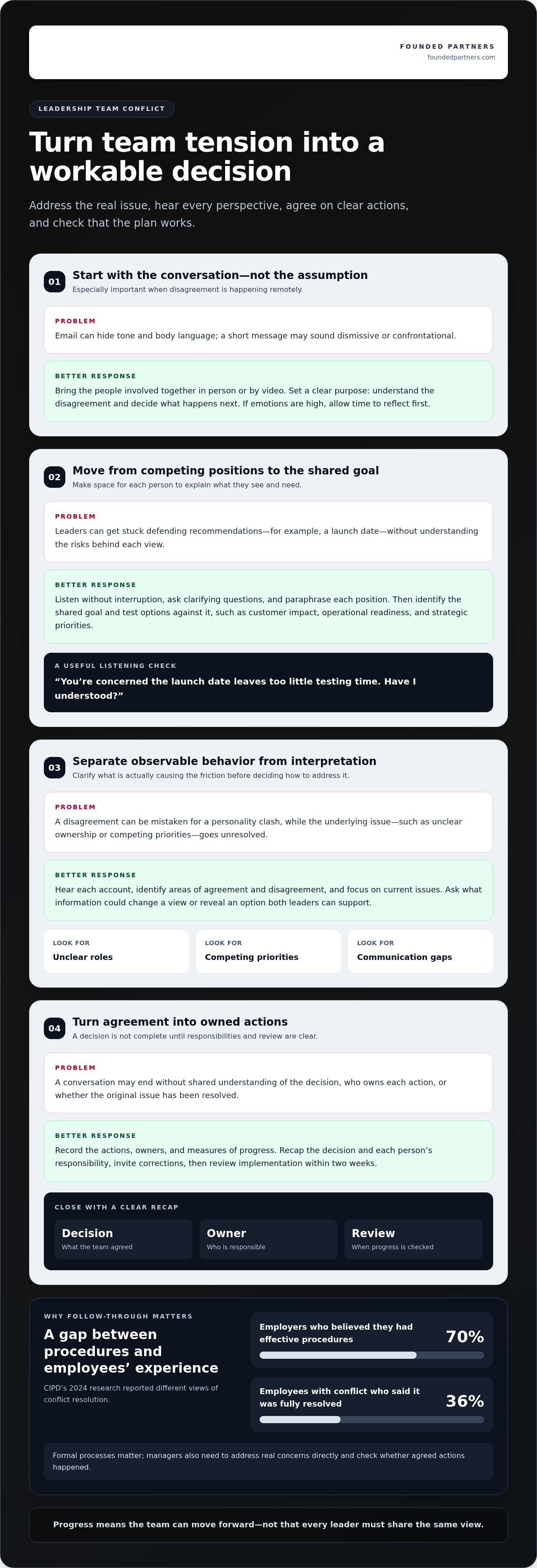
For senior leaders, useful communication techniques include listening without interruption, asking clarifying questions, and paraphrasing each person’s position. In a video conversation, a manager might say, “You’re concerned the launch date leaves too little testing time. Have I understood?” This confirms the concern before the group weighs options. These listening skills help leaders address differences without turning disagreement into a contest.
Make space for each person to explain what they observed, what they need, and what outcome they’re seeking. A finance leader and an operations leader may both support a product launch but disagree about its timing. Ask each to describe the risks behind their recommendation, then identify the shared goal. This shifts the conversation from competing positions to the decision the team must make.
Choose a live conversation when tension surfaces remotely. Email can obscure tone and body language, so even a brief message may come across as dismissive or confrontational. Invite the people involved to meet in person or by video, and set a clear purpose: understand the disagreement and decide what happens next. If emotions are high, give participants time to reflect before the meeting.
Validate a perspective without endorsing every conclusion. A manager can say, “I can see why the revised schedule feels difficult, given your team’s existing commitments.” Then ask what information could change the view or reveal an option both leaders can support. This shows empathy while keeping the discussion grounded in evidence, responsibilities, and the decision at hand.
During video conversations, practise mindful presence: close unrelated tabs, pause before responding, and listen for both words and tone. Notice if someone’s voice tightens or they stop contributing, then invite them in without putting them on the spot. For example, “We haven’t heard your view on the handoff yet. What should we understand?” Such invitations help team members feel heard, even when the group chooses another path.
Check whether technology is contributing to the dispute. If a remote leader repeatedly misses updates, establish where decisions and deadlines are recorded, then confirm everyone can access those tools. Discuss workload and results directly rather than treating remote colleagues as untrustworthy. To prevent scheduling friction, make availability visible, explain expectations, and invite discussion before a timetable becomes a source of resentment.
Close with a concise recap: the decision, each person’s responsibility, and the next point for review. Ask participants to correct anything they believe was misunderstood. This final listening step turns a remote conversation into shared understanding, not just a record of the loudest viewpoint. When leaders respond with curiosity and follow-through, managing conflict within a leadership team becomes a deliberate practice, not an email exchange.
2. What Conflict Resolution Skills Should a Manager Have?
Effective managers combine curiosity, impartiality, sound judgment, and follow-through. Start by clarifying the disagreement’s cause, then decide whether it affects a priority, working relationship, or team decision. A dispute over who owns a critical customer handoff needs attention; a minor difference in presentation style may not. Resolving the right issue protects attention for work that matters.
Leadership teams disagree productively when they challenge ideas without attacking colleagues. Agree on the decision to make, give each person space to explain their reasoning, and test proposals against shared goals. For example, leaders debating a launch date can weigh customer impact, operational readiness, and strategic priorities while keeping criticism focused on the plan.
Avoiding conflict can leave misunderstandings and competing assumptions unaddressed. Over time, these can weaken trust, slow decisions, and damage collaboration. CIPD’s 2024 research found that 70% of employers believed they had effective procedures for resolving conflict, while 36% of employees who experienced workplace conflict said it was fully resolved. Formal processes matter, but managers also need to address real concerns directly.
Use a deliberate resolution process: hear each person’s account, separate observable behavior from interpretation, identify areas of agreement and disagreement, and invite participants to shape a workable solution. Keep the discussion on current issues instead of reopening old disputes. Once the team agrees, record actions, owners, and measures of progress. Schedule a follow-up conversation within two weeks to review implementation and address any remaining friction.
Check whether conflict resolution worked by reviewing whether the agreed actions happened and whether the original issue still disrupts decisions or collaboration. For a handoff dispute, assess whether responsibilities are clear and work moves as agreed. Ask participants whether they understand the decision and can raise concerns constructively. Progress means the team can move forward, not that every leader must share the same view.
Use an external mediator when leaders cannot hold an impartial conversation, repeated attempts stall, or unresolved tension is obstructing an important decision. A neutral facilitator can structure discussion, surface misunderstandings, and help participants identify common ground. If the challenge reflects a broader pattern in how leaders work together, Leadership Advisory can support stronger leadership alignment and conflict-resolution practices.
3. Emotional self-regulation and leadership self-awareness
In a tense leadership meeting, a manager’s emotional response can shape the entire discussion. Self-awareness starts with noticing personal signals, such as a tightened jaw, faster speech, or an urge to interrupt. Naming the reaction privately creates a pause between feeling challenged and responding. That pause helps leaders choose a constructive response instead of escalating the disagreement.
Before a difficult conversation, identify the issue most likely to trigger a defensive reaction. A finance lead might feel dismissed when colleagues question a forecast; an operations lead might react strongly to a sudden deadline. Ask yourself what you’re assuming, what evidence supports it, and what information you still need. These questions help separate the immediate emotional response from the decision the team must make.
During discussion, use a practical reset: pause, take a slow breath, and state the concern in neutral language. Replace “You’re undermining my team” with “I’m concerned the revised scope leaves our team without clear ownership.” The second statement describes an impact the group can examine. Managing stress in the moment helps people stay focused and interpret verbal and nonverbal communication more accurately.
Emotional intelligence also means recognizing that colleagues may experience the same decision differently. A leader asked to reduce a budget may feel pressure to protect service quality, while another sees a need to control spending. Acknowledge each concern without deciding too soon who is right. Empathy does not require agreement; it gives the team a clearer picture of what each position is trying to protect.
Neutrality requires attention to habits that can distort a manager’s judgment. Notice whether you give more time to a familiar colleague, defend your own department first, or interpret disagreement as disloyalty. In the meeting, invite each leader to describe one impact and one concern. Then summarize both views in balanced language before guiding the group toward evidence, trade-offs, and shared priorities.
Build emotional awareness outside high-pressure meetings, too. Neuroscience supports daily reflection and meditation as tools for strengthening focus and resilience. At the end of a workday, write down one moment when your reaction helped or hindered a conversation. Record the trigger, your response, and what you might try next time. This specific review turns experience into a practical leadership habit.
Consider a product pivot where leaders disagree about timing. If the chief executive feels urgency rising, they can name the pressure, ask each executive to explain their concern, and wait to respond until the evidence is clear. That measured approach supports productive discussion without suppressing emotion. Self-regulation doesn’t remove disagreement; it helps leaders keep the conversation useful and the decision deliberate.
4. Clear communication and workplace culture
A leadership team’s communication norms shape whether pressure produces useful debate or quiet resentment. Set a clear expectation that people can raise concerns about how work is conducted without fear of retribution. For example, invite a leader to flag a missed handoff by describing its effect on the project, not by attacking the colleague responsible.
Make expectations visible before disagreement grows. Record each decision’s owner, responsibilities, deadline, and dependencies in a shared team document. If the product team expects approval before launch but the operations team expects to decide independently, clarify who has authority and when input is required. Clear accountability reduces avoidable friction and makes it easier to address problems directly.
When a team’s behavior signals misalignment, name the tension early and invite people to explore it. A leader might say, “We seem to be prioritizing speed and reliability differently. What trade-off are we making?” This makes competing priorities discussable and helps prevent unspoken assumptions from hardening into divisions between departments.
Workplace conflict can stem from poor communication, personality or working-style differences, suspected discrimination or harassment, and opposing objectives or values across divisions. These causes call for different responses. A missed update may need a better process; competing goals may require leaders to clarify priorities. Concerns involving suspected discrimination or harassment deserve careful, direct attention rather than being dismissed as a personality clash.
For remote teams, make schedules transparent and expectations explicit. If leaders in different time zones disagree about meeting access or response times, show availability, explain why a schedule was chosen, and invite discussion of its impact. Create regular opportunities for remote colleagues to connect around shared work, too. Familiarity can reduce assumptions that arise when communication happens only during tense decisions.
Culture takes shape through repeated routines. Use leadership meetings to state the decision needed, identify who owns it, and record unresolved concerns. When a disagreement remains, assign someone to gather the missing information and set a point to revisit the issue. These steps make open communication, collaboration, and accountability part of how work gets done, not just values on a slide.
In one leadership-team case, managers worked in silos, trust eroded, and decisions slowed during a high-stakes project pivot. Structured conversations helped the teams shift from reactivity to clarity within three weeks. The lesson is practical: surface tensions, connect them to specific work, and create a forum where leaders can resolve the underlying misalignment together.
5. Common causes of workplace conflict
Conflict often appears personal before its underlying cause becomes clear. A disagreement about a missed deadline, for example, may reflect unclear ownership, competing priorities, or limited capacity. Leaders can identify the root cause by comparing each person’s account with the decision, role, or work process involved. Ask what happened, what each person expected, and where those expectations differed.
Unclear roles are a frequent source of friction. If two executives both believe they approve a major purchase, delays and frustration can follow. Map the decision: who recommends, who contributes, and who has final authority? Then compare the agreed responsibilities with what happened in practice. A mismatch in roles may explain the conflict better than assumptions about a colleague’s attitude.
Strengths and capabilities matter, too. Conflict can arise when a leader repeatedly owns work that doesn’t suit their skills, or when responsibilities overlook the team’s strengths. For instance, assigning a detail-focused executive to a fast-moving negotiation without support may create tension and missed expectations. Review the work, each person’s relevant skills, and whether roles support the outcome the team needs.
Different working styles can also lead to misread intentions. One leader may want detailed analysis before deciding, while another values a quick response. Establish what information the decision requires and agree on a process that accommodates both needs. Personality differences become harder to navigate when deadlines, communication habits, and decision rights remain implicit.
Look for organizational causes as well as interpersonal ones. Poor communication can leave teams working from different information; opposing departmental objectives can make each leader defend their own measures of success. A sales executive may prioritize speed, while operations focuses on reliable delivery. Ask which goals are in tension, what each function is accountable for, and where the organization needs a shared priority.
Some conflict involves concerns about suspected discrimination or harassment. Take these concerns seriously and distinguish them from ordinary disagreement about style or priorities. Focus on the specific behavior described, its impact, and whether the pattern is affecting someone’s ability to participate or do their work. Treating a serious concern as a personality clash can deepen mistrust and leave the underlying issue untouched.
At the moment tension surfaces, resist deciding that one person is simply difficult. Gather examples from the work, compare expectations, and check whether the same problem recurs across decisions or relationships. If missed handoffs repeatedly follow unclear ownership, address the workflow; if conflict follows competing objectives, clarify priorities. For a broader assessment of leadership roles and alignment, strengthen your leadership team.
Founded Partners: Capital raising support
Founded Partners provides capital raising support for founder-led organizations preparing to pursue investment for strategic growth. When leaders disagree about funding priorities, growth plans, or how investment fits the company’s direction, those tensions can point to a broader need for alignment. Clarifying objectives and responsibilities helps leadership teams approach capital decisions with a shared understanding.
For challenges beyond a financing decision, Founded Partners offers Leadership Advisory and Business Transformation Consulting. These services support leaders working through organizational alignment and the operational changes that accompany growth. The right next step depends on the issue: capital raising support for investment needs, or leadership and transformation advice when internal alignment is the central concern.
Contact Founded Partners to discuss the priorities your leadership team is working through.
Make the Next Leadership Conversation Count
The way leaders handle a difficult moment becomes part of how the organization makes decisions. Treat each disagreement as a chance to examine assumptions, clarify what matters, and strengthen the team’s ability to move forward together. The aim isn’t to eliminate differences, but to create conditions where people can address them without losing sight of the work or one another.
For managing conflict within a leadership team to create lasting value, leaders need to carry useful habits beyond a single conversation. They can model openness, take responsibility for their impact, and make space for perspectives that challenge their own. Over time, these choices help shape a more deliberate, resilient way of working.
If your leadership team needs support addressing alignment challenges as the business evolves, Founded Partners offers Leadership Advisory. Contact Founded Partners to discuss leadership support and consider a clear next step for your team. Stronger conversations can begin with one thoughtful decision.
Frequently Asked Questions
What Conflict Resolution Skills Should a Manager Have?
A manager needs judgment, negotiation, emotional discipline, and the ability to make decisions transparently. For example, when two executives want the same analyst assigned to different projects, clarify business priorities and negotiate a workable allocation. Explain the reasoning behind the decision, including what would prompt a review. This helps people distinguish a considered decision from favoritism and gives the team a clear basis for moving forward.
How Can Conflict Be Avoided?
Leaders can reduce preventable conflict by designing work so people understand how decisions, resources, and accountability fit together. Before launching a cross-functional initiative, agree on its purpose, decision owner, and how teams will raise risks. Check that incentives don’t reward one department for undermining another’s objectives. Conflict can’t be eliminated, but these practices address avoidable sources before pressure turns a small mismatch into a persistent dispute.
How Can You Manage Conflict in Remote/Hybrid Environments?
Move sensitive disagreements from chat or email into a live conversation, and make sure each participant can join and contribute. Share a short agenda and relevant documents beforehand so remote leaders aren’t reacting to information they haven’t seen. If connectivity or access problems disrupt participation, resolve those first. Afterward, record decisions in a shared workspace so people working across locations can refer to the same understanding.
What Is Team Conflict, and Why Isn’t It Always a Problem?
Team conflict is disagreement among colleagues about ideas, priorities, responsibilities, or ways of working. A debate over whether to prioritize product reliability or faster release may expose useful trade-offs and improve a decision. The distinction is whether people can challenge proposals while continuing to respect one another. Conflict becomes damaging when personal attacks, repeated disruption, or fear of speaking replace discussion of the work.
Why Do Workplace Conflicts Happen?
Workplace conflicts arise when people’s expectations, interests, or interpretations don’t align. A new reporting process, for instance, may leave one department expecting immediate updates while another assumes information is shared weekly. Different incentives can also pull reasonable teams in opposing directions. To understand the trigger, examine the work situation and each person’s expectations rather than assuming disagreement reflects bad intent.
What Are Common Causes of Conflict Within Leadership Teams?
Leadership teams often clash over decision rights, resource allocation, competing measures of success, and gaps between responsibility and authority. A department head held accountable for delivery may resent a decision made without their input. Team design can also create friction if roles overlook people’s strengths or working relationships. Look for recurring patterns across decisions; they can reveal an organizational issue beneath an individual disagreement.
What Steps Should a Leadership Team Take to Resolve Conflict Constructively?
Start by agreeing on the specific decision or work issue that needs attention. Let each leader explain their preferred outcome and the concern behind it. Compare the options against shared priorities, then select an action with a named owner. For example, a team debating a supplier change could test a limited transition before committing fully. Review the result together and adjust the decision based on what the team learns.
How Should a CEO or Facilitator Mediate Conflict Between Leadership Team Members?
A CEO should first consider whether their own interests or prior decisions make neutrality difficult. If so, an external facilitator can help structure the discussion without deciding the outcome. Set ground rules, give each person uninterrupted time, and keep the conversation focused on specific events and impacts. Close by confirming what participants agree to do and how they’ll raise unresolved concerns without restarting personal accusations.