

A founder can become the organization’s biggest constraint precisely because they built it. Founder’s syndrome describes behaviors that limit an organization when its founder struggles to share authority, step back from daily operations, or adapt the original vision as the organization grows. Overcoming founder syndrome starts with a deliberate transition, not simply a change in title: decision rights and responsibilities need to be clear.
It can be difficult to loosen a founder’s grip without diminishing the commitment and history behind the work. A considered transition makes room for both: the founder’s contributions are recognized while the incoming executive gains genuine authority to lead. This article explains how to define the founder’s board role, acknowledge their legacy, and distinguish their responsibilities from the executive’s so the organization can move forward with greater clarity.
Key Takeaways
- Spot when growing complexity or a changing vision makes founder-led decision-making a constraint on the organization.
- Clarify whether a founder’s board role supports the incoming executive or leaves authority blurred.
- Recognize the founder’s contributions in ways that honor the past while making space for the organization’s next chapter.
- Define distinct responsibilities for the founder and executive so the new leader can make decisions and the team can take ownership.
1. What is founder’s syndrome?
Founder’s syndrome describes founder behavior that constrains an organization. It can emerge when growing complexity exceeds the founder’s capacity or the original vision needs substantial change. That threshold may arrive one to 20 years after an organization begins. When one person keeps day-to-day decisions, staff may wait for approval, boards may struggle to provide oversight, and growth can stall.
A leadership advisor can help map decisions, assign authority, and build a capable leadership team. For example, an advisor can clarify which operating choices belong to executives and which strategic matters belong to the board. The founder can then delegate defined responsibilities while leaders gain room to make decisions, learn, and be accountable. This creates a practical route to overcoming founder syndrome without treating the founder’s history as something to erase.
Conflict needs structure, not blame. When a founder resists shared decision-making, an advisor can facilitate candid conversations, clarify the effects of specific behaviors, and help participants agree on decision boundaries. Staff can raise concerns through organizational channels and describe observed impacts respectfully. The founder can manage stress through reflection, honest communication, and support from a trusted mentor. Patience matters because new responsibilities and working relationships take time to settle.
A succession plan supports continuity by identifying how leadership, relationships, fundraising, and institutional knowledge will transfer. Boards can test readiness by simulating the founder’s sudden departure once a year. For founders, leaving can also mean separating personal identity from a mission they built. A defined transition role, a meaningful way to recognize contributions, and space for the next leader can make that change more considered.
Successful transitions give the organization the capacity to operate and evolve without relying on the founder’s daily direction. For example, a founder can transfer operational decisions to an executive while helping preserve community relationships and institutional memory. The board supports the incoming leader’s authority, and staff are trusted to own their work. The result is an organization whose mission can continue beyond its founder.
2. Should the founder remain on the board?
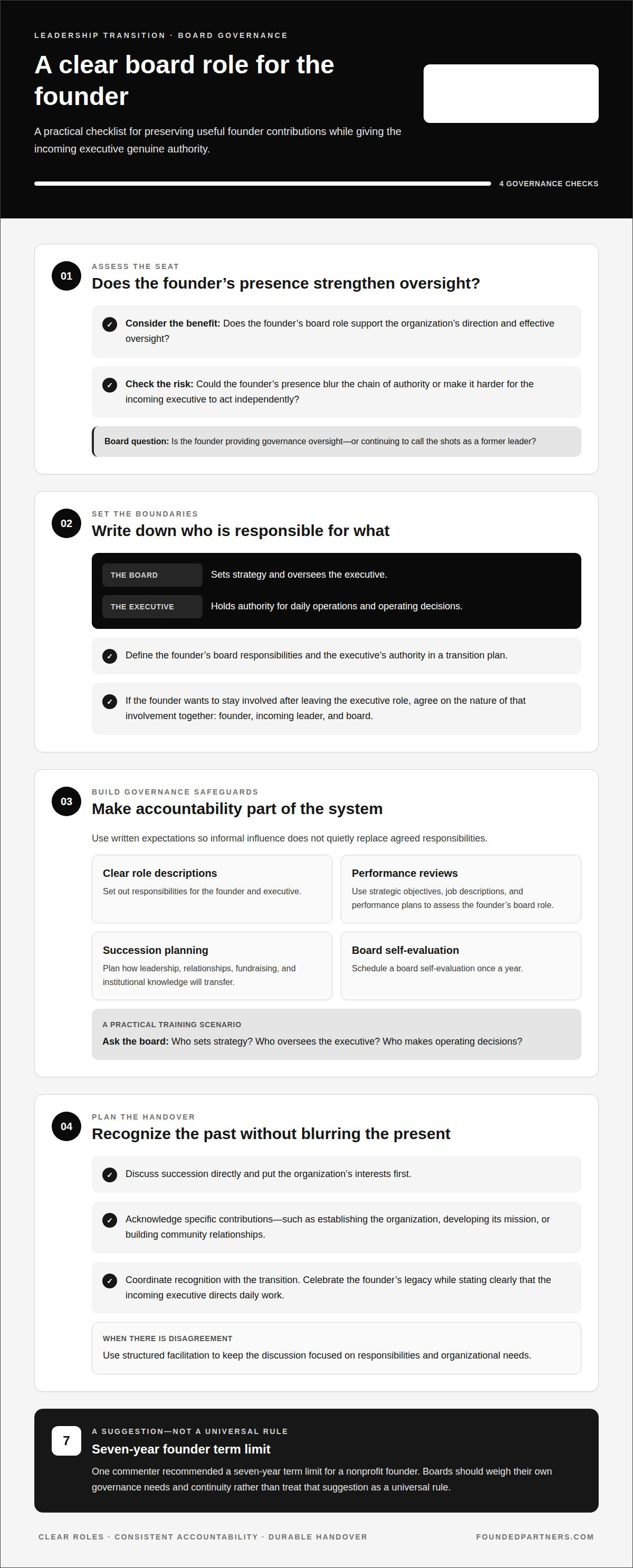
A founder can remain on the board when the role is clearly defined and supports the organization’s direction. The risk is a blurred chain of authority: an incoming executive may report to a board that includes a former leader who still calls the shots. Boards should assess whether the founder’s presence strengthens oversight or makes it harder for new leaders to act independently.
To address founder syndrome while respecting the founder’s contributions, boards can discuss succession directly, recognize the founder’s work, and put the organization’s interests first. A transition plan should clarify the founder’s board responsibilities and the executive’s authority. If the founder wants to keep working with the organization after leaving an executive role, the founder, incoming leader, and board should agree on the nature of that involvement together.
Useful governance policies include clear role descriptions, regular performance reviews, succession planning, and a board self-evaluation once a year. A commenter recommends a seven-year term limit for a nonprofit founder, but boards should weigh their governance needs and continuity rather than treat that suggestion as a universal rule. Written expectations help prevent informal influence from quietly replacing agreed responsibilities.
Board training can help leaders distinguish governance from daily management. A practical session can use a transition scenario: who sets strategy, who oversees the executive, and who makes operating decisions? Boards can also assess founders against strategic objectives and job descriptions through regular performance plans and reviews. These practices make accountability consistent rather than dependent on personal history or difficult conversations.
When board members disagree about the founder’s role, structured facilitation can keep the discussion focused on responsibilities and organizational needs. Leadership transition guidance can help boards clarify roles, address sensitive tensions, and support a durable handover.
3. Acknowledging a founder’s contributions
Recognition can honor a founder’s work without preserving their authority over every decision. A board can publicly acknowledge the founder at a major event, present an award, and issue a press release describing specific contributions. For example, it might recognize the founder’s role in establishing the organization, developing its mission, or building community relationships. Concrete details make the tribute meaningful to staff and stakeholders.
Timing and language matter. The board can coordinate recognition with the leadership transition, then describe the incoming leader’s responsibilities clearly. A tribute should distinguish the founder’s legacy from the executive’s current role. That distinction helps prevent appreciation from being mistaken for ongoing operational control. For example, a public statement can celebrate the founder’s vision while affirming that the new executive directs daily work.
Specific examples show how contributions can be acknowledged honestly. One commenter described an organization established close to 20 years earlier by its founder. Another commenter reported that services grew sixfold during an organizational transformation, while fundraising tripled under their leadership. These are separate accounts, not a promise that every transition will produce the same results. They illustrate why recognition should credit meaningful work accurately.
Boards can develop a recognition plan with the founder and incoming executive. It can identify which contributions to name, who will communicate them, and how the organization will mark the handover. A major event suits a public tribute; a press release can record the founder’s role for external audiences. Staff communications can also explain how institutional knowledge will be carried forward.
Leaving can be personal as well as professional, especially when the founder’s identity is closely tied to the organization. A defined role in the recognition process gives the founder a clear moment of acknowledgment, while agreed boundaries protect the new leader’s authority. If gratitude becomes a reason to retain informal control, staff and incoming leaders may face unclear accountability. Respectful recognition should honor what the founder built and make room for what the organization will develop next.
4. Founder and executive director roles during leadership transition
A transition works when the founder’s title matches their actual authority. The executive director should lead daily operations, manage staff, and make decisions within the board’s direction. The founder can support continuity by sharing institutional knowledge, relationships, and context behind the mission. A written role description helps prevent two people from directing the same work.
Founders should step down from executive duties when the organization needs a leader with authority they’re reluctant to share. They may remain involved as an advisor if the incoming executive and board agree on defined responsibilities, boundaries, and contact. If the founder’s vision still guides the organization, it belongs in shared strategy, not informal control over the new leader.
Consider a transition schedule with specific duties and an end point. One opera-company founder planned to stay for two weeks after the new director arrived, yet was still coming in every day four months later. That contrast shows why a brief handover needs clear limits. After the new director takes over, limiting founder contact can help staff understand whose decisions stand.
An interim executive director appointment lasting 12-18 months can give an organization time to prepare for a permanent leader. Another continuity measure is training a potential replacement who can step in temporarily, even if the founder expects to remain for another 10 years. These arrangements reduce dependence on one person and let future leaders practise real responsibilities.
Define the transition in a shared document: the founder’s remaining duties, the executive director’s decision rights, and the board’s oversight role. Include how staff should raise questions and how disagreements will be resolved. Review the agreement as responsibilities shift. Clear boundaries protect the incoming leader without dismissing the founder’s contribution to the organization.
For support clarifying leadership responsibilities and transition boundaries, discuss leadership transition roles through Leadership Advisory.
Founded Partners
Founded Partners helps founder-led organizations bring greater clarity to leadership transitions and the responsibilities that come with growth. When decision-making remains concentrated around the founder, Leadership Advisory can support clearer executive roles and a stronger leadership structure. Business Transformation Consulting can help align the organization’s operating model with its evolving needs, while exit planning can support founders considering a future departure.
The right next step depends on the organization’s priorities: clarifying authority, preparing for succession, or shaping a sustainable path forward. A thoughtful transition can preserve what matters about the founder’s vision while enabling the organization to develop beyond one person’s day-to-day involvement.
Contact Founded Partners to discuss your organization’s leadership transition.
Build a transition that can keep evolving
A leadership transition isn’t a single handover. It’s a continuing commitment to keep authority, accountability, and the organization’s needs aligned as circumstances change. A useful next step is to identify which decisions still depend on the founder’s involvement and consider whether that dependence serves the organization’s future. This creates a practical starting point for overcoming founder syndrome without making the transition a judgment on the founder’s past.
As the organization develops, revisit whether the executive role has the authority to deliver its responsibilities, whether board oversight is focused on strategy, and whether the founder’s agreed involvement remains appropriate. These conversations can help the organization adapt its leadership structure as priorities shift. Progress comes from clarifying responsibilities and adjusting them with care, not preserving old arrangements by default.
If your organization is considering its next leadership step, contact Founded Partners to discuss your transition. A well-shaped transition can help the organization move forward with purpose and confidence.
Frequently Asked Questions
What is founder’s syndrome?
Founder’s syndrome is a pattern in which an organization’s reliance on its founder limits its ability to operate or adapt. A founder’s continued involvement alone doesn’t indicate a problem. A useful distinction is whether decisions, relationships, or essential knowledge remain inaccessible to other leaders. For example, if routine approvals repeatedly wait for the founder, the organization may need to examine how authority and information flow.
Should the founder remain on the board?
A founder may remain on the board if the role supports effective governance and doesn’t undermine the incoming executive’s authority. Consider a board meeting where staff still seek the founder’s approval after the executive has made a decision. That pattern suggests the arrangement may be confusing. The board can assess whether the founder’s participation contributes an independent perspective or makes leadership accountability harder to understand.
Is there a graceful way to send them off?
Yes. Make the departure a planned handover rather than a sudden disappearance or an indefinite farewell. Agree on how the founder will communicate the change to employees, customers, and other important relationships. A personal note from the founder can express confidence in the organization’s next chapter. A separate internal briefing can address practical questions, such as who now handles decisions previously directed to the founder.
Is there any way that founders can continue working with their organizations?
Yes, if the ongoing contribution has a defined purpose and the incoming leader supports it. For example, a founder might help introduce the new executive to key relationships or provide background on a past strategic decision. Agree on the work, reporting relationship, and limits before the role begins. A specific assignment is easier to manage than a broad promise to remain available whenever needed.
Should the founder continue after a replacement is named?
Only when continued involvement has a clear purpose that doesn’t compete with the replacement’s authority. Naming a successor should establish who leads, even if a handover follows. For instance, the founder might answer agreed historical questions while the new executive directs staff and operations. If employees receive conflicting instructions, the overlap is obscuring leadership rather than supporting continuity, and the arrangement needs adjustment.
What are the most difficult issues for the founder to face?
Founders can find it difficult to release familiar decisions, accept that a successor may approach the work differently, and separate personal identity from the organization’s daily activity. A practical way to face these tensions is to name which responsibilities feel hardest to relinquish and why. That reflection helps distinguish a valuable contribution from a habit of retaining control, and can guide a more intentional next role.