
Scaling Business Operations Effectively Through Automation

Workday research found that 7% of organizations are scaling AI operations effectively, a reminder that adding technology alone doesn’t make growth sustainable. Scaling business operations effectively means expanding capacity without increasing costs at the same pace or letting quality suffer. The aim is to build processes that can handle more customers and work without placing an equivalent burden on people and resources.
Growth brings new opportunities, but it can also strain cash flow, customer experience, and the systems that keep daily work moving. Automation can help by removing repetitive tasks, while clear processes and human oversight protect decision quality and service.
This article explains what business scaling means, how scalable operations work, and where automation can support growth. It also considers what scaling statistics can reveal and how to use them as signals for better decisions, not guarantees of success.
Key Takeaways
- Build team structures and repeatable processes that can absorb greater demand without letting quality or coordination slip.
- Identify repetitive work that automation can streamline, while keeping people responsible for oversight and judgment.
- Shape an operating model around growth priorities, clear accountability, and the capacity your business needs next.
- Read scaling statistics as indicators, then pair them with operational measures to assess what’s working in your own business.
1. What Does It Mean to Build Scalable Operations?
Scalable operations let a business expand without overwhelming its resources or weakening quality. A scalable company can handle ten times as many customers without needing ten times as many employees or ten times the costs. That principle shifts attention from growth alone to the processes, roles, and infrastructure that support each new customer.
Start by mapping a critical workflow, such as customer onboarding, from the first step to the final handoff. Mark bottlenecks, duplicate approvals, and tasks that rely on one person’s memory. Then document repeatable work in standard operating procedures that identify ownership, decision points, and escalation paths. Clear procedures help new hires contribute consistently instead of relying on informal instruction.
Team structure matters, too. Define responsibilities around outcomes, then delegate decisions to the people closest to the work. For example, a customer support team can follow shared response procedures while assigning complex cases to experienced staff. Hire to fill capability gaps, not simply to add headcount. Clear goals and coordination across teams help create a culture that can support growth.
Some processes scale more easily than others. A repeatable digital onboarding workflow can serve more customers with little additional effort. But a process that requires the founder’s approval at every stage can become a bottleneck as volume rises. Review workflows for manual dependencies, repeated rework, and decisions that could move closer to the work.
Technology should support that operating model. Cloud-based infrastructure can scale IT resources up or down with business needs, while shared systems make information easier to access across teams. Structure and technology are changing together: according to PwC, 94% of leaders with siloed or partially integrated structures expect a shift toward a more horizontal, networked model, while 41% say their organizations already operate that way. Aligning authority, processes, and systems helps teams expand without losing accountability.
2. Automation of repetitive tasks
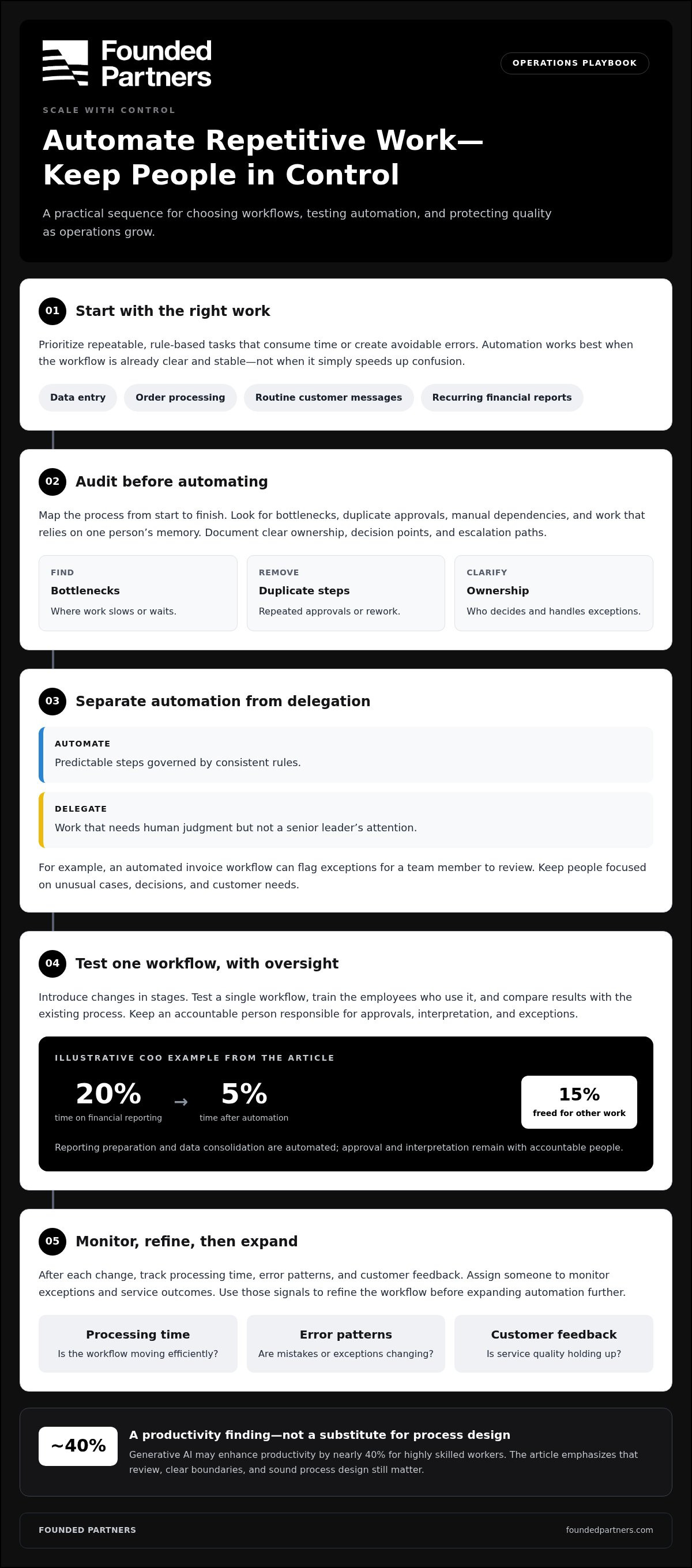
Which business processes should be automated before scaling? Start with repeatable, rule-based workflows that consume time or create avoidable errors, such as data entry, order processing, routine customer messages, and recurring financial reports. Audit each process first. Automation should follow a clear, stable workflow, not reproduce confusion at greater speed.
For HR, automate routine onboarding steps such as collecting employee details and assigning standard training materials, while managers handle role-specific conversations. In finance, automate report preparation and data consolidation, then keep approval and interpretation with accountable people. In a hypothetical COO example, shifting financial reporting from 20% of the COO’s time to 5% frees 15% for other work, while retaining oversight.
Delegation and automation address different needs. Delegate work that requires human judgment but not a senior leader’s attention; automate predictable steps governed by consistent rules. For example, a team member can review exceptions flagged by an automated invoice workflow. This keeps human attention on decisions, unusual cases, and customer needs.
How can businesses scale operations without sacrificing quality or customer service? Standardize the workflow, automate routine steps, and assign someone to monitor exceptions and service outcomes. After each change, track processing time, error patterns, and customer feedback. Use those signals to refine the workflow before expanding it further.
Invest in automation where repeated effort is holding back higher-value work, but introduce changes in stages. Test one workflow, train the employees who use it, and compare its results with the existing process. Generative AI may enhance productivity by nearly 40% for highly skilled workers, but that finding doesn’t remove the need for review, clear boundaries, and sound process design.
When workflows cross teams or create recurring bottlenecks, a structured review can clarify what to simplify, delegate, and automate. Explore operational workflow optimization as a way to align process changes with the demands of growth.
3. What does scaling a business mean?
Growth means increasing revenue, customers, or output. Scaling means expanding without costs rising at the same rate. A manufacturer that adds production shifts but also needs proportionally more supervisors may be growing without becoming more scalable. A sustainable operating model aligns people, infrastructure, capacity, and decision-making with expected demand.
Design the operating model by mapping how customer demand becomes delivered value. Identify the steps that generate revenue, the resources each consumes, and the bottlenecks limiting throughput. Then compare growth opportunities, such as entering a new market, expanding an offering, or improving customer retention. Choose a path that fits current capabilities and strengthens the business model.
Small businesses may need to formalize founder-led decisions before demand increases; startups may need to test repeatable delivery and customer acquisition. Established companies can focus on removing cross-team bottlenecks, updating infrastructure, or adapting processes for new markets. The right strategy depends on what constrains the organization, not its label.
Key steps are to assess demand and cash flow, map the operating model, resolve capacity constraints, then set measures for quality and performance. Readiness signals include consistent revenue growth, customer retention, positive cash flow, and sound market potential. To assess employee capacity, compare current workloads with workloads 12 months earlier, then identify recurring tasks and skills gaps.
Manufacturing growth can expose constraints in suppliers, production capacity, quality control, and delivery. Expanding output before resolving a production bottleneck can increase rework and weaken customer satisfaction. Other common risks include straining cash flow, hiring ahead of demand, and entering markets without a repeatable sales process. Track output quality, customer feedback, and employee productivity as demand rises. If these measures deteriorate, refine the operating model before expanding further.
4. Business scaling statistics
Scaling statistics are useful when they show where effort matters, not when they promise a result. Treat each figure as a signal about organizations, then compare it with your own operating measures. A business must maintain quality while handling increased demand; headline growth alone cannot show whether its systems can keep pace.
A McKinsey Digital survey found that 22% of new businesses scaled over the past decade. That figure highlights how scaling differs from simply launching or growing. It also makes a practical question important: can your organization repeat its customer and delivery model as demand expands? Look for evidence in repeat purchases, reliable fulfillment, and manageable operating demands.
Two-thirds of value creation occurs during the scale-up phase. Organizations addressing seven or more elements of their operating model are three times more likely to achieve a successful transformation. Together, these findings point to the importance of alignment across strategy, structure, processes, and talent. Improving one function while leaving connected work unchanged can limit the impact.
AI adoption figures also reveal a gap between interest and execution. Workday research found that 7% of organizations are scaling AI operations effectively. Treat that statistic as a prompt to examine governance, workforce readiness, and how AI fits existing workflows, not as a reason to adopt technology for its own sake. A measured pilot can expose training needs and process weaknesses before wider investment.
Translate broad findings into a focused set of operational indicators. Track revenue growth alongside customer acquisition cost, customer satisfaction, and employee productivity. For example, rising sales paired with falling satisfaction may signal that service capacity is lagging. Review the measures together, then adjust processes, staffing, or investment based on the constraint they reveal.
Statistics can frame decisions, but organizational data determines the next move. If your measures expose gaps across strategy and execution, explore business transformation consulting to assess how those parts can be aligned for sustainable growth.
Founded Partners: Capital raising support
Founded Partners provides capital raising support for founder-led organizations preparing to fund strategic growth. This can be a natural next step when your operating model is clearer, demand is developing, and growth plans require investment. Aligning capital needs with business priorities helps founders plan how funding can support capacity, transformation, and long-term direction.
For businesses facing operational constraints alongside growth decisions, Business Transformation Consulting can help address the broader changes involved. Leadership Advisory supports leaders working through complex choices, while Exit planning is relevant when owners are considering a future transition. The right focus depends on the business’s objectives and stage.
If you’re weighing growth priorities, funding needs, or organizational change, contact Founded Partners to discuss your next step.
Make the Next Move Deliberate
The next stage of growth is a design choice, not just a target. Before committing resources, decide what the business needs to strengthen first: its operating foundation, leadership capacity, or access to growth capital. A deliberate sequence can keep ambition aligned with the organization’s ability to deliver.
Scaling business operations effectively means planning beyond the next milestone. Consider how today’s decisions shape future ownership, strategic options, and business resilience. Founded Partners supports this work through Business Transformation Consulting, capital raising support, and Exit planning, aligned with the priorities you’re pursuing.
If you’re ready to turn your growth priorities into a considered plan, contact Founded Partners today. Thoughtful decisions now can give your next chapter a stronger foundation.
Frequently Asked Questions
What does scaling a business mean?
Scaling means increasing a company’s capacity and value without requiring resources to rise at the same pace. Scaling business operations effectively depends on whether added demand strengthens the model or simply adds work, expense, and coordination pressure. For example, a subscription business might serve more customers through self-service account management while keeping human support available for complex needs.
What Does It Mean to Build Scalable Operations?
Scalable operations let a business handle more work while maintaining dependable delivery. Test this by tracing a customer request across teams: can staff find the information they need, understand who owns the next step, and resolve exceptions without relying on the founder to intervene? Clear handoffs and accessible records show whether operations can expand smoothly or depend on individual memory.
How do you know when a business is ready to scale?
A business is better positioned to scale when demand is repeatable and its finances can support the next stage. Review customer retention, cash flow, delivery consistency, and market opportunity together. For example, a full order pipeline may not indicate readiness if customers pay slowly or production delays already affect service. Scaling business operations effectively means assessing these signals as a connected picture.
What technology and tools support operational scalability?
Choose technology that addresses a defined operational constraint and works with the systems employees already use. Cloud infrastructure can adapt to changing resource needs, while shared records can reduce delays between sales, service, and finance. Before expanding a tool across the organization, test data handoffs, user permissions, exception handling, and how teams will continue working if the system is unavailable.
How should a business hire and structure teams as it grows?
Hire to address capability gaps, then give each role clear ownership and decision boundaries. A growing company might assign customer onboarding to a dedicated team instead of splitting it across sales and support. Document each role’s expected outcomes, pair new employees with trained colleagues, and identify where approvals slow work. This helps preserve accountability as responsibilities spread.
How can companies manage cash flow and funding during rapid growth?
Manage cash flow by forecasting customer payment timing alongside payroll, supplier obligations, and planned expansion costs. Growth can absorb cash before revenue arrives, so compare timing and commitments before adding capacity. When outside capital fits the strategy, Founded Partners provides capital raising support to help founder-led organizations pursue investment aligned with their growth objectives.