

A McKinsey survey found that 60% of CIOs felt their organization’s technical debt had risen perceptibly over the previous three years. That debt can weigh on company valuation when aging systems and accumulated shortcuts increase maintenance and modernization costs, slow planned growth, or make a business harder to integrate. Understanding how technology debt impacts company valuation starts with seeing it as more than an engineering concern: it can shape the costs and risks a buyer sees.
It’s natural to focus first on visible assets, revenue, and growth potential. But the technology behind those results matters too. Technical debt is not automatically a deal-breaker. Its effect often depends on whether the company understands its scope and manages its business impact.
This article explains what technical debt is, how it creates ongoing costs and future investment needs, and why those can influence valuation and negotiations. It also covers what investors may examine during due diligence, helping you connect technology decisions to your business’s health and readiness.
Key Takeaways
- Technical debt can raise maintenance and modernization costs, while unsupported components may increase security and transaction risks.
- Separate debt that affects growth plans, security, or operating costs from issues that are untidy but less consequential.
- Buyers may assess how technology risks affect forecasts, integration, and the work needed after a transaction.
- Record significant debt, its business impact, and a credible resolution plan to make technology risks easier to understand.
Introduction: What is tech debt?
Technical debt is future work created when shortcuts or aging technology make systems harder to maintain. To understand how technology debt impacts company valuation, start with its practical effects: security exposure, unreliable performance, and the effort required to support growth.
Security Exposure and Unsupported Components
Security exposure can arise when legacy components are no longer supported, making known weaknesses harder to address. During due diligence, buyers may view unsupported software as a risk that requires remediation, closer scrutiny, or changes to deal terms. For example, a business relying on an unmaintained database may struggle to show how it protects sensitive information. Documenting the component, its role in the business, and a resolution plan makes the risk clearer and easier to assess.
Reliability, Performance, and Security Risks
Technical debt can undermine reliability when fragile dependencies cause failures or make routine changes risky. Performance may also slow as growing workloads strain systems that were not designed to scale. A sluggish order platform, for example, may delay transactions during a busy period. These issues can reduce efficiency and disrupt operations underlying revenue forecasts. Systems that are difficult to update may also leave security vulnerabilities unresolved.
Software and Platform Debt
Software and platform debt includes outdated architecture, tangled integrations, and code that’s difficult to change safely. Fortran and COBOL, developed in the 1950s, remain in use, illustrating how long-lived systems can become part of a company’s operating foundation. Their age alone doesn’t establish a problem. The concern is whether the platform can support required features, connect with other systems, and adapt without disproportionate effort. A planned transformation can expose these dependencies before they constrain growth, and enterprise architecture specialists such as ebsaconsult.net help organizations align underlying technology with long-term business strategy.
Technology Debt Risks for SMBs
For an SMB, technology debt may be concentrated in a core platform, a specialist who understands it, or an integration that supports daily work. During the global pandemic, 78% of organizations took on additional technical debt to stay competitive. A small company that deferred upgrades may now depend on manual workarounds or unsupported components. Hardware refresh cycles typically run 3 to 5 years, so overdue equipment can compound software constraints. Mapping essential systems helps leaders identify what to maintain, modernize, or replace.
Maintenance, remediation and modernization costs
Technical debt turns deferred engineering work into recurring operating effort and future investment. Its effects may show up in support queues, delayed releases, infrastructure upgrades, or remediation after a transaction.
Productivity and Maintenance Burdens
Technical debt consumes staff capacity through repeated workarounds, troubleshooting, and maintenance of difficult systems. Some estimates indicate engineers spend 33% of their time dealing with technical debt, while organizations regularly lose 20% or more of their time to it. PwC’s latest CEO survey found 39% of CEOs believed their companies spent time addressing technology issues inefficiently. Those hours can delay feature development, service improvements, and work that supports customers.
Remediation and Modernization Costs
Remediation addresses specific weaknesses, while modernization replaces or reshapes systems that no longer support business needs. Legacy applications installed on office servers 20 or 30 years ago can be expensive and impractical to adapt for modern cloud infrastructure, particularly for scalability. During a transaction, buyers may estimate the cost of fixing material debt after completion, add that work to the post-completion plan, or adjust the price. Planning for this work makes its business effect more visible.
Scalability and Infrastructure Costs
Growth can become more expensive when infrastructure needs repeated upgrades or cannot handle changing workloads efficiently. A company expanding into global markets, for example, may find that its platform depends on manual processes to support new users or integrations. Infrastructure updates should account for related technical debt, not just replacement hardware or platforms. Otherwise, modernization may carry old constraints forward and limit the scalability it was meant to deliver.
ROI of Paying Down Technical Debt
Companies can quantify ROI by comparing remediation effort with measurable operating improvements. Establish a baseline for maintenance costs, cycle time, defects, and reuse, then track those measures after the work. Include capacity returned to product development and improvements to user experience where they can be observed. Tie each debt item to a business outcome, such as removing a release bottleneck. Leaders aligning infrastructure choices with growth priorities can use scalability planning to frame those decisions.
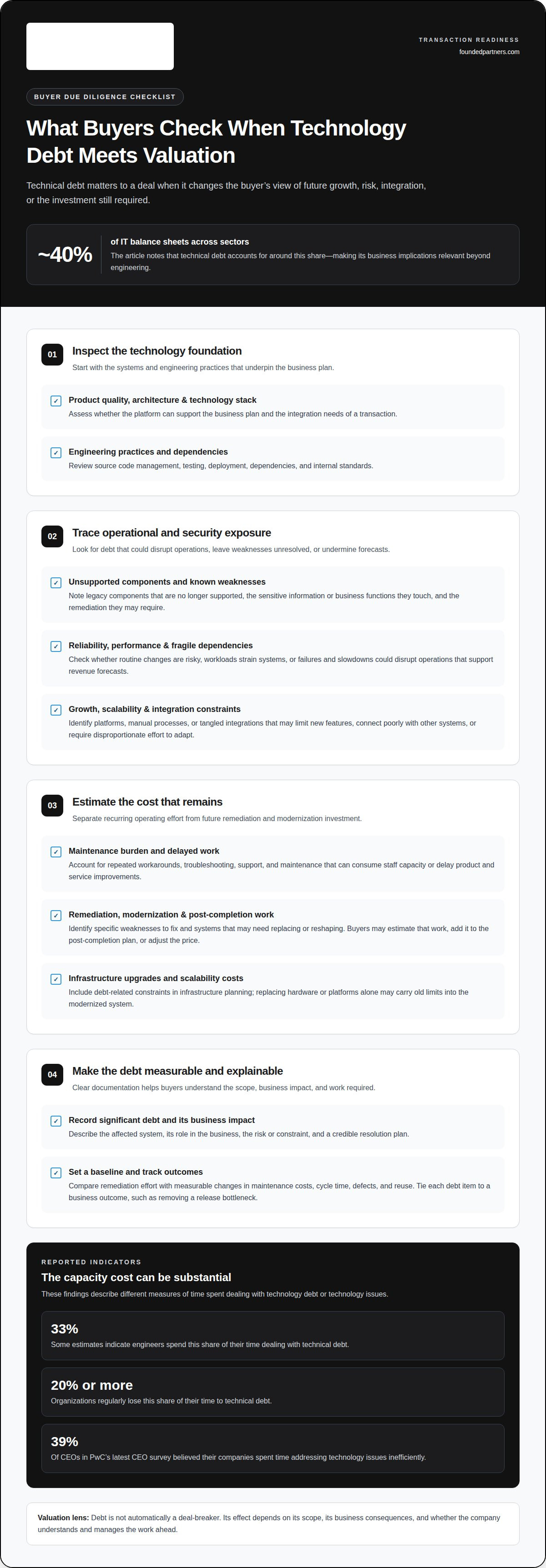
How technical debt affects company valuation
Technical debt affects valuation when it changes the buyer’s view of future growth, risk, and required investment. Technical debt accounts for around 40% of IT balance sheets across sectors, making its business implications relevant beyond engineering.
Assessing Debt During Due Diligence
Technical due diligence examines a company’s technology foundation to identify risks, costs, and constraints that could affect a deal. Software buyers assess product quality, architecture, and the technology stack, as well as source code management, testing, deployment, dependencies, and internal standards. This helps investors judge whether the platform can support the business plan and integration needs.
Buyers distinguish manageable debt from debt that threatens valuation by asking whether it is known, sized, and actively managed. Debt that blocks forecast features, creates security exposure, or requires substantial remediation can weaken confidence in the plan. A register linking each major item to its business impact and resolution effort gives leaders a clearer basis for prioritization.
Manageable and Valuation-Threatening Debt
Manageable technical debt has a defined scope and credible plan. More concerning debt undermines growth assumptions, security, or operating economics. A documented backlog with prioritized fixes, for example, is easier to assess than an undiscovered dependency that could force a platform replacement. Buyers may question whether forecast growth can be achieved on schedule if the architecture slows new features or scaling.
Known debt is not automatically harmless. Its effect depends on the effort and timing required for remediation, and whether it compromises integration with the buyer’s systems.
Revenue Growth, Margins, and Cash Flow
Technical debt can constrain revenue growth if delayed features or limited scalability prevent a company from serving demand. It can pressure margins when maintenance and remediation consume resources that could otherwise support delivery. Cash flow may also face added demands if a buyer has to fund fixes after closing.
In M&A, due diligence findings can create negotiating leverage and lead to price adjustments, warranties, indemnities, retentions, or conditions. Earnouts may tie part of the consideration to future performance, but debt that makes targets harder to achieve can complicate negotiations. A credible remediation plan connects the required investment to the company’s forecast and the rationale for the deal.
How do investors measure technology debt during due diligence?
Investors assess technical debt by examining the systems behind the business plan, not simply by counting old code. For a software company, due diligence connects architecture and engineering practices to security, operating costs, and the ability to deliver planned growth.
A review may trace how software changes move from development into production. Investors examine source code management, automated testing, deployment practices, third-party dependencies and licenses, architectural choices, and documented internal standards. Limited automated testing, for example, can make releases harder to evaluate, while a critical dependency with unclear licensing can create integration concerns. Each finding matters because of its effect on operations and future requirements.
- Architecture: Identify components that constrain planned features, scaling, or integration.
- Testing and deployment: Review whether changes can be tested and released in a controlled way.
- Dependencies: Record third-party software, licenses, and the role each plays in the product.
- Internal standards: Compare documented practices with how teams actually maintain the platform.
Investors separate consequential debt from untidy work that does not materially affect the business. Ask whether an item affects the plan, security, or operating costs. A formatting inconsistency may be low priority, while a dependency that blocks a forecast feature deserves closer attention. Recording each item’s business impact and estimated resolution effort makes priorities clearer.
Evidence matters too. Buyers can evaluate debt that has been identified, sized, and actively managed more easily than surprises discovered during due diligence. A record of completed remediation can carry more weight than a plan that has yet to begin. Pairing completed work with remaining risks, accountable owners, and a credible resolution plan shows progress without obscuring unfinished work.
Prepare for review by connecting significant technology findings to forecasts, operating costs, security, and integration requirements. This gives investors a clearer view of what the business can deliver and what follow-up work remains. Prepare your business for transaction diligence with a disciplined view of technology risks and growth plans.
Founded Partners: Capital raising support
Founded Partners helps founder-led organizations connect technology priorities with broader growth and transaction goals. When modernization requires investment, its capital raising support helps businesses pursue funding aligned with their strategic growth objectives. Business Transformation Consulting helps leaders align operational changes with growth plans, while exit planning supports preparation for a future sale.
Consider this support when technical findings affect an investment narrative, transformation plan, or transaction readiness. A clear account of the risks, planned remediation, and expected business impact helps decision-makers assess how technology work fits the company’s wider direction. The goal is a coherent plan, not an assumption that every legacy system needs replacing.
Contact Founded Partners to discuss your company’s priorities, or visit foundedpartners.com.
Turn technology insight into a stronger next move
Treat technology decisions as part of the company’s wider strategic direction. Understanding how technology debt impacts company valuation helps leaders decide which work supports the business plan, which risks need attention, and how to explain priorities with confidence. That perspective can guide planning well before a financing conversation or sale becomes imminent.
Start by aligning business and technology leaders around the outcomes the company needs to achieve. Give each priority a clear owner, connect it to an operating or growth objective, and revisit the plan as conditions change. This creates a stronger basis for investment decisions and future discussions with stakeholders.
For a considered conversation about valuation and your company’s next stage, discuss your valuation priorities with Founded Partners. A thoughtful plan can turn complexity into clearer choices and steady progress.
Frequently Asked Questions
What Is Technical Debt and How Is It Impacting Your Organization?
Technical debt is extra work created by technology choices that make later changes harder. In a small business, for example, staff may use a spreadsheet to bridge two systems that do not integrate. That workaround can slow reporting, create duplicate records, and make routine decisions less reliable. Map where employees rely on manual fixes to identify technology constraints affecting daily operations.
Should you fix it before a sale?
Fix debt that blocks the business plan or creates security exposure before a sale, and document remaining work with a credible plan. Businesses preparing for a transaction should start exit-readiness work 12 to 24 months beforehand. Avoid beginning a major rewrite in the final year: an unfinished migration can look riskier than the system it was meant to replace. Prioritize targeted remediation and clear records.
How does technology debt affect a company's valuation?
Technology debt can affect valuation by making future performance less certain or requiring a buyer to fund additional work. To understand how technology debt impacts company valuation, connect each issue to a business consequence, such as a delayed product launch or a platform that cannot support the operating plan. A clear record of impact, resolution effort, and ownership helps distinguish defined obligations from uncertain exposure.
How does technology debt affect SaaS company valuation multiples?
For a SaaS business, debt can affect how confidently a buyer views recurring revenue and future expansion. A product architecture that slows customer onboarding, for example, may make growth assumptions harder to support. Buyers may also consider whether the platform can integrate with their systems or needs replacing. The key is how technology constraints affect customer experience and the company’s ability to sustain its business model.
What technology debt risks affect a company's ability to scale or innovate?
Debt can limit scaling when each new customer, feature, or integration requires extra manual work. A product team may spend its capacity maintaining existing workflows instead of building improvements customers need. Tightly connected components, for example, can make a small update require changes across several functions. Leaders can assess the effect by linking blocked initiatives and recurring workarounds to specific growth plans.
How do technology debt and cybersecurity risks affect valuation?
Cybersecurity-related debt can raise valuation concerns when unsupported components or difficult-to-update systems leave exposure unresolved. A buyer may examine whether known weaknesses affect sensitive data, business continuity, or planned integration needs. Documentation should identify affected systems, business impact, remediation priorities, and remaining exposure. This gives transaction discussions a grounded account of the issue rather than leaving buyers to guess at its scope.