
Best Practices for Scaling a Founder-Led Business in 2026

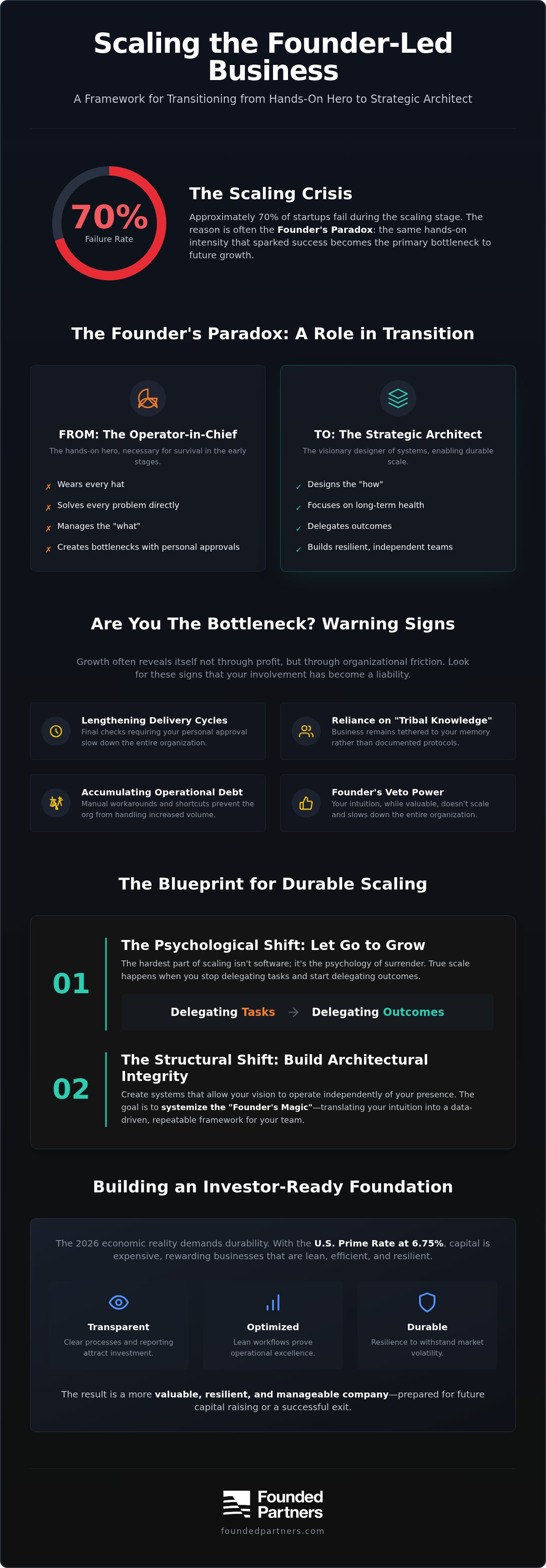
Approximately 70% of startups fail during the scaling stage because their founders struggle to transition away from daily operations. You've likely reached the point where every decision still requires your personal approval, and your once-vibrant culture feels diluted as the team expands. It's a common paradox: the hands-on intensity that sparked your success has become the primary bottleneck to your future growth. Adopting the best practices for scaling a founder-led business is the only way to ensure your enterprise remains resilient as it expands.
You deserve a business that thrives on your vision but survives without your constant presence. In the following sections, you'll discover the architectural framework for transforming from a hands-on founder into a strategic leader of a durable, scalable enterprise. We'll provide a clear roadmap for leadership transition and explain how to build an investor-ready operational foundation. By focusing on structural health and disciplined systems, you can move away from the frantic energy of a startup and toward the composed authority of a mature organization.
Key Takeaways
- Recognize the "Founder's Paradox" where personal heroics become the bottleneck, and learn the psychological shift required for true enterprise scale.
- Implement best practices for scaling a founder-led business by systemizing core operations to ensure the organization remains durable and repeatable without your direct oversight.
- Transition from an individual decision-maker to a strategic architect by building a leadership team grounded in both technical competence and shared character.
- Prepare for future capital raising or exit planning by refining your operational foundation into one that is transparent, optimized, and investor-ready.
The Founder's Paradox: Defining the Transition to Scale
A founder-led business begins with a burst of individual will. In the early days of a startup company, success depends on your ability to wear every hat, solve every problem, and outwork every obstacle. This era of personal heroics is necessary for survival, but it creates a fragile foundation. As we move through 2026, the global economy rewards durability over the "growth at all costs" mentality of previous decades. With the U.S. Prime Rate holding at 6.75%, capital is more expensive than it was in the early 2020s. This reality demands that your operations be lean, efficient, and resilient.
The Founder's Paradox is the realization that the very intensity that built your company is now what prevents it from growing. Your intuition, while valuable, doesn't scale. Your presence in every meeting, while reassuring, creates a bottleneck that slows down the entire organization. Implementing best practices for scaling a founder-led business requires a fundamental evolution in your role. You're moving from the Operator-in-Chief, who manages the "what," to the Strategic Architect, who designs the "how."
Recognizing the Operational Bottleneck
Growth often reveals itself not through profit, but through friction. You might notice that delivery cycles are lengthening because every final check requires your personal approval. When your team relies on "tribal knowledge" rather than documented protocols, the business remains tethered to your memory. Operational debt is the cumulative burden of manual workarounds and technical shortcuts that prevents an organization from handling increased volume. Without optimization, these cracks become chasms as you hire faster, ultimately threatening the health of the enterprise.
The Emotional Shift: Letting Go to Grow
The hardest part of scaling isn't the software or the spreadsheets; it's the psychology of surrender. Many founders fear that delegating will lead to a dilution of quality or a loss of the company's unique culture. However, a "founder-led" organization should be defined by your vision and values, not your daily execution. True scale happens when you stop delegating tasks and start delegating outcomes. This shift empowers your leadership team to own their results, allowing you to focus on the long-term health, sustainability, and architectural integrity of the business.
Architectural Integrity: 5 Best Practices for Scaling Operations
Architectural integrity is the measure of how well your business functions when you aren't looking. While the initial stage of growth relies on the founder's willpower, scaling operations requires a durability-first mindset. This involves building systems that prioritize long-term organizational health over short-term vanity metrics. When you implement the best practices for scaling a founder-led business, you're essentially creating a blueprint that allows your vision to operate independently of your presence. This structural clarity ensures that as the volume of work increases, the quality of delivery remains steadfast.
Operational excellence isn't about installing rigid bureaucracy; it's about creating clarity through systemization. To achieve this, you must systemize your core value proposition so it becomes repeatable by any trained team member. This process often involves engaging in leadership advisory to gain an objective, strategic view of your current organizational structure. By aligning your operations optimization with long-term strategic objectives, you ensure every workflow serves a specific purpose. Even if you aren't currently ready to sell, building for a future exit forces a level of discipline that makes the company more valuable, resilient, and manageable today.
Systemizing the 'Founder's Magic'
Every successful founder has a "magic" that drives customer success, yet this magic is often trapped in their own intuition. Scaling requires you to identify, document, and refine these unique processes into a data-driven framework. Before accelerating, it's wise to review a pre-flight checklist for scaling to ensure your operational readiness. Utilizing business transformation consulting helps translate your innate talent into a structured methodology that your team can execute with precision and confidence.
Operations Optimization for Sustainable Growth
In 2026, market volatility is a constant factor that demands organizational resilience. Building for sustainable growth means aggressively removing friction from both the customer journey and internal workflows. Technology should act as a facilitator for these improvements, not a substitute for a sound strategy. By focusing on operations optimization, you strengthen the core of your enterprise. These best practices for scaling a founder-led business provide the necessary guardrails to ensure your company can withstand economic shifts while maintaining high service standards.
The Leadership Transition: Building a Resilient Team
Scaling a business is less about increasing headcount and more about elevating the quality of your leadership. Founders don't always realize that hiring for immediate relief is a trap; it often fills gaps with individuals who can perform tasks but cannot lead teams. One of the best practices for scaling a founder-led business is to prioritize character as heavily as technical competence. In a high-growth environment, skills are often learnable, but integrity, ownership, and strategic alignment are foundational traits that can't be retrofitted into a team.
Transitioning from a team of doers to a team of leaders requires a proven framework for scaling a business that emphasizes shared values and organizational structure. This shift demands a culture of accountability where the team is responsible for outcomes rather than just checking off lists. Leadership advisory is often the catalyst for this change. It provides the founder with the necessary distance to see where their own intervention is creating a ceiling for the company's potential, allowing for a more strategic distribution of authority.
From Founder to CEO: A Roadmap
The evolution from founder to CEO requires a new set of metrics for success. Instead of measuring your value by the number of problems you solve, you must measure it by the number of leaders you develop. Transition planning involves defining clear KPIs for your new role: vision, capital strategy, and talent development. A resilient organization is one where a second layer of leadership can execute the strategic plan independently, ensuring stability even during your absence or eventual transition.
When to Bring in Specialized Support
There is a specific moment in the growth cycle where internal resources aren't enough. Bringing in a fractional COO or a strategic advisor allows you to implement professional management without the overhead of a full-time executive search. Boutique business consulting firms provide a level of "calm expertise" that generic agencies cannot match, focusing on the architectural health of your organization. This specialized support, particularly in areas like ownership transition consulting, ensures that team morale remains high even as the company's structure becomes more complex and disciplined.
Capital Strategy and Investor Readiness
Capital is the catalyst for expansion, but its utility depends entirely on the structural integrity of the receiving organization. In a market where the U.S. Prime Rate sits at 6.75%, the margin for error in capital allocation has narrowed. Investor readiness is no longer just about a compelling pitch deck; it's about demonstrating that your business is a durable machine rather than a collection of founder-led heroics. By integrating the best practices for scaling a founder-led business, you signal to the market that your enterprise is prepared for the rigorous scrutiny of Series A and beyond.
Attracting "smart money" requires more than showing a high growth rate. It requires proof of operations optimization. Sophisticated investors look for a leadership structure that can sustain momentum without the founder's constant intervention. They value organizations that have already de-risked the transition from a startup to a scalable enterprise. This is where professional capital raising support becomes essential, guiding you to align your funding objectives with a clear, architecturally sound growth roadmap.
Preparing for Your Next Round
Investors are increasingly wary of "founder bottlenecks," where the departure or distraction of the visionary could collapse the operation. Common red flags include inconsistent unit economics or a lack of documented systems. To shorten the funding cycle, you must clean up the balance sheet and prove a healthy LTV:CAC ratio of at least 3:1. Strategic advisory for growing companies helps you identify these vulnerabilities early, ensuring that your financial narrative is backed by operational reality.
Scaling Toward a Strategic Exit
Every scaling effort should contribute to future enterprise value. In today's M&A landscape, the most valuable companies are those that are "founder-independent." A business that runs without you is significantly more attractive to strategic acquirers because it represents a lower integration risk. Exit planning isn't a sign that you're ready to leave; it's a commitment to building a business that is inherently scalable and, therefore, inherently more valuable. By focusing on durability now, you ensure that your eventual transition happens on your own terms and at peak valuation.
Partnering for Success: The Founded Partners Approach
Transformation is a deliberate architectural process, not a byproduct of rapid hiring or new software. While many generic agencies suggest that a specific tool will solve your scaling pains, Founded Partners understands that the root of sustainable growth lies in the structural health of your organization. We act as the Strategic Architect for founder-led firms, helping you move beyond the era of personal heroics toward a model of durable, enterprise-level performance. By implementing the best practices for scaling a founder-led business, we ensure your vision remains the heart of the company even as your daily involvement shifts toward high-level strategy.
Our methodology focuses on the twin pillars of Business Transformation Consulting and Operations Optimization. We don't just identify what needs to change; we design the systems that make change possible. This involves refining your core processes so they are repeatable, measurable, and resilient to market shifts. Whether you are preparing for a capital raise or simply want a business that runs without your constant approval, our approach provides the psychological security and operational clarity required for the next stage of your journey.
Why a Boutique Advisory Firm Matters
There is a profound difference between a templated consulting framework and a bespoke partnership. At Founded Partners, you work with advisors who have been in the founder's shoes and understand the weight of every executive decision. We eschew one-size-fits-all solutions in favor of custom strategies that respect your company's unique culture and character. Our commitment is to build a foundation that lasts, ensuring that your scaling efforts result in a more valuable, manageable, and impactful enterprise.
Next Steps for Your Scaling Journey
The path toward a scalable future begins with an honest assessment of your current operational state. A strategic growth advisory engagement allows you to identify hidden bottlenecks and align your team around a shared roadmap for the future. This process reduces the "operational debt" mentioned earlier and prepares you for the scrutiny of investors or potential acquirers. If you're ready to transition from being the primary operator to the strategic leader of your organization, the time to act is now.
Your business deserves a foundation as bold as your vision. To begin refining your organization for the challenges of 2026 and beyond, Schedule a strategy briefing with Founded Partners today.
Architecting Your Enterprise Legacy
Scaling is a transformation of both structure and mindset. By moving from a model of personal heroics to one of architectural integrity, you ensure your organization remains resilient in a shifting 2026 economy. You've learned that systemizing your core value proposition and empowering a second layer of leadership are the essential best practices for scaling a founder-led business. These steps don't just reduce friction; they build the enterprise value required for successful capital raising or a strategic exit.
Founded Partners provides the calm expertise needed to navigate this transition. As a boutique advisory firm led by seasoned partners, we specialize in founder-led business transformation, capital raising support, and exit planning. We help you refine your operations and strengthen your leadership foundation so the business can thrive independently of your daily oversight. Your vision is the heart of the company; we provide the structure to let it beat on its own.
Build a scalable foundation with Founded Partners
The journey from operator to strategic architect is a significant evolution, but it's the most rewarding path a founder can take. With the right systems and partners in place, your business will grow into a durable legacy that reflects your values while outlasting your direct intervention.
Frequently Asked Questions
What is the biggest challenge when scaling a founder-led business?
The primary hurdle is the transition from personal heroics to organizational systems. Founders often find that the intuition and hands-on control that fueled their initial success now limit their growth. Overcoming this requires a shift in identity from being the primary operator to acting as a strategic architect who empowers others through documented processes and clear delegation.
How do I know if I need a business transformation consultant?
You likely need a business transformation consultant when your involvement is the primary factor slowing down delivery cycles. If you feel that every decision requires your approval or that your team lacks the clarity to execute without your direct intervention, it's time for professional advisory. This support helps you move away from tribal knowledge and toward a durable, scalable enterprise structure.
When should a founder stop leading the sales process?
A founder should step back from leading the sales process once the value proposition is proven and a repeatable sales playbook has been documented. While your passion is a powerful closer, your time is better spent on high-level capital strategy and talent development. Scaling requires a team that can close deals based on a systemized methodology rather than just your personal charisma.
What does investor readiness consulting actually involve?
Investor readiness consulting involves a comprehensive audit of your operations, financials, and leadership structure to ensure you can withstand the scrutiny of institutional capital. It focuses on cleaning up the balance sheet and de-risking the business by proving it can function without the founder. This process ensures you attract smart money by demonstrating an optimized operational foundation and clear unit economics.
How can I scale my operations without losing my company culture?
Maintaining culture during expansion requires systemizing your core values into your operational workflows and hiring processes. You don't lose culture by documenting systems; you lose it by failing to hire for character and competence. One of the best practices for scaling a founder-led business is ensuring that every new hire is aligned with the organizational vision, even as daily interactions with the founder decrease.
What is the difference between growth and scaling in a founder-led firm?
Growth refers to increasing revenue by adding resources at a similar rate, while scaling is the ability to increase revenue without a corresponding increase in costs. In a founder-led firm, growth often feels like doing more of the same and can lead to burnout. Scaling is about building an architectural foundation that allows for exponential expansion through efficiency, automation, and systemized leadership.
How does exit planning benefit a founder who isn't ready to sell yet?
Exit planning benefits you today by forcing a level of discipline that makes the business more manageable and valuable right now. A business that is exit-ready is one that runs independently of its founder, which reduces your daily stress and increases your strategic options. It ensures that when you are eventually ready to move on, the organization is prepared to command peak market valuation.
Why is operations optimization critical for raising capital in 2026?
With the U.S. Prime Rate at 6.75% as of July 2026, capital is more expensive and investors are prioritizing efficiency over raw growth. Operations optimization is critical because it proves your business can generate sustainable returns without wasting capital on inefficient workflows. Demonstrating lean, resilient operations is the most effective way to secure funding in a market that now demands durability and a clear path to profitability.