
Preparing a Founder-Led Business for Acquisition

What if your greatest professional achievement is actually your company's biggest risk? For many founders, the answer is their own involvement. When determining how to value a founder-led business for sale, sophisticated buyers look beyond the bottom line to see if the engine can run without its architect. If the revenue relies on your personal relationships or the operations live inside your head, the enterprise value remains capped. You've built something remarkable, but the goal now is to make it durable without you.
You likely feel the weight of tax-optimized financials that don't tell your true growth story, or perhaps you worry that due diligence will expose operational gaps. It's a common tension. This article outlines the strategic framework for decoupling yourself from the daily grind to maximize your valuation multiple and ensure a seamless transition. We'll examine how to optimize your leadership structure, prepare your data for rigorous scrutiny, and build a legacy that survives the acquisition.
Key Takeaways
- Understand the "Founder Discount" and why businesses that rely on a single individual trade at lower multiples than their operationally independent peers.
- Learn how to build a robust second-tier management layer that institutionalizes knowledge and moves operational authority away from the founder's head into documented SOPs.
- Discover the specific adjustments needed to normalize financials and reduce customer concentration, which are critical factors in how to value a founder-led business for sale.
- Follow a structured 24-month roadmap that transitions your business from tax-optimized to exit-optimized, ensuring a smooth due diligence process with no operational red flags.
- Shift your perspective from viewing an exit as a year-end task to treating it as a consequential strategic project that requires architectural refinement and steady leadership advisory.
The Founder’s Paradox: Why Preparation is the Ultimate Value Driver
The founder is often a company's greatest asset and its most significant liability. This is the paradox of ownership. While your vision, grit, and intuition built the enterprise, your presence may now be the primary obstacle to a premium exit. If the business cannot breathe without your oxygen, it isn't an asset; it's a high-paying job. Understanding how to value a founder-led business for sale requires a shift in perspective. You are no longer building only for growth; you are building for transferability and long-term sustainability.
True acquisition readiness isn't a year-end checklist or a frantic cleanup before a pitch. It's a strategic project spanning 24 to 36 months. This timeline allows for the deep architectural work needed to move from an owner-operator mindset to that of a shareholder-strategist. In the 2026 market, where global M&A deal value is projected to reach $4 trillion, buyers are increasingly discerning. They distinguish between market value, what a business is worth on paper, and enterprise value, what it's worth without your daily involvement. Standard business valuation methods often penalize companies where the founder is the sole repository of culture, strategy, and sales. By starting early, you bridge the gap between potential and reality.
Understanding the 'Founder Discount'
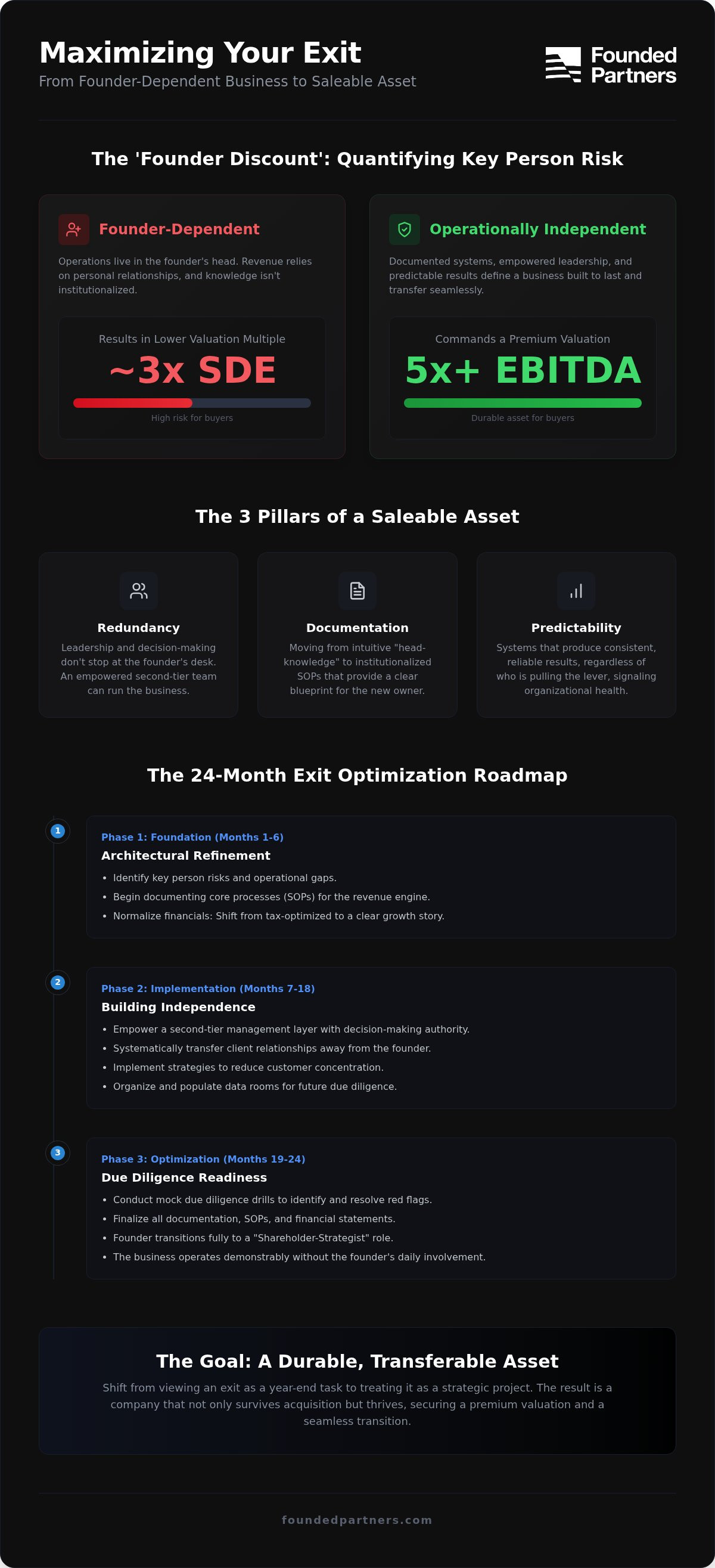
Buyers quantify risk through the valuation multiple. A business that relies on a founder's personal relationships or "head-knowledge" attracts a "Founder Discount." This isn't just a slight reduction; it can slash a multiple from 5x EBITDA to 3x SDE. When determining how to value a founder-led business for sale, messy operations lead to aggressive purchase price adjustments. Buyers use earn-out structures to hedge their bets because they want a machine, not a personality.
The Architecture of a Saleable Asset
Transforming a "job you own" into a "business that works" requires rigorous operations optimization. Strategic buyers prioritize durability over sheer growth. They seek assets that function independently. This architectural shift focuses on three pillars:
- Redundancy: Leadership and decision-making don't stop at your desk.
- Documentation: Moving from intuitive "head-knowledge" to institutionalized SOPs.
- Predictability: Systems that produce consistent results regardless of who pulls the lever.
Organizational health is the ultimate signal to Tier-1 investors. It proves the company can sustain momentum during a consequential transition. By refining the core today, you strengthen the legacy you leave tomorrow.
Decoupling the Founder: Architecting Operational Independence
Architecture is the antidote to the founder's paradox. A buyer isn't just purchasing your past performance; they're purchasing your future reliability. If the company's success is tied to your personal charisma or unique intuition, that reliability is fragile. When sophisticated investors analyze how to value a founder-led business for sale, the most heavily weighted factor is often "key person risk." To maximize your exit, you must transform the business into a self-healing organism that thrives in your absence.
Empowering a Second-Tier Leadership Team
Buyers look for a management layer that can execute the strategy without calling the founder for permission. This transition involves more than just hiring; it requires a systematic transfer of authority and client relationships. You must identify key roles-typically in operations, sales, and finance-that bridge the gap between your vision and daily execution. This is a consequential transition that often benefits from professional Leadership Advisory to help founders navigate the psychological and structural challenges of letting go. The goal is to move from being the "Chief Everything Officer" to a "Shareholder-Strategist" who provides guidance rather than dictates actions.
Documenting the 'Secret Sauce'
Institutionalizing knowledge is the process of moving "head-knowledge" into documented, repeatable systems. If your sales process or delivery model exists only in your mind, it has zero transferrable value. Documented SOPs reduce due diligence friction because they provide a blueprint for the buyer to follow. Focus on mapping three core areas:
- The Revenue Engine: How customers are found, nurtured, and closed without founder intervention.
- The Delivery Machine: The step-by-step process for fulfilling the brand promise with consistent quality.
- The Support Framework: How the organization handles exceptions, hires talent, and maintains financial health.
The ultimate litmus test for operational independence is the "Vacation Test." Can you step away for 30 days without checking email? If the business grows while you're offline, you've built a saleable asset. If it stagnates, you've merely built a high-paying job. Refining the culture during this phase is vital. The company's identity must shift from being "the founder's firm" to a mission-driven entity with its own gravity. When you master how to value a founder-led business for sale, you realize that the highest multiples go to the founders who have made themselves redundant.
Strategic Pillars of Acquisition Readiness
Operational independence is the foundation, but financial clarity is the language of the transaction. Investors don't buy what you've done; they buy the future cash flows your systems will produce. When determining how to value a founder-led business for sale, the transition from tax-optimized books to exit-optimized financials is a critical hurdle. This process, known as normalization, reveals the true economic engine of your company by stripping away the personal nuances of founder ownership.
Financial Normalization and Quality of Earnings
Most founder-led firms are managed to minimize tax liability, which often involves "founder perks" such as personal travel, family members on the payroll, or non-operating expenses. In an M&A context, these must be "added-back" to show the true EBITDA. Exit-accounting requires a different rigor than standard tax-accounting, and engaging a firm like Timothy Roberts & Associates, LLC can help ensure your tax preparation and wealth management are optimized for the sale. In the 2026 market, a Quality of Earnings (QofE) report has become a prerequisite for any mid-market exit. This third-party analysis validates the sustainability of your earnings and prevents aggressive purchase price adjustments during due diligence. It transforms your financials from a historical record into a credible forecast that buyers can trust.
De-risking the Revenue Stream
Value is inversely proportional to risk. One of the most significant red flags for a buyer is customer concentration. If a single client accounts for more than 15% of your revenue, your valuation multiple will likely face a "concentration discount." De-risking the revenue stream involves diversifying your client base and ensuring contract durability. Buyers also place a premium on predictability. Current 2026 data indicates that businesses with 60% recurring revenue can trade for 1 to 2 turns of EBITDA higher than similar firms with only 15% recurring revenue. Shifting your model toward maintenance contracts or subscription services directly impacts the final sale price.
Beyond the current numbers, a buyer needs a Scalability Strategy. You must demonstrate a clear path to 2x or 3x growth that the next owner can execute without your personal involvement. This is where our expertise in Capital Raising Support becomes a powerful tool for validation. By preparing the business as if it were seeking outside investment, you stress-test your growth thesis and prove its market value to potential acquirers. This dual-track focus on operations optimization and financial integrity ensures that you aren't just selling a company; you're offering a high-performance investment. This architectural approach moves the conversation from a subjective negotiation to an objective assessment of enterprise value.
The 24-Month Roadmap: Preparing for the Due Diligence Spotlight
Time is the founder's most valuable currency. A premium exit is the result of disciplined architecture, not fortunate market timing. When you begin the journey of understanding how to value a founder-led business for sale, you quickly realize that the most lucrative deals are won or lost years before the letter of intent is signed. A structured 24 month roadmap allows you to address operational friction while you still have the leverage to fix it. This proactive approach transforms due diligence from an interrogation into a verification of excellence.
The First 12 Months: Building the Foundation
The initial phase, from month 24 to 18, centers on a rigorous strategic assessment and gap analysis. You must identify where the business relies on your personal intervention and where systems are failing to scale. This is the time for an internal "Red Flag" audit, examining everything from customer concentration to contract durability with the cold eyes of an acquirer. Between month 18 and 12, the focus shifts to operations optimization and management team build-out. The Transformation Phase serves as the essential bridge between a stagnant current state and the higher valuation multiple of a market-ready asset. By implementing scalability strategies now, you prove to buyers that the company's best days are ahead of it, not behind it.
The Final Countdown: Deal Execution
As you move into the final year, the work becomes increasingly technical. From month 12 to 6, you should prioritize financial audits and tax structuring. This is also the period for "Investor Readiness" consulting, where you stress-test your growth thesis and ensure your data supports your valuation. In the final six months, you assemble your deal team, including M&A attorneys, specialized accountants, and strategic advisors. It is also the ideal time to engage Zenith Wealth to ensure your personal financial planning is optimized for the impending liquidity event. Setting up a virtual data room early prevents the frantic scramble that often kills deal momentum. You must also prepare a management presentation that tells a compelling transformation story, highlighting the durability of the asset you've built.
The emotional toll of this process is often underestimated. Transitioning from owner-operator to seller requires a significant psychological shift. Our Exit Planning services provide the steady hand needed to navigate these complexities with confidence. By following a structured roadmap, you ensure that due diligence is a confirmation of value rather than a discovery of defects. You move toward the closing table not with hope, but with the certainty of a well-executed plan.
The Strategic Architect: How Founded Partners Refines Your Exit
An exit is more than a transaction; it's the culmination of a life’s work. At Founded Partners, we don't believe in surface-level fixes. Many firms focus on the pitch deck, but we focus on the operational core. This distinction is fundamental to how to value a founder-led business for sale because buyers see through a polished presentation if the underlying engine is failing. We act as your Strategic Architect, refining the very foundation of your enterprise to ensure durability, sustainability, and maximum value. Our goal is to move beyond vanity metrics to build a machine that works without its architect.
Our boutique approach is led by partners Adam and Matt, providing a "Trusted Peer" relationship that larger consultancies cannot replicate. We understand the nuances of founder-led firms because we've navigated these complex challenges before. We prioritize character alongside competence, building deep trust through transparency and shared values. Our process moves methodically from Business Transformation Consulting to successful transaction advisory, ensuring every strategic concept leads to a specific operational outcome. We don't just offer advice; we provide a steady hand to guide you through the psychological and operational hurdles of an exit.
Beyond Transactional Consulting
While others focus solely on the close, we focus on long-term organizational health and resilience. We don't just want you to sell; we want you to sell to the right buyer with the right capital structure. When we analyze how to value a founder-led business for sale, we look for the hidden value in your culture, your systems, and your people. This involves steady Leadership Advisory and a commitment to your legacy. We assist in identifying partners who value the architectural integrity of what you've built, ensuring the business continues to thrive long after the keys have changed hands. Our commitment to founder-led success means we stay in your corner through the entire consequential transition, guiding you with intellectually rigorous and emotionally intelligent strategy.
Taking the Next Step
Understanding your current position is the first step toward a successful exit. A confidential discovery call allows us to assess your current "Exit Readiness" and identify the operational red flags that might hinder your valuation. We help you look at your business through the eyes of an acquirer, providing a clear-eyed assessment of your strengths and weaknesses. It's time to stop reacting to growth and start architecting your departure. Refine your foundation for exit with Founded Partners and ensure your legacy is as strong as the business you built.
Architecting Your Legacy for the Next Stage
The journey from owner-operator to successful seller requires a fundamental shift in how you view your enterprise. It isn't just about the exit; it's about the architectural integrity of the business you leave behind. By decoupling your personal identity from daily operations and institutionalizing your unique knowledge, you transform a personal achievement into a durable asset. This strategic preparation directly influences how to value a founder-led business for sale, moving the conversation from a personality-driven pitch to an objective assessment of enterprise value.
As a boutique advisory specialized in founder-led business transformation, we act as the strategic architects of your transition. We understand that an exit is a consequential life event, one that requires a steady hand and a partner who values character as much as competence. Whether you're 24 months out or entering the final countdown, the work you do today defines the legacy you secure tomorrow. You've built something remarkable. Now, let's ensure it's ready to stand on its own.
Refine your business for a successful exit with Founded Partners
Frequently Asked Questions
How long does it take to prepare a company for acquisition?
Preparation typically requires a 24 to 36 month strategic runway. This timeline isn't arbitrary; it's the necessary window to implement operations optimization and build a leadership layer. Starting early allows you to address operational gaps while you still have the leverage to influence the outcome. If you rush the process, you leave enterprise value on the table. A methodical approach ensures the business is exit-optimized rather than just tax-optimized.
What is the most important factor in valuing a founder-led business?
Transferability is the most critical factor. Buyers seek a machine that produces cash flow, not a personality-driven firm. When analyzing how to value a founder-led business for sale, investors look at the owner-dependency score. If the engine stops when you step away, the valuation multiple will suffer a significant discount. High value is found in the systems, documented processes, and a management team that executes without your daily oversight.
Can I sell my business if I am still the main salesperson?
You can, but it often impacts how to value a founder-led business for sale by triggering a heavy earn-out. Buyers view founder-led sales as a high-risk revenue stream that might evaporate after the transition. To maximize your multiple, you should transition accounts to a second-tier sales team at least 12 to 18 months before a sale. This proves the revenue is institutionalized and not merely a byproduct of your personal relationships.
What are the common 'red flags' that kill an acquisition deal?
High customer concentration and undocumented workflows are the primary deal killers. If a single client accounts for more than 15% of your revenue, buyers see a fragile foundation. Other red flags include messy financials, pending litigation, or a lack of clear employment contracts. These issues suggest operational instability. Due diligence is designed to uncover these risks, and finding them late in the process often leads to aggressive price re-negotiations.
How do I normalize my financials for an EBITDA-based valuation?
Normalization involves adding back discretionary or non-recurring expenses to show the company's true earning power. This includes founder perks, family members on the payroll, and one-time legal fees. In 2026, a Quality of Earnings (QofE) report is the gold standard for this process. It provides an objective third-party validation that turns tax-compliant books into investor-ready financials. This transparency builds buyer confidence and supports a higher multiple through verified data.
What is the role of an exit planning consultant vs. a business broker?
An exit planning consultant acts as a Strategic Architect to refine the business's core before the sale. A business broker acts as the transaction agent to find buyers. While a broker manages the marketplace, a consultant focuses on operations optimization and leadership advisory. Working with a consultant years in advance ensures that when the broker takes the business to market, it's a high-performance asset worth a premium price.
Should I tell my employees I am preparing the company for sale?
Confidentiality is vital to prevent talent loss and customer anxiety. Generally, you shouldn't disclose a sale until the Letter of Intent is signed and due diligence is well underway. Frame your preparation work as a scalability strategy or business transformation. This keeps the team engaged in building a better company without the distraction of an impending exit. It protects the very value you're trying to sell during this consequential transition.
How do I protect my company culture during an acquisition?
Culture is protected by institutionalizing it into your systems and finding a buyer with shared values. If your culture depends solely on your presence, it won't survive the acquisition. You must document the core values and empower your leadership team to uphold them. During the sale process, prioritize cultural fit as a key criterion for selecting a buyer. This ensures your legacy remains intact long after you've moved on to your next stage.