
Building a Sustainable Leadership Team: A Founder’s Guide

A leadership team that depends on the founder for every consequential decision isn’t built for durable growth. Building a sustainable leadership team means creating the clarity and capacity for decisions to happen well across the organization, not just at the top.
If you’re the person everyone turns to when priorities conflict, responsibilities overlap, or growth brings new pressure, you know the cost: progress slows and confidence can weaken. The answer isn’t simply to add people or delegate more tasks. It’s to make ownership, decision rights, and communication clear enough for leaders to act together.
This guide explains how to build leadership capacity for your company’s next stage. You’ll learn how to define responsibilities, strengthen trust and accountability, and help the team adapt as the business changes. The goal is a business that can make sound decisions and maintain continuity without relying on heroic effort from one person.
Key Takeaways
- Building a sustainable leadership team starts with the company’s next stage, not with adding titles or headcount.
- Connect strategic priorities to clear roles, decision rights, and accountability so leaders know where they can act.
- Share ownership without losing trust or alignment by setting thoughtful boundaries around the founder’s decisions.
- Assess leadership capacity through role clarity, decision quality, collaboration, and continuity risks.
- Make leadership development part of the growth plan, adapting responsibilities as the business changes.
Building a Sustainable Leadership Team Starts With the Company’s Next Stage
A leadership team is sustainable when it can guide the business through changing demands without relying on one person to interpret every priority, resolve every conflict, or keep every commitment moving. The right design depends on what the company is becoming. A team suited to a focused, founder-led operation may need different responsibilities as the organization adds customers, expands offerings, or enters new markets.
Adding senior titles or headcount doesn’t automatically create leadership capacity. If authority remains unclear, new leaders may wait for the founder’s direction or duplicate one another’s work. Durable capacity comes from matching responsibilities and decision-making authority to the work the company needs done, then making clear how those choices support its priorities.
What makes a leadership team sustainable?
Sustainability rests on clear responsibilities, sound judgment, and shared organizational context. Leaders need to understand not only their own remit, but also how their decisions affect other functions and the company’s direction. Leadership Development describes how people build the capabilities needed to lead. In practice, that growth is most useful when connected to the business’s real responsibilities and challenges.
A sustainable leadership team combines clear roles, shared accountability, and the capacity to maintain leadership through change. It isn’t a fixed organizational chart or a stretch of strong results driven by individual heroics. It’s a set of practices that helps the company make sound decisions as priorities, roles, and operating demands evolve.
When does founder-led leadership need to evolve?
Look for repeated patterns, not a single difficult week. Decisions that routinely wait for the founder, work that stalls between functions, and team members unsure who owns an outcome can signal that the current approach no longer fits the company’s coordination needs. These are signs to examine the system, not evidence that the founder has failed.
As a company grows, decisions may involve more teams, dependencies, and trade-offs. A new customer commitment, for example, could affect delivery capacity, staffing, and cash planning. If each function acts separately, the founder may become the default link between them. Building a sustainable leadership team means giving the people closest to the work a clear way to coordinate and make decisions within agreed boundaries.
- Notice which decisions repeatedly return to the founder.
- Identify outcomes with overlapping or unclear ownership.
- Track where teams wait for information or alignment before acting.
There’s no universal executive structure every growing firm should adopt. Ask whether the current leadership arrangement can handle the company’s next stage with clarity and continuity. A considered design can strengthen the business foundation for growth while preserving the founder’s role in setting direction and protecting what matters about the company’s culture.
Design Leadership Roles Around Decisions, Accountability, and Business Priorities
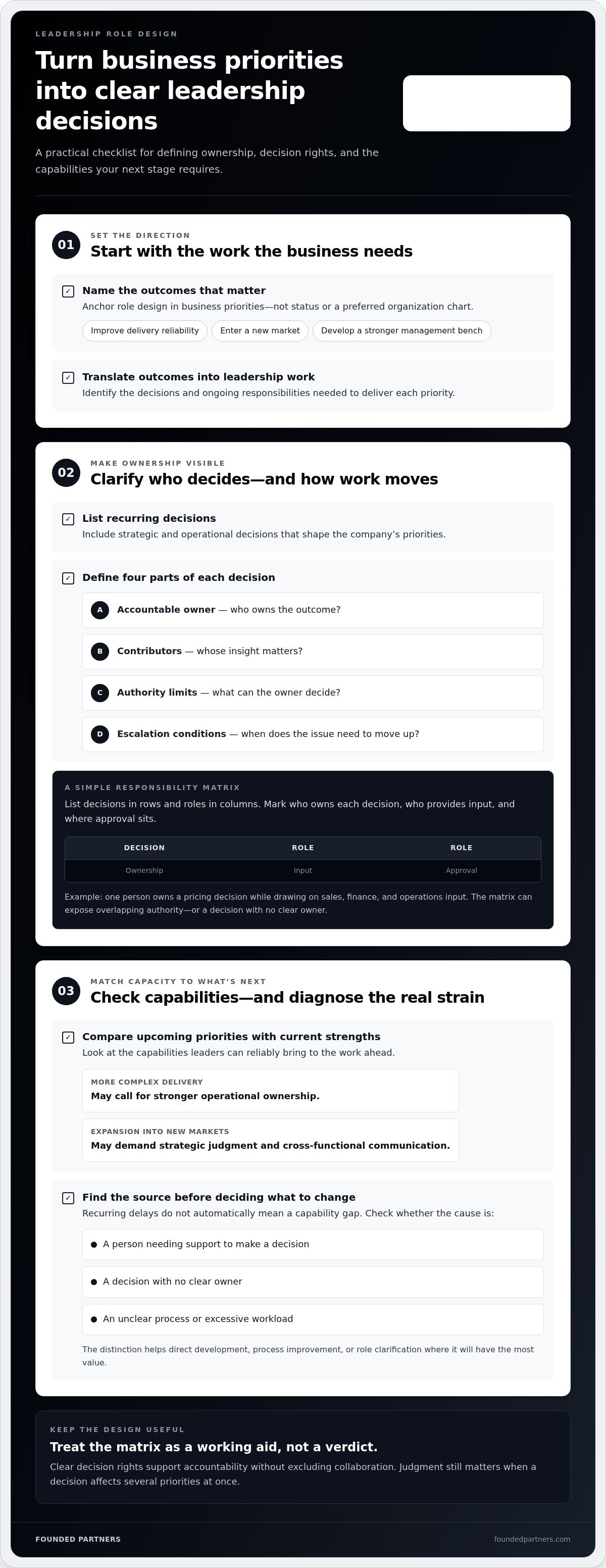
Once you understand what the next stage requires, translate those priorities into leadership work. Start with outcomes, such as improving delivery reliability, entering a new market, or developing a stronger management bench. Then identify the decisions and ongoing responsibilities needed to achieve them. This keeps role design anchored in business needs rather than status or a preferred organization chart.
Titles describe position; decision rights determine how work moves. A role becomes meaningful when its owner knows what they can decide, whose input matters, and when an issue must be escalated. That clarity supports accountability without excluding collaboration.
How should founders clarify leadership roles?
Before changing reporting lines, list recurring strategic and operational decisions. For each one, name an accountable owner, the people who contribute insight, the limits of the owner’s authority, and the conditions that require escalation. A simple responsibility matrix can make the pattern visible: list decisions in rows and roles in columns, then mark ownership, input, and approval.
For example, one person might own a pricing decision while drawing on sales, finance, and operations input. If several roles believe they have final authority, or no one does, the matrix exposes the gap. Treat it as a working aid, not a verdict. Judgment still matters, especially when a decision affects several priorities at once.
Which capabilities should the team build next?
Compare the company’s upcoming priorities with the capabilities leaders can reliably bring to them. More complex delivery may call for stronger operational ownership; expansion into new markets may demand strategic judgment and cross-functional communication. Talent development matters too, because leaders need to prepare people to carry more responsibility as the business evolves.
Don’t mistake every strain for a capability gap. Recurring delays may reflect an unclear process or excessive workload rather than a lack of leadership ability. Look for the source: does a person need support to make a decision, or does the decision lack a clear owner? That distinction helps direct development, process improvement, or role clarification where it will have the most value.
A practical review can follow this sequence:
- Connect each major business priority to the leadership work required.
- List the decisions that shape those outcomes and assign an accountable owner.
- Use a responsibility matrix to clarify contributors, authority, and escalation paths.
- Compare required capabilities with current strengths, then identify whether gaps call for development, clearer processes, or adjusted ownership.
Harvard Business Review’s The Founder's Dilemma: Control vs. Wealth explores how founder choices around control can shape a company’s leadership path. The practical implication isn’t that every founder should relinquish authority. It’s that decision boundaries should reflect the company’s needs and the founder’s intended role.
For founder-led organizations, leadership advisory for founder-led organizations can help connect role design with business priorities and organizational change.
Address the Founder Bottleneck Without Losing Trust or Company Culture
Sharing leadership doesn’t mean a founder must surrender all control. It means deciding where the founder’s judgment is essential and where another leader can act within agreed boundaries. Keeping every choice centralized may preserve consistency, but it can slow responses and make the founder the default point of coordination. Delegating everything without context or limits can create conflicting decisions and weaken trust.
The balance is clear ownership with shared direction. A founder might retain decisions that set the company’s overall direction while a functional leader decides how to deliver an agreed priority. The team can move independently on execution while staying aligned on the destination.
How can founders delegate without creating confusion?
Define decision boundaries in practical terms. Specify which choices remain founder-led, which belong to team leaders, and which require consultation before action. Set expectations for when to escalate, such as when a decision changes a strategic commitment or affects multiple functions. Agree on how the owner will communicate the decision and its rationale so affected teams can act on it.
These boundaries aren’t permanent. Review them as the company’s priorities, operating complexity, and risks change. A decision that once required the founder’s close involvement may later fit within a leader’s authority, provided the purpose and limits are understood.
Centralizing a recurring decision can maintain consistency and provide close oversight, especially when the choice carries broad consequences. The trade-off is that decisions may wait for one person, while other leaders get less practice exercising judgment. Delegation can improve responsiveness and strengthen ownership, but it requires clear guardrails and follow-through. Choose based on the decision’s impact and reversibility, not on a blanket preference for control or autonomy.
- Keep closer oversight for choices that materially alter strategy or commitments.
- Delegate within defined limits for repeatable decisions connected to an agreed priority.
- Consult across functions when an action affects shared resources, customers, or delivery.
Operational decision rights are distinct from governance. For founders working with a board, founder board management strategies address how governance can contribute to oversight and strategic direction. A board’s role shouldn’t be confused with the day-to-day authority assigned to company leaders.
How can a team preserve culture through growth?
Culture becomes durable when values guide observable choices. If the company values candor, leaders can raise risks early and discuss setbacks without blame. If it values accountability, they can make commitments explicit, follow through, and address missed expectations consistently. These behaviors belong to the whole leadership team, not just the founder or one executive.
As responsibilities spread, building a sustainable leadership team means reinforcing shared norms through everyday decisions. Leaders should explain how consequential choices reflect the company’s principles, invite respectful challenge, and apply expectations consistently across functions. That helps people understand what the culture means in practice, even as the organization and its leadership responsibilities evolve.
Build Leadership Capacity With a Practical, Repeatable Assessment
A leadership assessment is useful when it leads to better decisions, not a thicker report. Treat it as a regular review of whether the team can deliver the company’s priorities, coordinate effectively, and maintain continuity as responsibilities shift. Building a sustainable leadership team calls for a repeatable process that adapts alongside the business, rather than a one-time evaluation tied to a fixed structure.
Define priorities, map decisions, assess capacity, close the most important gaps, and review progress as the business changes. This sequence connects leadership development to real operating needs and keeps attention on the conditions that affect execution.
What should a leadership-team assessment examine?
Start by checking whether every major priority has an accountable leader with suitable decision authority. Then examine how work moves between leaders: repeated handoffs, unresolved conflicts, or decisions that keep returning to the founder can signal friction in the operating model. Include continuity in the review. Consider where critical responsibilities depend heavily on one person and how prepared the team is to sustain them through a transition.
Assess four connected areas:
- Role clarity: Do leaders understand what they own and where their authority begins and ends?
- Decision quality: Are choices timely, informed, and aligned with business priorities?
- Collaboration: Can functions resolve dependencies and disagreements constructively?
- Continuity: Are key responsibilities and organizational knowledge concentrated in a way that creates exposure?
Use these as prompts for discussion, not universal performance benchmarks. Look for recurring patterns and their effect on the work rather than judging leaders by isolated moments.
How can leaders turn findings into an improvement plan?
Choose a small number of material gaps and assign each one an owner. Describe the expected change in observable terms, such as decisions being made at the right level, fewer stalled handoffs, or clearer coverage for a critical responsibility. Set review points around relevant business events, milestones, or planning discussions instead of following a universal timetable. This makes progress visible without imposing a schedule that may not fit the company.
Keep the review active. As strategy changes, revisit whether leadership responsibilities, authority, and team capacity still fit the work ahead. If a finding points to a broader need to align growth priorities with operating capabilities, growth consulting for founder-led companies can provide a wider frame for that alignment.
A focused assessment doesn’t need to resolve every organizational question at once. It should help leaders identify what is working, where continuity is vulnerable, and which adjustment deserves attention first. Discuss leadership and growth alignment with Founded Partners to connect leadership capacity with the company’s next stage.
Make Sustainable Leadership Part of the Company’s Growth Plan
Leadership design shouldn’t sit apart from the company’s growth strategy. It belongs within a broader business transformation effort when the way the organization is led no longer supports its direction, whether the business is entering a consequential growth phase, changing operating priorities, or preparing for a significant leadership transition. In those moments, structure, decision-making, and execution are connected. A change to one can affect the others.
Building a sustainable leadership team is part of strengthening the business foundation. The aim isn’t to create a perfect organization chart. It’s to align leadership capacity with the company’s next stage, so priorities have clear owners and the business can maintain continuity as responsibilities evolve.
When is outside leadership advisory useful?
An external strategic perspective can be useful when leaders face a consequential decision, navigate role changes, or work through organizational transition. An advisor can help examine assumptions, clarify priorities, and connect leadership responsibilities to the broader transformation underway. That perspective supports the founder and leadership team; it doesn’t replace their judgment or accountability.
Founded Partners’ leadership advisory and business transformation work supports founder-led organizations as they align leadership capacity with growth and change. This work is most relevant when leadership questions are tied to wider operating needs, rather than treated as isolated personnel issues.
Bringing leadership design into growth planning can surface questions that might otherwise be addressed too late: whether the current team can carry the next phase, whether responsibilities fit the operating model, and where a transition could disrupt continuity. Addressing these questions together helps leaders align on what the business needs and how leadership must support it.
How can founders begin strengthening leadership capacity?
Start with a focused review of which decisions and responsibilities still depend heavily on you. Choose one meaningful issue, such as unclear ownership of a strategic priority or a recurring approval that could sit closer to the work. Discuss the intended outcome with the relevant leaders, agree on who owns the next step, and observe whether the change improves clarity and continuity.
Keep the first step proportionate. Leadership capacity develops through deliberate adjustments, reflection, and learning from how the organization responds. As business priorities shift, revisit whether the arrangements still serve the company. That keeps leadership development connected to the real work of growth rather than turning it into a separate initiative.
Founded Partners brings leadership advisory together with transformation and operational improvement perspectives to help founder-led organizations clarify priorities and navigate consequential change. If you’re considering how leadership should support your company’s next stage, explore Founded Partners’ advisory approach.
Build Leadership Capacity for What Comes Next
The next stage of your company will bring decisions and demands you can’t fully predict. A resilient leadership system gives people room to respond with sound judgment while keeping their work connected to a shared direction. Building a sustainable leadership team isn’t a one-time restructuring; it’s an ongoing commitment to prepare the organization for change.
Begin by asking where your leadership structure needs to grow alongside the business. That question can open a practical conversation about the priorities, responsibilities, and transitions that matter most. Founded Partners brings leadership advisory together with business transformation and operations optimization consulting to help founder-led organizations consider those needs in context, while keeping the judgment and commitment of the team at the center.
Discuss your leadership priorities with Founded Partners and explore how your team can support the company’s next chapter. Thoughtful steps taken now can help build a stronger foundation for lasting growth.
Frequently Asked Questions
What is a sustainable leadership team?
Building a sustainable leadership team means creating a group that can guide the organization as its priorities, people, and operating conditions shift. Its durability rests on clear roles, shared responsibility for outcomes, and the ability to adapt without losing coordination. If a key leader changes roles, for example, colleagues should understand how decisions and responsibilities will be covered. The team can adjust its approach while preserving direction rather than relying on one person to restore momentum.
How do you build a leadership team in a growing company?
Translate the company’s priorities into outcomes that leaders must deliver. List the recurring decisions and dependencies behind those outcomes, then assign owners and identify where collaboration is essential. Compare the work with leaders’ available skills and capacity; address gaps through development, process changes, or role adjustments. Finally, review progress after a meaningful shift in strategy or operating demands. This keeps leadership design connected to actual work.
Can a founder build a sustainable leadership team without hiring more executives?
Yes. A founder can often strengthen leadership capacity by clarifying existing responsibilities and authority before adding executives. A capable functional leader may already be coordinating a recurring decision informally; explicitly assigning ownership can reduce duplicated effort and help build judgment. But role clarity can’t create unlimited capacity. If essential work consistently exceeds the team’s skills or available time, assess whether capabilities or staffing need to change.
How do you know when a leadership team needs to change?
A leadership team may need to change when routine work repeatedly stalls, decisions are revisited without new information, or two leaders assume the other owns a deliverable. Look for patterns across projects rather than reacting to one disagreement. If product, sales, and delivery repeatedly make incompatible commitments, for example, the issue may involve decision authority or coordination. Diagnose the source before changing titles, reporting lines, or personnel.
What happens if a company relies too heavily on its founder?
Heavy founder dependence can leave important context, relationships, or approval authority concentrated in one person. If the founder is unavailable, work may pause while colleagues reconstruct past decisions or wait for direction. This is a continuity exposure, not a prediction that the company will fail. Teams can reduce it by recording the rationale behind consequential choices, sharing key relationships, and preparing another leader to maintain essential work when responsibilities shift.
How can a leadership team maintain company culture while scaling?
A scaling team can preserve culture by making its values tangible in routines people experience: how leaders run meetings, resolve disagreements, recognize contributions, and respond when commitments are missed. New managers should hear not only what the company values, but what those values look like in decisions. Consistency matters; if standards differ across departments, employees may receive conflicting signals about what the organization truly expects.
How often should a leadership team review its roles and responsibilities?
Review roles when the business reaches a meaningful turning point, such as entering a new market, changing its operating model, adding a major product line, or preparing for a leadership transition. These events can shift who needs to decide, contribute, or coordinate. Between them, revisit responsibilities when repeated delays or overlap emerge. Use the review to confirm owners, surface new dependencies, and agree on adjustments rather than following an arbitrary calendar.