
How to Overcome the Founder Bottleneck Without Losing Control

Delegation alone won’t solve a founder bottleneck. If routine decisions, approvals, and client questions keep returning to you, it’s understandable to worry that stepping back could weaken standards or slow momentum. But learning how to overcome the founder bottleneck isn’t about giving up control. It’s about designing an organization that can act with clarity when you’re not in every conversation.
This pattern often grows from the habits that helped a business get started: the founder holds critical knowledge, makes quick calls, and keeps work moving. As the company grows, those same habits can leave teams waiting for decisions and add complexity faster than the business builds capacity.
In this article, you’ll learn to spot the decisions and workflows that depend unnecessarily on you, clarify ownership and decision boundaries, and establish operating rhythms that keep work moving. We’ll look at how to transfer responsibility deliberately while preserving accountability and quality, so the business can execute more consistently as it scales.
Key Takeaways
- Spot the recurring approvals, escalations, and stalled handoffs that reveal where work still depends on you.
- Trace why decisions return to the founder, including gaps in ownership, context, or authority.
- Learn how to overcome the founder bottleneck by transferring one bounded, recurring decision at a time.
- Set clear decision boundaries so your team can act with confidence while standards and accountability remain visible.
- Strengthen lasting independence by aligning role clarity, leadership capability, and consistent operating rhythms.
What the Founder Bottleneck Looks Like in a Growing Business
A proposal sits ready, but the team won’t send it until you review a familiar clause. A manager escalates a routine customer decision. Two departments wait for you to settle a handoff that should have a clear owner. Each pause may seem minor; repeated across the business, they create a pattern: work depends on your personal input to move forward.
The founder bottleneck is recurring dependence on the founder’s knowledge, approval, or decisions that slows execution or concentrates authority. It isn’t simply a full calendar or a demanding week. It’s a structural pattern: capable people can’t complete ordinary work because the next step, permission, or context lives with you. A useful distinction is that founder involvement can be valuable without being required at every turn.
The phrase has a loose conceptual parallel in the founder effect, a genetics concept in which a small founding population can shape the diversity of what follows. The business meaning isn’t the same, but the analogy is useful: early conditions can influence what an organization is able to become.
How to recognize founder dependency in everyday work
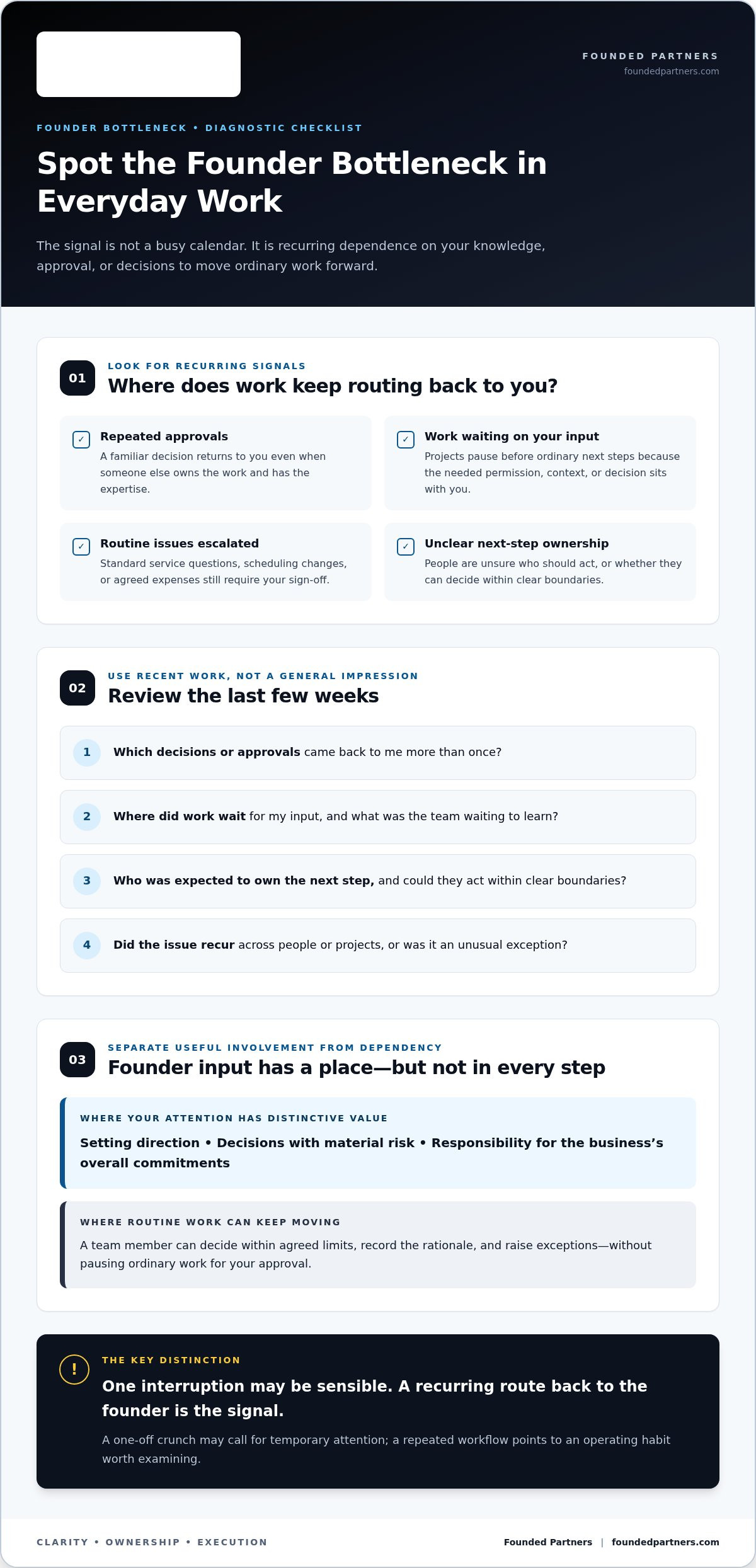
Look for decisions that keep returning to you even when an employee owns the work and has the necessary expertise. Notice projects that pause before ordinary next steps, such as scheduling a delivery, resolving a standard service issue, or moving a routine expense through an agreed process. One interruption may be sensible. The recurring route is the signal.
Use recent work, not a general impression, to check for a pattern. Consider the last few weeks and ask:
- Which decisions or approvals came back to me more than once?
- Where did work wait for my input, and what was the team waiting to learn?
- Who was expected to own the next step, and could they act within clear boundaries?
- Did the issue recur across people or projects, or was it an unusual exception?
Answers help distinguish a one-off crunch from a workflow that repeatedly routes decisions upward. That distinction matters: the first may call for temporary attention; the second points to an operating habit worth examining.
When founder involvement helps, and when it slows execution
Your attention belongs where it has distinctive value: setting direction, making decisions with material risk, and taking responsibility for the business’s overall commitments. But staying informed doesn’t require personally approving every action. A team member can make a decision within agreed limits, record the rationale, and raise exceptions without pausing routine work.
A founder bottleneck exists when the business repeatedly needs the founder’s personal input to complete work that should be owned and advanced elsewhere. This is the practical starting point for how to overcome the founder bottleneck: identify where dependence is built into everyday execution before deciding what to change.
Why Founder Bottlenecks Form: Decisions, Context, and Operating Habits
Founder dependence often begins as a practical response to uncertainty. In an early-stage business, the founder may hold the customer history, product knowledge, and authority needed to make quick calls. The team is small, responsibilities overlap, and informal conversations can be faster than formal processes. Those habits help establish momentum, but they can remain in place even as the organization adds roles, teams, and layers of coordination.
Growth doesn’t guarantee a bottleneck. It does create more interfaces: one team’s decision may affect another team’s timing, resources, or commitments. Without clear ownership and decision boundaries, people naturally seek the person they believe can resolve the trade-off. If that person has always been the founder, more activity can mean more requests funnel upward, even when others have the skills to decide.
How decision rights become concentrated at the top
Informal approval habits often outlast the original reason for them. A founder who once reviewed every supplier choice may keep being copied after a manager takes responsibility for purchasing. The team may not know whether the founder is being consulted for perspective, asked to approve the choice, or simply kept informed. These are different roles, and treating them as interchangeable leaves authority ambiguous.
For example, an operations lead might escalate a routine scheduling adjustment because no one has defined which changes they can make independently. The founder’s quick approval resolves that instance, but it can reinforce the expectation that similar decisions need the same sign-off. Clear decision rights specify who decides, who provides input, and which exceptions require escalation.
Why delegation fails without context and accountability
Assigning a task transfers activity; genuine ownership transfers responsibility for an outcome within understood boundaries. “Prepare the client update” gives someone work to complete. Ownership also clarifies the purpose, the commitments that must be protected, what choices they can make, and when to bring a risk forward. Without that context, a handoff can leave the founder answering a stream of follow-up questions or reworking the result.
Useful context doesn’t need to become a lengthy manual. It can include the reason behind a decision, relevant constraints, quality expectations, and examples of acceptable judgment. Accountability then makes the arrangement durable: the owner tracks progress, communicates exceptions, and learns from the result. A task can be handed off in a moment; ownership requires context, authority, and responsibility for what happens next.
These causes tend to reinforce one another. Unclear decision rights prompt questions; undocumented context makes independent judgment feel risky; repeated founder intervention confirms that the founder remains the safest route. Seeing that cycle makes how to overcome the founder bottleneck an operating-design question, not a test of whether you can simply let go. A deliberate review of responsibilities and leadership practices can help reveal where the design needs to change. Business transformation and leadership advisory can support that work when these patterns reach across the organization.
How to Diagnose the Founder Bottleneck Before Choosing a Fix
Before changing roles or handing off decisions, find out where the work actually gets stuck. A useful diagnosis starts with recurring workflows, not a general feeling that you’re too involved. Choose a representative recent period, such as the last few weeks, and collect real examples of decisions, delays, and escalations. The aim isn’t to assess individual performance. It’s to see whether the way work is designed repeatedly directs it back to you.
Map decision and workflow patterns
For each example, note the workflow, the decision needed, who owns the next step, where the work waited, and why it was escalated. Include the reason given, such as missing information, unclear authority, or concern about a customer commitment. Group examples by workflow or decision type, not by employee. That keeps the diagnosis focused on recurring conditions rather than assigning blame.
- Decision: What needed to be decided or completed?
- Owner: Who was responsible for the next step?
- Wait point: Where did progress pause, and for how long?
- Escalation reason: Was the issue unclear authority, incomplete context, competing priorities, or a genuine exception?
Then separate the visible symptom from its likely cause. A delayed approval is a symptom; the root cause might be an absent spending boundary, an unclear handoff, or information held only by the founder. If the same type of work returns for different reasons, record those reasons separately. A single fix may not address them all.
Rank constraints by business significance
Not every escalation deserves the same response. Prioritize repeated constraints that affect customer delivery, interrupt team execution, or pull attention away from strategic work. Consider both frequency and consequence: a recurring low-risk choice may be suitable for clearer delegation, while an infrequent decision with serious implications may still need founder involvement.
Track practical signals, such as how long work waits for input, how often it needs rework, and whether a handoff leaves the next owner uncertain. These measures create a baseline for judging whether a change is helping, without mistaking activity for progress. For a broader view of selecting meaningful measures, explore measuring business transformation success.
The costs can compound quietly. Waiting extends cycle time; unclear direction creates rework; repeated questions consume leadership attention; and undocumented decisions make continuity fragile when the founder is unavailable. Record what each constraint interrupts, not just how often it occurs. That gives you a grounded basis for choosing what to address first.
A short map is enough to begin: list the recurring work, identify where it pauses, and note why it comes back. This evidence shifts the question from “Why can’t the team handle this?” to “What in the operating design makes independent progress difficult?” That distinction is essential to deciding how to overcome the founder bottleneck without changing the wrong thing.
How to Overcome the Founder Bottleneck: A Practical Sequence
Reducing founder dependence is an operating change, not a single act of delegation. Keep the work contained: choose one recurring decision, give it a clear owner, and establish how you’ll learn from the results. This measured approach helps the team build confidence while preserving oversight where it matters.
- Choose a bounded constraint. Start with a repeat decision that causes avoidable delays but has manageable consequences, such as adjusting a routine schedule within agreed customer commitments. Don’t begin by transferring an entire function or a decision with high financial, customer, or strategic risk.
- Name the accountable owner. Identify one person responsible for moving the decision to completion. Clarify who should offer input, who needs to be informed, and who has final authority. Shared involvement can be useful, but shared accountability often leaves the next step unclear.
- Transfer the context. Explain the outcome the decision supports, relevant constraints, past lessons, and the principles you use to judge a good result. Context helps the owner apply sound judgment to situations that won’t match a script exactly.
- Set decision boundaries. Define what the owner can decide independently and what should be escalated. Use practical thresholds: for example, routine changes that stay within an agreed schedule can proceed, while changes that affect a customer commitment need discussion. Specify urgent exceptions separately.
- Review and refine. Agree on a proportionate check-in and look at outcomes, delays, questions, and exceptions. Use what you learn to improve the boundary or guidance. Review should strengthen the operating model, not quietly turn every decision back into a founder approval.
Transfer ownership without abandoning oversight
Oversight works best when it is designed in advance. Set a check-in cadence suited to the decision’s risk, and make clear which issues require immediate escalation. In routine reviews, ask what the owner noticed, how they weighed trade-offs, and what would help next time. Coaching builds judgment; taking over at the first imperfect call teaches the team to wait for you again.
Build repeatable systems around recurring work
Document the principles people need at the point of decision: the desired outcome, handoff expectations, boundaries, and common exceptions. Keep guidance practical enough to use during the work, then use regular team operating rhythms to surface blockers before they become urgent founder requests. If the same constraints appear across functions, business scalability consulting explores how operating capacity supports sustainable growth.
Apply the sequence again only after the first change is understood. That discipline turns how to overcome the founder bottleneck into a repeatable practice: transfer one decision, observe how the system responds, and refine ownership as the organization develops. For support strengthening decision rights and operating capacity, explore Founded Partners’ business transformation support.
Make Founder Independence Durable Through Leadership and Operating Design
A handoff can remove one recurring approval. Durable independence comes from connecting that change to the way the organization is led and coordinated. People need to understand their roles, have the authority and context to carry them out, and work within operating rhythms that make priorities and issues visible. If one of those elements is missing, decisions may drift back to the founder even after a process has been documented.
Think of these elements as mutually reinforcing. Clear roles establish who owns an outcome. Capable leaders help teams exercise judgment and raise concerns appropriately. Regular planning and review create a place to resolve cross-team dependencies before they become urgent escalations. Together, they let the founder stay informed without becoming the default route for everyday progress.
Tell a process issue from a broader organizational constraint
A single recurring delay may call for a clearer handoff or decision rule. Similar escalations across functions suggest a wider constraint: responsibilities may overlap, leaders may lack authority or context, or their capacity may not match the work they’re expected to carry. Founder independence lasts when roles, decision rights, and leadership capacity are designed to work together.
Look for patterns: Are different teams waiting on the same founder judgment? Do managers own results but lack the authority to shape them? Does work stall at the boundaries between functions? Those signals point beyond an isolated process fix and toward a review of how the organization is structured, led, and supported.
Choose a measured next step for the company
Make the diagnosis concrete before deciding how broad a response should be. Summarize the recurring constraint, its operational effect, the owner closest to resolving it, and when you’ll review progress. If the issue is contained, refine that process and observe what changes. If it appears across teams or reveals gaps in leadership capacity, treat it as an organizational priority rather than adding another one-off handoff.
A measured plan can connect role clarity, leadership development, and operating design without trying to change everything at once. Business transformation and leadership advisory can provide a partner-led way to work through consequential organizational changes, clarify ownership, and strengthen the capacity required for the company’s next stage. The aim isn’t to remove the founder from important decisions; it’s to make sure the organization can carry appropriate decisions with consistency.
If you’re weighing a process adjustment against a broader change, discuss your organization’s next stage with Founded Partners. A clear view of the constraint, the people affected, and the decision that needs to move is a useful place to begin. That’s how to overcome the founder bottleneck as an enduring operating-design challenge, not simply a temporary delegation exercise.
Build the Next Stage Around Shared Leadership
The next stage of your business doesn’t require you to become less invested. It asks you to invest differently: in leaders who can exercise sound judgment, in decision-making that reflects your principles, and in an organization that can keep learning as it grows. That shift takes attention and deliberate practice, not a sudden step back.
As you consider how to overcome the founder bottleneck, look beyond the immediate handoff. Ask what kind of leadership the company will need as its responsibilities expand, and whether its current structure gives people the clarity and room to meet those demands. A thoughtful next step can turn that question into a practical path for strengthening the organization.
Founded Partners works with founder-led organizations on business transformation and leadership advisory, helping them consider the organizational changes that support their next stage. Discuss your organization’s next stage with Founded Partners and explore what a more resilient way of operating could look like for your business.
You can build a company that reflects your vision and moves forward through the strength of its people.
Frequently Asked Questions
What does it mean to be the founder bottleneck?
A founder is the bottleneck when routine work repeatedly needs their personal judgment or permission before it can move. For example, a sales lead may wait for approval of a standard discount, or a department head may hold a hiring decision until the founder weighs in. That differs from strategic involvement, such as setting the company’s direction or making a decision with material risk.
Is the founder bottleneck always the founder’s fault?
No. Founder dependency often develops through habits and structures that once helped the company move quickly, rather than from one person’s failure. Early roles may overlap, and guidance may live in conversations instead of shared references. As teams grow, unclear ownership or incomplete context can lead people to seek founder input because the system offers no dependable alternative. Treat the pattern as something the organization can redesign together.
Can hiring an operations leader solve the founder bottleneck?
An operations leader can reduce the founder’s load, but hiring alone won’t resolve unclear decision rights. The role needs a defined mandate, access to relevant business context, authority over specified outcomes, and executive backing when priorities conflict. For instance, hiring a leader to improve delivery won’t help if every staffing adjustment still requires founder approval. Clarify how the role makes decisions before expecting it to change the operating pattern.
How do I delegate without losing control of quality?
Delegate the result, not just the task. Describe what quality means in observable terms, such as review criteria, customer commitments, or a standard for completeness. Then set which choices the owner can make independently and which conditions warrant escalation. Review samples or outcomes at an agreed cadence rather than signing off on every step. This preserves visibility while allowing the person responsible to build judgment through real decisions.
Should a founder stop making day-to-day decisions completely?
No. The goal is appropriate involvement, not founder absence. You may retain decisions that shape strategy, ownership, or the company’s exposure to material risk, while leaders handle established operating choices. A useful test is whether your input changes the decision because of your distinctive perspective, or merely confirms a choice someone else is equipped to make. Maintain visibility through updates and exception reporting, not automatic approval.
How can a founder bottleneck affect a company preparing to raise capital?
Founder dependence may prompt questions about whether the company can maintain execution if leadership attention shifts, particularly during a demanding fundraising process. A prospective capital partner could want to understand who leads key functions, how decisions get made, and whether operating knowledge is shared. These considerations vary by investor and situation; dependence doesn’t automatically prevent a raise. Clear ownership and leadership continuity can make the operating model easier to explain.
How can I tell whether delegation is working?
Assess delegation over a meaningful period, not from one decision. Track how often the same issue escalates, how long comparable decisions take, whether work needs correction, and whether the named owner can explain their remit. Read the measures together: faster decisions aren’t useful if quality suffers, and fewer escalations may mean problems are hidden. Use regular reviews to adjust boundaries and support. This helps show how to overcome the founder bottleneck in practice.