
Building Resilience: A Guide for Founder-Led Firms

What if the very intuition that built your firm is now the primary factor limiting its survival? For many founders, the business feels less like a self-sustaining engine and more like a high-stakes performance where every cue depends on them. You've likely felt the exhaustion of being the single point of failure, watching operational bottlenecks stifle growth while worrying that a single market shift could unravel years of effort. Building organizational resilience requires moving past this fragility. It's a common paradox. The founder's strength often becomes the firm's ceiling.
True resilience is no longer a matter of having a plan on a shelf; it's about embedding adaptive capacity into your core operations. This guide explores how to transition from a founder-led startup to a durable enterprise that operates with precision even in your absence. We'll show you how to optimize operations to eliminate burnout, attract high-level investors, and establish a predictable framework for managing change. By the end, you'll understand how to transform fragility into a strategic advantage, ensuring your organization remains durable as global standards like ISO 22316 move toward a resilience-by-design model.
Key Takeaways
- Shift your perspective from defensive disaster recovery to a proactive growth strategy that absorbs market shocks.
- Identify the core operational and financial pillars required for building organizational resilience in a founder-led environment.
- Learn to navigate the paradox of systems and agility, ensuring your organizational frameworks empower growth instead of creating rigidity.
- Use a resilience audit to pinpoint "single points of failure" that could compromise your attractiveness to high-level investors or acquirers.
- Discover how a Strategic Architect provides the steady hand and seasoned expertise needed to transition from a fragile startup to a durable enterprise.
What is Organizational Resilience in the Context of Growth?
Resilience is often misunderstood as a purely defensive posture, a bunker built to weather a storm. In a strategic context, it's far more dynamic. It's the structural capacity to absorb shock while maintaining momentum toward your long-term objectives. For a founder-led firm, building organizational resilience isn't just about surviving a market downturn; it's about creating a competitive growth advantage. It's the difference between a business that's merely "lean" and one that is truly durable. While a lean startup might be agile, it's often fragile, lacking the depth to handle a key departure or a regulatory shift. Organizational resilience is the architectural integrity of a firm’s operations and leadership.
The Fragility of the Founder-Dependent Model
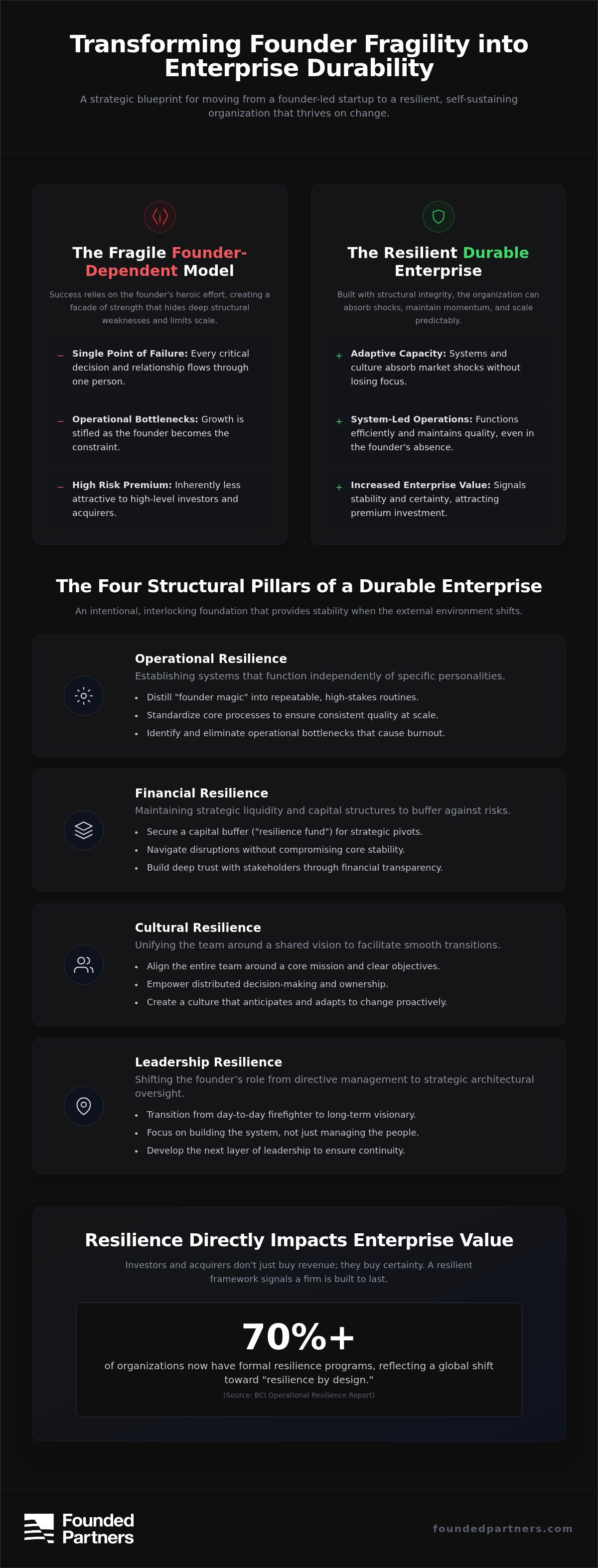
Early-stage success is frequently a testament to the founder’s individual stamina. This "Heroic Effort" trap creates a facade of strength that hides deep structural weaknesses. When every critical decision, client relationship, and operational fix flows through one person, the firm isn't resilient; it's dependent. Rapid scaling quickly exposes these gaps. As the organization grows, the "stamina-led" model reaches a breaking point, leading to burnout and operational bottlenecks. True durability requires shifting the weight from the individual to the system, moving beyond the limits of a single person's capacity.
Resilience as Enterprise Value
Investors and acquirers don't just buy revenue; they buy certainty. Building organizational resilience directly impacts enterprise value by reducing the "risk premium" associated with founder-led firms. A business that runs efficiently without the founder’s constant intervention is inherently more attractive for capital raising or exit planning. According to the BCI Operational Resilience Report 2025, over 70% of organizations now have formal resilience programs in place. This shift reflects a global move toward "resilience by design" and heightened accountability. For a firm looking to scale, demonstrating this architectural health is a prerequisite for high-level investment. It signals to partners that the firm is built to last, not just to burn bright and fade. By refining your foundation today, you secure your position in the market tomorrow.
The Structural Pillars of a Durable Enterprise
A resilient firm isn't built on luck. It's built on a foundation of intentional, interlocking pillars that provide stability when the external environment shifts. Building organizational resilience involves more than just a backup plan; it requires a fundamental shift in how you view the architecture of your business. This transformation moves the firm from a collection of individual efforts to a structured entity capable of enduring growth and market volatility. By refining these pillars, you ensure the organization can absorb shock without losing its strategic focus.
- Operational Resilience: Establishing systems that function independently of specific personalities.
- Financial Resilience: Maintaining strategic liquidity and capital structures to buffer against innovation risks.
- Cultural Resilience: Unifying the team around a shared vision to facilitate smooth transitions.
- Leadership Resilience: Shifting the founder’s role from directive management to strategic architectural oversight.
Operations Optimization: The Engine of Durability
The "founder magic" is often what starts a business, but it's also what can eventually throttle it. Operations optimization is the process of distilling that magic into repeatable, high-stakes routines. By standardizing core processes, you ensure that quality remains consistent even as you scale. This isn't about creating a rigid bureaucracy. Instead, it's about identifying and eliminating the operational bottlenecks that cause burnout and stall momentum. When your systems are durable, they reinforce the foundation rather than straining it during periods of rapid expansion. For many leaders, operations optimization serves as the first step toward a business that runs efficiently without constant founder intervention.
Strategic Capital and Financial Buffers
Building organizational resilience requires a financial buffer for strategic pivots. Capital raising support is often viewed through the lens of growth, but its true value lies in building a resilience fund. This liquidity allows you to navigate disruptions or invest in new opportunities without compromising your core stability. Financial transparency plays a critical role here, as it builds deep trust with stakeholders and investors during times of crisis. Balancing aggressive growth with a durable balance sheet ensures that you aren't just growing fast, but growing sustainably. A well-capitalized firm can afford to be patient and disciplined, which is a hallmark of a seasoned, resilient enterprise.
Navigating the Paradox: Systems vs. Agility
Many founders fear that formal systems will extinguish the creative spark that fueled their early growth. They worry that process leads to a slow, bureaucratic environment where innovation goes to die. However, building organizational resilience requires a delicate balance between order and adaptability. Over-processed firms become brittle and break under the pressure of unexpected market shifts. A truly resilient enterprise avoids this fragility by adopting the role of a Strategic Architect, designing frameworks that empower teams rather than restricting them. This approach fosters "scripted improvisation," where employees follow established routines but retain the autonomy to solve novel problems. True resilience is the ability to pivot without losing structural integrity.
The Founder to CEO Transition
As the organization matures, the founder’s role must evolve to allow the business to develop its own momentum. This transition is often the most consequential shift a firm will face. Moving from a directive manager to a strategic leader requires a fundamental change in identity and daily focus. It involves refining the vision, guiding the executive team, and strengthening the organizational core. Utilizing professional Leadership Advisory services can provide the objective perspective needed to navigate this transition without losing focus. By empowering the next tier of leadership to own operational outcomes, the founder ensures the firm isn't tethered to a single person’s capacity. This shift is a prerequisite for building organizational resilience at scale.
Maintaining Culture During Business Transformation
Transformation shouldn't come at the cost of character. Scaling operations involves standardizing "how" things are done without diluting the "why" that defines the brand. Clear communication strategies are essential for managing organizational change and reducing internal friction during growth spurts. When team members understand the shared vision, culture acts as a powerful shock absorber for morale during market volatility. A resilient culture provides the psychological security that allows a team to remain composed under pressure. It ensures that as the business transforms, the commitment to its foundational values remains unshakable. This cultural durability is what keeps a team aligned when the path forward becomes uncertain.
The Resilience Audit: Stress-Testing Your Foundation
Resilience is a diagnostic, not a feeling. A thorough audit reveals the hidden fissures that appear when a firm attempts to scale without a reinforced foundation. Building organizational resilience requires a cold, clinical look at the current architecture of your business to ensure it can withstand consequential market shifts. It's about moving from a state of reactive "firefighting" to one of proactive structural health. This process identifies exactly where the firm is most vulnerable, allowing you to refine your operations before a crisis forces your hand. Without this data, growth is merely a gamble on continued stability.
A critical metric in this audit is the "Time to Pivot." If your firm faced a 20% market drop tomorrow, how many days would it take for your team to execute a coordinated, strategic response? A resilient organization doesn't just survive such a shock; it absorbs it and adjusts its trajectory without losing structural integrity. This speed of response is the ultimate KPI for durability. It measures the gap between having a strategy and having the operational capacity to execute it under pressure.
Operational Red Flags to Watch For
Identifying "Single Points of Failure" is the most urgent task for any founder-led firm. These are the individuals or processes that, if removed, would cause the entire system to stall. Common red flags include:
- Over-reliance on the founder for day-to-day decision making, which creates a permanent bottleneck.
- A lack of documented, repeatable processes for core revenue drivers, making the firm dependent on individual memory.
- High turnover in key roles during scaling phases, suggesting that the culture or systems are under too much strain.
The Capital Readiness Check
Financial durability is the buffer that allows for innovation during uncertainty. You must evaluate whether your current capital strategy is built for a sprint or a marathon. Ask yourself if the business would remain attractive to high-level investors or acquirers if you stepped away for three months. A truly durable enterprise has a capital structure designed to survive a prolonged downturn, not just fuel rapid expansion. Furthermore, your exit plan should be integrated into your current operational strategy today, rather than being treated as a distant "someday" event. This alignment ensures that every growth move you make adds tangible enterprise value.
If you're ready to identify these structural gaps and secure your firm's future, our Business Transformation Consulting provides the strategic oversight needed to turn these vulnerabilities into strengths.
Fortifying the Future: The Strategic Partner’s Role
Building organizational resilience is a complex architectural feat that rarely succeeds as a solo endeavor. Founders are often too deeply embedded in the daily mechanics of their firm to see the structural fissures that threaten their long-term vision. A strategic partner acts as both a mirror and a compass, providing the objective distance required to assess organizational health and the technical expertise to reinforce it. This collaboration moves the firm beyond the repetitive cycle of fixing immediate bottlenecks. It allows you to focus on the deliberate act of architecting a legacy, ensuring the business thrives long after the initial startup energy has settled into a steady, powerful hum.
True partnership in this context isn't about delivering a static report; it's about the shared journey of refinement. It involves a methodical approach to strengthening the core, optimizing the engine, and securing the perimeter. By integrating resilience into the very fabric of your business transformation, you create an organization that doesn't just survive market shifts but uses them as a springboard for further expansion. This is the hallmark of a durable enterprise: the ability to remain composed, disciplined, and focused while competitors are forced into reactive retreats.
Leadership Advisory and Strategic Support
An external perspective is essential for identifying the blind spots that naturally develop as a business grows in complexity. Specialized Leadership Advisory helps founders navigate consequential transitions, such as the shift from directive management to strategic oversight. This partnership is built on a foundation of character, competence, and a shared commitment to long-term sustainability. Working with a "Trusted Peer" who has navigated complex scaling challenges before provides the psychological security needed to make bold, disciplined moves. It transforms the lonely experience of leadership into a collaborative effort to build something substantial and lasting.
Your Next Step Toward Durability
The journey toward building organizational resilience begins with a single decision to prioritize health over vanity metrics. Refining your operations to support the next stage of growth is a prerequisite for any major milestone, whether that involves Capital raising support or comprehensive Exit planning. A resilient foundation ensures that your firm remains attractive to high-level investors and acquirers by proving that the business is a durable asset, not a fragile performance. Our approach to Business Transformation Consulting ensures that your systems, culture, and capital are aligned to support your vision through any market cycle.
Speak with a Strategic Architect at Founded Partners to begin your resilience journey.
Architecting Your Firm's Future
Building organizational resilience is a deliberate choice to prioritize the architectural health of your firm over short-term vanity metrics. It requires a fundamental transition from a model of heroic effort to one of durable, repeatable systems. By stress-testing your foundation and refining your core operations, you transform your business from a fragile startup into a valuable enterprise that thrives independently of any single individual. This shift doesn't just protect your legacy; it actively enhances it by preparing the organization for high-stakes capital raising or a successful exit.
Our seasoned partners bring a calm expertise to specialized advisory for founder-led organizations. We focus on business transformation and operations optimization to ensure your firm is ready for its next consequential transition. You've built the vision; now it's time to build the structure that can sustain it through any market shift. The path to durability is a shared journey, and the right strategic oversight makes all the difference in achieving a self-sustaining engine of growth.
Partner with Founded Partners to build a more resilient, scalable foundation for your business.
Frequently Asked Questions
What is the first step in building organizational resilience?
The first step is identifying single points of failure within your current operations. You must determine where the firm is overly dependent on your personal intervention or the specialized knowledge of one employee. Start with a diagnostic audit to map out these vulnerabilities. This clarity allows you to prioritize which systems need reinforcement first. Building organizational resilience begins by acknowledging that your current stamina isn't a sustainable substitute for structural systems.
How does organizational resilience differ from business continuity planning?
Business continuity is defensive and reactive, focusing on survival after a specific disruption occurs. Resilience is a strategic and architectural property that allows a firm to absorb shocks while maintaining momentum. It's about resilience by design, as seen in evolving global standards like ISO 22316. While continuity planning keeps the lights on during a crisis, resilience ensures the organization’s core engine remains durable and capable of growth despite market shifts.
Can a small founder-led team be truly resilient?
A small team can be exceptionally resilient if it prioritizes decentralized decision-making and documented routines. Size isn't the primary factor in durability; architectural integrity is. Even a small team can build organizational resilience by ensuring no single person holds the keys to a critical revenue driver. By standardizing high-stakes processes early, small firms avoid the fragility that often plagues rapid growth and make themselves more attractive to future partners.
How does building resilience impact my company’s valuation?
Building resilience significantly increases valuation by reducing the risk premium investors apply to founder-dependent firms. Acquirers look for certainty and predictable outcomes. When you prove that the business runs efficiently without your constant intervention, you're selling a self-sustaining asset rather than a job. This structural strength signals to the market that your firm can handle volatility, which translates directly into higher multiples and more favorable deal terms during an exit.
What role does leadership advisory play in organizational health?
Leadership advisory provides the objective distance needed to navigate consequential transitions with composure. Seasoned advisors help you identify blind spots in your organizational health that are often invisible from the inside. They guide the shift from directive management to strategic oversight, ensuring you don't stall the firm's growth. This partnership offers the psychological security and technical expertise required to refine your leadership style into that of a Strategic Architect.
How can I maintain agility while building more formal systems?
You maintain agility by building frameworks that empower teams rather than restrictive bureaucracies. Resilient systems should act as guardrails that define the how while leaving room for scripted improvisation. This approach allows employees to solve novel problems within a structured environment. By focusing on clear outcomes and shared values, you ensure the firm can pivot quickly without losing its structural integrity or diluting the original mission that fueled your success.
When is the right time to conduct a resilience audit?
The right time for a resilience audit is before you reach a major strategic crossroads. This includes preparing for capital raising, planning an exit, or initiating a significant business transformation. Conducting an audit during periods of relative calm allows you to identify fissures before they become catastrophic failures. Regular stress-testing ensures that your foundation is reinforced to support the weight of your next stage of growth. It prevents bottlenecks from becoming permanent.
How does capital raising support contribute to long-term resilience?
Capital raising support helps you secure the strategic liquidity needed to buffer against innovation risks and market downturns. It’s not just about fueling growth; it’s about creating a resilience fund for strategic pivots. Investors also act as a validation layer for your organizational health. Successfully raising capital requires proving that your operations are optimized and your leadership is ready, which reinforces the long-term durability and credibility of your firm with all stakeholders.