
Common Founder Exit Planning Mistakes: 2026 Framework

Your exit isn't a single transaction; it's the final exam for your company's operational maturity. Many leaders view a sale as a destination, yet they often arrive only to find their "founder magic" doesn't translate into a spreadsheet. You’ve likely felt the quiet anxiety of wondering if your team can lead without your daily intervention or how to step away without losing your sense of identity. It’s a sobering reality when a lifetime of effort is discounted because the business can't breathe without its creator.
By identifying common exit planning mistakes for founders early, you can transform your business into an independent asset that commands a premium valuation. This guide provides a structured framework for 2026 to help you identify the hidden traps that devalue founder-led businesses. We'll explore how to optimize your operations, maximize your enterprise value, and ensure your legacy survives the final signature. We will move from the strategic "why" of preparation to the specific "how" of architectural business building, ensuring you transition with clarity and confidence.
Key Takeaways
- Discover why 2026 market dynamics require a 24-month lead time, so you don't leave value on the table when closing the gap between perceived and actual enterprise value.
- Learn to dismantle the founder-centric trap by identifying how common exit planning mistakes for founders often stem from tying business success to personal relationships.
- Prepare for sophisticated scrutiny by addressing lifestyle accounting and aligning your financial hygiene with the specific expectations of strategic or financial acquirers.
- Implement a 4-pillar framework that prioritizes operational durability and scalable systems, ensuring your business functions with architectural precision without your daily involvement.
- Navigate the psychological shift from owner to former-owner with a legacy-focused strategy that values character and organizational health as much as the final transaction.
The Cost of Reactive Exit Planning: Why Most Founder Exits Underperform
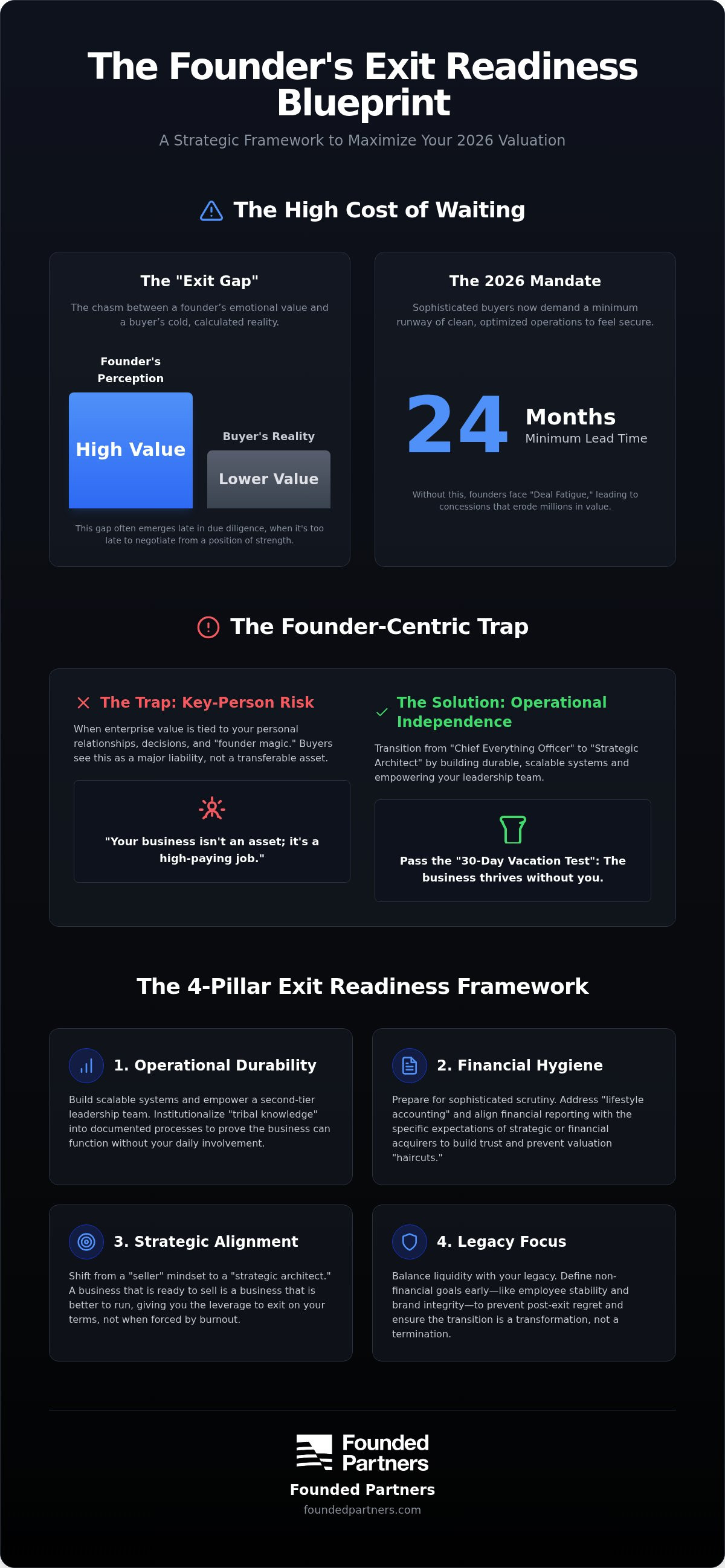
The "Exit Gap" is a quiet killer of wealth. It represents the chasm between a founder’s emotional valuation and the cold, calculated reality of a buyer’s spreadsheet. For many, this gap only becomes visible during the final stages of due diligence, when it’s too late to pivot or negotiate from a position of strength. This discrepancy is among the most common exit planning mistakes for founders. They mistake their personal "magic" for transferable enterprise value, forgetting that a buyer isn't purchasing your past hard work; they're purchasing your company’s future cash flows.
In 2026, market dynamics have shifted toward extreme scrutiny. Sophisticated buyers now demand a minimum 24-month lead time of clean, optimized operations to feel secure in a transaction. Without this runway, founders often face "Deal Fatigue." This is a hidden tax where the friction of a poorly prepared business drains the founder’s energy, leading to concessions that erode millions in value. Deal fatigue typically manifests in three distinct ways: eroded trust during the discovery phase, emotional exhaustion leading to poor decision-making, and significant valuation "haircuts" as buyers uncover unmitigated risks. Transitioning from a "seller" mindset to that of a "strategic architect" allows you to build a business that doesn't just sell, but attracts the right capital on your terms.
The Illusion of Market Timing
Market timing is a seductive myth. Many leaders wait for the "perfect" external economic window to list their company, but this reactive strategy often backfires. Internal readiness, including the health of your systems, the strength of your leadership, and the clarity of your data, outweighs external cycles. If you wait until external conditions are ideal but your internal health is failing, you risk a fire sale driven by founder burnout. A business that is ready to sell is a business that is better to run, providing you with the leverage to exit when you choose, not when you're forced.
The Legacy vs. Liquidity Paradox
A successful transition is measured by more than the final check. You must balance the need for liquidity with the preservation of your legacy, which includes employee stability, brand integrity, and the survival of the culture you built. Failing to define these legacy goals early is one of the more subtle common exit planning mistakes for founders, often leading to deep post-exit regret even after a significant payout. By aligning shareholder returns with a clear vision for the company’s future, you ensure the transition is a transformation rather than a termination.
Operational Mistake: The Founder-Centric Trap and Its Impact on Value
A business that relies on a single individual's brilliance isn't an asset; it's a high-paying job. The Founder-Centric Trap occurs when your enterprise value is inextricably tied to your personal relationships, unique decision-making style, or technical expertise. While "founder magic" is what fuels early-stage growth, it becomes a glaring red flag for sophisticated private equity and strategic buyers during an exit. They aren't looking for a hero; they're looking for a durable, scalable system that produces predictable results.
When your presence is the primary driver of revenue, your business carries immense key-person risk. Buyers view this as a liability that necessitates a significant "valuation haircut." If the gears stop turning the moment you step away, the business has failed the "Vacation Test." Can your organization continue to grow and serve customers for 30 days without your input? If the answer is no, you have an operational bottleneck that will stall your acquisition. Addressing these common exit planning mistakes for founders requires a shift in how you view your role within the architecture of the firm.
Decentralizing Decision-Making
The transition from "Chief Everything Officer" to Strategic Architect is a prerequisite for a high-value exit. This process involves empowering a second-tier leadership team that buyers can trust to maintain momentum after the transaction. You must build a culture where decisions are made based on data and shared frameworks rather than your gut instinct. Operational Independence is the primary driver of the EBITDA multiple because it proves the business can thrive under new ownership. If you're unsure where to start, engaging in Operations Optimization can help pinpoint exactly where your involvement is stifling growth.
Institutionalizing Tribal Knowledge
Institutionalizing knowledge is a critical step in avoiding common exit planning mistakes for founders that devalue your life's work. Buyers pay a premium for businesses with "boring" but predictable processes. Moving away from "how we've always done it" requires documenting tribal knowledge and turning it into scalable systems. This institutionalization transforms your company into a turnkey acquisition target. When your operations are codified, the buyer sees a machine that can be scaled with more capital, rather than a puzzle they have to solve. Predictability is the ultimate currency in a transaction, and it's built through the disciplined refinement of your daily workflows.
Financial and Strategic Misalignments That Stall Acquisitions
Financial integrity is the bedrock of a successful exit, yet it's often where the most friction occurs during due diligence. Many leaders fall into the habit of "lifestyle accounting," where personal expenses and non-essential costs are woven into the company's ledger to minimize tax liabilities. While this serves short-term cash flow, it creates a fragmented narrative for a buyer. You must begin cleaning your books at least three years before a transition to demonstrate true, sustainable profitability. A buyer is looking for clarity, consistency, and professional rigor in your reporting.
Customer concentration is another silent deal-killer that founders often overlook until they reach the negotiating table. If a single client represents more than 20% of your total revenue, a sophisticated acquirer sees a house of cards rather than a durable enterprise. This risk is among the common exit planning mistakes for founders that leads to significant valuation haircuts or deals falling through entirely. Diversifying your revenue base, refining your sales funnel, and institutionalizing your client relationships are essential steps to prove your business can survive the loss of any single account.
Quality of Earnings (QofE) Readiness
Sophisticated buyers won't rely solely on your internal P&L or tax returns. They'll conduct a rigorous Quality of Earnings (QofE) audit to verify that your EBITDA is both durable and recurring. Proactively identifying "add-backs," specifically one-time expenses or owner-related costs that won't continue under new ownership, is a critical part of preparation. By conducting a sell-side QofE, you can address financial red flags before they become deal-breakers. This level of transparency builds trust, accelerates the timeline, and protects your negotiated valuation during the final stages of the process.
Strategic Alignment: Who is Your Ideal Acquirer?
Acquirers are not a monolith. They fall into distinct archetypes with vastly different motivations, ranging from financial yield to strategic market expansion. A financial buyer, such as a private equity firm, focuses primarily on yield, cash flow, and operational efficiency. In contrast, a strategic buyer might pay a significant premium because your business fills a specific gap in their portfolio, provides access to a new market, or offers a proprietary technology. Mapping your business transformation to the needs of a specific buyer archetype allows you to structure your operations for their future growth objectives. Ignoring the Post-Acquisition Integration (PMI) plan during negotiations is another of the common exit planning mistakes for founders, as it often leads to cultural friction that devalues the transition for both parties.
The Founder’s Exit Readiness Template: A 4-Pillar Framework
Preparation is the difference between a panicked sale and a purposeful transition. An enduring exit is built on four structural pillars: financial hygiene, operational durability, strategic positioning, and a personal transition roadmap. Pillar 1 focuses on audit-ready books and optimized tax structures to ensure no value is lost to avoidable liabilities. Pillar 2 emphasizes operational durability through scalable systems and independent leadership. Pillar 3 addresses strategic positioning, securing defensible IP and diversified revenue streams. Finally, Pillar 4 handles the personal transition, anchoring your identity beyond the business to prevent post-exit regret.
Phase 1: The Architectural Audit (Months 24-18)
During months 24-18, the focus is the architectural audit. This is the stage where you conduct an internal "pre-due diligence" to find operational cracks before a buyer does. One of the common exit planning mistakes for founders is failing to benchmark their company against industry-standard exit multiples early enough. In the current 2026 market, small businesses often trade at 2.6 to 2.7 times SDE, while larger firms with EBITDA between $1 million and $25 million can see multiples in the 4x to 7x range. Identifying which value drivers need refinement now allows you to move toward the higher end of those brackets.
Phase 2: Optimization and Scaling (Months 18-6)
Phase 2 shifts from identification to execution. You are no longer just finding gaps; you're closing them through Business Transformation Consulting that builds enterprise value. This is the time to test your leadership team's autonomy by delegating high-stakes projects. If your team can't manage a major contract without your direct involvement, your business carries a key-person risk that will stall an acquisition. Use the following 5-point checklist to verify your Phase 2 readiness before moving into a formal sale process.
- Codify all high-impact workflows into documented, scalable systems that don't require your oversight.
- Transfer all primary client and vendor relationships to your second-tier leadership team.
- Cleanse the company ledger of any "lifestyle" expenses that obscure true profitability.
- Formalize defensible IP and long-term contracts to secure recurring revenue streams.
- Establish a clear 12-month post-exit roadmap to manage the psychological shift from founder to former owner.
By treating these phases with architectural precision, you avoid the common exit planning mistakes for founders that lead to deal fatigue and devalued legacies. This structured approach ensures that when you do exit, you do so with a business that is optimized for its next chapter and a personal plan that honors your next stage of growth.
Transitioning with Purpose: The Founded Partners Approach
Navigating a business sale requires more than a broker; it requires a partner who understands the architectural nature of your enterprise. Large consultancies often delegate the heavy lifting to junior associates, treating your life's work as a volume-based transaction. At Founded Partners, we reject this model in favor of a boutique, partner-led approach. We recognize that an exit is a consequential transition, one that demands the same discipline and precision you used to build the firm. Our "Trusted Peer" philosophy acknowledges the emotional complexity inherent in stepping away, providing the psychological security of having a seasoned advisor in your corner.
We align operations optimization with a long-term capital strategy, ensuring your business isn't just sold, but successfully transitioned. By focusing on the "how" of the process, we help you avoid the common exit planning mistakes for founders that often lead to deal collapse or seller's remorse. We don't just look at the numbers; we look at the character of the organization. This holistic view ensures that the enterprise value you've built is recognized and protected by the right acquirer.
Beyond the Transaction
Leadership advisory is about more than preparing the company for a buyer; it's about preparing you for the "Day After." A successful deal shouldn't leave a wake of cultural destruction or a team that feels abandoned. We work to ensure your culture survives the change in ownership, protecting the legacy you’ve cultivated over years of hard work. Your exit should serve as a springboard for your next chapter of growth, whether that involves a new venture, philanthropy, or a well-earned retirement. By addressing the common exit planning mistakes for founders early, you create the freedom to choose your own path without being tethered to a failing transition.
Your Next Consequential Step
High-stakes environments require a steady hand and a strategic architect who values character as much as competence. Character-driven consulting leads to better transaction outcomes because it builds deep trust with all stakeholders, from employees to potential buyers. We help you refine the foundational aspects of your business so you can approach the market with confidence and clarity. If you're ready to move beyond reactive planning and secure a high-value, purposeful transition, the time to start is now.
Start your architectural audit with Founded Partners
Securing Your Legacy Through Architectural Precision
Your business is the architectural result of years of disciplined effort, yet its final chapter requires a different kind of precision. We've explored how the Exit Gap, the Founder-Centric Trap, and poor financial hygiene can silently devalue your enterprise. By implementing the 4-pillar framework, you move from a reactive seller to a strategic architect. This shift ensures your operations are durable, your leadership is independent, and your books are audit-ready. Avoiding common exit planning mistakes for founders isn't just about maximizing a check; it's about honoring the legacy you've built over a lifetime.
Founded Partners provides boutique, partner-led advisory specialized in founder-led business transformation. With a global scope and a measured, long-term perspective, we help you navigate the emotional and operational complexities of a consequential transition. Having a steady hand in your corner provides the psychological security needed to transition with purpose and clarity. The journey toward a high-value exit is a shared one, and with the right preparation, your most significant professional milestone is well within reach.
Refine your exit strategy with the Strategic Architects at Founded Partners
Frequently Asked Questions
What is the biggest mistake founders make when starting exit planning?
The most significant error is viewing an exit as a single financial event rather than the culmination of an operational transformation. Waiting until you are ready to leave before preparing the business is one of the most common exit planning mistakes for founders. This reactive approach often results in a lower valuation because the company lacks the systems to thrive without its creator. Proactive leaders begin refining their architecture years before they intend to step away.
How long does it actually take to prepare a small business for sale?
A strategic exit requires a minimum of 24 months of preparation to achieve maximum enterprise value. This window allows you to clean three years of financial records, optimize operations, and prove that the leadership team can function independently. Rushing the process typically leads to deal fatigue or significant valuation haircuts during due diligence. A longer runway provides the architectural precision needed to attract sophisticated buyers who value predictability and sustainability.
Can I sell my business if it still relies heavily on my personal involvement?
You can sell a founder-centric business, but you should expect a lower valuation and a rigorous earn-out period. Sophisticated buyers view heavy personal involvement as a key-person risk that devalues the asset. To command a premium, you must pass the "vacation test" by proving the organization grows without your daily input. Transitioning from a hero-led model to a system-led model is the most effective way to protect your legacy and maximize your final check.
What is the difference between an exit strategy and a succession plan?
An exit strategy focuses on the transaction itself, including the financial structure, buyer archetypes, and liquidity goals. A succession plan is the architectural roadmap for who will lead the company after you depart. While they are distinct, they must be aligned to ensure a successful transition. A strong succession plan de-risks the investment for the buyer, while a clear exit strategy ensures the founder's personal and financial objectives are met with precision.
How do I know if my business is 'investor ready' or 'exit ready'?
Your business is exit ready when it functions as an independent machine that produces predictable cash flow. Key indicators include audit-ready financial statements, a second-tier leadership team with decision-making authority, and documented, scalable systems. If your revenue is diversified and you have defensible intellectual property, you are likely prepared for a high-value transaction. Readiness is less about your desire to leave and more about the company's ability to thrive in your absence.
What role does a business transformation consultant play in an exit?
A business transformation consultant acts as a strategic architect who identifies and closes the gaps between your current state and your ideal exit value. They focus on operations optimization to ensure the business is scalable and independent. By addressing common exit planning mistakes for founders before they reach the negotiating table, these advisors help you build a more durable foundation. This preparation leads to faster due diligence and more favorable terms from sophisticated acquirers.
Is it possible to maximize value without losing my company's culture?
Maximizing value and preserving culture are not mutually exclusive goals if you prioritize strategic alignment during the buyer search. By defining your legacy goals early, you can identify acquirers whose values mirror your own. A disciplined approach to preparation allows you to vet buyers for cultural fit as much as financial capacity. Protecting your team and your brand's integrity ensures that the transition is a transformation for the better rather than a termination.
When is the right time to hire an exit planning advisor?
The ideal time to engage an advisor is two to three years before your target exit date. This timeframe allows for the deep architectural work required to optimize operations and clean financial records. Early involvement helps you navigate the psychological shift of leaving while ensuring the business is positioned to attract the right capital. Waiting until you are ready to sell often means you have already missed the window to significantly influence your company's enterprise value.