
Challenges of a First-Time Founder CEO: How to Lead Through the Shift

The harder you work as a founder CEO, the more easily you can become the company’s bottleneck. The challenges of a first-time founder CEO often begin when the habits that helped build the business, making quick decisions and staying close to every detail, no longer serve its next stage of growth. More people, priorities, and operational demands call for a different kind of leadership.
If decisions still funnel through you, delegation feels risky, and leadership competes with product and customer needs, you’re not alone. These pressures don’t necessarily mean you’re falling short. They may signal that the organization has outgrown its informal ways of working. The answer isn’t simply to work harder. It’s to make responsibilities, decisions, and priorities clearer.
This article explores the shift from hands-on founder to enterprise-wide leader, including the challenges of decision ownership, delegation, team development, and competing demands. You’ll find practical ways to clarify who owns what, build a steadier operating approach, and lead with greater confidence while preserving the purpose and values that shaped the company.
Key Takeaways
- The challenges of a first-time founder CEO often signal that the company’s leadership needs are evolving, not that you’re failing.
- Unclear ownership and concentrated decision-making can pull you back into routine work and slow your team’s progress.
- Scaling leadership doesn’t mean giving up your vision. It means setting clear decision boundaries so others can act within it.
- Build a practical operating rhythm around priorities, ownership, and regular review, then adapt it to your company’s stage and capacity.
- Leadership advisory can help when recurring bottlenecks or unclear responsibilities make it difficult to lead the organization’s next stage.
Why the Challenges of a First-Time Founder CEO Begin with a Role Shift
Building a business rewards proximity to the work. In the early stages, a founder may shape the product, respond directly to customers, and resolve problems as they arise. As the organization grows, those responsibilities expand: more people need direction, decisions have wider consequences, and informal habits may no longer keep teams aligned. The challenges of a first-time founder CEO begin when creating the business is no longer the whole job. Leading the organization becomes a distinct responsibility.
A CEO’s work is to set direction and align people, priorities, and resources so the organization can move toward shared objectives. The role includes decisions that affect the business as a whole, not only the function where the founder has the most experience. A general overview of the Chief Executive Officer (CEO) role helps frame that wider scope. In practice, the shift is from solving every problem personally to giving others the context and authority to solve the right problems well.
A founder creates the business; a CEO creates the clarity and conditions that let the whole business deliver.
What changes when a founder becomes CEO?
The change shows up in how a founder spends attention. Instead of stepping into every customer issue or operational snag, the CEO looks for patterns, clarifies which outcomes matter, and ensures someone has the authority and resources to address them. For example, if delivery delays keep recurring, the underlying issue may be unclear ownership or a weak review process, not a need for more founder-led follow-up.
This transition is gradual, not a title change that instantly supplies a new operating model. Its shape depends on company stage, team capability, and business model. A small team may still need the CEO close to execution; a larger or more complex organization may require more time spent aligning leaders and managing trade-offs. The useful question isn’t whether to stop being hands-on. It’s where your involvement has the greatest effect.
Why the transition can feel personal
Delegation can affect identity as much as workload. Founders often care deeply about the product, customer experience, and standards they established, so handing work over may feel like risking the quality of what they built. Yet holding every detail can prevent others from developing judgment and make the company dependent on one person’s attention.
Founder-level urgency can also be difficult for a growing team to interpret. Rapid changes in direction may have helped resolve early uncertainty, but colleagues need enough consistency to coordinate their work and understand what takes priority. If adapting feels uncomfortable, treat that as useful information, not evidence that you can’t lead. Consider which standards must remain firm, which decisions can move closer to the work, and what context your team needs to act with confidence.
The Core Challenges of a First-Time Founder CEO: People, Decisions, and Focus
The demands of the CEO role often surface as a knot of related pressures: delegating work, developing leaders, handling a growing stream of decisions, and protecting time for priorities beyond today. These challenges of a first-time founder CEO become harder to manage when the team isn’t sure who owns a decision or which objective takes precedence. A routine customer request, for example, may land with the CEO not because it needs their judgment, but because no one knows who can resolve it.
Clear decision ownership turns individual judgment into organizational capacity. When responsibility and authority are visible, you can focus on decisions that genuinely need an enterprise-wide view, while the team moves routine work forward without waiting for permission.
Delegating without losing standards
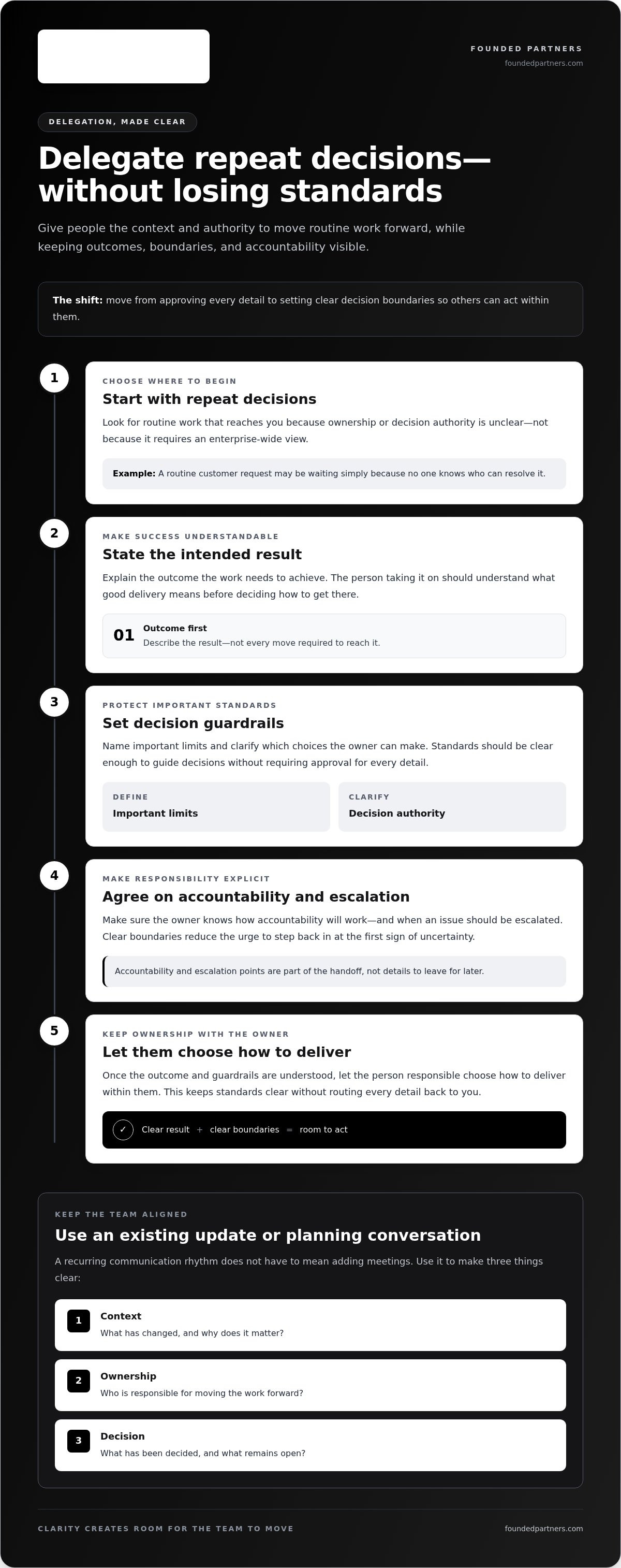
Delegation is more than assigning a task. The person taking it on needs to understand the intended result, the decisions they can make, and how accountability will work. Without those boundaries, you may step back in at the first sign of uncertainty. Perfectionism can add to the pull: if the expected standard exists only in your head, a team member’s reasonable approach may look like a mistake.
Start with repeat decisions. State the outcome, define any important limits, and specify when an issue should be escalated. Then let the owner choose how to deliver within those guardrails. This keeps standards clear without requiring you to approve every detail.
Leading people while protecting strategic focus
The CEO is responsible for alignment, not for personally resolving every disagreement or operational snag. That distinction matters when urgent requests compete with longer-term priorities. If each interruption resets the day, strategic work gets postponed; if you’re inaccessible, people may guess at priorities or authority. The aim is to give the team enough context and direction to act, then reserve your attention for decisions with broader consequences.
A recurring communication rhythm can help, and it doesn’t have to mean adding meetings. Use existing team updates or planning conversations to clarify:
- Context: What has changed, and why does it matter?
- Ownership: Who is responsible for moving the work forward?
- Decision: What has been decided, and what remains open?
As the leadership team develops, your focus also shifts toward helping its members work together. Shared priorities reduce conflicting instructions, while clear accountability makes follow-through easier to see. If decision bottlenecks or competing demands keep recurring, leadership advisory can help you examine the responsibilities and operating assumptions shaping the team.
Must a First-Time Founder CEO Give Up Control to Scale?
No. Scaling leadership doesn’t mean giving up the company’s vision or values. It means replacing personal control over every action with clear accountability for the outcomes that matter. You still have an important role in setting direction, protecting the company’s principles, and making consequential choices. The shift is to decide where your involvement adds value and where it only creates another approval step.
Centralized decision-making can feel reassuring because you see the whole picture. But if every customer exception, hiring choice, or operating adjustment waits for you, the organization can only move as quickly as your attention allows. At the other extreme, distributing authority without boundaries can lead to conflicting decisions. A more durable approach makes decision rights explicit across strategic, functional, and routine matters.
Control, accountability, and decision rights
Decision rights clarify who recommends an action, who decides, who contributes input, and who executes. For a routine customer issue, a team member closest to the situation might resolve it within agreed service principles. A material strategic choice, such as changing the company’s target market, may call for CEO leadership and input from relevant leaders. The right owner depends on the decision’s impact, the expertise required, and who is accountable for the outcome.
Make escalation criteria as clear as ownership. Define which circumstances require CEO review, such as a decision that changes a strategic commitment, crosses an agreed risk boundary, or affects multiple functions. This preserves oversight without requiring approval for every ordinary variation. The challenges of a first-time founder CEO often ease when authority is matched to accountability, rather than treated as something the founder must personally retain.
A simple comparison can help identify where control habits are slowing the work:
Control-heavy: The founder approves routine decisions, gives instructions without explaining the objective, and steps in whenever someone takes a different route.
Stewardship-oriented: The founder sets principles and boundaries, gives an accountable owner room to decide, and reviews outcomes to improve judgment and execution.
Keep the vision while changing how work gets done
Separate what must endure from what can evolve. Company purpose, customer commitments, and standards of conduct may be foundational; approval paths, reporting routines, and role boundaries can be refined as the organization changes. Protecting a principle doesn’t require freezing the process built around it.
When communicating a decision, explain the reasoning as well as the result. Naming the objective, trade-offs, and limits helps employees apply the same logic in situations you won’t personally see. Where a company has a board, constructive engagement can help clarify strategic choices, surface assumptions, and strengthen governance. Without a board, the same discipline can be applied through the leadership team and other appropriate review practices.
Leadership and transformation advisory can help founders examine whether decision authority, governance, and operating practices still fit the company’s needs. The aim isn’t less care or weaker standards. It’s stewardship that lets the organization act with greater clarity while staying true to its purpose.
A Practical Operating System for First-Time Founder CEOs
A useful operating system doesn’t need to be elaborate. It needs to make priorities visible, ownership clear, and learning part of how the company works. The right structure depends on the organization’s stage, team capacity, and existing management practices. Start with what will help people make progress now, then refine the approach as the business changes.
Use this sequence as a working framework:
- Clarify priorities. Translate the company’s strategic aims into a limited set of current priorities. If everything is urgent, teams can’t make sound trade-offs.
- Assign owners. Give each priority one accountable owner, a defined outcome, and authority to make relevant decisions. Contributors can be many; accountability should be clear.
- Establish a review rhythm. Create regular opportunities to assess progress, surface obstacles, resolve decisions, and revisit assumptions.
- Adjust based on learning. If an initiative stalls or new information changes its value, revise the plan, ownership, or resources rather than continuing by default.
Set priorities and make ownership visible
Make each priority specific enough to guide choices. “Improve customer experience,” for instance, may be too broad to assign. A clearer aim might be to reduce recurring friction in a particular part of the customer journey. Name the person accountable, the outcome they’re responsible for, and the decisions they can make without further approval. This gives the team a shared reference point and helps you distinguish genuine escalations from routine execution.
Choose a small set of meaningful indicators that show whether the work is moving in the right direction. The measures should fit the priority and the business, not follow a universal KPI formula. For a broader view of organizational foundations that support growth, see this business scalability consulting guide.
Create a decision and review cadence
Use review conversations to examine progress, obstacles, upcoming decisions, and assumptions that may have changed. Keep routine information-sharing in concise written updates where practical; reserve live discussion for topics that need judgment, coordination, or a decision from you or the leadership team. The rhythm should be frequent enough to catch emerging issues, but light enough to preserve time for execution.
Look for one recurring bottleneck to improve first. Perhaps a customer exception repeatedly waits for founder approval, or a handoff between teams leaves work unclaimed. Clarify who owns the decision, define the conditions for escalation, and review whether the change resolves the delay. If board oversight applies, founder board management strategies can help connect governance conversations with company priorities and strategic choices.
The challenges of a first-time founder CEO are easier to address when the operating system creates clarity without adding process for its own sake. Founded Partners’ leadership and business transformation advisory helps founder-led organizations refine leadership priorities and operating practices.
When Leadership Advisory Can Help a First-Time Founder CEO
Not every difficult week calls for outside support. Some growing pains are temporary: a new hire needs time to settle in, a process needs a few adjustments, or a decision takes longer because the team is learning to work together. A different signal appears when the same problems return despite repeated effort. If routine decisions keep reaching you, leaders interpret priorities differently, or agreed work regularly stalls between teams, the issue may lie in the organization’s structure or operating practices rather than in one person’s performance.
The challenges of a first-time founder CEO can be hard to assess from inside the company. You’re close to the history, people, and trade-offs that shaped its current approach. That closeness is valuable, but it can also make familiar patterns difficult to see clearly. Leadership advisory offers a structured opportunity to step back, examine how the organization is working, and consider what needs to change as your role evolves.
Recognize when the challenge is organizational, not individual
Look for patterns across decisions, communication, and follow-through. Does work pause whenever a particular person is unavailable? Do team members receive different direction from different leaders? Are priorities agreed upon but repeatedly displaced by urgent requests? These questions can help distinguish an isolated setback from a recurring organizational issue. They aren’t a diagnosis; they’re a starting point for understanding where clarity, ownership, or process may need attention.
Build the next stage with a trusted strategic partner
An outside perspective can help you test operating assumptions, clarify leadership priorities, and identify organizational needs without treating every challenge as a personal shortcoming. Founded Partners’ leadership advisory and business transformation work supports founders navigating consequential changes in how they lead and how the company operates. The focus is on examining the situation and strengthening the organization, not promising a preset outcome.
That work may involve defining your priorities more sharply, considering how leadership responsibilities are shared, or examining whether existing operating practices still serve the company’s direction. The right focus depends on the organization, its team, and the decisions in front of it. Connecting leadership clarity with operational improvement can help build a stronger foundation for sustainable growth while keeping the company’s purpose and values in view.
Before seeking support, note a few recurring examples: decisions that repeatedly escalate, responsibilities that remain unclear, or commitments that don’t translate into consistent follow-through. This makes the conversation more grounded and helps distinguish symptoms from the underlying questions worth exploring. Support should fit the company’s actual context; there isn’t one advisory approach that suits every founder-led organization.
Leadership can feel isolating, especially when decisions affect people and the company’s future. A strategic partner can offer space to examine those decisions, challenge assumptions, and bring greater clarity to the next stage. Founded Partners provides leadership advisory and business transformation consulting for founder-led organizations navigating these changes.
Shape the Leadership Your Next Stage Requires
The next step isn’t to become a different kind of founder. It’s to build leadership practices that help the company move forward without relying on your personal attention at every turn. Treat the challenges of a first-time founder CEO as a prompt to ask what the organization will need from you next, and what it needs to be able to do without you.
Start with one question: which leadership or operating pattern, if strengthened, would make the greatest difference to the company’s next stage? A considered outside perspective can help you examine that question, align leadership priorities, and make consequential changes with the company’s purpose in view.
Founded Partners is a partner-led boutique consultancy led by Adam and Matt. Its work in leadership advisory, business transformation, and operations optimization supports founder-led organizations as their leadership needs evolve. Explore Founded Partners’ strategic advisory for founder-led organizations and take a thoughtful next step toward leading with greater clarity and confidence.
Frequently Asked Questions
Is it normal for a first-time founder CEO to struggle with delegation?
Yes. Delegation is a learned leadership practice, especially when your judgment has shaped the product or customer experience. Start with a contained responsibility, such as approving standard refunds or publishing a routine update, and agree on the boundaries and when to flag an exception. You remain accountable for the system and can review outcomes; you don’t need to personally make every decision within it.
Can a founder be an effective CEO without previous executive experience?
Yes. Previous executive experience can help, but it isn’t a prerequisite for effective leadership. Build capability by seeking candid feedback, noticing where your strengths end, and learning from decisions that miss the mark. You can also recruit or develop leaders whose skills complement your own, such as someone experienced in finance, people leadership, or delivery. Self-awareness helps you learn deliberately rather than pretend to know everything.
How should a first-time founder CEO decide what to delegate?
Delegate decisions that recur, have manageable consequences, and can be guided by clear principles. Stay closer to choices that could materially change the company’s direction, carry substantial risk, or depend on expertise only you currently hold. For repeatable decisions, document the intended outcome, limits, and escalation triggers, then assign an owner. Revisit the arrangement after real cases: expand authority as judgment develops, or refine the guardrails when surprises reveal a gap.
What is the biggest mistake first-time founder CEOs make?
There isn’t one mistake that applies to every founder, but retaining every decision can constrain the organization. If leaders wait for approval before making ordinary trade-offs, work can stall and capable people may stop exercising judgment. Notice where decisions regularly pause, then ask whether your input is genuinely needed or whether the team lacks context, authority, or confidence. Addressing that underlying gap can be more useful than simply pushing everyone to move faster.
When should a founder CEO consider leadership advisory?
Consider it when recurring questions about leadership, priorities, or operating practices are difficult to resolve from inside the business. A new leadership layer, a shift in strategic direction, or persistent confusion about responsibilities may be useful prompts for reflection, not fixed thresholds. Leadership advisory can offer an outside perspective to help examine assumptions and clarify what deserves attention. The right scope depends on your circumstances and the organization’s needs.
How can a founder CEO stay connected to company culture while delegating?
Make culture observable in everyday choices, not just statements of values. Explain how principles apply to decisions, model the behavior you expect, and invite employees to share where actual practices feel inconsistent. For example, if the company values thoughtful customer care, discuss how teams should handle a difficult request and gather feedback after the issue is resolved. These conversations keep culture active while allowing people to make decisions in their own roles.
Should a first-time founder CEO have a board of directors?
Not necessarily. Governance needs vary with ownership, financing, and company structure, so a board isn’t the right fit for every founder-led business. Consider what oversight and strategic input the organization needs, who should provide it, and how decisions will be made and documented. In some circumstances, formal board governance may be appropriate; in others, different leadership or advisory practices may suit the company. The structure should match the business’s context and responsibilities.