
How to Professionalize a Founder-Led Company: A Practical Guide

A company shouldn’t need its founder in every room to make a sound decision. If key customer relationships, approvals, and day-to-day problem-solving still depend on you, growth can start to feel like more pressure than progress. Learning how to professionalize a founder-led company isn’t about adding structure for its own sake. It’s about making good judgment repeatable across the organization while protecting the vision and values that built the business.
It’s understandable to hesitate. Too little structure can leave teams guessing, but too much, introduced too quickly, can distance the company from what makes it distinctive. The right approach is deliberate: improve how work gets done without turning the business into something it was never meant to be.
This guide explains how to build the systems, leadership capacity, and operating discipline needed to scale with confidence. You’ll learn how to clarify roles and decision rights, make important processes more consistent, and reduce reliance on the founder in daily operations. The aim is a business that operates reliably beyond your constant involvement, stays true to its purpose, and is prepared for its next stage of growth or transition.
Key Takeaways
- Professionalization means making sound decisions and reliable execution repeatable, not adding corporate polish or rigid rules.
- Strengthen leadership capacity, decision rights, operating routines, financial visibility, and performance measures in ways that fit your company.
- Purposeful accountability can protect the founder’s culture by helping people act on its values consistently.
- To understand how to professionalize a founder-led company, align on priorities, identify constraints, assign owners, improve core routines, and review what’s working.
- When execution stalls or a major transition approaches, advisory support can connect strategic aims with operating improvements and leadership decisions.
What It Means to Professionalize a Founder-Led Company
Professionalization isn’t about making a company look more corporate. It’s about making the way it’s led and run more dependable as the business grows. A practical definition is this: Professionalization makes a founder’s sound judgment repeatable through clear accountability, consistent management practices, and reliable information for decisions.
This distinction matters when considering how to professionalize a founder-led company. Adding titles, hiring quickly, or documenting every task can create the appearance of structure without solving the underlying problem. The goal is to help people make good decisions and deliver consistent work, even when the founder isn’t personally involved in every conversation.
In an early-stage company, informal coordination can be a strength. A small team can share context quickly, adjust responsibilities as needed, and bring questions straight to the founder. But as the team, customer base, and number of consequential decisions grow, that approach can become difficult to sustain.
How a founder-led company outgrows informal management
As responsibilities expand, decisions can collect around the founder. Team members wait for approvals, customer issues escalate unnecessarily, and capable leaders may hesitate because it isn’t clear where their authority begins. The founder’s experience remains valuable, but requiring it for every routine choice limits the organization’s ability to act.
Undocumented knowledge creates another strain. If one manager knows how a customer handoff works and another relies on a different understanding, execution may vary across teams or locations. A few clear, shared expectations can reduce that inconsistency without turning every task into a rigid script.
Understanding the role of a founder helps clarify the balance: founders often shape a company’s direction and character, but that doesn’t require personal ownership of every operating decision. The founder can remain closely involved in strategy, key relationships, and consequential choices while routine approvals move to the leaders closest to the work.
What professionalization is, and what it is not
Professionalization strengthens management practices; it doesn’t require changing ownership or abandoning entrepreneurial character. It can mean agreeing on who decides, establishing a regular way to review priorities, or making key operating information visible to the people responsible for acting on it. The right choices depend on the company’s complexity and strategic aims.
Useful processes have a clear purpose. For example, a consistent way to handle customer commitments can help a team coordinate and keep promises. A process that requires several approvals for a routine decision, without improving quality or managing a meaningful risk, may simply slow service and operations.
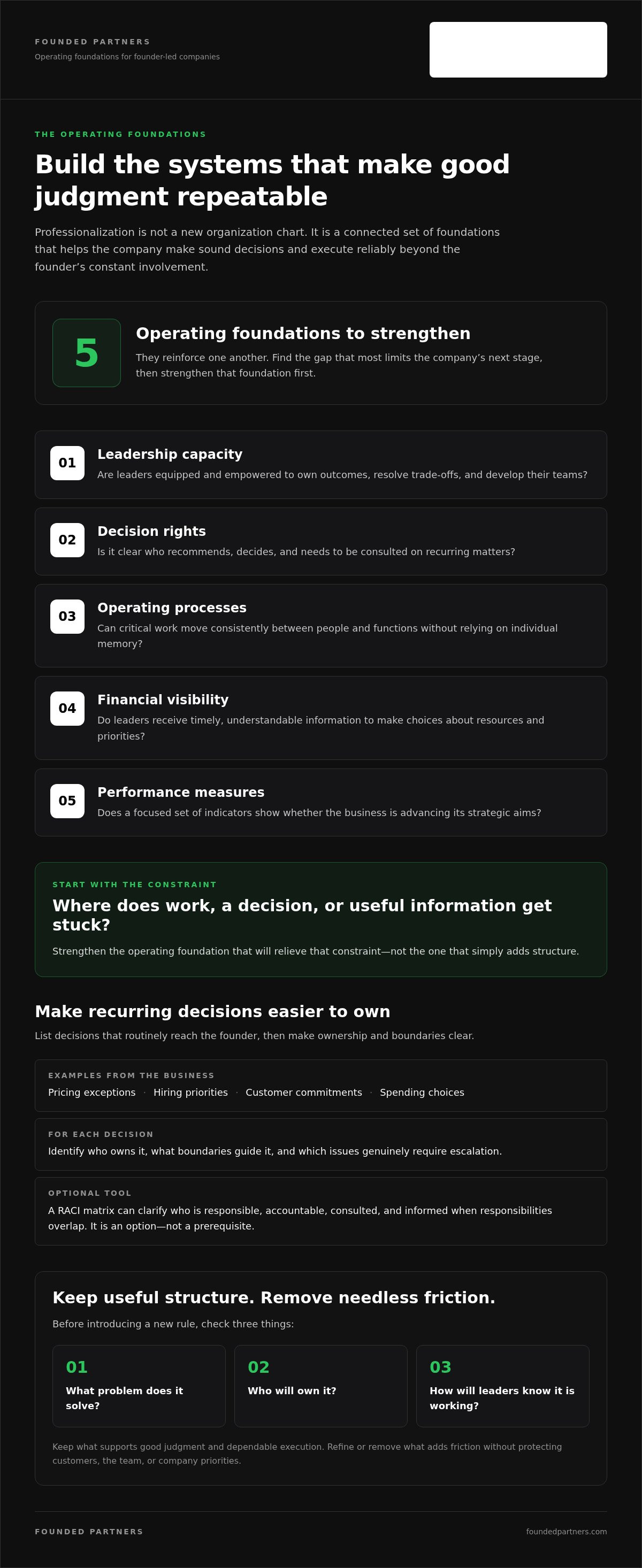
Before introducing a new rule, ask what problem it solves, who will own it, and how leaders will know it’s working. Keep what supports good judgment and dependable execution. Refine or remove what adds friction without protecting customers, the team, or the company’s priorities. That’s how structure can carry the founder’s intent forward rather than crowd it out.
The Operating Foundations a Founder-Led Company Needs to Strengthen
Professionalization works best as a connected set of operating foundations, not a new organization chart. Leadership capacity, decision rights, processes, financial visibility, and performance measures reinforce one another. If people have responsibility but lack timely information, decisions stall. If processes are clear but no one owns them, they drift. The practical question isn’t whether every foundation is fully built; it’s which gap most limits the company’s next stage.
Professionalization starts with the constraint, not the organization chart. To determine how to professionalize a founder-led company, assess where work, decisions, or useful information currently get stuck. Then strengthen the foundation that will relieve that constraint.
- Leadership capacity: Are leaders equipped and empowered to own outcomes, resolve trade-offs, and develop their teams?
- Decision rights: Is it clear who recommends, decides, and needs to be consulted on recurring matters?
- Operating processes: Can critical work move consistently between people and functions without relying on individual memory?
- Financial visibility: Do leaders receive timely, understandable information to make choices about resources and priorities?
- Performance measures: Do a focused set of indicators show whether the business is advancing its strategic aims?
Roles, decision rights, and management information
Start by listing recurring decisions that routinely reach the founder, such as pricing exceptions, hiring priorities, customer commitments, or spending choices. For each, identify who owns the decision, what boundaries guide it, and which issues genuinely require escalation. A RACI matrix, which clarifies who is responsible, accountable, consulted, and informed, can help when responsibilities overlap. It’s an option, not a prerequisite. The aim is shared understanding, not a more elaborate chart.
Then give decision-makers a concise, consistent view of the facts that matter. Depending on the decision, that might include current priorities, delivery status, customer concerns, or financial trends. Information should support action, not become a reporting burden. Agree on who prepares it, who reviews it, and what follow-up a concerning change requires.
Repeatable operations and financial visibility
Trace important workflows from beginning to end, especially those involving handoffs, customer commitments, or recurring delays. Note which steps exist only in someone’s memory, where work waits for clarification, and where outcomes vary between teams. First document the essential sequence, owner, and exception path. Then refine the process with the people doing the work so the guidance reflects actual operating conditions.
Timely financial reporting helps leaders understand whether plans remain achievable and where resources may need to shift. Pair that visibility with a small set of KPIs tied to strategic priorities. If the priority is dependable delivery, for example, choose a measure that reflects delivery performance rather than one that merely looks impressive. Review the measures regularly enough to spot a change and decide what action follows.
Quick diagnostic: Ask leaders to identify the business’s most important recurring decisions, workflows, and measures. If their answers differ, ownership or expectations may be unclear. If no one can explain the financial picture or connect reported KPIs to priorities, information may be limiting sound action. Start with the clearest, most consequential gap, then reassess as the business evolves. Founded Partners connects strategic aims with operating improvements through business transformation advice tailored to the organization.
Can You Professionalize Without Losing the Founder’s Culture?
Yes. Well-designed structure can protect the founder’s intent by helping people apply it consistently, especially when the founder isn’t present. The key is to build around the work the company actually does, not impose procedures just to look more formal. Professionalization enables people to use sound judgment; bureaucracy replaces judgment with steps that don’t serve the work.
Culture isn’t preserved by slogans alone. People learn what matters from leaders’ behavior, the decisions the company rewards, and the trade-offs it accepts. If a founder values exceptional customer care, for example, leaders need to know how to balance that principle with delivery commitments and business priorities. Clear decision boundaries can help them act on the principle without escalating every customer issue.
Keep the founder’s strengths while distributing ownership
Start by naming the founder’s highest-value contributions, such as deep customer understanding, long-term vision, or product judgment. Then distinguish decisions where that perspective is essential from routine operating choices others can own. Leaders can carry the founder’s principles into daily work by discussing real examples, explaining the reasoning behind priorities, and recognizing decisions that reflect those values. This makes culture practical rather than dependent on personal access to the founder.
Choose structure that fits the company’s stage
Management cadence and process depth should reflect the company’s complexity, risk, and growth priorities. A team coordinating a few closely connected activities may need only clear owners and regular check-ins. As responsibilities, locations, or consequential commitments multiply, written handoffs, defined review points, or more formal escalation paths may improve reliability. Add structure where it reduces confusion or risk; reconsider it when it creates delay without a clear benefit.
The same principle applies to oversight. A board can contribute perspective and challenge strategic assumptions, while management remains responsible for leading day-to-day operations. Clear expectations about what belongs in board discussions and what belongs with management help preserve useful oversight and operational momentum. Founders preparing for that relationship can explore founder board management strategies as part of shaping how governance supports the company’s direction.
To assess whether a proposed routine supports the culture, ask:
- Does it help people make decisions consistent with the company’s principles?
- Does it clarify ownership or improve a meaningful customer or operating outcome?
- Can the process be simplified without losing its purpose?
These questions keep structure in service of the company rather than making it an end in itself. For leaders considering how to professionalize a founder-led company, the aim isn’t to preserve every informal habit. It’s to carry forward the founder’s most valuable judgment while giving the team enough clarity to act with confidence.
How to Professionalize a Founder-Led Company in Practical Stages
Professionalization is easier to sustain when leaders treat it as a sequence of decisions and observable improvements, not a deadline-driven reorganization. The right pace depends on the company’s priorities and constraints. Each stage should leave behind something leaders can see: an agreed direction, a clearer view of what is holding execution back, or a routine that works more reliably.
Start with the strategic priorities and operational bottlenecks
Before redesigning roles or workflows, agree on what the company needs to accomplish next. Then look for evidence of what makes progress difficult: delays, rework, approval queues, recurring customer issues, or decisions that routinely wait for the founder. Choose a small number of constraints to address, focusing on those most closely connected to the agreed direction.
- Align on priorities. Clarify the outcomes that matter to the business now, and record the leadership team’s shared view of what should take precedence when trade-offs arise. The output is a concise set of priorities that guides decisions across functions.
- Diagnose constraints. Trace a consequential workflow or decision from start to finish. Use available evidence, such as handoff delays or unresolved approvals, to identify where execution stalls. The output is a specific description of the constraint and its effect, not a broad diagnosis like “communication needs work.”
- Assign owners. Name the leader accountable for addressing the selected constraint. Clarify what decisions that person can make independently, what information they need, and which exceptions should be escalated. The output is clear ownership and practical decision boundaries.
- Improve a core routine. Pilot a focused change in one consequential workflow before applying it more widely. For example, establish a clear owner and escalation path for a customer handoff. The output is a tested routine, along with feedback from the people using it.
- Review and refine. Compare results with the starting point, discuss unintended effects, and decide whether to adjust, extend, or stop the change. The output is a recorded decision based on evidence and operating experience.
Assign owners, establish routines, and learn from results
Accountability becomes useful when owners have both responsibility and room to act. Set a management cadence suited to the work, with time to review performance, emerging risks, and unresolved decisions. Keep the discussion focused: what changed, what needs attention, who will act, and when the team will review the result. Adjust the routine when it creates overhead without improving follow-through.
Choose operational measures that reflect the priority being addressed, and agree on how leaders will interpret them. A measure should prompt a useful question or action, not simply populate a report. Connect progress measures to the intended change so leaders can see whether it is working. As the company grows, Founded Partners’ business transformation and operations optimization work can help leaders assess how operating improvements support sustainable growth.
That is a practical way to approach how to professionalize a founder-led company: build from strategic priorities, test changes in real work, and let evidence guide the next step. To connect operating improvements with your company’s direction, discuss your transformation priorities with Founded Partners.
When Advisory Support Can Help Professionalize a Founder-Led Business
An outside perspective can be useful when leaders agree that the company needs to operate differently but can’t settle on what to address first. Competing priorities, stalled execution, or a consequential growth, capital, or ownership transition can make it difficult to distinguish the underlying constraint from its symptoms. Advisory support gives leaders a structured way to connect strategic aims with operating improvements and leadership decisions.
That doesn’t mean handing responsibility for change to an adviser. A useful engagement helps the leadership team build clarity and ownership: what the company is trying to achieve, which operating capabilities matter, and where decisions or execution need to improve. The right scope depends on the company’s context, not a standard transformation template.
What a focused transformation effort should align
A focused effort connects the business’s desired direction with the capabilities and leadership responsibilities needed to pursue it. Leaders can clarify which decisions, workflows, and measures are central, then consider how they need to change together. For example, a new growth priority may call for clearer ownership across teams as well as better visibility into the work required to deliver it.
Collaboration matters. Advisers can help frame questions, surface trade-offs, and support planning, while company leaders contribute their knowledge of customers, people, and operations. Decisions and routines should make sense to the people who will use them. That builds internal ownership and helps improvements continue as part of the company’s work, rather than depending on an external adviser to keep them moving.
Preparing for growth, capital, or a future transition
More dependable operations can give leaders a stronger basis for pursuing growth: responsibilities are clearer, important work is easier to assess, and management can make decisions with a better view of the business. Those foundations don’t guarantee a particular outcome. They help the company consider opportunities with greater operational awareness and align its plans with the capacity it has or needs to build.
Capital raising support may be relevant when financing is part of the company’s strategic plans. Exit planning may matter when founders are considering a future ownership transition. These are distinct considerations, and neither should be treated as the automatic next step in professionalization. Founded Partners provides capital raising support and exit planning for founder-led organizations pursuing these strategic priorities.
Founded Partners advises founder-led organizations on business transformation and operations optimization, tailoring the work to the company’s strategic aims and operating context. If you’re weighing how to professionalize a founder-led company, aligning priorities, leadership decisions, and operating improvements can help clarify the next stage.
Build a Company Ready for What Comes Next
The next stage of a founder-led business asks a different question: not only what can the founder accomplish, but what can the organization sustain together? That shift creates room for leaders to take greater ownership, for the company to respond consistently, and for the founder’s vision to endure beyond their daily involvement.
Learning how to professionalize a founder-led company is ultimately about building lasting capacity without losing what makes the business distinct. Progress doesn’t require solving every organizational challenge at once. A clear view of the company’s ambitions and the changes that matter most can help leaders make thoughtful choices about what to strengthen next.
Founded Partners is a privately owned boutique consultancy led by partners Adam and Matt, working with founder-led organizations on consequential growth and transitions. If you’re considering what your company needs for its next stage, Discuss the next stage of your company with Founded Partners.
Your vision can remain the company’s compass while the organization grows stronger around it.
Frequently Asked Questions
What does it mean to professionalize a founder-led company?
It means creating ways for the company to make and carry out decisions consistently without requiring the founder to personally guide every task. In practice, a team lead might handle a customer request using agreed principles, while bringing unusual commitments to the founder. Understanding how to professionalize a founder-led company starts with identifying where greater clarity would help people act confidently and protect the company’s priorities.
Is professionalizing a company the same as hiring a professional CEO?
No. Hiring a CEO is one possible leadership decision, while professionalization concerns how the company is managed and operated. A founder may remain CEO and strengthen leadership responsibilities, reporting, and decision practices around them. Another company may decide a different leadership arrangement suits its needs. Before considering a new executive, clarify which responsibilities require different capacity and whether existing leaders can own them with clearer authority or support.
Can a founder delegate decisions without losing control of the business?
Yes. Delegation can give leaders authority within boundaries the founder agrees to. For example, a functional leader might approve routine customer accommodations within established limits, while the founder retains input on commitments that affect strategy or reputation. Make the boundaries explicit, and review how delegated decisions are working. Control needn’t mean approving every choice; it can mean setting direction, defining guardrails, and staying informed about decisions that matter most.
When should a founder-led company start professionalizing?
Start when the current way of working repeatedly prevents the company from delivering its priorities. Signals might include the founder becoming the default approver, important work pausing during their absence, or leaders giving customers different answers to the same request. A company doesn’t need to wait for a particular size or growth milestone. One recurring point of friction is enough reason to examine what clarity or ownership would improve.
How long does it take to professionalize a founder-led company?
There’s no fixed timeline. The effort depends on the company’s starting point, the complexity of its operations, and how much leadership alignment is needed. Clarifying ownership for one recurring decision may be relatively contained; changing several connected workflows takes more coordination and learning. Rather than promise a completion date, define observable milestones, such as leaders using an agreed routine independently and reviewing whether it supports the intended outcome.
Does a founder-led business need a board before professionalizing?
No. A board isn’t a prerequisite for improving how the company operates. Founders can begin by strengthening internal management and clarifying how leadership decisions are made. A board may become relevant as the company’s governance needs or strategic context evolve, but it serves a different purpose from day-to-day management. First identify the guidance, oversight, or expertise the business needs, then consider what structure best supports those needs.
What should a founder document first when making the company less dependent on them?
Start with decisions that repeatedly return to you, especially where others lack the context to act. Record the decision’s purpose, the factors you weigh, what a leader can decide independently, and which exceptions merit escalation. A short decision guide can be more useful than a lengthy manual. Test it with a leader handling real work, then clarify any points that still require your intervention.