

Operational investment is easier to support when it’s presented as a series of manageable decisions, not a single leap. Convincing your board to invest in operations starts with a focused first phase, clear measures of progress, and a plan to learn before scaling. Show how the change could free staff time for higher-value work, then connect those gains to board priorities.
Board members are right to ask what the investment will solve, how disruption will be managed, and when results may become visible. A sound proposal welcomes these questions. It treats caution as a useful part of governance while making the operational costs of standing still visible too.
This article explains how to phase operational change, address common objections, and demonstrate staff-time savings without overstating the case. You’ll also learn how to tailor the discussion to board members’ priorities, connecting day-to-day improvements with the organization’s wider goals.
Key Takeaways
- Start with a contained operational pilot, map the workflows it touches, and define what progress will look like before expanding the change.
- Address board concerns with a clear case for value, a realistic view of implementation risks, and evidence suited to the proposal.
- Translate repetitive manual work into staff time and salary-based value to show how better operations can support mission-focused work.
- Frame the proposal around board members’ priorities, linking operational improvements to the organization’s broader goals and resilience.
1. Phased implementation and change management
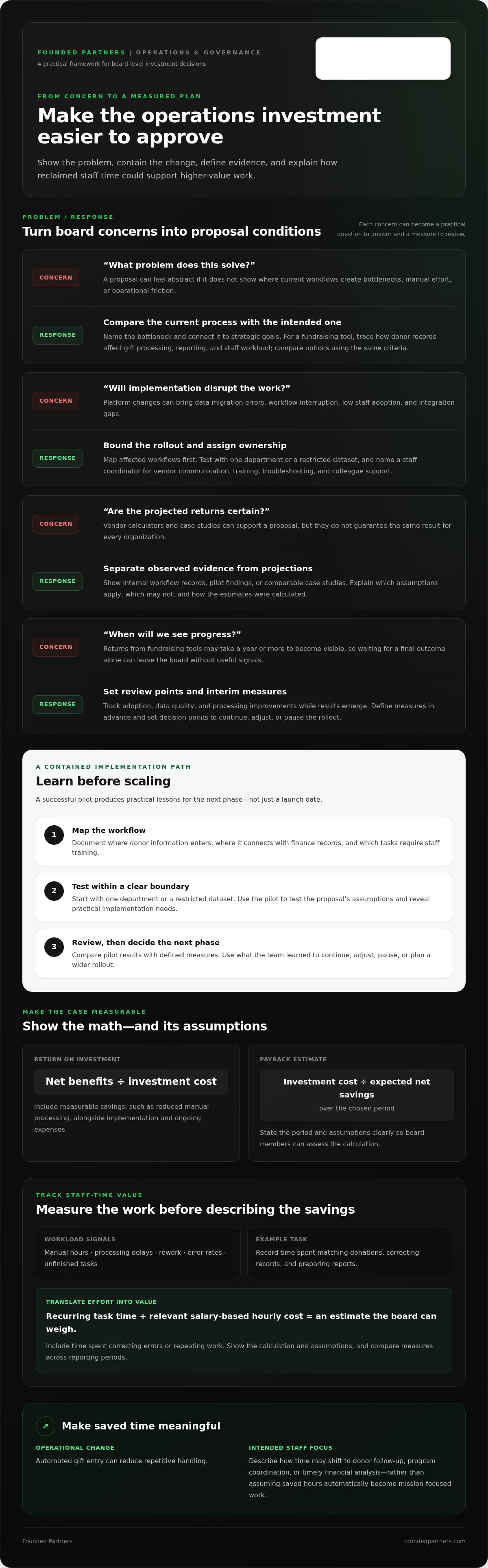
Compare operations proposals by the problem each solves, their impact on staff, integration needs, and expected benefits. Prioritize projects that address a clear bottleneck, support strategic goals, and can be tested before wider rollout. For example, compare a fundraising tool with a data-management improvement by tracing how each could change gift processing, reporting, and staff workload.
Map the affected workflows before selecting a pilot. For a fundraising platform, document how donor information enters the system, where it connects with finance records, and which tasks require staff training. Test the platform with one department or a restricted dataset before expanding it. Assign a staff coordinator to manage vendor communication, training, troubleshooting, and colleague support. A successful pilot yields practical lessons for the next implementation phase, not just a launch date.
Calculate ROI by dividing the net benefits of the investment by its cost. Estimate payback by dividing the investment cost by expected net savings over the chosen period. Include measurable savings, such as reduced manual processing, alongside implementation and ongoing expenses. State assumptions clearly so board members can assess the calculations.
A strong investment proposal connects the problem, evidence, risks, and measures of progress. Include current workflow data, projected changes in staff time, integration requirements, training needs, and pilot results where available. For fundraising tools, explain how better data management supports gift tracking and reporting. Set review points so the board can assess progress against the proposal’s defined measures.
Separate operational project decisions from the management of organizational investments. A nonprofit board may delegate investment management and the selection of specific investments while retaining responsibility for oversight. Use an investment policy to define goals and acceptable risk, then review advisor performance and alignment with the policy regularly. The board’s role is oversight, not selecting individual investments. Treat approval for fundraising investment as an ongoing conversation, supported by updates as results emerge.
2. Addressing board objections
Build the business case around the operational problem, the proposed change, and its strategic value. Compare the current process with the intended one, then explain how success will be measured. For example, a fundraising tool proposal can link cleaner donor records with more reliable reporting and less manual reconciliation.
Use evidence the board can examine: internal workflow records, pilot findings, vendor ROI calculators, or case studies from comparable organizations. Distinguish observed results from projections and explain the assumptions behind each estimate. Returns from fundraising tools may take a year or more to become visible, so include interim measures such as adoption, data quality, and processing improvements.
Answer “Why invest now?” by describing the cost of continuing the current process, including staff effort and operational friction. Answer “Why this option?” by comparing alternatives against the same criteria: strategic fit, implementation demands, expected benefits, and disruption risk. A concise comparison makes trade-offs clear without presenting projections as guaranteed outcomes.
Include risks and mitigations in the proposal. For a platform change, consider data migration errors, workflow interruption, low staff adoption, and integration gaps. Mitigate these risks with a limited pilot, data checks, staff training, a named implementation owner, and clear escalation steps. Set decision points for continuing, adjusting, or pausing the rollout.
Invite questions and record which evidence would resolve them. If a director doubts the time savings, identify the relevant task and track its workload before and during the pilot. If the concern is disruption, explain the rollout boundary and support plan. This turns objections into practical conditions for approval and keeps board oversight focused on results. For complex proposals, structured operational change planning can help clarify the case and its implementation risks.
When using vendor ROI calculators or case studies from comparable organizations, explain which assumptions apply to your proposal and which may not. Present this material as supporting evidence, not as a promise of a particular return. Connect each estimate or example to the operational change under consideration, and clarify what the board should assess before relying on it. This gives directors a focused basis for judging the proposal while keeping expectations measured.
3. Staff time savings and mission-focused work
Track manual hours, processing delays, rework, error rates, and unfinished tasks to show where operations constrain the organization’s work. For example, a finance team can record time spent matching donations, correcting records, and preparing reports. Compare these measures across reporting periods to reveal persistent workloads, not just isolated busy days.
Estimate the cost of inefficiency by identifying a recurring task, recording staff time, and applying the relevant salary-based hourly cost. Include time spent correcting errors or repeating work, then show the calculation and assumptions. This converts manual effort into a dollar value the board can weigh against the proposed operational investment.
Time savings matter when they change what employees can accomplish. If automated gift entry reduces repetitive handling, staff may redirect time to donor follow-up, program coordination, or timely financial analysis. Describe the intended shift in responsibilities rather than assuming that saved hours automatically become mission-focused work.
Pair workload measures with service and quality indicators. A growing queue of unprocessed requests, repeated corrections, delayed reports, or inconsistent records can signal operational strain. For example, compare how often staff must revisit a record with how reliably information reaches the people who need it. These measures connect internal friction to consequences across the organization.
Present the evidence as a clear chain: identify the task, establish its current burden, explain the operational change, and define what you’ll measure afterward. Distinguish time recovered from outcomes that still require staff judgment. A fundraising team may spend less time reconciling donor data, but relationship-building still depends on thoughtful human attention. This helps board members see where investment can free capacity without overstating what technology or process improvements can achieve.
Show how managers will use the capacity freed up. Name the work that receives priority, such as donor stewardship or program support, and track whether staff can complete it more consistently. Connecting workload evidence to organizational purpose makes the investment case tangible: the aim is not simply to reduce administrative tasks, but to strengthen capacity for the work they support. Working with experienced nonprofit capacity building consultants can also help teams design sustainable operational structures and ensure that reclaimed hours translate into lasting mission impact.
4. Understanding board members’ motivations
Board members may evaluate an operational proposal from different perspectives. One may focus on financial resilience, another on organizational growth, and another on mission delivery. Before presenting, review the organization’s stated strategy, recent board discussions, and each member’s area of responsibility. This preparation helps you frame the investment in terms that matter to different members.
Connect the proposed change directly to a strategic priority. If the organization plans to scale, explain how clearer workflows can support increased demand without adding avoidable complexity. If reliability is the priority, show how stronger data management can improve decision-making. If mission delivery comes first, explain how less manual work could create more capacity for programs or customers.
To link an operations investment to board priorities, map its expected outcomes to goals the organization has already adopted. State which priority it supports, what operational change enables it, and what evidence will show progress. Don’t present efficiency as an end in itself; explain what the organization can do better with the capacity it gains.
Research the goals and investment criteria of potential investors before approaching them. Apply the same discipline to a board discussion: understand members’ concerns, decision criteria, and tolerance for operational risk. A finance-focused director may want transparent assumptions, while a growth-focused member may want to know how the change supports future capacity. Address both with one consistent proposal, not competing promises.
Make the discussion specific to each member’s perspective without changing the underlying facts. Use a short briefing that links the strategic objective, operational change, risks, and measures of progress. Invite members to identify unresolved trade-offs, then record how those concerns will inform oversight. This creates a shared basis for evaluating the proposal over time. If the organization needs help aligning operational priorities with its strategy, work through strategic alignment with an experienced advisor.
When planning implementation, consider whether a nonprofit can assign a dedicated staff member to coordinate vendor communications, training, troubleshooting, and staff support during a technology transition. This gives board members a concrete way to discuss responsibility for adoption alongside the operational proposal, including how that role fits the organization’s priorities and oversight expectations.
Founded Partners: Capital raising support
Founded Partners provides capital raising support for founder-led organizations seeking investment to advance strategic priorities. When a phased operations plan requires external capital, this support can help clarify the growth objective and shape a coherent investment case. Connect funding needs to operational milestones, expected capacity, and the organization’s broader direction.
For organizations reassessing how they operate before pursuing investment, Founded Partners’ Business Transformation Consulting can help frame the wider change. The right next step depends on whether the priority is strengthening operations, preparing for growth, or building an investment case. A clear understanding of those needs can make board discussions more focused and grounded.
Contact Founded Partners to discuss capital raising support for your organization’s goals.
Make the next decision with purpose
Board approval isn’t the finish line. It creates an opportunity to strengthen how the organization makes decisions, allocates resources, and prepares for its next stage. Convincing your board to invest in operations is an ongoing leadership practice: translate board priorities into clear ownership, define how progress will be reviewed, and decide when to assess what comes next.
Founded Partners supports founder-led organizations through capital raising support, Business Transformation Consulting, and exit planning. These services can help leaders connect operational priorities with broader strategic or transaction goals, whether they’re building capacity or preparing for a future transition. As you continue convincing your board to invest in operations, keep the discussion tied to the organization’s direction and the decisions ahead.
If you’re ready to explore how those priorities fit together, contact Founded Partners. A thoughtful next step can help turn board alignment into durable progress.
Frequently Asked Questions
How should I present an operations investment proposal to a board?
Present the proposal as a business decision, and show how convincing your board to invest in operations supports strategic priorities. Explain the operational constraint, its likely effect, the proposed change, and how progress will be assessed. For example, link recurring delivery delays to growth capacity, then outline process and ownership changes that could address them. Include assumptions, risks, alternatives, and the decision you’re requesting. Founded Partners’ Operations Optimization support can help clarify the operational rationale.