
De-Risk Your Business for Acquisition: A Founder’s Guide

What if the strongest way to prepare for an acquisition is to make fewer claims and build better evidence? Buyers look beyond a polished growth story to understand whether performance is consistent, relationships can transfer, and the business can operate without the founder at its center. If financial records are unclear or diligence could expose issues late in negotiations, learning how to de-risk your business for acquisition starts with seeing the company through a buyer’s eyes.
It’s natural to focus on presenting the business well. But confidence comes from supporting what you say with clear, credible records. Preparation helps you distinguish material risks from manageable gaps, then address the issues that matter most before a transaction process begins.
This guide explains what buyers commonly examine, how to prioritize improvements, and what evidence to organize in advance. From financial reporting and customer concentration to founder dependence and operational continuity, you’ll learn how to strengthen the business itself, not just its presentation, and enter acquisition discussions with greater clarity.
Key Takeaways
- De-risking means reducing avoidable uncertainty, not trying to make the business risk-free.
- Map financial, commercial, operational, leadership, technology, and documentation exposures. For each risk, record its impact, owner, evidence, controls, and next action.
- Assess and prioritize risks by their effect on business continuity, performance, buyer verification, and the time needed to address them.
- Strengthen transferability and support management claims with consistent records and clear accountability.
- Coordinated exit planning and business transformation can help align practical fixes with longer-term priorities.
De-Risk Your Business for Acquisition: A Balanced Approach
De-risking means reducing avoidable uncertainty for a potential buyer, not eliminating every risk from the company. It can make the business easier to understand and assess, but it can’t guarantee buyer interest, favorable deal terms, or a completed transaction.
Historical performance matters, but it doesn’t tell the whole story. A buyer also needs to judge whether results can continue, whether key relationships and responsibilities can transfer, and whether the company’s claims can be verified. That investigation, known as due diligence, examines both the business and the evidence behind its performance. The aim is to strengthen the underlying operation and make its condition clear.
What does acquisition de-risking mean for a founder-led company?
A risk is an uncertainty that could affect continuity, performance, or a buyer’s ability to verify what the company says about itself. Some risks are operational: a vital customer relationship may depend almost entirely on the founder. Others are evidentiary: the relationship may be shared across the team, but records of its history and terms may be scattered or difficult to access.
These are different problems and call for different responses. The first may require building broader customer ownership; the second may call for organizing existing records. Incomplete evidence can also make a manageable issue appear harder to assess. If reports show inconsistent figures from one period to another, a buyer may struggle to distinguish normal variation from a deeper performance concern. Clear documentation doesn’t erase a business issue, but it can clarify its scope and show how it is being addressed.
Why start before a buyer begins diligence?
Early preparation gives leadership time to investigate root causes, assign responsibility, and determine whether a change is working. A rushed explanation during negotiations may clarify what happened, but it’s less persuasive than a sustained improvement supported by consistent records. Cosmetic changes can create the appearance of readiness without resolving the underlying uncertainty.
Start by asking what a buyer would need to understand, verify, and rely on after a transition. Then give the business time to build sound processes and evidence around those questions. De-risking is most useful when it strengthens the company for its next stage, whether or not a transaction happens on a particular timeline. For a broader framework for preparing for a transition, explore the Exit Planning for Founders guide.
Which Acquisition Risks Should You Examine Across the Business?
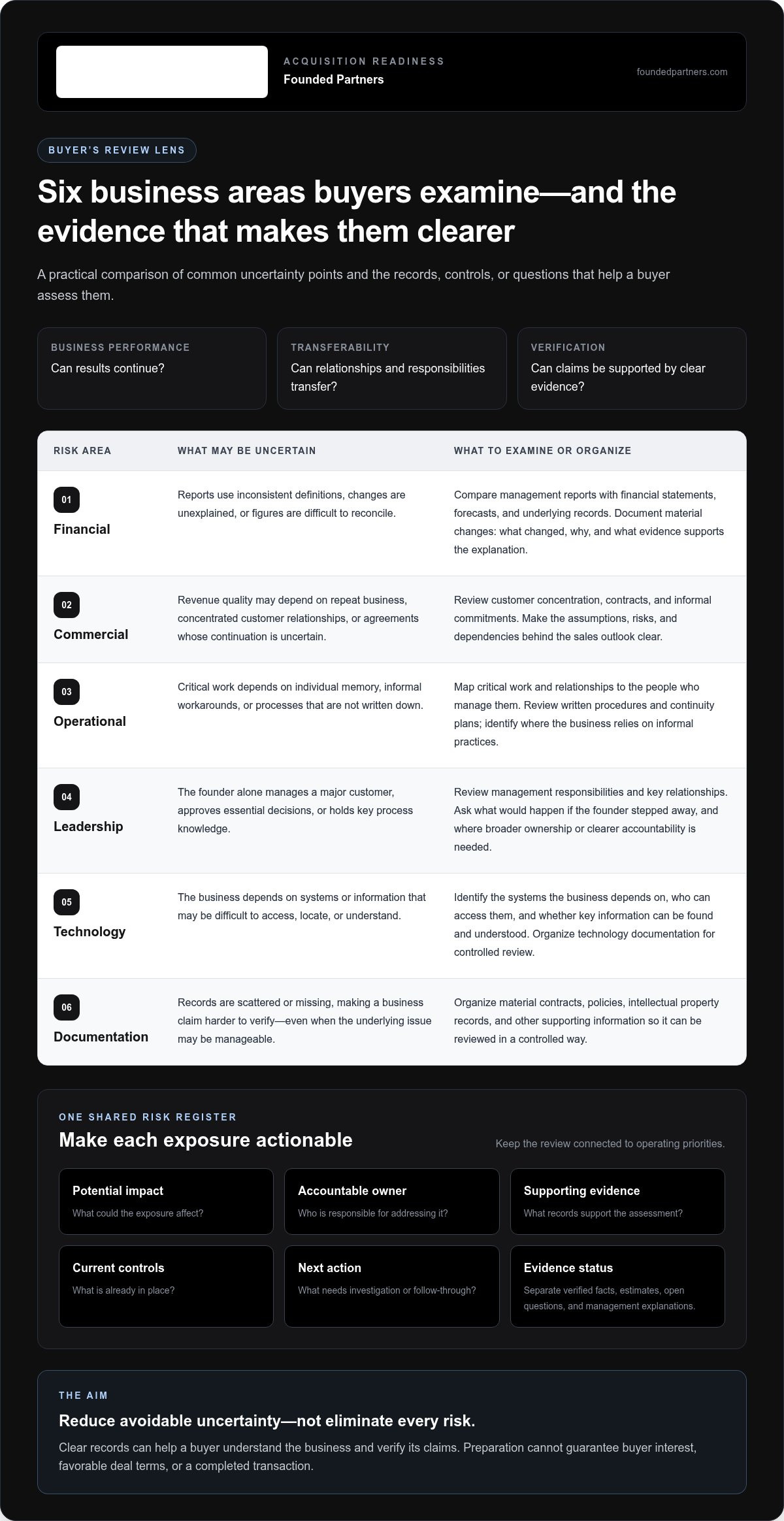
A useful risk review is broad enough to reveal connections, but disciplined enough not to label every imperfection a deal-breaker. Examine financial, commercial, operational, leadership, technology, and documentation exposures. For each item, record its potential business impact, accountable owner, supporting evidence, current controls, and next action. Buyer diligence typically tests both business performance and the evidence supporting it.
Keep the status of each statement clear. Separate verified facts from estimates, unresolved questions, and management explanations. A forecast, for example, is an estimate based on assumptions, not a verified result. Labeling information accurately helps leadership identify what needs investigation and gives a future buyer a clearer basis for review.
Where can financial and commercial uncertainty appear?
Compare management reports with financial statements, forecasts, and underlying records. Look for inconsistent definitions, unexplained changes, or figures that are difficult to reconcile. Then examine revenue quality: how much comes from repeat business, whether key customer relationships are concentrated, and whether contracts or informal commitments are likely to continue. A strong sales outlook still needs a clear explanation of its assumptions, risks, and dependencies.
For each material change in performance, document what changed, why, and what evidence supports the explanation. Harvard Business School’s discussion of positioning yourself for a strong finish is a useful prompt for considering how a buyer will understand the company’s value, not just its headline results. Present projections as projections, with their assumptions visible, rather than as guaranteed outcomes.
How can operations, leadership, and documentation create risk?
Map critical work and relationships to the people who manage them. If the founder alone handles a major customer, approves essential decisions, or holds key process knowledge, ask what would happen if that person stepped away. Review management responsibilities, continuity plans, systems access, and written procedures. Look for places where the company relies on individual memory or informal workarounds.
Technology and records deserve the same practical review. Identify the systems the business depends on, who can access them, and whether key information can be located and understood. Organize material contracts, policies, intellectual property records, and technology documentation for controlled review. A missing record doesn’t always mean an underlying problem exists, but it can make a claim harder to verify.
To make how to de-risk your business for acquisition actionable, maintain one risk register across these areas. A simple table can capture the exposure, evidence status, impact, owner, current control, and next step. This keeps the review connected to operating priorities instead of turning it into a folder-building exercise. Founders seeking structure across interconnected priorities can explore Founded Partners’ advisory approach.
How to Prioritize Acquisition Risks Before They Become Diligence Surprises
A risk inventory becomes useful when it leads to decisions. Use a consistent sequence: inventory exposures, assess their impact, assign an owner, take action, and preserve evidence of progress. This creates a working plan rather than a static list, helping leadership focus effort where uncertainty could most affect the business or a buyer’s ability to assess it.
How do you rank risks by materiality and readiness?
Use a high, medium, or low rating, and record why each item received that rating. Consider four factors together: likelihood, potential business impact, visibility to a buyer, and the effort or time required to address it. The rating is a prompt for judgment, not a precise prediction.
Escalate issues that could interrupt revenue, service delivery, reporting reliability, or leadership continuity. For example, an unresolved reporting control that affects the reliability of monthly results may need immediate attention. A longer-term opportunity to improve an already functioning process can be planned separately. This distinction keeps urgent control failures from competing with valuable but less time-sensitive improvements.
What belongs in a focused remediation plan?
For each priority, specify an accountable owner, the next action, a target review date, and the evidence needed to show progress or closure. “Improve reporting” is too broad to manage. A more useful action might be to reconcile a defined set of reports, document the method, and review whether the next reporting cycle follows it consistently.
Keep unresolved items visible. Record the issue, the response underway, who is responsible, and what evidence supports the current status. Don’t hide a problem or mark it resolved before the evidence is there. If new facts change the assessment, update the rating and explain why. Transparency gives leaders a sound basis for decisions and prevents old assumptions from quietly shaping the plan.
Review the plan regularly, not only when a transaction approaches. Look for evidence that a control works in practice, whether a dependency has been reduced, and whether the original risk has shifted. The guide to measuring transformation success offers a useful perspective on tracking whether an improvement is taking hold. A measured process for how to de-risk your business for acquisition turns remediation into an ongoing discipline: identify what matters, act with accountability, and retain proof that the work is progressing.
How to Strengthen Transferability, Reporting, and Buyer Confidence
A business is easier to assess when its performance and day-to-day operations don’t depend on one person’s memory. Documented processes, dependable reporting, and relationships shared across the team help show how the company works and whether it can continue through a transition. Transferable operations and credible documentation give buyers clearer evidence to assess and reduce avoidable uncertainty.
How can a founder reduce key-person dependency?
Start by mapping where decisions, customer relationships, approvals, and operating knowledge are concentrated. Look beyond formal job titles: the founder may resolve exceptions, know why a process works a certain way, or hold the context behind an important customer relationship.
Delegate appropriate responsibilities gradually, keeping essential relationships supported while another team member develops ownership. Document repeatable processes and clarify who can make which decisions. The goal isn’t to remove the founder abruptly. It’s to demonstrate leadership depth, clear accountability, and continuity beyond the founder’s direct involvement.
How should evidence and diligence materials be organized?
Build a controlled, logically organized repository that reflects the company rather than assuming every buyer will use the same checklist. Group records into practical areas such as financial, commercial, operational, people, and technology. Give each group an owner, use consistent file names and version control, and make sure current documents can be distinguished from outdated drafts.
Then connect important management claims to source records. If leadership says customer retention is strong, define how retention is measured and ensure the underlying records support the calculation. If a process is followed consistently, retain evidence showing who owns it and how it operates. The distinction matters: “Our reporting is reliable” is an assertion; a defined reporting process, reconciled records, and accountable ownership make it verifiable.
Prepare sensitive materials for controlled access, and maintain an issue log for open questions, missing records, and follow-up actions. This makes it easier to respond carefully without circulating information more broadly than needed. A well-prepared repository is more than a collection of files. It provides a clear path from a claim to its evidence.
This work connects leadership, operations, and evidence into one readiness effort. Founded Partners’ advisory approach brings structure to strengthening transferability and buyer confidence.
When to Bring in Exit Planning Support for Acquisition Readiness
Some readiness work can be owned by the leadership team. Coordinated support becomes valuable when risks are interdependent, internal capacity is stretched, or a transition is approaching and decisions need to move in step. A reporting weakness may connect to unclear operating ownership; founder dependency may affect customer continuity and leadership succession. Treating each issue in isolation can miss how one decision affects another.
Exit planning and business transformation can align practical improvements with the company’s longer-term priorities. Advisory work can bring structure to readiness assessment, leadership alignment, operational priorities, and transition planning. It supports business decisions and execution, but it doesn’t replace legal or tax advice.
What can an advisor help a founder coordinate?
An integrated view connects commercial, financial, operational, and founder-dependency issues. It can help leadership decide which improvements matter most, who will lead them, and how progress will be reviewed. Where governance and oversight shape decision-making, founder board management strategies can help frame the role of the board in providing direction and accountability.
The purpose isn’t to create activity for its own sake. It’s to focus effort on a more resilient, transferable business while keeping transition decisions grounded in the company’s circumstances.
What are practical next steps for the next 90 days?
Use the next 90 days to establish a steady rhythm rather than trying to solve every issue at once:
- Start with a cross-functional inventory. Bring relevant leaders together to identify material risks and agree on accountable owners.
- Review progress regularly. Track remediation, open questions, and whether the evidence behind key claims is becoming clearer and more reliable.
- Reassess priorities. Update the plan as new facts emerge, and connect immediate actions to longer-term business goals.
This creates a practical foundation for how to de-risk your business for acquisition without treating readiness as a last-minute document exercise. If risks are connected or the leadership team lacks capacity to coordinate the work, a structured approach to exit planning and business transformation can help clarify priorities. For the wider transition, explore strategic exit planning for founders.
Build Readiness That Strengthens the Business
Acquisition readiness isn’t about making a company risk-free or polishing a story. It’s about reducing avoidable uncertainty through reliable evidence, stronger transferability, and clear ownership of material risks. A focused inventory and remediation plan help leadership address the issues that matter, track progress, and prepare for informed buyer review.
Understanding how to de-risk your business for acquisition also means looking beyond diligence materials. Consistent reporting, documented operations, and relationships that extend beyond the founder can strengthen the business for its next chapter, whether or not a transaction is imminent. Preparation can improve clarity and resilience, but it can’t guarantee buyer interest or a particular outcome.
Founded Partners advises founder-led organizations on exit planning, business transformation, and operations optimization, helping align readiness work with longer-term priorities. Discuss your acquisition readiness and next steps with Founded Partners.
Start with the next practical step. Each improvement can build a more transferable business and give you greater confidence in the decisions ahead.
Frequently Asked Questions
What does it mean to de-risk a business for acquisition?
De-risking means reducing avoidable uncertainty a buyer may have about the company’s performance, continuity, and ability to operate after a transition. Examine both underlying business issues and the evidence used to explain them. The goal isn’t to make the company risk-free. It’s to address material weaknesses, clarify unresolved questions, and make important claims easier to verify.
How far in advance should you prepare a business for acquisition?
Begin as early as practical, ideally before a sale process is underway. There’s no single preparation timeline that fits every company: the time needed depends on the issues, the business’s capacity to address them, and the nature of a potential transition. Early work gives leaders more room to investigate causes, strengthen processes, and observe whether changes are working. Even if a transition is approaching, an organized review can clarify immediate priorities.
What risks do buyers look for during acquisition due diligence?
Buyers may examine financial reporting, revenue quality, customer concentration, contract continuity, operational resilience, leadership depth, technology dependencies, and the records supporting management claims. The areas that matter most vary by business and buyer. A buyer may ask whether results are consistent, whether key responsibilities can transfer, and whether risks have clear owners and controls. Focus on exposures that could affect performance, continuity, or the ability to verify information.
Can you sell a business if due diligence uncovers problems?
Yes, a problem uncovered during diligence doesn’t automatically prevent a sale. Its effect depends on the issue, its impact on the business, and the buyer’s assessment of the facts and response. Prepare a clear account of what’s known, what remains unresolved, who is addressing it, and what evidence shows progress. Be candid rather than minimizing the issue. A buyer may reassess terms, request further information, or decide not to proceed.
How do you reduce a business’s dependence on its founder before a sale?
First identify where the founder holds essential customer relationships, approvals, operating knowledge, or decision authority. Then delegate appropriate responsibilities, define decision rights, and document repeatable processes. For example, a key customer relationship may be transitioned gradually to a team member while the founder remains involved. Clear accountability and capable leadership beyond the founder help demonstrate that important work can continue through a change in ownership.
Does de-risking a business guarantee a higher acquisition valuation?
No. De-risking can make performance and operations easier to assess, but it can’t guarantee buyer interest, a higher valuation, particular deal terms, or a completed transaction. Buyers weigh many factors, including strategic fit, expected performance, and their own view of risk. Focus on strengthening the business and supporting its claims with credible evidence. Those steps improve preparedness and decision-making, regardless of whether a transaction happens on a particular timeline.
What should be included in an acquisition diligence data room?
A diligence repository may include financial reports and forecasts, customer and supplier information, material contracts, operating procedures, organizational responsibilities, policies, and relevant technology records. The contents should reflect the company and the questions under review, since buyers don’t all follow one identical checklist. Organize materials by topic, assign document owners, maintain version control, and manage sensitive access carefully. Keep an issue log for missing records, open questions, and follow-up actions.