
Managing Employee Morale During a Restructure

A restructure can change reporting lines quickly; trust takes longer to rebuild. Managing employee morale during a restructure means more than delivering announcements. It means being clear about what’s known, honest about what remains uncertain, and consistent as decisions take shape.
If you’re concerned about job security, lost influence, or expectations that keep shifting, those concerns are reasonable. Employees need straight answers, while leaders must keep the business moving without asking remaining teams to absorb work they can’t sustain.
This article offers a practical plan to protect trust and maintain performance through change. You’ll learn how to explain the rationale, establish reliable communication and listening rhythms, treat affected and remaining employees fairly, and spot early signs that morale or capacity is slipping. The principle is simple: morale holds when the restructure is understandable, fair, and workable in practice. Aligning leadership decisions with the realities of daily work helps make that principle visible.
Key Takeaways
- Identify how changes to roles, reporting lines, teams, or operations may affect trust, engagement, and day-to-day work.
- See why reassurance loses credibility when role clarity, workload, or knowledge transfer don’t match leadership’s message.
- Compare morale-building actions by purpose, timing, owner, and the signals that show whether they’re working.
- Use a phased plan for managing employee morale during a restructure, from preparation through stabilization, with clear ownership for updates and follow-up.
- Connect leadership decisions, organizational design, and execution to make the restructure more workable for employees and the business.
Managing Employee Morale During a Restructure Starts With Understanding the Change
A restructure is a material change to how work is organized. It may reshape roles, reporting lines, teams, decision rights, operations, or the workforce. Layoffs can be part of it, but they’re only one possibility. A team might keep the same people and still face a major shift if approval authority moves, responsibilities are redistributed, or departments combine.
These changes affect more than an organization chart. Employees may wonder whether their work still matters, who can make decisions, or whether they’ll be treated fairly. Even a sound strategic rationale can lose credibility if people experience inconsistent explanations, unclear expectations, or disruption without support. The broader discipline of Change management considers how people and organizations adapt to change; morale is one important signal of how that adaptation is going.
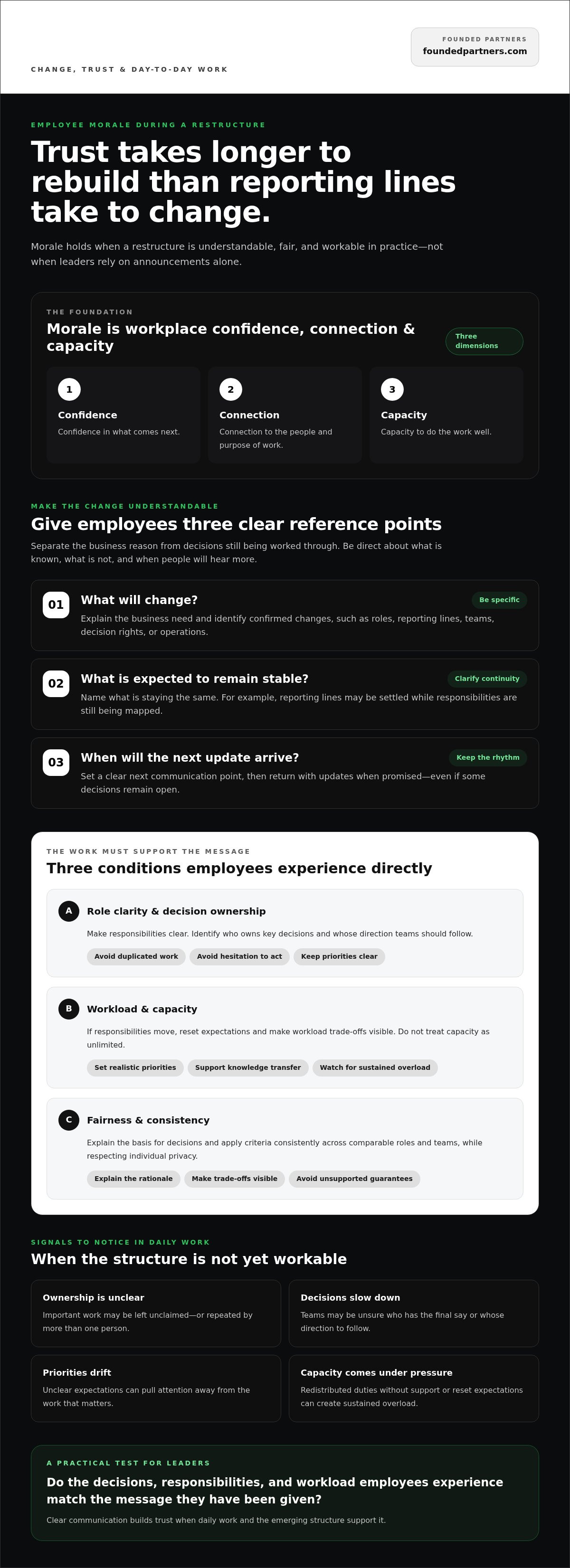
Morale isn’t the same as short-term enthusiasm or visible optimism. Morale is workplace confidence, connection, and capacity: confidence in what comes next, connection to the people and purpose of work, and capacity to do that work well. Leaders can’t remove every concern, especially when decisions are still unfolding. They can respond clearly and consistently, and make sure the emerging structure is workable.
Which parts of a restructure most affect employee morale?
Look beyond headcount. A role redesign may change priorities; a new reporting relationship may alter access to support; revised decision rights may leave employees unsure who has the final say. Workforce reductions can add grief and pressure, while a team merger can unsettle established relationships even when no jobs are lost.
Unclear responsibilities create practical problems: employees may duplicate work, hesitate to act, or focus on the wrong priorities. Timing shapes how these changes are interpreted, too. A late explanation can feel like concealment, while decisions perceived as inconsistent or unevenly applied can weaken trust. Explain the basis for decisions and the process used, while respecting individual privacy.
What employees need to understand before they can adapt
Separate the reason for the restructure from decisions that are still open. Explain the business need in plain language, then distinguish confirmed changes from unresolved details. Employees don’t need false certainty; they need an honest account of what leaders know and what they’re still working through.
Make three things explicit: what will change, what is expected to remain stable, and when the next update will arrive. For example, if reporting lines are settled but role responsibilities are still being mapped, say so and name the next communication point. This gives teams a reliable reference while work continues. For leaders managing employee morale during a restructure, that distinction is a practical foundation for confidence, not a promise that every concern has been resolved.
Why Restructuring Communication Alone Cannot Sustain Employee Morale
A clear message can orient people, but it can’t make an unworkable structure sustainable. Employees judge leadership’s words against what happens next: who owns key decisions, whether priorities are realistic, and how work is distributed. If leaders promise clarity while responsibilities remain contested, reassurance may sound polished but won’t restore confidence.
Communication builds trust when decisions and daily work support the message. That principle connects employee experience to operating conditions. If a restructure removes a role but leaves its responsibilities untouched, the remaining team may face extra work with no clear priorities or handover. If the new structure changes who approves work but teams don’t know whose direction to follow, delays and duplicated effort can follow. The organizational change management perspective also treats implementation as more than an announcement: people need support as the change becomes part of how the business operates.
How uncertainty, workload, and fairness shape morale
Role ambiguity can leave important responsibilities unclaimed while employees assume someone else is handling them. The opposite can happen, too: two people may repeat the same work because ownership is unclear. Either pattern undermines confidence and pulls attention away from priorities.
Work redistribution matters just as much. If one team inherits significant duties while another retains more capacity, employees may see the change as unfair, especially if leaders haven’t explained the rationale or reset expectations. Sustained overload can also raise burnout risk. Employees notice whether decision criteria are applied consistently across comparable roles and teams. Explain the principles behind choices, and make workload trade-offs visible rather than treating capacity as unlimited.
What transparent communication sounds like in practice
Transparency doesn’t mean having every answer on day one. It means separating what’s decided from what’s still being assessed, explaining the business rationale in plain language, and returning with updates when promised. Avoid unsupported guarantees about job security, timing, or outcomes. A confident but inaccurate assurance can damage trust more than an honest statement of uncertainty.
- What we know: “The teams will be combined, and the new reporting structure is set.”
- What remains unresolved: “We’re still reviewing how responsibilities will be divided.”
- What happens next: “We’ll share an update at the next scheduled team briefing, including what has changed and what is still open.”
Then check whether the operating model supports the message. Are managers able to answer questions? Do employees have clear decision boundaries and realistic priorities? For leaders working through complex transitions, leadership advisory support can help align the rationale for change with organizational design and execution.
Which Morale-Building Actions Matter Most During a Restructure?
Choose actions based on what employees are experiencing, not on a generic checklist. Regular updates won’t solve an overloaded team’s capacity problem, and recognition won’t clarify who has authority to make a decision. Morale is both a human responsibility and a useful indicator of whether the new operating model is workable.
A qualitative case study on the effects of organizational restructuring on university employees' behavior examines how restructuring can shape employee experience. The practical takeaway for leaders is to listen for the concern beneath a morale signal, then match the response to its cause.
Match each morale action to the problem it can address
Use this comparison to set priorities and make ownership visible. Time each action to when employees face the issue, and choose a signal that shows whether the action is helping.
- Predictable communication: Reduces uncertainty through direct answers and scheduled updates. Use it before and during key decisions; the accountable leader owns the message. Monitor recurring unanswered questions and whether employees know where to find updates.
- Manager support: Helps teams interpret changes and raise concerns close to the work. Brief managers before announcements and equip them for follow-up; senior leaders own that preparation. Monitor whether managers can explain priorities consistently and escalate unresolved issues.
- Workload redesign: Addresses pressure created by redistributed or newly combined responsibilities. Review capacity as duties shift; functional leaders own trade-offs and role clarity. Monitor missed handoffs, competing priorities, and work that has no clear owner.
- Employee listening: Surfaces concerns that leaders may not see from the organization chart. Use focused conversations or feedback channels during transition; managers or designated leaders own closing the loop. Monitor recurring themes and whether employees see action on feedback.
- Practical transition support: Helps people adapt to new workflows, relationships, or responsibilities. Provide it as the change takes effect; team leaders own identifying the support needed. Monitor whether employees can carry out new responsibilities with confidence.
Why symbolic gestures cannot replace operational fixes
Recognition can matter, but a celebratory message may feel hollow if responsibilities remain unclear or essential work keeps accumulating. Communication helps employees understand decisions; it can’t substitute for fair criteria, manageable priorities, or roles people can perform.
When managing employee morale during a restructure, treat feedback as a test of whether the response fits the problem. If employees say they don’t know which work takes precedence, clarify priorities before adding another morale event. If trust is low, explain decision criteria and demonstrate consistent follow-through. No single action will protect morale across every team or restructure. A stronger approach is to identify the concern, assign an owner, act, and check whether conditions improve.
A Practical Plan for Managing Employee Morale During a Restructure
A reliable plan turns good intentions into clear responsibilities and follow-through. Organize the work into four phases: preparation, announcement, transition, and stabilization. In each phase, identify who owns the message, who briefs managers, who gathers employee questions, and who reports back on action taken. One person may hold several roles, but ownership should never be vague.
Before and during the restructure announcement
Preparation: Align leaders on the business rationale, decisions already made, boundaries for decisions still under review, and the questions employees are likely to raise. Agree on shared language so employees don’t receive conflicting explanations from different leaders. Assign an owner to maintain the central message and update it as facts change.
Announcement: Brief managers before they speak with their teams. Give them approved information, a clear route for escalating unanswered questions, and guidance on directing sensitive individual matters to the appropriate leader. Communicate directly and respectfully with affected employees, and explain what support and next steps are available to them. Don’t ask managers to improvise answers or promise outcomes they can’t control.
After the announcement: listen, adjust, and reinforce clarity
Transition: Set recurring check-ins, listening sessions, or a dedicated way to submit questions. Assign someone to log themes, route questions to decision-makers, and close the loop with employees. Review role clarity, workload, unanswered questions, and missed handoffs at planned intervals. A pattern of duplicated tasks or unclear ownership may signal an operating problem, not simply a communication gap.
Stabilization: Tell employees what leaders heard, what will change in response, and what will remain unchanged. If no adjustment is planned, explain why and when the issue will be reviewed again. This follow-through shows that listening is part of how the transition is managed, not a one-time exercise.
- Qualitative signals: recurring concerns, manager observations, confidence in priorities, and whether employees understand decision ownership.
- Operational signals: workload pressure, delayed decisions, missed handoffs, and responsibilities without a clear owner.
Review these signals together rather than relying on a single morale score. The most useful measures reveal where the new structure is helping work move forward and where it is creating friction. Connect employee feedback with practical indicators such as whether decisions are delayed, handoffs are missed, or key responsibilities lack an owner.
For founder-led organizations, aligning leadership decisions, structure, and execution can make change more workable. Explore Founded Partners’ business transformation advisory for support through consequential transitions.
How Leadership Advisory Can Help Make a Restructure More Credible
A restructure becomes credible when the strategic rationale, organizational design, and employee experience reinforce one another. Leaders may agree on why change is needed yet overlook how decisions, handoffs, and responsibilities will work in practice. Leadership advisory can help founder-led organizations examine those connections, clarify priorities, and assess operating implications before uncertainty turns into persistent friction.
An outside strategic perspective can be useful when leaders are too close to decisions to see conflicting assumptions, unclear accountabilities, or dependencies between teams. The aim isn’t to add another layer of process. It’s to test whether the proposed structure supports the work the business needs to do and whether employees can understand how their roles contribute.
Align the new structure with the work the business must do
Start with the capabilities and decisions the organization needs going forward. Identify who owns critical outcomes, where authority sits, and which teams depend on one another to deliver. For example, moving a customer-facing responsibility without clarifying its connection to operations can create a gap in service ownership. Mapping these dependencies helps leaders spot transition risks before they become employee confusion or missed work.
That analysis also keeps the discussion broader than headcount. A smaller or differently arranged team is only sustainable if responsibilities, resources, and decision rights align with the operating model. The right structure makes execution clearer, not simply different.
Turn leadership intent into consistent employee experience
Leaders should be able to explain the same strategic rationale while speaking honestly about the different effects on each team. Consistency doesn’t require identical answers; it requires shared principles and clear decision boundaries. Review whether people have the authority, context, and capacity to meet expectations under the new design. If they don’t, adjust the structure or the work rather than relying on reassurance alone.
This is where managing employee morale during a restructure connects directly to organizational health. Employee feedback can reveal whether the design is working as intended: Are decisions reaching the right people? Do responsibilities have clear owners? Are teams able to meet priorities without depending on informal workarounds? These questions help leaders distinguish temporary adjustment from structural problems that need attention.
Founded Partners advises founder-led organizations on business transformation and leadership through consequential transitions. If your restructure raises questions about strategic priorities, accountability, or sustainable execution, discuss those business transformation challenges with Founded Partners. For a related perspective, explore the guide on business scalability consulting.
Make the Restructure Work for People and the Business
Morale is shaped by more than what leaders announce. Employees also experience the choices behind the message: whether roles are clear, work is manageable, and decisions are applied consistently. Managing employee morale during a restructure means treating these conditions as part of the change plan, not as issues to address after the new structure is in place.
Start by explaining what’s known and what remains unresolved. Then match support to the concern, listen for signs that the operating model isn’t working, and follow through on what employees raise. These steps won’t remove every uncertainty, but they can help preserve trust while teams adapt.
For founder-led organizations, aligning strategic intent, organizational design, and execution can be especially consequential during transition. Founded Partners provides advisory and consulting tailored to founder-led organizations, including business transformation, operations optimization, and leadership advisory. Explore Founded Partners’ business transformation advisory to consider how that perspective could support your next stage of change.
Clear decisions and steady follow-through help make a restructure a stronger foundation for both the people and the work ahead.
Frequently Asked Questions
How do you maintain employee morale during a restructure?
Managing employee morale during a restructure starts with making the change understandable and responding to its effects on daily work. Explain the business rationale, distinguish confirmed decisions from open questions, and set a dependable update rhythm. Prepare managers to answer consistently and escalate what they can’t resolve. As roles shift, review priorities, capacity, and handoffs. Close feedback loops by reporting what employees raised, what leadership will adjust, and what will remain as planned.
Why does a restructure affect employee morale?
A restructure can affect morale because it changes more than reporting lines: it can alter roles, priorities, decision authority, routines, or perceptions of job security. Even when the rationale makes business sense, employees may worry about fairness, workload, lost influence, or whether leaders understand the effect on daily work. Those concerns aren’t evidence that the change is wrong, but they signal where clearer explanations or practical adjustments may be needed.
What should leaders communicate during a company restructure?
Leaders should explain why the restructure is happening, which decisions are final, what remains open, and when the next update is due. Describe expected effects on roles, reporting lines, priorities, or processes in plain language. Give managers shared core messages and a route for unanswered questions. Be candid about uncertainty, and avoid assurances about job security, timing, or outcomes unless leaders can support them.
How can managers support employees during restructuring?
Managers can support employees by turning organization-wide decisions into clear team-level expectations. Explain near-term priorities, clarify who owns key work, and check whether the team has capacity to deliver it. Listen without dismissing concerns, record questions that need leadership input, and follow up through a reliable escalation route. Managers should avoid speculation; candor about what they don’t know is more useful than an unsupported prediction.
Can employee morale recover after a restructure?
Yes, morale can recover as employees gain role clarity, experience consistent leadership, and see the new structure become workable. Recovery isn’t automatic, and may differ across teams depending on the changes and support each faces. Leaders can assess progress through ongoing feedback, workload and handoff reviews, and conversations about trust and priorities. If concerns persist, revisit the operating arrangements rather than relying on a one-time announcement or symbolic recognition.
How do you reduce workload concerns after layoffs or role changes?
After layoffs or role changes, reduce workload concerns by mapping essential responsibilities before assigning them to remaining employees. Decide what should stop, pause, or take priority, and clarify ownership for each critical task. Discuss capacity with affected teams rather than assuming they can absorb all the work. Identify knowledge gaps and handoffs, then revisit allocations once the new arrangement is operating, since actual demands may differ from initial plans.
How often should leaders update employees during a restructure?
Set a predictable update cadence that reflects the pace of decisions and the information employees need. Keep the schedule even when there’s little new to report; confirm what has changed, what remains unresolved, and when the next update will come. Use team meetings and direct channels for questions, while keeping core messages consistent. The right cadence depends on the situation, but dependable communication matters more than a rigid universal schedule.