
Developing a Leadership Team in a Startup: The Founder’s Path to CEO

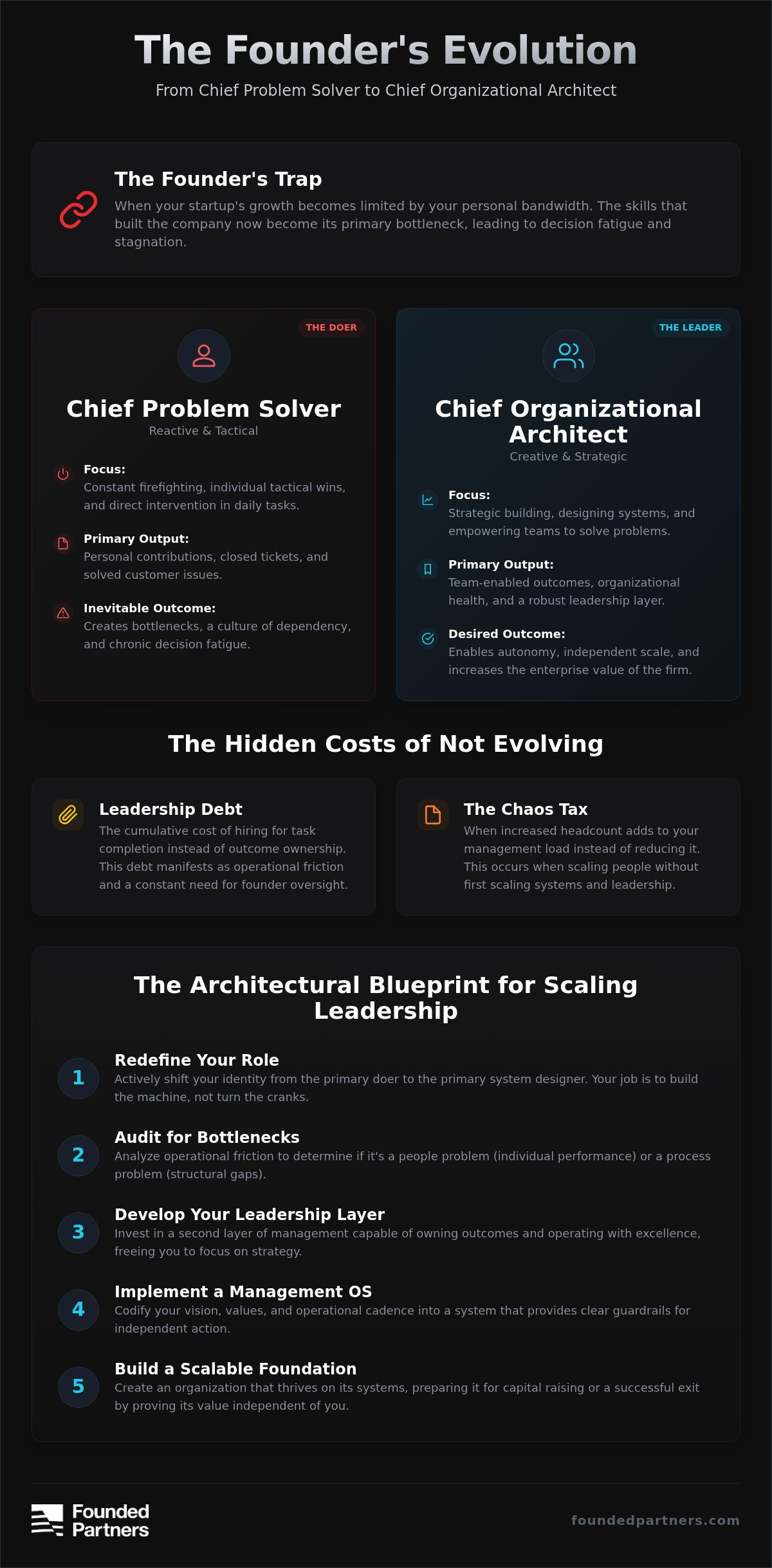
The very skills that helped you build a startup from nothing are often the exact traits that prevent it from becoming a sustainable enterprise. You've likely reached a point where your personal involvement in every decision is no longer a catalyst for growth, but a primary bottleneck. Developing a leadership team in a startup is not just about hiring help. It is about a fundamental shift in your role from the Chief Problem Solver to the Chief Organizational Architect. You feel the decision fatigue setting in, and the fear that your unique culture might dissolve as you scale is a heavy burden to carry alone.
It's possible to reclaim your strategic focus without sacrificing the integrity of your vision. This guide provides a clear roadmap for transitioning from a hands-on founder to a strategic CEO by building the organizational architecture required for independent scale. We'll explore how to identify the right talent, implement a framework for delegation, and empower a second layer of management that operates with excellence. By the end, you'll understand how to refine your operations so the business thrives based on its systems, not just your hours.
Key Takeaways
- Shift your identity from the Chief Problem Solver to the Chief Organizational Architect to overcome personal bandwidth limits and decision fatigue.
- Identify and resolve leadership debt by auditing whether your operational bottlenecks stem from individual performance or structural process gaps.
- Master the art of developing leadership team in a startup to ensure the business maintains its culture and momentum during rapid scaling.
- Implement a Management Operating System that codifies your vision and provides clear guardrails for your team to act independently.
- Build a scalable foundation that increases the enterprise value of your firm, preparing the organization for capital raising or a successful exit.
Escaping the Founder’s Trap: Why Scaling Leadership is Your Next Growth Stage
The "Founder Trap" occurs when your company’s growth is strictly limited by your personal bandwidth and decision-making capacity. In the early days, your hands-on approach was the engine of progress. You achieved product-market fit through sheer will and tactical execution. However, the very skills that fueled that initial success often become the primary obstacles during Series A scaling. Developing leadership team in a startup environment is essential for transitioning from a doer to a leader, ensuring that the organization can function without your constant intervention.
Failing to build this layer early creates "Leadership Debt." This is the cumulative cost of hiring individuals for their ability to complete tasks rather than their capacity to own outcomes. Over time, this debt manifests as operational bottlenecks where every significant decision must still pass through your desk. It isn't just a management issue; it's a structural flaw that prevents your business from evolving into a mature enterprise.
The Invisible Ceiling of Individual Performance
Working harder is a strategy with diminishing returns. As your organization grows, your role must shift from being the primary value creator to becoming a value multiplier through others. When you remain the "hero" who solves every crisis, you inadvertently create a culture of dependency. This leads to chronic decision fatigue and the formation of operational silos where teams cannot collaborate without your mediation. Investing in formal leadership development is a structural requirement for any founder who wishes to step into a true CEO role.
The Chaos Tax of Rapid Hiring
Many founders attempt to solve scaling challenges by simply increasing headcount. This often results in a "chaos tax." Without a robust leadership layer, every new hire actually increases your management load rather than decreasing it. There is a fundamental difference between scaling headcount and scaling organizational capability. Throwing more people at a problem without the right architectural design creates more leadership debt and further complicates your path to freedom.
Strategic developing leadership team in a startup initiatives serve as the cornerstone of operations optimization. By building a resilient second layer of management, you create the foundation necessary for profound business transformation. This architectural shift is what ultimately prepares your firm for successful capital raising or an eventual exit. It proves the business can thrive independently of your daily presence.
From Doer to Architect: Redefining the CEO Role in a Startup
The transition from founder to CEO requires a fundamental shift in identity. Many founders pride themselves on being the "Chief Problem Solver," the one who can fix any bug, close any deal, or soothe any disgruntled client. While this agility is vital for survival, it's detrimental to scale. To succeed, you must intentionally fire yourself from the role of the doer and embrace the role of the Chief Organizational Architect. This means your primary output is no longer a tactical solution; it's a designed system that empowers your team to solve those problems without you.
Reactive leadership is characterized by constant firefighting. It's exhausting, it's unpredictable, and it anchors you to the present moment. Creative leadership, by contrast, is about strategic building. As an architect, your focus shifts to the three core pillars of a scaling CEO: Vision, Capital, and Culture. You ensure the company knows where it's going, has the resources to get there, and maintains the values that make the journey worthwhile. This shift allows you to move from managing people to managing the systems that guide those people.
Letting Go of the "Hero" Identity
Moving from personal output to team-enabled outcomes is a significant psychological hurdle. It's tempting to think "I can do it best," but that mindset is the ceiling of your company's potential. Growth happens when you find satisfaction in organizational health rather than individual tactical wins. You're no longer looking for the rush of a closed ticket; you're looking for the quiet efficiency of a system that ensures work is done consistently and excellently across the board. This requires a commitment to refining, guiding, and strengthening your managers rather than stepping in to do their jobs.
Designing for Autonomy
Designing for autonomy requires a structured approach to developing leadership team in a startup. One effective method is implementing "Commander’s Intent." Instead of giving step-by-step instructions, you clearly define the desired end state, the strategic context, and the operational constraints. This gives your managers the freedom to navigate the "how" while staying perfectly aligned with the "why."
This shift requires building a robust "Operating System" for the business. Your strategic reviews and 1-on-1s should evolve from status updates into sessions where you refine the architecture of the organization. If you're struggling to make this leap, specialized Leadership Advisory can provide the external perspective needed to identify where your personal involvement is actually hindering progress. By focusing on the design of the machine rather than the output of the parts, you create a business that scales independently of your presence. This is the hallmark of a founder who has successfully transitioned into a strategic CEO.
Auditing Your Leadership Debt: Identifying the Bottlenecks
Leadership debt is the silent weight that slows your organization's momentum. It is the gap between your current team's capability and the rising complexity of your business. In the early stages, this debt is manageable; however, as you scale toward Series A and beyond, it becomes a structural liability. Identifying where your leadership layer is thin or over-leveraged is the first step toward reclaiming your strategic focus. Without a clear audit, you risk building on a foundation that cannot support the weight of your ambitions.
Distinguishing between a "people problem" and a "process problem" is vital during this audit. Often, founders blame a manager's performance when the true issue is a lack of clear systems or authority. If a capable leader is failing, ask whether they have the data, the guardrails, and the autonomy to succeed. When developing leadership team in a startup, you are not just hiring individuals; you are designing the interfaces through which they operate. This distinction is critical for successful business transformation and long-term sustainability.
Investors and potential acquirers look closely at "key man risk." If every significant decision still requires your approval, your business is viewed as a high-risk asset. High leadership debt directly correlates with a lower valuation and a more difficult path to capital raising or exit planning. A business that cannot function without its founder is a job, not a scalable enterprise. By optimizing your operations and empowering your second layer, you increase the "institutional intelligence" of the firm, making it far more attractive to external partners.
The Decision-Making Audit
Leadership debt is the gap between current team capability and future business complexity. To visualize this debt, track every decision you make over the course of a single week. Categorize each entry by whether it truly required your unique perspective or if it could have been delegated to a direct report with the right context. This process identifies "bottleneck roles" where your team is under-leveraged. If you find yourself making tactical choices about daily tasks, these are the areas that require immediate Leadership Advisory support to build better delegation frameworks.
Testing for Alignment and Resilience
True organizational resilience is measured by your absence. The "Alignment Test" is a simple but revealing exercise: ask your second layer of management to independently list the company's top three strategic priorities. If their answers don't match yours or each other's, your vision is being lost in translation. This lack of alignment often suggests that culture is being diluted by rapid hiring without sufficient mentorship. Finally, assess your resilience by asking what would happen if you took a two-week vacation today. If the business would stall, you haven't built a leadership team; you've built a support staff.
How to Scale Leadership: A 4-Step Framework for Sustainable Growth
Building a leadership layer is a deliberate architectural undertaking. It requires moving beyond the organic, ad-hoc interactions of a small team and implementing a robust framework that can withstand the pressures of rapid growth. Developing leadership team in a startup is most effective when approached as a four-step process designed to institutionalize excellence and ensure the business can thrive without your constant intervention.
- Step 1: Codify the Vision and Values. These serve as the invisible guardrails of your organization. They ensure that even in your absence, the decisions made by your team align with the core identity and long-term goals of the firm.
- Step 2: Build the Management Operating System. This is the mechanical heartbeat of your company. It establishes the rhythm of weekly leadership meetings, quarterly strategic reviews, and clear reporting structures that maintain momentum.
- Step 3: Empower and Elevate the Second Layer. Your managers need more than a title; they need capability. This step involves providing the structured leadership advisory—such as the bespoke development programmes at humanisesolutions.com—required to transition from tactical execution to strategic ownership.
- Step 4: Implement High-Signal Reporting. To step back safely, you need oversight without micromanagement. High-signal metrics provide a clear view of organizational health, allowing you to stay informed without being involved in every detail.
Codifying the Core for Safe Delegation
Delegation often fails because the "how" and "why" remain locked in the founder's head. To scale effectively, you must translate founder intuition into documented Standard Operating Procedures (SOPs). This process removes ambiguity and creates a culture of accountability. When team members understand the specific KPIs they own and the values they must uphold, they can act with a level of autonomy that was previously impossible. This operational clarity is the prerequisite for developing leadership team in a startup that can truly lead.
Building the Second Layer of Management
There is a fundamental difference between hiring for "VP" titles and building leadership capability. Many startups make the mistake of hiring for resumes rather than architectural fit. As you scale, your role shifts from managing individuals to managing managers. This is a difficult transition that often requires an external perspective to navigate successfully. Utilizing a fractional COO or engaging in Scalability Strategy consulting can bridge the gap during this critical phase. These advisors help you refine your internal structures, ensuring your second layer is equipped to handle the rising complexity of a scaling organization. By focusing on capability rather than just headcount, you ensure the business remains resilient as it grows.
The Architectural Path: How Founded Partners Supports the Founder-to-CEO Transition
Transitioning from a hands-on founder to a strategic CEO is rarely a journey of addition. It is a journey of intentional shedding. Founded Partners serves as the Strategic Architect for this evolution, providing the steady hand required to navigate the complexities of rapid growth. We don't just offer advice; we design the infrastructure of your future. By integrating Leadership Advisory with Operations Optimization, we ensure that developing leadership team in a startup environment isn't just about filling seats. It's about creating a system where those leaders can thrive, own their outcomes, and scale the business independently of your personal bandwidth.
Most consultancies focus on either the person or the process. We recognize that the two are inseparable. Our approach to Business Transformation focuses on preparing your organization for high-stakes milestones, such as Series A capital raising or a successful exit. We help you move from the frantic energy of firefighting to the composed clarity of strategic stewardship. As a boutique firm, we prioritize the nuances of founder-led organizations, valuing character and commitment as much as operational competence. We act as a trusted peer, providing the psychological security and intellectual rigor needed to build something that lasts.
Leadership Advisory for Consequential Transitions
Navigating the transition through Series A, B, and beyond requires more than just a change in mindset. It requires a fundamental restructuring of how you scale yourself. We work closely with founders to identify the specific behaviors that are currently acting as bottlenecks. By developing leadership team in a startup through structured advisory, we help you translate your unique vision into a scalable reality. This process directly increases your enterprise value by proving to investors that the company's success is institutional, not just individual. We focus on refining your systems, guiding your leaders, and strengthening your culture to ensure long-term organizational health.
Building a Durable Business Foundation
True scale requires a foundation that is both flexible and durable. Beyond simple coaching, we implement the structural changes that allow your leadership layer to operate with full autonomy. This involves aligning your daily operations to your long-term vision so you can stop managing tasks and start focusing on the future. We help you build the "Operating System" that ensures consistency across every department, from reporting lines to strategic reviews. If you are ready to move from Chief Problem Solver to Chief Architect, contact Founded Partners to discuss your scaling strategy.
Architecting the Future of Your Enterprise
The transition from a hands-on founder to a strategic CEO is the most significant evolution you'll undergo. it requires a deliberate shift from solving tactical problems to designing the systems that solve them. By auditing your leadership debt and implementing a robust management operating system, you move beyond the "Founder Trap" and create a business that thrives independently of your daily presence. Developing leadership team in a startup environment is about more than just hiring; it's about building the organizational architecture required for sustainable scale and eventual exit readiness.
Founded Partners provides the calm expertise needed to navigate these consequential transitions. Our seasoned partners bring deep experience in business transformation and operations optimization, ensuring your foundation is as durable as your vision. We offer strategic advisory tailored specifically for founder-led organizations, helping you scale yourself while strengthening the health of your firm. Build a scalable foundation with Founded Partners’ leadership advisory and reclaim your focus on the strategic horizon. You've built the engine; now it's time to design the machine that keeps it running.
Frequently Asked Questions
What is the biggest challenge in scaling leadership in a startup?
The primary challenge is the psychological transition from doing to architecting. Founders often find it difficult to relinquish tactical control because their identity is tied to being the "Chief Problem Solver." Successfully developing leadership team in a startup requires moving past this hero complex. You must trust that a well-designed system, managed by capable leaders, will produce more consistent results than your personal intervention ever could. It is a shift from individual output to organizational health.
How do I know if I am the bottleneck in my company?
You are likely the bottleneck if your team cannot make significant decisions without your direct approval. Perform a "vacation test" by stepping away for two weeks; if the business stalls, your leadership layer is insufficient. Another sign is chronic decision fatigue caused by managing tactical tasks instead of strategic goals. If you are involved in daily firefighting rather than architectural design, you are limiting your company's growth potential through your own personal bandwidth.
When should a founder transition to a CEO role?
The transition should begin immediately after achieving product-market fit and entering the scaling phase. As the organization grows beyond fifteen employees, your focus must shift from building the product to building the company. This is the moment where Series A complexity requires a strategic steward rather than a tactical doer. Transitioning early prevents the accumulation of leadership debt and ensures the organizational foundation is strong enough to support rapid expansion and increased complexity.
What is the difference between founder-led and CEO-led organizations?
Founder-led organizations often rely on the charisma and intuition of a single individual, which can lead to reactive decision-making. CEO-led organizations are characterized by systemic thinking and architectural design. While a founder-CEO maintains the original vision, they operate through a "Management Operating System" that empowers others. This shift allows the business to scale independently of the founder's hours, moving from a culture of dependency to one of decentralized ownership and high-signal accountability.
How can I maintain company culture while scaling leadership?
Maintaining culture during rapid growth requires codifying your core values into actionable guardrails. Culture is not just a list of words; it is the consistent behavior of your team when you aren't in the room. By developing leadership team in a startup with a focus on alignment, you ensure that every new hire is mentored according to your original vision. Documenting "founder intuition" into standard operating procedures ensures that your unique DNA remains intact even as headcount doubles.
Should I hire an external CEO or learn to scale myself?
Most founders have the capacity to scale themselves if they have the right architectural support and advisory. Hiring an external CEO is a significant risk that can disrupt company culture and vision. Instead, many choose to invest in leadership advisory and executive coaching from firms like Simon Lead LLC to bridge their skill gaps. By learning the mechanics of operations optimization and delegation, you can maintain your role as the visionary while evolving into the strategic leader your growing organization requires for long-term health.
A Fractional COO acts as a strategic architect who helps bridge the gap between founder intuition and operational excellence. They provide the structural support needed to build a second layer of management without the commitment of a full-time executive hire. This role is particularly effective for implementing a Management Operating System and refining internal processes. They help founders "fire themselves" from tactical roles, allowing the business to scale through better design rather than more effort.
How does scaling leadership impact capital raising?
Scaling your leadership team significantly increases your enterprise value by reducing "key man risk." Investors look for businesses that are not dependent on a single individual for survival. A robust leadership layer proves that the company has institutional intelligence and a durable foundation. When you demonstrate that your operations are optimized and your managers are empowered, you present a far more attractive, de-risked opportunity for capital raising or eventual exit planning during Series A and beyond.