
Startup Operations KPIs: The Founder’s Checklist for Scalable Growth

Growth is a poor proxy for health when your internal systems are quietly fracturing under the pressure of scale. You've likely felt the friction already; processes that served you at ten employees are failing at fifty, and your board reporting feels more like a defensive maneuver than a strategic briefing. It's easy to feel overwhelmed by vanity metrics that look good on a slide but fail to solve the operational bottlenecks stalling your momentum. To build something durable, you must look beneath the surface and master the startup operations kpis that transform a chaotic venture into a disciplined, investable enterprise.
This checklist provides the clarity you need to move from reactive management to proactive leadership. We'll define the essential metrics that measure your true operational throughput, from the Rule of 40 to modern burn efficiency standards. You'll learn how to build a dashboard that communicates your efficiency to investors with confidence and precision. We'll cover the transition from founder-led intuition to data-driven systems, ensuring your organization is ready for its next capital raise or an eventual exit. It's time to stop guessing and start measuring the foundational elements that drive sustainable, long-term growth.
Key Takeaways
- Learn why shifting from vanity metrics to sanity metrics is essential for building a durable, investable enterprise.
- Discover how to categorize and track the four pillars of startup operations kpis to maintain a balanced view of organizational health.
- Master the unit economics and burn efficiency ratios that move your reporting beyond simple revenue tracking toward sophisticated investor readiness.
- Implement a tactical five step plan to integrate operational metrics into your daily workflow without creating unnecessary friction for your team.
- Understand how strategic advisory can help you navigate the transition from founder-led intuition to a structured, scalable business architecture.
The Shift from Hustle to Systems: Why Startup Operations KPIs Matter
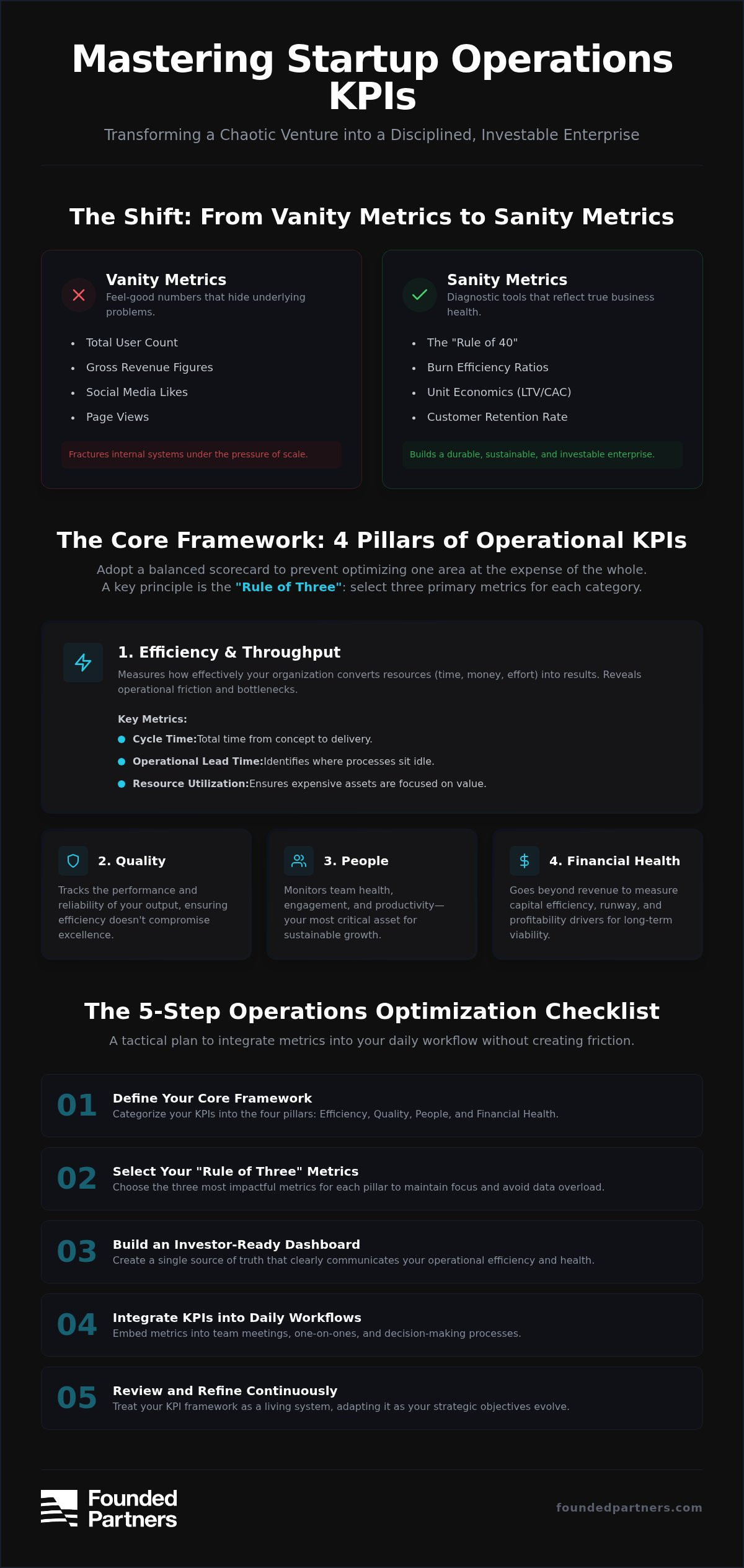
Hustle gets you off the ground, but it won't keep you in the air. For a founder, the transition from "doing" to "designing" marks the true birth of a CEO. This evolution requires a shift in focus from vanity metrics, like total user count or gross revenue, to sanity metrics that reflect the actual efficiency of your business engine. A well-chosen performance indicator isn't just a number on a spreadsheet; it's a diagnostic tool that reveals the health of your internal systems.
Mastering startup operations kpis allows you to adopt the mindset of a Strategic Architect. This means prioritizing durability, sustainability, and clarity over the frantic energy of the early days. By tracking how resources are consumed to generate output, you move beyond simply observing what happened to understanding how it happened. This structural clarity mirrors the organizational efficiency required to build, refine, and scale a substantial enterprise. It provides a steady hand for the journey ahead, grounding your ambition in operational reality.
The Difference Between Growth and Scalability
Growth is often a matter of brute force. Scalability, however, is the ability to handle increased volume without a linear increase in costs or operational chaos. Many founders fall into the "scaling trap," where they accelerate revenue growth while their internal foundations are quietly fracturing. Sophisticated startup operations kpis act as early warning systems, identifying bottlenecks in your workflow before they become catastrophic failures. These metrics provide a common language that preserves company culture during rapid expansion, ensuring that your team remains focused on measurable excellence rather than just movement.
KPIs as a Language for Capital Raising
Sophisticated investors look past the pitch deck to the underlying machinery of the enterprise. They value unit economics, burn efficiency, and retention as indicators of a disciplined leadership team that values character as much as competence. Demonstrating "Investor Readiness" means presenting a dashboard that proves you can manage capital as effectively as you can raise it. When you speak the language of operational data, you reduce perceived risk and build deep trust through transparency. This approach positions your startup as a structured, high-value asset that is ready for the rigors of a professional transaction or a significant capital raise.
The Core Framework: 4 Essential Categories of Startup Operations KPIs
Complexity is the enemy of execution. To build a business that endures, you must move beyond tracking disparate data points and adopt a structured framework. By categorizing your startup operations kpis into four distinct pillars; Efficiency, Quality, People, and Financial Health; you create a balanced scorecard that prevents any single department from optimizing at the expense of the whole. This alignment is central to the Business Transformation philosophy, where every metric serves as a blueprint for long term enterprise value.
To avoid the paralysis of data overload, we advocate for the Rule of Three. Select three primary metrics for each category that directly influence your strategic objectives. This disciplined focus ensures that your leadership team remains agile and responsive. Identifying these friction points is the first step in a meaningful Operations Optimization engagement, allowing you to refine your engine while it's still running.
Efficiency and Throughput Metrics
Efficiency is not about working harder; it's about reducing the friction between an idea and its realization. These metrics reveal how effectively your organization converts resources into results. When throughput stalls, your growth becomes expensive and unsustainable. Focus on these three areas to maintain momentum:
- Cycle Time: This measures the total time elapsed from lead generation to delivery, or from product concept to launch. Shorter cycle times typically indicate a highly responsive and lean organization.
- Operational Lead Time: By identifying exactly where a process sits idle, you can pinpoint the specific bottlenecks that delay your output.
- Resource Utilization: It's vital to track whether your most expensive assets, your people, are focused on high value strategic tasks or are buried in low level administrative rework.
Quality and Customer Success Operations
The "move fast and break things" era has been replaced by a demand for durable quality. If your operations are fast but flawed, you're simply accelerating your churn rate. A strategic approach to startup operations kpis ensures that your quality control scales alongside your revenue. High quality operations build the psychological security that investors and customers value most.
- Error Rates and Rework: Track the frequency of mistakes that require team members to repeat a task. High rework rates are a hidden tax on your profitability and team morale.
- NPS vs. CSAT: While Net Promoter Score measures long term loyalty, Customer Satisfaction (CSAT) tracks the immediate operational success of a specific interaction. Both are necessary to see the full picture.
- First Response Time (FRT): In support operations, the speed of the initial acknowledgment is often as important as the final resolution. It signals reliability and commitment to the partner journey.
Measuring the 'Engine': Financial and People Operations KPIs
Revenue often masks the underlying inefficiencies of a growing firm. While top-line growth provides the fuel, your unit economics and people systems determine whether the engine can withstand the heat of a high-stakes capital raise or a complex exit. To build a durable enterprise, you must look beyond total cash on hand and focus on the ratios that define your operational throughput. These startup operations kpis provide the architectural blueprint for a business that is not just bigger, but fundamentally stronger.
Adopting a "calm expertise" means moving away from the frantic growth-at-all-costs mindset that defined previous cycles. In 2026, the market prioritizes capital efficiency, unit economics, and organizational health. By measuring how effectively you convert human and financial capital into enterprise value, you demonstrate a level of maturity that sophisticated investors demand. This disciplined approach ensures that your startup remains structured, resilient, and ready for the next stage of its journey.
Unit Economics and Financial Efficiency
Financial health is more than just a low burn rate; it's about the efficiency of every dollar deployed. Sophisticated founders use these metrics to prove their business model is sustainable at scale. They provide the quantitative proof that your operations are optimized for long-term profitability rather than short-term vanity. Focus on these three pillars of financial efficiency:
- LTV/CAC Ratio: For B2B SaaS firms, a ratio of 3:1 is the gold standard for healthy growth. This metric confirms that your sales and marketing operations are generating significantly more value than they cost to execute.
- Payback Period: This measures the time required to recover the cost of acquiring a customer. A shorter payback period increases your liquidity and allows you to reinvest in growth more aggressively.
- Burn Multiple: Rather than looking at total burn, track your burn multiple to see how much you spend to generate each dollar of new ARR. A multiple of less than 1.0 is considered outstanding, indicating an exceptionally efficient operation.
People and Organizational Health
A business is an architectural feat of human cooperation. If your people operations are neglected, the entire structure becomes brittle. High turnover and low sentiment are not just "HR issues"; they are operational failures that lead to the loss of vital institutional knowledge. Measuring the internal health of your firm is essential for maintaining the momentum required for a successful transition from founder-led to CEO-managed.
- Employee Net Promoter Score (eNPS): This serves as a high-level pulse check on your internal brand. A high eNPS suggests a culture of commitment and psychological security, which are prerequisites for sustained innovation.
- Revenue per Employee: This is a powerful proxy for operational leverage. It reveals how effectively your systems and processes amplify the impact of your team members.
- Turnover Rate: In a founder-led firm, losing key personnel is expensive and disruptive. Tracking turnover allows you to identify leadership gaps and refine your retention strategies before they impact your scalability.
The Operations Optimization Checklist: A 5-Step Implementation Plan
Implementation of a measurement framework should feel like a steady briefing, not a high pressure overhaul. To move from founder led intuition to data driven leadership, you must follow a rhythmic, methodical path that prioritizes the "why" before the "how." By focusing on the act of refining, guiding, and strengthening your existing processes, you can integrate sophisticated startup operations kpis into your culture without disrupting the daily flow of your team. This tactical roadmap ensures that your transition toward a structured enterprise is both orderly and durable.
Audit and Alignment
The first stage of transformation is a quiet assessment of your current foundations. You cannot optimize what you do not understand, and you cannot scale what you have not measured. This phase is about creating a baseline of truth that serves as the starting point for your growth journey.
- Step 1: Identify your North Star and levers. Every organization has one primary metric that defines success, but that metric is supported by several operational levers. You must identify which specific activities actually move the needle for your unique business model.
- Step 2: Audit data sources. Before you build a dashboard, ensure your data is accurate, accessible, and clean. This involves verifying that your CRM, financial software, and project management tools are capturing information consistently across all teams.
- Step 3: Align with Scalability Strategy. Ensure every department's objectives are mapped back to your overall long term goals. This alignment creates a unified front that builds deep trust with potential investors and partners.
Dashboards and Review Cadence
Once your data is aligned, you must create a rhythm for reviewing it. A dashboard is only as valuable as the actions it inspires. If your reporting doesn't lead to a change in behavior, it's merely another form of noise that distracts from your strategic objectives.
- Step 4: Build a Low-Noise dashboard. Resist the urge to track dozens of data points. Focus on the 5-7 most critical startup operations kpis that provide a comprehensive view of your efficiency, quality, and financial health.
- Step 5: Establish a monthly Operational Review. Dedicate time each month to turn your data into strategic action. This methodical review allows you to identify trends, address bottlenecks, and refine your approach with composed expertise.
A clean dashboard is defined as one that prompts a decision, not just a discussion. If you're ready to move from operational chaos to architectural clarity, explore our Operations Optimization services to build a foundation that scales with your ambition.
Beyond the Dashboard: Partnering for Operational Excellence
Data provides the clarity, but leadership provides the direction. While tracking startup operations kpis is an essential first step, the true value lies in the strategic application of those insights. As a Strategic Architect, Founded Partners moves beyond the dashboard to help you build a durable, scalable business foundation. We act as a trusted peer, identifying the operational blind spots that often remain invisible to those caught in the frantic energy of daily growth. This external perspective is vital for refining your processes, guiding your team, and strengthening your market position. By looking past the immediate horizon, we help you transition from a reactive startup to a composed, investable enterprise.
When to Seek Strategic Advisory
There is a specific moment in every successful venture where hustle begins to yield diminishing returns. Your operational engine might be redlining even as your revenue climbs. Common signs include stalled decision making, high team burnout, and a growing disconnect between high level strategy and daily execution. This is where a seasoned advisor or leadership advisory becomes indispensable. They facilitate the critical transition from founder led intuition to CEO managed systems by implementing the structural clarity required for a structured enterprise. By offloading the technicality of operations optimization, you regain the mental space to focus on the long term vision of your organization.
Building for the Final Transaction
Operational mastery is the ultimate form of exit planning. When it comes time for a significant capital raise or a final sale, sophisticated investors aren't just buying your product; they are buying your business engine. Optimized startup operations kpis demonstrate that your growth is repeatable, sustainable, and low risk. This level of preparation maximizes enterprise value and provides the psychological security of knowing your organization can withstand the rigors of professional due diligence. Having a partner who has navigated these complex challenges before ensures you don't just reach the finish line, but you cross it with integrity and strength. We help you build something substantial that stands the test of time.
The journey of building a great firm is a shared one. It requires a balance of professional authority and grounded empathy to navigate the pitfalls of rapid growth. Optimize your foundations with Founded Partners to ensure your venture is ready for its next stage of scalable growth. Remember that while the metrics tell you where you are, your character and commitment determine where you'll go.
Designing the Architecture of Your Future
Building a scalable startup is an architectural challenge that requires both vision and discipline. By mastering your startup operations kpis, you move beyond the frantic energy of survival and begin the work of refining, guiding, and strengthening a durable enterprise. You've learned that true health is found in unit economics and organizational culture rather than top-line vanity. This transition from founder-led intuition to structured excellence is what prepares you for the rigors of capital raising and eventual exit planning.
Founded Partners provides boutique advisory for founder-led organizations seeking this level of business transformation. As experts in operations optimization, we offer the strategic support needed to navigate the complexities of growth with composed expertise. Whether you're preparing for a significant capital raise or an eventual sale, our leadership advisory ensures your foundations are as bold as your ambitions. Build a stronger operational foundation with Founded Partners and take the next step in your scaling journey. Your vision deserves a business engine that can keep pace with your potential.
Frequently Asked Questions
What are the most important operations KPIs for a Series A startup?
For a Series A startup, the focus shifts toward unit economics and retention. The most critical metrics include a healthy LTV/CAC ratio of 3:1 or better and a Net Revenue Retention (NRR) of 110% or higher. These benchmarks prove to investors that your growth is sustainable. You should also track the Payback Period to understand how quickly capital returns to the business, ensuring your operational engine is primed for the next stage of scale.
How do I choose between vanity metrics and operational KPIs?
Vanity metrics like total signups or social media followers often mask underlying inefficiencies because they don't correlate with profitability. Operational KPIs, such as cycle time or error rates, measure the actual efficiency of your business engine. To choose correctly, ask if a change in the number prompts a specific strategic decision. If the metric doesn't lead to an action that strengthens your organizational health, it's likely a vanity metric that should be deprioritized.
Can operations KPIs help me raise capital more effectively?
Precise startup operations kpis significantly enhance your investor readiness by reducing perceived risk. In 2026, investors increasingly use AI to perform consistency checks across pitch decks and financial models. Presenting a clear dashboard of unit economics and burn efficiency demonstrates a level of "calm expertise" that builds trust. It shows you aren't just growing by chance but are building a structured, investable enterprise with a high degree of architectural integrity.
How often should a founder review operational metrics?
Founders should establish a rhythmic, monthly operational review to turn data into strategic action. While high level pulse checks might happen weekly, a deep dive into the 5-7 most critical KPIs ensures you remain proactive rather than reactive. This cadence allows you to identify bottlenecks before they fracture your systems. It also provides a steady hand for the organization, moving from frantic intuition to a methodical, data driven approach that values durability over shortcuts.
What is the 'Burn Multiple' and why does it matter for operations?
The Burn Multiple measures how much your startup spends to generate each dollar of new Annual Recurring Revenue (ARR). It's a vital indicator of capital efficiency. According to 2026 benchmarks, a burn multiple of less than 1.0 is considered outstanding, while 1.0 to 1.5 is good. Tracking this ratio ensures your operations are optimized for efficiency rather than just growth at all costs, which is essential for maintaining long term enterprise value.
How do I implement KPIs without slowing down my team?
Successful implementation requires a focus on "low noise" dashboards that track only 5-7 critical metrics. Start by auditing existing data sources to ensure accuracy before introducing new tracking requirements. By aligning departmental goals with your overall scalability strategy, you integrate these measurements into existing workflows rather than adding administrative burden. This methodical approach allows your team to maintain its momentum while gaining the clarity needed to refine, guide, and strengthen the organization's internal structures.
What role does a business transformation consultant play in operations?
A business transformation consultant acts as a Strategic Architect, identifying operational blind spots that founders often miss during rapid growth. They provide the expertise needed for a smooth transition from founder led intuition to professional CEO leadership. By focusing on operations optimization, a consultant helps build the durable foundations required for capital raising and exit planning. This partnership offers the psychological security of having a seasoned peer who prioritizes organizational health over vanity metrics and short term gains.