
Exit Planning for Founders: Strategic Architect's Guide

The most successful exit isn't a transaction; it's the final stage of a deliberate business transformation. If your company cannot function without your daily presence, you haven't built an asset; you've built a high-stakes job. Effective exit planning for founders requires an architectural shift that moves you from being the central pillar to the designer of a self-sustaining system. It's natural to worry that operational bottlenecks might stall your valuation or that due diligence will expose a dependency on your personal intuition rather than repeatable processes.
You've spent years building something substantial, and you deserve a transition that honors that legacy while maximizing your enterprise value. This guide provides a strategic roadmap to transform your founder-led business into a transferable asset that thrives in your absence. We'll examine the shifts required to achieve multiple expansion, clarify whether to sell to private equity or a strategic buyer, and define your role once the deal is done. By the end, you'll have the clarity needed to lead your organization toward its most consequential milestone with confidence and composure.
Key Takeaways
- Learn how to escape the "Founder Trap" by shifting your role from the primary value driver to the strategic architect of a self-sustaining system.
- Understand the essential transition from tax-focused accounting to transaction-ready financials that withstand the rigors of due diligence.
- Execute a 36-month roadmap for exit planning for founders that prioritizes operational optimization and removes you from the daily critical path.
- Evaluate the strategic nuances between private equity recapitalization and a full sale to a strategic acquirer to align with your personal legacy.
- Discover how to maximize enterprise value through multiple expansion by building a business that operates independently of its creator.
Rethinking the Exit: Why Founder-Led Businesses Require a Different Architecture
An exit is often viewed as a financial destination or a legal event. In reality, it's the culmination of a deliberate structural evolution. For most entrepreneurs, the business is an extension of their personality, intuition, and grit. While these traits drive early growth, they eventually create a ceiling for valuation. Authentic exit planning for founders isn't merely about finding a buyer; it's about the architectural process of making a business independent of its creator. This exit planning overview illustrates how the process differs from simple succession. You aren't just selling a revenue stream. You're selling an enterprise that can survive your departure.
The "Founder Trap" is the most common reason deals fail or valuations plummet. When you are the primary value driver, the business is essentially a high-paying job rather than a transferable asset. Buyers don't want to buy your personal effort; they want to buy a self-sustaining system. Moving from Chief Operator to Strategic Architect of Value requires a psychological shift. You must stop valuing your indispensability and start valuing your irrelevance to the daily workflow. This transition is what separates a modest payout from a consequential legacy.
The Founder-Dependency Tax
Buyers are inherently risk-averse. If you hold all the key client relationships or if every major decision requires your approval, you've created a "Founder-Dependency Tax." Professional investors will aggressively discount businesses where the CEO is the sole architect of strategy. This "Key Man Risk" becomes a glaring red flag during due diligence. Operational bottlenecks that require your personal intervention suggest the business is fragile. To maximize your multiple, you must identify these dependencies early. A business that relies on a founder's "magic" is unscalable and, ultimately, unbuyable at a premium price.
The Architecture of Transferability
A business must be runnable by a third party to be truly buyable. This requires shifting your focus from vanity metrics, like top-line revenue or social following, to durable value drivers. These include recurring revenue, documented processes, and a leadership team that doesn't need your permission to execute. Building this "steady hand" within your organization provides the psychological security a buyer needs. It demonstrates that the company possesses its own momentum. By refining your operations and strengthening your team's autonomy, you transform a founder-led organization into a high-value asset ready for a clean, successful transition.
The Pillars of Exit Readiness: Quantifying and Closing the Value Gap
Readiness isn't a feeling. It is a measurable state of organizational maturity that determines whether a buyer sees a high-yield asset or a risky liability. While the previous section explored the mindset shift required for success, this stage focuses on the structural pillars that support a premium valuation. Rigorous exit planning for founders involves scrutinizing every internal lever that impacts the bottom line, starting with the quality of your financials. Many entrepreneurs manage their books to minimize tax liabilities, but a buyer requires transaction-ready records that clearly demonstrate profitability and growth potential.
Revenue quality is equally vital. A business built on one-off, founder-led sales is perceived as volatile and fragile. In contrast, recurring revenue streams provide the predictability that justifies high multiples. This predictability must be matched by organizational health. Your leadership team must be capable of steering the ship long after you've departed. If the institutional knowledge resides only in your head, the value gap won't close. Closing this gap requires a disciplined approach to building a company that functions as a professional enterprise rather than a personal project.
Operations Optimization for Exit
Operations optimization is the process of refining the business foundation for long-term durability. By streamlining core processes, you prove to a potential acquirer that the business is scalable. One of the most critical areas to address is the "Quote-to-Cash" cycle. Reducing friction in how you attract, serve, and bill customers creates a visible track record of efficiency. When these systems are documented and repeatable, they remove the need for your constant intervention, directly increasing the attractiveness of the asset.
Multiple Expansion Strategies
Moving from a 4x multiple to a 7x multiple is a deliberate act of strategic transformation. It requires identifying "Value Levers" that attract premium strategic acquirers. These levers often include:
- Proprietary intellectual property or unique technology.
- High customer switching costs and low churn rates.
- A dominant, defensible position in a growing niche market.
Utilizing business transformation consulting allows you to address these levers systematically. Strengthening the balance sheet through exit planning for founders might also involve capital raising support to fuel a final growth spurt or clean up debt. These actions ensure that when you finally enter the room for due diligence, you are negotiating from a position of undeniable strength and clarity.
Evaluating the Landscape: Strategic, Financial, and Internal Exit Paths
Choosing an exit path is as consequential as the years spent building the enterprise. It's the moment where your architectural preparation meets market reality. For many, exit planning for founders is often reduced to a single question of price, but the structure of the deal defines your legacy and your post-exit role. You must determine if you are seeking the highest immediate payout, a partner for future growth, or a way to reward the team that helped you build the foundation. Each path requires a different strategic posture and a specific set of value drivers.
Strategic acquirers typically offer the highest multiples because they buy for "synergy." They aren't just looking at your bottom line; they're looking at how your intellectual property or market position accelerates their own roadmap. Conversely, private equity firms often favor recapitalization. This "second bite of the apple" allows you to take significant chips off the table while retaining an equity stake for a future, often larger, liquidity event. If your priority is preserving culture, a management buyout (MBO) or a partial exit through capital raising can provide liquidity without sacrificing the soul of the organization.
The Strategic vs. Financial Buyer
A strategic buyer values your business for what it adds to theirs. They pay a premium for your technology, your brand, or your customer list. However, this path carries significant integration risk. Your culture might be absorbed into a larger, less agile entity. Financial buyers, like private equity groups, value your cash flow and your ability to grow. They want a "runnable" business with a steady hand at the helm. To maintain leverage during these negotiations, you must have a clear capital strategy that proves you don't need to sell, which forces buyers to compete on your terms.
To navigate these high-stakes negotiations, many founders partner with investment banks that offer Success-based transaction advisory fees, ensuring that the advisor's incentives are perfectly aligned with achieving the highest possible valuation.
Internal Transitions and MBOs
Selling to your leadership team is often the most rewarding path for founders who value continuity. An MBO or an Employee Stock Ownership Plan (ESOP) keeps the business in the hands of those who understand its DNA. This requires years of transition advisory to move your team from an employee mindset to an ownership mindset. You must refine your leadership advisory efforts to ensure the organization remains resilient once you step back. While internal transitions might not always match the top-line price of a strategic sale, they offer the psychological security of knowing your legacy is in trusted hands.
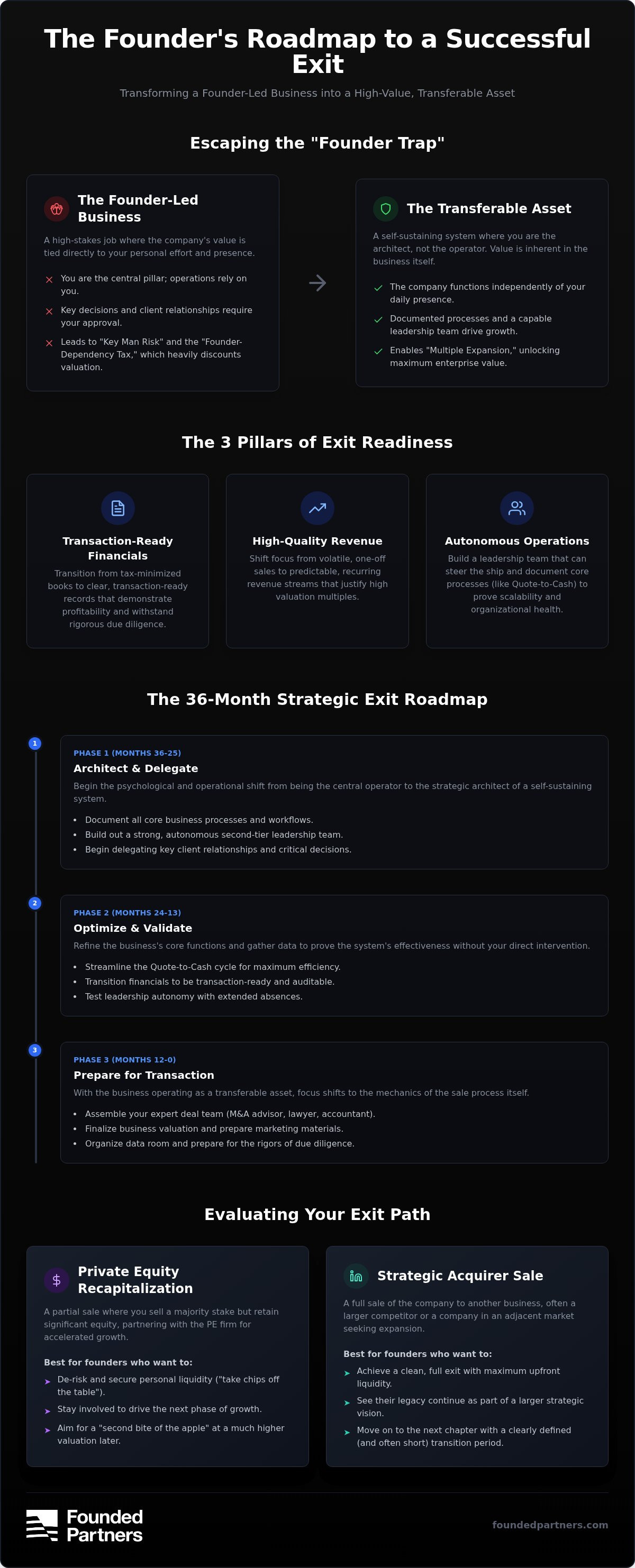
The 36-Month Strategic Roadmap: Preparing for a Consequential Transition
A successful exit isn't an accident; it's a construction project. A 36-month horizon provides the necessary runway to identify weaknesses, implement structural changes, and demonstrate sustained performance to potential buyers. This timeline allows you to approach the market with a business that isn't just "for sale," but is an optimized, transferable asset. Strategic exit planning for founders is a multi-year discipline that sequences transformation, optimization, and execution. By adopting this phased approach, you move away from the frantic energy of last-minute deals and toward a state of calm readiness.
Phase 1: The Transformation Audit
The first twelve months are dedicated to the transformation audit. This period involves conducting a rigorous "Value Gap" analysis to pinpoint where the business is leaking potential enterprise value. You must align your current operations with the ultimate exit vision, ensuring that every department contributes to a cohesive narrative of growth. During this phase, leadership advisory is essential to assess the strength of your "bench." You need to know if your current team has the character and competence to lead the organization through the friction of a transition. Fixing operational bottlenecks now prevents them from becoming deal-breakers during the scrutiny of due diligence.
Phase 2: Building Founder Independence
Months thirteen through twenty-four focus on removing you from the critical path. This is the stage where you systematize "Founder’s Intuition" into repeatable operational playbooks. By documenting your unique processes, you make the business runnable by a third party. This often requires hiring or elevating a COO to manage day-to-day complexities, allowing you to step into the role of a strategic architect. Refining your scalability strategy during this window is vital. It shows buyers a clear growth runway that exists independently of your personal effort. You're no longer selling your daily labor; you're selling a self-sustaining system.
The final twelve months represent the home stretch: transaction readiness. This period involves preparing clean data rooms, conducting internal financial audits, and sharpening your market positioning. Navigating this final mile requires a sense of "calm expertise" to avoid the burnout that often plagues founders during the intense final negotiations. To begin mapping your specific trajectory, explore our exit planning services to ensure your legacy is preserved through a structured, high-value transition.
Partnering for the Next Chapter: How Founded Partners Guides the Journey
A consequential exit requires more than a checklist; it demands a partner who understands that your business is an extension of your character. At Founded Partners, we provide the calm expertise needed to navigate the complexities of exit planning for founders. Our approach isn't purely transactional. We integrate business transformation, capital raising support, and transaction advisory into a single, cohesive journey. By acting as your Strategic Architect, we ensure that the foundation you've built is not only ready for a buyer but is optimized to protect your legacy and maximize enterprise value.
We believe that the health of the organization is paramount. Our partners, Adam and Matt, provide peer-level advisory that goes beyond traditional consulting. We don't just deliver a service; we share the burden of building something substantial. This means refining your operations, strengthening your leadership bench, and preparing your financials to withstand the most rigorous due diligence. We help you move from being the center of the storm to the designer of a durable system. This architectural shift is what allows you to exit on your own terms with confidence.
Beyond the Transaction: Leadership and Legacy
The emotional "Day After" a sale is often the most challenging part of the entire process. For many founders, their identity is deeply intertwined with their company's success. We offer leadership advisory that prepares you for your next act, whether that involves a new venture, board roles, or a meaningful transition into retirement. Having a partner who values integrity and interpersonal connection as much as technical competence provides the psychological security required for a clean break. We help you define your role post-exit so that the transition feels like a graduation rather than a loss.
Getting Started with a Readiness Assessment
The journey toward a high-value exit begins with a single, confidential conversation. This initial dialogue allows us to align your personal vision with the market's perception of value. We focus on "Investor Readiness" as a prerequisite for any successful transaction. This involves a deep dive into your operations optimization and scalability strategy to ensure there are no hidden bottlenecks. We look for the durability of your systems and the strength of your character. When you are ready to explore the architectural shifts required for a consequential transition, you can Speak with a Strategic Architect at Founded Partners. Let's work together to transform your founder-led business into a truly transferable asset.
Building Your Next Horizon
A consequential exit is the final expression of the value you've built over years of dedicated effort. It's the moment where strategic architecture and operational discipline converge to create a legacy that thrives without its creator. By addressing the founder trap early and closing the value gap through operations optimization, you ensure your business is perceived as a high-value, transferable asset rather than a personal job. Successful exit planning for founders is the ultimate act of leadership; it provides clarity for your team and security for your future.
Founded Partners offers the steady hand and calm expertise required to navigate this multi-year journey. Our boutique partnership, led by experienced partners Adam and Matt, specializes in the unique needs of founder-led organizations. We provide an integrated approach that combines business transformation with transaction advisory, ensuring every operational lever is aligned with your exit vision. When you're ready to move beyond the daily critical path and toward a meaningful transition, we are here to guide the way. Plan your consequential transition with Founded Partners and step into your next chapter with confidence.
Frequently Asked Questions
When is the best time for a founder to start exit planning?
The ideal window is 36 months before your desired transition date. This duration provides enough time to implement architectural shifts and demonstrate a track record of operational durability. Starting early prevents the frantic energy of a forced sale. It allows you to build a leadership team that functions independently of your daily presence, ensuring the asset is truly transferable when the right buyer appears.
How does founder dependency affect the valuation of my business?
Founder dependency creates a significant valuation discount because buyers perceive it as "Key Man Risk." If your personal relationships or intuition are the primary revenue drivers, the business is seen as fragile. Reducing this dependency through operations optimization directly increases your multiple. A self-sustaining system is always more valuable than a company that requires its creator's constant intervention to maintain its current momentum.
What is the difference between a strategic exit and a financial exit?
A strategic exit involves selling to an acquirer who values your intellectual property or market position for its synergy. They often pay a premium to accelerate their own corporate roadmap. A financial exit, typically involving private equity, focuses on your cash flow and growth potential. This path often utilizes a recapitalization, allowing you to take chips off the table while retaining equity for a future event.
Can I sell my business and still stay involved in the leadership?
Many deal structures allow or even require founders to remain involved for a specific period. Private equity buyers often favor a "second bite of the apple" where you stay on to lead the next growth phase. Strategic buyers might use earn-outs that tie your final payout to performance over 12 to 24 months. Your post-exit role is a key negotiation point that should align with your personal vision.
What are the main "Value Drivers" that buyers look for in a founder-led company?
Buyers look for recurring revenue, documented operational playbooks, and a resilient leadership bench. They value high customer switching costs and a defensible position in a growing niche market. Clear, transaction-ready financials and a history of scalable growth are also vital. These drivers demonstrate that the organization possesses its own momentum and can thrive without the founder's daily oversight or personal intervention.
How do I prepare my management team for a change in ownership?
Preparing your team involves shifting them from an employee mindset to an ownership mindset through targeted leadership advisory. You should involve key leaders in the strategic roadmap early to build trust and alignment. Empowering them to make high-level decisions now proves to buyers that the bench is strong. This transparency reduces anxiety and ensures organizational resilience during the change in ownership.
What is a "Value Gap" and how do I close it before selling?
The value gap is the difference between your current valuation and the potential value if the business were fully optimized. You close it by identifying and fixing operational bottlenecks that leak profit or increase risk. Effective exit planning for founders focuses on closing this gap by refining systems and strengthening the balance sheet. This architectural work ensures you capture the maximum possible enterprise value during a transition.
Do I need a business transformation consultant before hiring a broker?
Engaging a consultant first is a strategic advantage. A broker's primary role is to sell the business you have; a consultant's role is to build the business that buyers will pay a premium to acquire. By utilizing business transformation consulting before going to market, you resolve structural issues that would otherwise decrease your valuation. This preparation ensures you enter negotiations from a position of undeniable strength.