
Founder Board Management Strategies: From Governance to Strategic Leverage

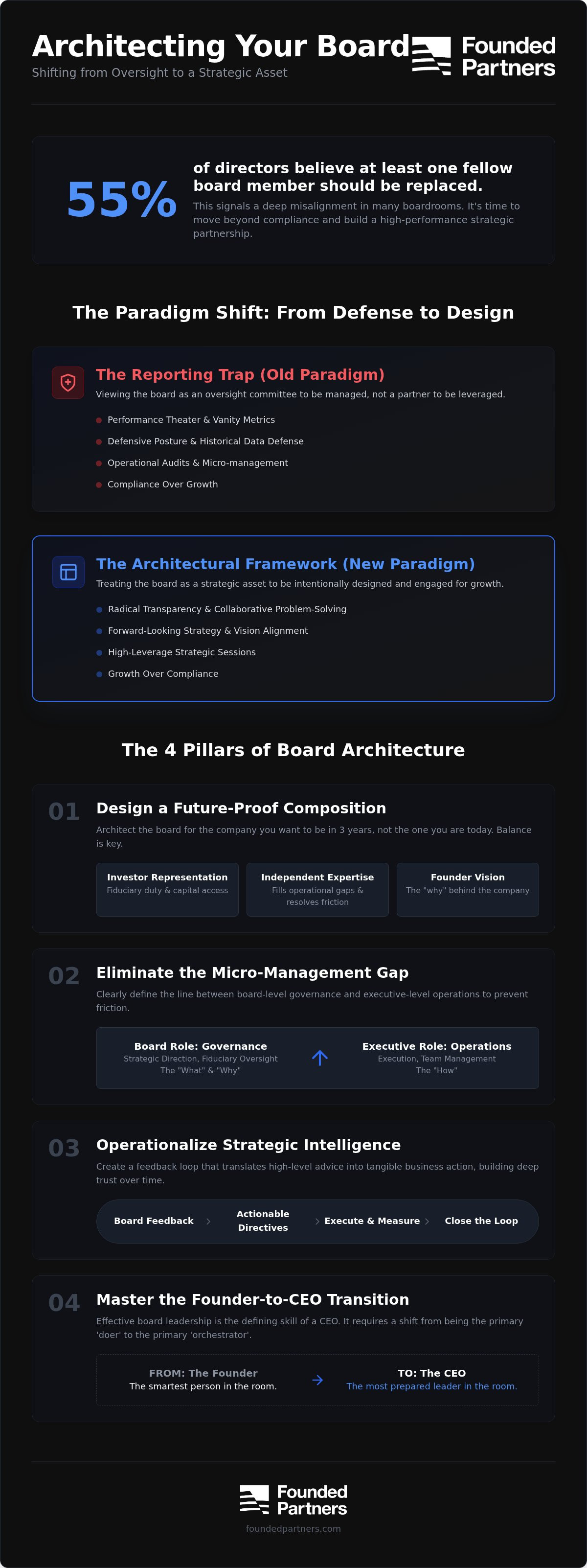
A board of directors is not a reporting body; it is a strategic asset that requires intentional architectural design. Too often, founders treat these sessions as performance theater where they defend historical data rather than architecting a collective future. In a landscape where 55% of directors believe at least one of their fellow board members should be replaced, according to 2025 survey data, the quality of your engagement defines your trajectory. If your meetings feel like an operational audit instead of a high-leverage strategy session, your current founder board management strategies may be prioritizing compliance over growth.
It's understandable to feel frustrated when directors drift into micro-management or misalign with your original vision. You want a seasoned peer, not a supervisor. This article promises to help you master an architectural approach that turns reporting obligations into a powerful engine for scaling your vision. We will explore how to build deep trust, align diverse expectations, and translate high-level feedback into actual business growth. It's time to stop managing your board and start leading it toward a more substantial future.
Key Takeaways
- Shift the fundamental paradigm from defensive reporting to a collaborative architectural framework that treats the board as a high-leverage strategic asset.
- Implement effective founder board management strategies by designing a board composition that reflects your future scale, balancing investor representation with independent expertise.
- Eliminate the "micro-management gap" by establishing clear boundaries between board-level governance and executive-level operational decisions.
- Operationalize strategic intelligence by translating board feedback into actionable business directives and closing the loop in every subsequent session to build trust.
- Recognize that board leadership is a refined skill that requires intentional practice and can be accelerated through professional leadership advisory.
Redefining the Board: From Oversight to Strategic Asset
The board of directors is often viewed through a lens of apprehension. For many founders, a board meeting feels like a quarterly defense of their right to lead rather than a collaborative session to solve complex problems. This perception is the primary barrier to effective founder board management strategies. When you view the board as a hurdle, you naturally lean into "performance theater," presenting curated vanity metrics that obscure the real challenges your business faces. This is the Reporting Trap. It stalls growth by replacing strategic dialogue with a polished script, leaving directors to guess at the actual health of the organization.
True board management requires moving from a reporting mindset to a partnership framework. Your board's true purpose isn't just to check your homework; it's to provide strategic guidance, unlock capital access, and ensure organizational resilience. They're the architects of your company's long-term durability. By shifting your approach, you transform the boardroom from a courtroom into a laboratory where the most difficult aspects of scaling are dismantled and solved together.
The Psychology of Board Dynamics
The friction between a founder and their board often stems from a fundamental disconnect in perspective. You have a deep emotional investment in the vision. The directors, however, are bound by corporate governance principles that prioritize fiduciary duty to all shareholders. This gap frequently widens during the power shifts following Series A and B funding rounds. As the board evolves from a small circle of trusted advisors to a structured body of professional investors, the founder's sense of autonomy can feel threatened.
Building a culture of radical transparency is the only way to eliminate the anxiety that fuels micro-management. When you share bad news early and provide context for missed targets, you remove the element of surprise. This transparency builds the psychological security directors need to step back from operational details and focus on high-level strategy.
The Founder-to-CEO Transition
Transitioning from a founder who "does" to a CEO who "orchestrates" is a professional milestone that many struggle to reach. Managing a board effectively is the defining skill of this evolution. It requires you to stop being the smartest person in the room and start being the most prepared leader. As you master these founder board management strategies, your role evolves from defending your past decisions to aligning your directors with your future vision.
The Founder-CEO board management mindset is a strategic architectural shift that repositions the board from a regulatory obligation to a high-leverage engine of growth.
Architecting Board Alignment: Composition and Structure
Building a board is an act of organizational architecture. You aren't just filling seats; you're designing the system of rules, practices and procedures that will either accelerate your growth or anchor your progress. Effective founder board management strategies begin with a simple premise: design the board for the company you want to become, not the one you are today. If you aim for an exit or a major capital event in three years, your composition must reflect that ambition now. This requires a deliberate balance of power between investors, independent directors, and founder representation.
While a prestigious resume offers comfort to external stakeholders, chemistry is what sustains a high-functioning boardroom. A director with an impeccable pedigree but no cultural alignment will inevitably create friction during high-stakes transitions. You need partners who understand the psychological toll of scaling. Rightsizing is equally vital. Early-stage firms often suffer from "too many cooks" syndrome, where a bloated board dilutes accountability and slows decision-making. Aim for a lean, agile group that values precision over volume.
Selecting Independent Directors
Independent directors serve as the "Neutral Peer." They're essential for resolving the natural friction that arises between founder vision and investor-led expectations. When identifying these members, look for specific operational gaps in your own leadership. If your current team is product-heavy, an independent director with deep go-to-market experience provides invaluable balance. Character vetting is paramount. You're looking for someone who has the courage to challenge you in private but the commitment to support you in public.
Structuring the Board Calendar
The most effective boards don't just meet four times a year. They maintain a consistent "between-meeting" cadence that keeps momentum alive. This rhythm prevents the quarterly session from becoming a frantic data dump. Use informal 1-on-1s to socialize difficult topics well before they reach the boardroom table. This proactive alignment is a core component of Leadership Advisory for founders who want to lead with composure. Additionally, designing specific committee structures, such as Audit or Compensation, allows for deep-dive results that the full board can't always achieve in a general session. By orchestrating these interactions, you ensure that every director's expertise is being leveraged toward business growth.
Governance vs. Guidance: Navigating Founder-Board Friction
Friction is a natural byproduct of high-stakes leadership. The most common source of tension is the 'Micro-management Gap,' a psychological space where directors feel compelled to intervene because they lack clarity on the operational roadmap. Successful founder board management strategies proactively close this gap by defining the perimeter of influence. When you lead with clarity, you replace the board’s anxiety with confidence, allowing them to shift from oversight to genuine guidance.
Establishing these boundaries begins with a mutual commitment to the roles and responsibilities of board members. While the board owns the 'what' and 'why' of long-term governance, the executive team must own the 'how' of daily execution. When directors drift into operational details, it's often a symptom of unaddressed anxiety rather than a desire for control. By clarifying these roles, you protect your team's execution speed and ensure that board meetings remain focused on high-level strategy.
Trust thrives on predictability. The 'No Surprises' rule is the most effective tool in your arsenal. If a key executive resigns or a funding milestone is missed, the board should hear it from you immediately. By providing context before they ask for it, you maintain the narrative and reinforce your position as a composed leader. Dissent, when handled correctly, becomes a strategic stress test that refines your vision rather than undermining it. Conflict is not a sign of failure; it's an opportunity to pressure-test your assumptions against seasoned perspectives.
Mitigating Micro-management
Protecting your execution speed requires you to educate the board on operational realities without appearing defensive. If a director fixates on a specific tactical detail, reframe the question. Turn a query about a single marketing campaign into a strategic discussion about customer acquisition costs. Implementing a formal 'Levels of Authority' (LOA) document is a practical way to codify these boundaries. This document explicitly outlines which decisions require board approval and which remain within the CEO’s purview, ensuring that your team can move fast without constant second-guessing.
Building Long-term Trust
Authentic leadership requires the courage to be vulnerable. Admitting what isn't working can actually strengthen your relationship with directors, as it demonstrates a commitment to reality over vanity. At Founded Partners, we provide the Leadership Advisory necessary to bridge communication gaps between founders and their boards. We help you navigate high-stakes transitions by operationalizing trust and ensuring that your directors remain aligned with your long-term objectives. This partnership transforms the board from a skeptical audience into a dedicated strategic ally.
Operationalizing Board Intelligence: Turning Advice into Action
The value of a board meeting is not found in the minutes but in the subsequent execution. Many founder board management strategies fail because the strategic insights gathered during the session never leave the boardroom. To transform advice into action, you must conduct a rigorous post-meeting debrief within 48 hours. This process involves translating high-level board commentary into specific operational directives for your executive team. Closing the loop is equally critical. At the start of your next session, report back on how previous advice was implemented. This demonstrates that you value their expertise, which in turn builds the autonomy you need to lead.
Think of your board as a "Scale-up Laboratory" for testing new business transformation ideas. Before rolling out a major shift in strategy, use your directors as a sounding board to pressure-test your assumptions. This collaborative approach reduces risk and ensures buy-in from the start. You should also empower your leadership team to interact with the board directly. Inviting your VPs to present their own sections of the deck provides directors with a clear view of your bench strength and allows your executives to learn from seasoned strategic perspectives.
The Executive Board Deck
Professionalizing your board materials is a prerequisite for high-leverage sessions. Move away from exhaustive data dumping and toward narrative-driven decks that highlight strategic inflection points. Adhere to the 72-hour rule: send pre-reads three days in advance to ensure directors arrive informed and ready for debate. A well-crafted board deck functions as a tool for strategic alignment, not just a ledger for historical reporting. By focusing on the narrative, you guide the conversation toward the future rather than litigating the past.
Operations Optimization via Board Insight
Strategic board-level KPIs should filter down into your organization’s daily rhythm. By linking board-approved strategy to department-level OKRs, you ensure that every layer of the business is pulling in the same direction. This alignment is where organizational health meets operational efficiency. If you are struggling to bridge this gap, our team at Founded Partners offers specialized Operations Optimization services to help you meet board-level growth targets through disciplined execution. We help you refine, guide, and strengthen your internal processes so that the board's vision becomes a tangible reality.
Scaling the Partnership: Leadership Advisory for Founders
Board management is rarely an innate talent. For most founders, the ability to lead a room of seasoned investors and independent directors is a learned skill, refined through the friction of real-world transitions. It requires a shift from the "doing" mindset of an operator to the "orchestrating" mindset of a professional CEO. This evolution is where external advisors provide the most significant value. By acting as a bridge between founder vision and director expectations, an advisor helps you interpret board sentiment and prepare for the high-stakes decisions that define a company's legacy. This disciplined approach ensures that your founder board management strategies evolve alongside your organization's complexity.
External advisors don't just provide tips; they facilitate deep alignment. They help you navigate the psychological shift from being the sole decision-maker to being the leader of a collective strategic body. This partnership is particularly vital when preparing for the "Ultimate Board Decision," such as a major ownership change or a definitive exit. Without a structured advisory framework, these transitions can become fragmented, leading to misalignment that erodes value and slows momentum. A seasoned advisor acts as a Strategic Architect, ensuring the foundation of your leadership remains stable during periods of rapid transformation.
The Path to a Successful Exit
A successful exit is the culmination of years of intentional board alignment. It requires a shared understanding of exit timelines, valuation expectations, and the ideal profile of a future acquirer. When a board is unified, it significantly increases enterprise value during a transaction. Acquirers look for a cohesive leadership structure that demonstrates strategic maturity and governance stability. To achieve this, you must integrate Exit Planning into your quarterly board discussions long before a deal is on the table. By socializing these topics early, you ensure that every director is pulling in the same direction when the window for a transaction finally opens.
Next Steps for Founder-CEOs
Transforming your board dynamic begins with an honest self-assessment of your current interactions. If your meetings still feel like performance theater, it's time to re-architect the relationship. Evaluating your current board dynamic through a lens of strategic leverage rather than mere compliance will reveal the gaps in your current founder board management strategies. Engaging with professional Leadership Advisory allows you to close these gaps and step into your role with composed expertise.
At Founded Partners, we specialize in helping founder-led organizations navigate these consequential transitions through business transformation consulting and operations optimization. We provide the steady hand and strategic perspective necessary to turn your board into a powerful engine for scaling your vision. When you are ready to move from defensive reporting to offensive strategy, we are here to guide the way.
Architecting a Legacy Through Board Alignment
Trust thrives on clarity. Mastering the architectural approach to board leadership transforms a regulatory necessity into a high-leverage strategic engine. By shifting from defensive reporting to proactive partnership, you create the psychological security required for directors to focus on long-term scaling rather than operational minutiae. Effective founder board management strategies rely on this fundamental alignment, ensuring that every session pressure-tests your vision and strengthens organizational resilience.
As you navigate capital raising or prepare for a strategic exit, the quality of your board dynamic becomes a defining factor in your enterprise value. Founded Partners is a boutique advisory led by seasoned partners Adam and Matt. We bring deep expertise in founder-led business transformation and a proven track record in orchestrating high-stakes transitions. We help you move beyond governance to achieve true strategic leverage.
Refine your board strategy with Founded Partners' Leadership Advisory to build a partnership that scales with your ambition. You have already built a remarkable foundation. Now is the time to lead with the composed expertise your vision deserves.
Frequently Asked Questions
How often should a founder-led board meet?
A founder-led board typically meets once per quarter, though monthly sessions are common during early-stage scaling or periods of high volatility. This quarterly rhythm allows for deep strategic reflection without disrupting operational momentum. You should supplement these formal sessions with monthly update emails and informal 1-on-1s to ensure directors remain aligned between meetings. This cadence prevents the "data dump" effect and keeps the focus on long-term value creation.
What is the ideal board size for a Series A startup?
The ideal board size for a Series A startup is generally three to five members. This typically includes the founder, one lead investor, and one independent director to provide a neutral perspective. Keeping the board lean at this stage ensures agility and prevents the decision-making paralysis often caused by "too many cooks." As the company matures toward Series B, you can expand the group to include additional specialized expertise.
How do I handle a board member who is overstepping into operations?
Address an overstepping director by reframing their operational queries into strategic challenges for the board to solve. If a member fixates on tactical details, acknowledge the concern and ask how that detail impacts the broader company trajectory. Establishing clear "Levels of Authority" (LOA) is a core part of effective founder board management strategies. This document explicitly defines which decisions remain with the CEO and which require board-level governance.
What should be included in a founder's board report?
A founder's board report should prioritize a narrative-driven executive summary followed by key performance indicators (KPIs) and financial statements. Focus on the "three highs and three lows" to provide an honest assessment of the business's health. Include a specific section for "Board Asks" where you clearly define the strategic help you need. This structure transforms the report from a historical log into a forward-looking tool for alignment and growth.
Can a founder also be the Chairman of the Board?
A founder can serve as the Chairman of the Board, though many high-growth organizations are moving toward a separated model to ensure objective oversight. Holding both roles allows for strong vision alignment but can sometimes create a perception of limited accountability. If you choose to retain the Chair title, appointing a Lead Independent Director can provide the necessary balance to satisfy investor concerns while maintaining your leadership influence.
How do I find the right independent directors for my board?
Find independent directors by identifying specific operational or strategic gaps in your current leadership team. Look for "Neutral Peers" who have navigated similar scaling challenges and possess strong cultural alignment with your vision. Vet candidates for their character and willingness to provide radical transparency during difficult transitions. Use your existing network and professional advisors to source individuals who value organizational health as much as financial metrics.
What happens if the board and the founder disagree on the company's direction?
When the board and founder disagree on direction, use the conflict as a strategic stress test to pressure-test your assumptions. Avoid defensive posturing and instead facilitate a data-driven dialogue to explore the risks and rewards of each path. If the misalignment persists, engaging external founder board management strategies through leadership advisory can help bridge the communication gap. The goal is to reach a consensus that prioritizes the long-term durability of the enterprise.
How can I use my board to help with capital raising?
Use your board to assist with capital raising by leveraging their networks for warm introductions and using their expertise to refine your pitch. Directors often have deep relationships with follow-on investors and can provide social proof that increases your credibility. Involve them early in the process to align on valuation expectations and timing. Their involvement turns a solitary fundraising effort into a coordinated strategic campaign for the company's future.