
Financial Modeling for Strategic Decisions: Founder's Guide

What if the option with the strongest forecast isn’t the right strategic choice? A spreadsheet can look precise while hiding the assumptions that matter most, from hiring pace to customer demand and execution risk. Financial modeling for strategic decisions helps founders make those assumptions visible and compare paths based on more than a headline projection.
Leadership teams need a clear way to weigh choices with different costs, timelines, and operational demands. A useful model doesn’t make the decision for you. It connects strategic options to the drivers behind their financial outcomes, so you can see the trade-offs and what would need to be true for each path to work.
In this guide, you’ll learn how to frame scenarios, identify operating assumptions that materially affect results, and use decision triggers to keep forecasts grounded in business realities. You’ll also see how modeling can inform discussions about transformation, capital allocation, and ownership decisions, giving leadership a practical basis for choosing a direction and following through.
Key Takeaways
- Start with the leadership choice, then make the assumptions behind each option explicit.
- Trace how operating drivers, such as expansion pace or capacity, flow through to financial outcomes.
- Use scenarios to compare coherent paths and sensitivity analysis to test how selected assumptions affect results.
- Apply financial modeling for strategic decisions to clarify trade-offs, not to guarantee what will happen.
- Turn the analysis into a concise decision brief, then monitor the drivers that could change the chosen path.
What Financial Modeling for Strategic Decisions Actually Does
A forecast estimates what may happen if current expectations hold. A strategic decision asks a different question: what changes if leadership chooses one path over another? That distinction matters when a founder is weighing a capacity investment, entering a new market, or changing the pace of organizational growth. Financial modeling for strategic decisions is not just about projecting figures. It makes the financial consequences of a choice visible.
A strategic financial model is a structured representation of assumptions, business drivers, and possible outcomes. It links operating realities, such as customer demand, staffing needs, or production capacity, to financial results such as revenue, cash requirements, and margins. Financial modeling covers a broad range of analytical uses. For strategic decisions, the purpose is more focused: connect a leadership choice to the drivers that could shape its outcome.
A strategic financial model shows how a choice changes business drivers and how those drivers shape financial outcomes. It informs judgment, but it doesn’t predict the future or make the decision. Its value depends on whether leaders can understand and challenge the assumptions, then relate the outputs to the organization’s capacity and priorities.
How is strategic modeling different from routine budgeting?
A budget is generally a periodic spending and resource plan, often built around an agreed operating direction. A strategic model is designed to examine choices. It asks what the financial picture could look like if an important assumption changes, such as the timing of an investment or the pace of expansion.
The two can inform each other without serving identical purposes. A budget can provide a baseline for the model, while scenario analysis can show where a proposed strategy may require the budget to change. In practical terms, budgeting helps organize resources for a plan; modeling helps leaders assess the consequences of choosing that plan over alternatives.
Which decisions can a financial model help examine?
Start with a decision that has meaningful financial consequences. For example, a leadership team considering expansion might compare entering a market now with waiting until operating capacity is stronger. The model could map relevant assumptions, such as expected demand, additional staffing, launch timing, and the resources needed to support each path. These are inputs to explore, not evidence that a particular result will occur.
Other uses include assessing whether to add production capacity, sequence a transformation, or grow the organization at a different pace. The right model depends on the decision, its time horizon, and the constraints leaders need to respect, such as available cash, management attention, or execution capacity. A focused comparison may need only a few well-chosen drivers. More detail is useful only when it clarifies a real uncertainty; complexity on its own doesn’t make a model more reliable.
Keep the question clear: what choice is leadership making, what assumptions distinguish the options, and which outcomes would influence the decision? That focus gives the analysis a practical purpose and creates a foundation for comparing alternatives.
How Strategic Choices Become Financial Model Drivers
A leadership question becomes useful in a model when it can be traced from choice to operational change, then to financial effect. The aim isn’t to fill a spreadsheet with every available metric. It’s to identify the assumptions that could change the decision, make their relationships visible, and agree on what evidence would matter.
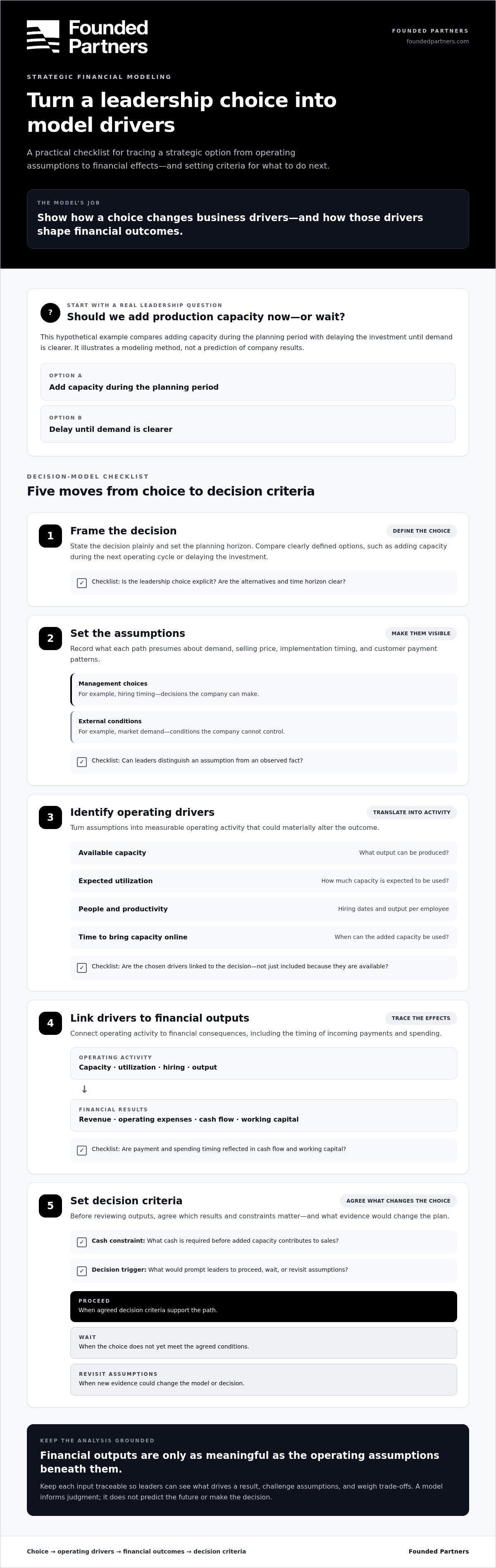
For a hypothetical company considering extra production capacity, the question might be: should we add capacity during the planning period, or wait until demand is clearer? A driver-based model could trace how either choice affects available output, staffing, sales, expenses, and cash needs. The example illustrates a method, not a prediction or a claim about actual company results.
- Frame the decision. State the choice and define the planning horizon. For example, compare adding capacity during the next operating cycle with delaying the investment.
- Set the assumptions. Record what each path presumes about demand, selling price, implementation timing, and customer payment patterns. Separate management choices, such as hiring timing, from external conditions, such as market demand, that the company can’t control.
- Identify operating drivers. Translate assumptions into measurable activity: usable capacity, expected utilization, output per employee, hiring dates, and the time required to bring new capacity online.
- Link drivers to financial outputs. Connect activity to revenue and operating expenses, then trace payment and spending timing into cash flow and working capital.
- Set decision criteria. Agree which outputs and constraints matter, such as the cash required before additional capacity contributes to sales, and what would prompt leaders to proceed, wait, or revisit assumptions.
Financial outputs are only as meaningful as the operating assumptions beneath them. Keep each input traceable so leaders can see what drives a result and distinguish an assumption from an observed fact.
Start with the decision and its measurable drivers
Write the question in plain language, with a clear time horizon and a comparison between defined options. Then identify the operational variables that could materially alter the outcome. In the capacity example, these might include demand, utilization, hiring pace, and launch timing. Mark which inputs leadership can choose and which are external assumptions. This clarifies what the team can act on and what it needs to monitor.
Connect operating assumptions to financial statements
Show the chain of cause and effect. More available capacity may support additional sales only if demand and staffing are sufficient. Hiring can add labor expense before new output generates revenue. If customers pay after delivery while suppliers or employees must be paid sooner, timing can increase working capital needs. Map these relationships into the income statement, balance sheet, and cash flow view so every decision-relevant output can be traced back to its operating inputs.
This discipline makes financial modeling for strategic decisions useful in practice: leaders can test how a change in one assumption flows through the business instead of treating a projected result as a standalone answer. For founder-led teams weighing major operational or capital choices, strategic advisory for founders can bring financial logic into conversation with execution capacity and leadership priorities.
How Scenarios and Sensitivity Analysis Reveal Strategic Trade-Offs
A single forecast can conceal the choices behind it. Scenario analysis and sensitivity analysis make those choices easier to examine, but they answer different questions. A scenario combines related assumptions into a coherent path, such as maintaining current operations, expanding in stages, or moving faster. A sensitivity changes one selected input, such as customer uptake or launch timing, to show how it affects a chosen output.
For a hypothetical regional expansion, leaders might compare a base case that maintains the current footprint with a staged entry and a faster rollout. These are possible paths, not guaranteed forecasts. The comparison should make clear what each path assumes and what it requires of the organization.
| Case | Key assumptions | Cash implications | Execution requirements | Principal uncertainty |
|---|---|---|---|---|
| Base case: maintain current footprint | Current operations continue without a new market launch. | Existing operating needs remain the reference point; no expansion-related outlay is modeled. | Leadership attention stays with current priorities. | Whether current demand and performance assumptions hold. |
| Alternative: staged entry | Expansion proceeds in phases, with later steps informed by early operating evidence. | Cash needs build over time, though timing depends on setup and operating assumptions. | Leaders must coordinate phased activity and assess progress between stages. | Whether early evidence supports continuing at the planned pace. |
| Alternative: faster rollout | More expansion activity happens earlier, with resources committed sooner. | Cash demands may arrive before the new operation contributes as assumed. | Greater coordination and execution capacity may be needed sooner. | Whether demand, hiring, and implementation can keep pace. |
The table doesn’t declare a winner. It helps leadership see where the options differ and what must be true for each to remain viable. Financial modeling for strategic decisions should expose trade-offs and decision thresholds, not manufacture certainty from precise-looking outputs.
When should leaders use scenarios instead of sensitivity analysis?
Use scenarios when comparing distinct strategic paths whose assumptions move together. A staged launch, for example, changes timing, resource commitments, and the sequence of execution as a connected package. Use sensitivity analysis to isolate a particular variable and test how it affects an outcome. Leaders can combine both: compare strategic paths first, then test which uncertain inputs could alter the choice between them.
How can a model show uncertainty without creating false precision?
Label assumptions by source and confidence: observed evidence is different from management judgment. Where a single estimate would imply more certainty than the team has, use a range or clearly defined cases, and explain what each represents. Focus on unknowns that could change the decision, such as whether the business can execute a launch at the proposed pace, rather than varying inputs simply because the model allows it.
A useful analysis also identifies a threshold: the condition that would prompt leaders to proceed, pause, or revisit the plan. That threshold may be operational as well as financial. For example, leadership might want evidence of adequate delivery capacity before committing to the next phase. The model supports the discussion; company context and leadership judgment remain essential.
A Practical Process for Using a Financial Model in Leadership Decisions
A model earns its place in a leadership discussion when it helps the team move from analysis to a clear choice, then learn from what happens next. A repeatable process keeps the conversation focused: frame the decision, agree on assumptions, compare options, decide, and monitor. This makes financial modeling for strategic decisions an ongoing discipline rather than a spreadsheet reviewed only at approval time.
- Frame the choice. State the decision, the options under consideration, and the time horizon. Make clear what leadership needs to decide now and what can remain open.
- Agree on assumptions. Identify the key inputs behind each option. Distinguish evidence from judgment, and make sure leaders understand where assumptions differ.
- Compare the options. Review relevant financial outcomes alongside cash requirements, operating capacity, dependencies, and risks. Keep definitions and time horizons consistent so the comparison is fair.
- Decide and record the rationale. Capture the chosen path, the reasons for it, and the uncertainties leadership accepts. Note what evidence would cause the team to reconsider.
- Monitor and learn. Assign owners to track decision-relevant indicators, compare actual performance with assumptions, and revisit the choice at meaningful milestones.
Before approval, look beyond headline returns. Check whether the options use comparable assumptions and whether the business can support the required hiring, delivery, or implementation. Name the assumptions that would materially change the decision if they proved wrong. A seemingly attractive path may depend on a timing or capacity assumption that deserves closer attention.
What should decision-makers review before approving a path?
A concise decision brief can make the discussion more productive. Summarize the choice, the options compared, the drivers with the greatest influence, the key trade-offs, and unresolved uncertainties. Include expected cash implications and operational dependencies, not just projected financial outcomes. Keep the brief short enough to guide a conversation while making its logic traceable to the model.
The brief should also state what the model cannot settle. For example, it may show the financial effect of a hiring plan, but leaders still need to judge whether the organization can recruit and onboard at the required pace. This keeps analysis in its proper role: informing judgment, not replacing it.
How should teams revisit a model after the decision?
Choose a small set of indicators tied directly to the decision and assign an owner to each. Set review points around meaningful milestones, such as launch readiness or the completion of an operating phase, rather than making arbitrary spreadsheet updates. At each review, compare actual performance with the original assumptions, explain material differences, and record whether the strategic choice still holds.
Follow-through also means connecting financial outcomes with the operating changes intended to produce them. Measuring business transformation success can help leaders consider how progress against transformation objectives informs ongoing decisions. That broader view can reveal whether a variance reflects timing, execution, or a premise that no longer fits.
For founder-led teams weighing a consequential decision, Founded Partners’ strategic advisory brings financial analysis into the wider context of operating priorities and execution capacity.
How Financial Modeling Connects to Strategic Advisory for Founders
A model can organize assumptions and show possible financial consequences. It can’t determine whether a strategy fits the company’s people, capabilities, or priorities. Founders need both views: financial logic to understand the implications of a choice, and operating context to judge whether the organization can carry it through.
That broader perspective matters when choices are connected. A market expansion may affect capacity, hiring, leadership attention, and capital needs at the same time. A transformation may ask teams to absorb operational changes while maintaining service. A model can help clarify these implications, while strategic discussion tests whether the assumptions reflect the company’s actual readiness and the founder’s objectives.
When might a founder benefit from an outside strategic perspective?
An outside perspective can be useful when leadership is balancing competing priorities, considering a material investment, or approaching a consequential transition. Advisors can help surface assumptions that have gone unchallenged, compare options on consistent terms, and bring operational constraints into the discussion. That perspective isn’t necessary for every decision; a focused internal review may be enough when the choice is limited and its consequences are readily understood.
The value lies in the quality of the questions, not in adding complexity. Does the plan depend on hiring faster than the organization can support? Are leaders weighing a near-term cash requirement against a longer-term strategic aim? Which uncertainty could change the decision? Working through questions like these can help founders distinguish an attractive projection from a path the business is positioned to execute.
Bring financial analysis into a wider growth decision
Use model insights alongside organizational readiness, execution capacity, and leadership priorities. If a capital decision is under consideration, for example, the analysis can help frame how funding might support a chosen direction and what operating commitments that direction entails. It should inform the discussion, not be treated as a substitute for judgment or as a promise of results. For context on planning growth around financing choices, see this guide to capital raising for founders.
Founded Partners advises founder-led organizations through business transformation, operations optimization, capital raising support, exit planning, and leadership transitions. This work connects strategic and transaction considerations with the realities founders face as they shape the next stage of a business. Financial modeling for strategic decisions can contribute by clarifying choices and trade-offs; the broader advisory conversation brings those insights into company context.
When the decision carries meaningful implications for growth, capital allocation, or ownership, a broader perspective can help align the analysis with the organization’s priorities. Strategic advisory for founder-led companies connects those considerations to the choices shaping a company’s next chapter.
Make the Next Decision With Greater Clarity
The next strategic choice doesn’t need to begin with a perfect forecast. Begin with a clear question: what would need to be true for this direction to serve the business well? That question can help leadership focus its attention, test its convictions, and decide what to learn before committing further resources.
Used thoughtfully, financial modeling for strategic decisions becomes part of how a company learns as it grows. The model should evolve as operating conditions change, while leaders stay grounded in what matters to the organization and the people responsible for execution. The aim isn’t certainty. It’s a more deliberate basis for action.
Founded Partners advises founder-led organizations on consequential decisions, with work spanning business transformation, capital raising support, exit planning, and leadership advisory. If you’re weighing a meaningful next step, discuss your strategic priorities with Founded Partners and consider how the analysis can support the direction you want to build.
Clearer choices create room to move forward with purpose.
Frequently Asked Questions
What is the difference between financial modeling and budgeting?
A budget sets the expected income and spending plan for a period, while financial modeling for strategic decisions tests how choices or changed assumptions could affect the business. For example, leadership might use the budget to manage the approved hiring plan, then model how delaying a role could affect capacity and cash. The budget can inform that analysis, but the model’s central purpose is to examine a decision, not simply track the plan.
How much historical data do you need to build a financial model?
There’s no universal minimum; the right amount depends on the decision, the company’s operating history, and the reliability of its records. Historical results can help reveal patterns, such as seasonal demand or payment timing, but they can’t establish what future conditions will be. For a new business or one undergoing change, label actual results separately from estimates and explain gaps so decision-makers can judge how much weight to give each input.
Can a financial model include nonfinancial assumptions?
Yes. Operational measures can be important model inputs when they help explain financial outcomes. For instance, a service business might connect customer retention and staff availability to the volume of work it can deliver. Choose measures because they relate to the decision, not just because data is easy to collect. Documenting the relationship between an operating input and its financial effect helps leaders assess whether the plan is plausible.
How often should a company update its financial model?
Update a model when new information could change a material assumption or the decision itself. That might happen after a major customer changes its plans, a key operational milestone is reached, or conditions shift enough to affect the company’s options. Set a clear reason for each review rather than revising figures for appearance. A brief change log can record what changed, why it changed, and whether leadership needs to reconsider its course.
How can leaders tell whether a financial model is too complex?
A model may be too complex if leaders can’t explain what drives its important outputs or identify which assumptions matter to the decision. Ask someone who wasn’t involved in building it to trace a key result back to its inputs. If the logic is hard to follow, simplify immaterial detail and clarify labels or links between inputs. A model should be rigorous enough to test the choice, yet understandable enough to challenge.
Can financial modeling help decide whether to hire ahead of growth?
Yes. A model can help compare hiring now with waiting for clearer evidence of demand by showing how role timing affects payroll, available capacity, and cash needs. Include the conditions that make each option viable, such as the work new hires are expected to support and the time needed for them to contribute. Treat demand as an assumption, not a certainty, and pair the analysis with leadership’s view of execution capacity.