
What to Do When Your Startup Hits a Growth Plateau

The most expensive response to a growth plateau may be moving faster in the wrong direction. If you’re asking what to do when your startup hits a growth plateau, resist the urge to add a product, enter a new market, or increase spend before you know what is holding growth back.
Flat results can reflect a temporary fluctuation or a deeper constraint in your market, operations, leadership, or growth model. Pressure from employees, investors, and board members can make it tempting to act quickly, but urgency alone doesn’t reveal which move will strengthen the business.
This article will help you diagnose the constraint, weigh options against evidence, and choose a proportionate response. You’ll learn which signals to examine, how to test growth levers without overcommitting scarce resources, and when strategic support may help clarify the next stage. A plateau isn’t automatically a failure. It can signal that the systems and choices that got you here need to evolve.
Key Takeaways
- Separate revenue, acquisition, retention, margins, and delivery capacity to pinpoint which growth signal has stalled.
- Trace the issue through customer funnel performance, unit economics, and execution.
- Match your response to the evidence, weighing improvements to the core offer against adjacent markets or partnerships.
- Turn what to do when your startup hits a growth plateau into a focused 90-day plan with clear ownership, measures, and review dates.
- Use strategic advisory when competing priorities or recurring execution gaps make it difficult to clarify direction and strengthen operations.
What a Startup Growth Plateau Signals, and What It Does Not
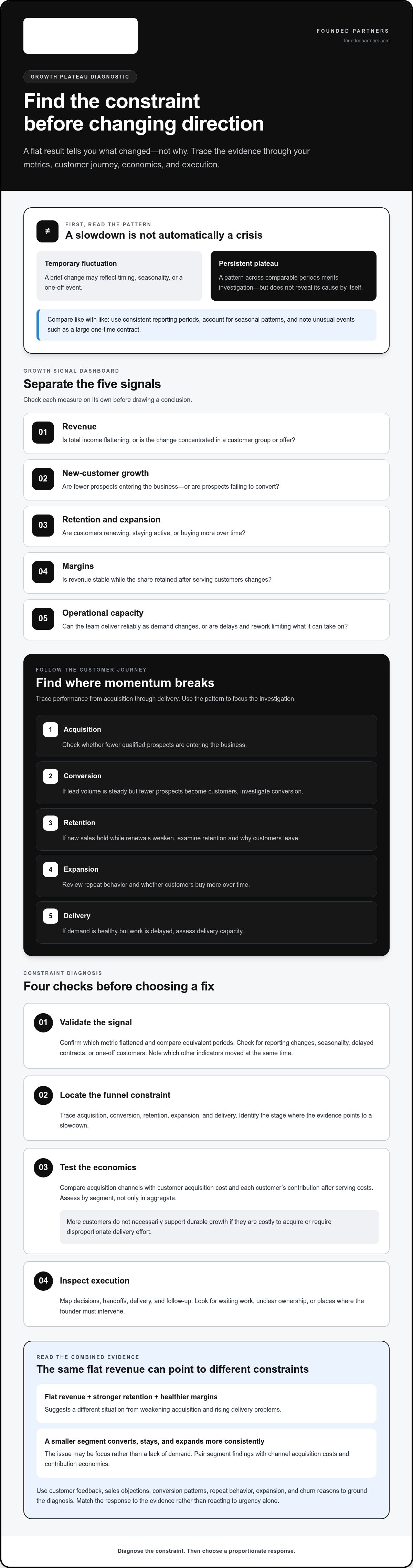
A growth plateau is a sustained flattening in one or more meaningful business indicators, not a single disappointing report. A soft month may reflect timing, seasonality, or a one-off event. A persistent pattern merits investigation, but it doesn’t reveal the cause on its own. Before deciding what to do when your startup hits a growth plateau, clarify which measure has changed and what it says about the business.
Startups operate with evolving products, markets, and ways of working. For broader understanding startup dynamics, keep in mind that early growth can depend on conditions that shift as a company develops. A flattening headline number may signal a need to adapt, not proof that the business has lost its potential.
Which growth metric has actually flattened?
“Growth” can describe several different outcomes. Review each separately before drawing a conclusion:
- Revenue: Is total income flattening, or is the change concentrated in a particular customer group or offer?
- New-customer growth: Are fewer prospects entering the business, or are prospects failing to convert?
- Retention and expansion: Are customers renewing, staying active, or buying more over time?
- Margins: Is revenue stable while the share retained after serving customers changes?
- Operational capacity: Can the team deliver reliably as demand changes, or are delays and rework limiting what it can take on?
Compare like with like: use consistent reporting periods, account for seasonal patterns, and note unusual events such as a large one-time contract. Measure performance against the company’s own history rather than a generic startup growth benchmark. The pattern across metrics matters. Flat revenue alongside stronger retention and healthier margins suggests a different situation from flat revenue paired with fewer new customers and increasing delivery problems.
Why a plateau is not automatically a crisis
Headline growth can slow by design. A company may focus on better-fit customers, reduce unprofitable activity, or improve delivery quality before pursuing more volume. Those choices can steady revenue while strengthening the business. A strategic pause differs from a loss of product relevance or an inability to execute, and the evidence should help distinguish between them.
A temporary fluctuation is a brief change that settles; a persistent plateau is a pattern that remains across comparable periods and deserves investigation. There’s no universal threshold for making this judgment. Look for supporting signals in customer feedback, conversion trends, renewals, margins, and the team’s ability to meet demand.
Keep the response proportionate. Confirm the pattern before setting aggressive expansion targets, restructuring the organization, or making a major strategic shift. Calm investigation gives founders, employees, and investors a clearer basis for deciding whether to restore momentum, strengthen the operating foundation, or recognize that current results reflect a deliberate choice.
How to Diagnose the Constraint Behind a Startup Growth Plateau
A plateau rarely tells you what to change. The same flat revenue line might stem from fewer qualified leads, weaker conversion, customer churn, limited delivery capacity, or several issues interacting. To decide what to do when your startup hits a growth plateau, follow the evidence through the business before choosing a remedy. The goal is to identify the constraint that most directly limits progress, not to generate a long list of possible fixes.
- Validate the signal. Confirm which metric has flattened and compare equivalent periods. Check whether a reporting change, seasonal pattern, delayed contract, or one-off customer is distorting the picture. Note which other indicators moved at the same time.
- Locate the funnel constraint. Trace the customer journey from acquisition to conversion, retention, expansion, and delivery. If lead volume is steady but fewer prospects become customers, investigate conversion. If new sales hold while renewals weaken, examine retention and why customers leave. If demand is healthy but work is delayed, assess delivery capacity.
- Test the economics. Compare acquisition channels with customer acquisition cost and each customer’s contribution after serving costs. A channel may bring in more customers without supporting durable growth if those customers are costly to acquire or require disproportionate delivery effort. Assess economics by customer segment, not only in aggregate.
- Inspect execution. Map the work behind the customer journey: decisions, handoffs, delivery, and follow-up. Identify where work waits, ownership becomes unclear, or the founder must intervene. A sound market opportunity can still be constrained by processes or a leadership model that cannot support the next stage.
Is the constraint demand, retention, or unit economics?
Bring customer evidence into the diagnosis. Review feedback, sales objections, conversion patterns, repeat behavior, expansion, and churn reasons. Compare acquisition channels and segments to see whether the strongest-fit customers differ from the original target market. If a smaller segment converts, stays, and expands more consistently, the issue may be focus rather than a lack of demand. Pair those findings with channel-level acquisition costs and contribution economics before increasing spend or broadening the offer.
Are operations and leadership limiting execution?
Follow a recurring customer request from the initial decision through delivery. Note where approvals stall, handoffs lose context, or accountability is divided. Look for founder dependency and processes that work at low volume but break as demand rises. Then compare stated priorities with team capacity and operating cadence. If every initiative is urgent, ownership is unclear, or the same execution gap returns, the constraint may sit in the operating model rather than the market.
Demand constraints, retention issues, weak economics, and operational limits call for different responses. Don’t treat them as interchangeable. The next growth move should relieve the constraint that most limits the business, not simply add activity. A focused review of strategic priorities and operating foundations can help turn diagnosis into clearer choices. Founded Partners’ strategic and operational advisory gives founder-led organizations a structured outside perspective when internal views remain divided.
Which Growth Response Fits the Constraint You Found?
A growth lever is useful only if it addresses the constraint. Once the evidence points to a likely cause, weigh the potential response against what you still need to learn and what the move could put at risk. A new market, partnership, or hiring plan can create momentum, but each adds complexity. Often the most proportionate move is to strengthen the business you already have.
| Diagnosed constraint | Potential response | Evidence to support it | Trade-off to consider |
|---|---|---|---|
| Customer friction or weak retention | Refine the core offer, onboarding, or customer support. | Repeated feedback, churn reasons, or drop-offs reveal a specific unmet need. | Refinement takes focus and may delay broader expansion. |
| Demand is concentrated in a narrow segment | Test an adjacent market or customer group. | The current model has repeatable strengths, and conversations or early tests show credible demand nearby. | A new segment may require different messaging, delivery, or expertise. |
| Reach is limited, but capabilities complement another organization’s | Explore a strategic partnership with defined responsibilities. | There is a clear shared customer need and a practical way to measure contribution. | Shared work can blur accountability or create dependency. |
| Delivery bottlenecks limit volume | Redesign processes, delegate decisions, or make targeted hires. | Work repeatedly stalls at the same handoff, approval, or skill gap. | Changes require management attention and can add cost before capacity improves. |
| A defined growth plan lacks adequate resources | Assess whether capital aligns with specific uses and milestones. | The plan has clear economics, operating readiness, and a credible path from resources to execution. | Capital can extend a weak model if demand or unit economics remain unclear. |
Improve the core before expanding the business
When customers value the offer but encounter friction, start close to the source: refine a feature or service, simplify onboarding, or address a recurring delivery issue. Check whether customers use the improvement and whether it supports retention, margins, or service quality. Assess the core operation’s capacity, too. If serving more customers would strain delivery or reduce quality, strengthen the operating model before adding volume.
When adjacent markets, partnerships, or capital may fit
Expansion is more grounded when the current model shows repeatable strengths and a nearby market has credible demand. Test the assumptions before committing significant resources. Partnerships can extend reach or capabilities, but define ownership, customer handoffs, and measures of success so shared effort doesn’t become unclear responsibility. Capital may support a specific, viable plan; it cannot substitute for customer demand, sound economics, or the ability to execute.
The right answer to what to do when your startup hits a growth plateau depends on the constraint, evidence, and capacity of the organization. For founder-led businesses weighing a strategic shift, Founded Partners’ scalability strategy and operations advisory can help clarify priorities and strengthen the foundations for execution.
A Practical 90-Day Plan to Respond Without Creating New Bottlenecks
A defined time frame can turn diagnosis into disciplined action. A 90-day plan gives the team room to establish a baseline, test one response, and review what the evidence supports. It doesn’t promise that growth will return within that period. It helps make the next decision clearer while keeping the organization focused.
For each initiative, name one accountable owner, choose a small set of measures, and set a decision date. Limit simultaneous priorities. When several changes launch at once, the team may not know which one affected results, and each initiative can add pressure to already constrained operations.
Set the baseline and choose a focused test
Record current performance, customer evidence, key assumptions, and operational limits. Identify the specific bottleneck the initiative is meant to address, then choose one intervention that can test the diagnosis. Before work begins, agree on leading indicators and guardrails, such as a customer response measure alongside a delivery-quality measure. This helps the owner monitor progress without treating one headline number as the whole story.
- Baseline: Establish the starting point and confirm the test’s scope. Write down what the team expects to change, what evidence would support that expectation, and what could signal unintended strain.
- Focused experiment: Run the selected intervention with a clear owner and regular check-ins. For example, if onboarding friction appears to hinder activation, test a specific onboarding improvement with the relevant customer group rather than changing the whole offer and acquisition approach at once.
- Evidence-based review: At the agreed decision date, compare results with the baseline, review guardrails, and assess the effort required. Decide whether to continue, adjust, or stop. Record the reasoning and what the team learned.
Review evidence and decide what happens next
Use regular reviews to surface emerging results, delivery issues, and capacity concerns before they grow. Separate leading indicators, which may shift before the main outcome, from the outcome the initiative is intended to influence. The guide on measuring business transformation success can also help frame measurement around meaningful progress rather than activity alone.
Agree in advance how evidence will inform the decision. If the intended indicator improves and guardrails remain sound, continuing or carefully extending the test may be reasonable. If results are mixed, adjust the intervention or revisit the assumption. If the test adds strain without addressing the bottleneck, stop it and document why. The aim isn’t to defend a plan; it’s to learn quickly enough to make a better next choice.
For founders asking what to do when your startup hits a growth plateau, a 90-day plan provides a clear cadence: establish, test, review. Founded Partners helps founder-led organizations translate strategic priorities into coordinated action through business transformation and operations optimization. Explore Founded Partners’ business transformation and operations optimization advisory to strengthen the foundations for execution.
When Strategic Advisory Can Help a Founder Move Beyond the Plateau
Sometimes the challenge isn’t a lack of ideas. It’s that the leadership team can’t agree on which idea matters most, who owns it, or how to execute it without disrupting the rest of the business. Competing priorities, unclear decision rights, and recurring execution gaps can signal that internal diagnosis has reached its limit. A fresh strategic perspective can help distinguish the underlying constraint from its symptoms and refocus attention on the choices in front of the company.
Strategic support is most useful when it strengthens decision-making, not when it adds another layer of activity. For founder-led organizations, business transformation and operations optimization connect strategic objectives with the capabilities, leadership alignment, and operating practices needed to pursue them. That may mean clarifying priorities, refining accountability, or addressing a bottleneck that keeps the team from carrying out an agreed plan.
What an advisory engagement should help clarify
A productive advisory conversation connects the company’s goals to how it operates today. Which constraints need attention now, and which should be monitored? Where do leadership decisions, team capacity, and day-to-day execution reinforce the strategy, and where do they conflict? The answers should lead to priorities that reflect the business’s context, not a generic growth formula or a promise of immediate results.
This perspective can be especially valuable when a founder remains the default decision-maker for routine work or initiatives repeatedly lose momentum after launch. An advisor can help the leadership team examine the operating model, surface trade-offs, and decide where transformation or operational changes may strengthen the foundation for future growth. The work should leave leaders clearer about what they’ve chosen to do, who is responsible, and what evidence will guide the next decision.
Choosing the next strategic conversation
Before seeking support, prepare a concise account of the plateau: which indicators changed, what diagnosis suggests is constraining growth, which responses have been tried, and which decisions remain unresolved. Include the operational realities behind the numbers, such as handoff delays or limited leadership capacity. This creates a more useful starting point than a broad request to “get growth moving again.”
Business scalability consulting can provide strategic context for founders considering how their organization must evolve as it grows. Capital raising may also be relevant when the diagnosis points to a defined growth objective and the business is prepared to deploy capital against a clear plan. It isn’t a universal answer to stalled demand, weak economics, or unclear execution.
If you’re deciding what to do when your startup hits a growth plateau, Founded Partners advises founder-led organizations on transformation and operations priorities. Explore business transformation consulting to clarify the choices ahead without assuming that growth requires expansion at any cost.
Build the Next Stage with Intention
A plateau can create space to ask a more useful question: what kind of organization do you want to build next? The answer may call for sharper priorities, stronger leadership alignment, or a more resilient operating foundation. Choosing what to do when your startup hits a growth plateau isn’t about chasing momentum at any cost. It’s about making the next move consistent with your ambition and the business you want to sustain.
Founded Partners works with founder-led organizations on business transformation, operations optimization, and scalability strategy. If an outside perspective would help you shape the next stage, explore strategic advisory for founder-led businesses. Start with a clear conversation about what the business needs to become more capable, focused, and durable.
Frequently Asked Questions
How do you know if your startup has hit a growth plateau?
Look for a recurring pattern across comparable reporting periods, then examine what’s happening beneath the headline result. A healthy pipeline with fewer closed deals may indicate a sales-conversion issue, while stable bookings alongside weaker renewals could point to customer value or fit. Check whether the pattern appears across customer segments and channels, too. One aggregate number can hide very different trajectories within the business.
What are the most common reasons a startup stops growing?
Growth can stall when customer needs shift, the offer no longer stands apart, or acquisition channels stop producing enough qualified prospects. Retention problems can offset new sales, while pricing or service costs may make growth less sustainable. Inside the company, unclear ownership, founder dependence, or delivery processes that don’t scale can slow execution. The cause is often a combination, so look for the factor with the strongest effect on results.
Should a startup raise capital to overcome a growth plateau?
Raise capital only when funding supports a specific, evidence-based plan, not simply because growth has slowed. A company might need resources to fulfill validated demand or run a defined market test, with milestones showing whether the investment is working. First understand the cash required, its intended use, and the operational capacity to deploy it. Funding won’t create product-market fit or repair economics that don’t support the plan.
Can a startup grow without expanding into new markets?
Yes. A startup can deepen growth in its existing market by improving customer activation, encouraging repeat use, increasing relevant expansion purchases, or strengthening referrals. A company with strong demand but inconsistent onboarding, for example, may have room to serve its current audience more effectively before pursuing a new one. Focus on the needs of customers already being served, and assess whether improvements support durable revenue and a manageable delivery workload.
How long should a startup test a new growth strategy?
Test long enough to observe the behavior the strategy is meant to change, not just the first response. A sales-channel test may need time to produce qualified opportunities and completed deals; a retention initiative needs enough customer usage or renewal activity to judge its effect. Set a review date and decision criteria before launch. If the company’s sales cycle is longer, extend the test rather than drawing a conclusion from incomplete evidence.
What metrics should founders track when growth slows?
Choose measures that reveal the path from investment to outcome. A useful dashboard might pair qualified leads and conversion rates with customer retention, expansion revenue, acquisition cost, and contribution margin. Add an operating measure tied to delivery, such as backlog or time to complete customer work, if capacity is a concern. Keep the set small enough to review consistently, and segment results where averages could conceal differences among customer groups.
When should a founder seek business transformation advice?
Consider outside advice when leadership discussions keep reopening the same decisions, initiatives lack clear ownership, or execution gaps persist despite repeated attempts to resolve them. Prepare a concise record of the company’s priorities, operating challenges, and unsettled decisions. Founded Partners advises founder-led organizations through business transformation and operations optimization, helping leadership teams connect strategic goals with operating capabilities and execution priorities.