
Founder Succession Planning: A Practical Guide to Leadership Continuity

Founder succession planning isn’t a countdown to the founder’s departure. It’s a way to protect the company’s direction while building the leadership capacity to carry it forward. When decisions, customer relationships, and strategic knowledge depend on one person, it’s understandable to worry that planning could unsettle the team or signal an imminent exit.
But a succession plan can begin well before a transition is on the horizon. It helps clarify who owns key responsibilities, where leadership needs development, and how the business can keep moving if circumstances change. You don’t need to have a successor ready today to start reducing founder dependency.
This guide lays out a phased approach suited to your company’s maturity. You’ll learn how to assess transition readiness, prepare emerging leaders, and communicate change in a way that supports employees, customers, and strategic priorities. The goal isn’t to replace the founder’s contribution overnight. It’s to create a stronger operating foundation, give future leaders room to grow, and help the company thrive through change.
Key Takeaways
- Use founder succession planning to protect decision-making, customer relationships, and strategic priorities, not just to prepare for an exit.
- Map work that relies on the founder, then clarify which responsibilities future leaders will need to own.
- Assess leadership readiness through judgment, delegation, and strategic capability, rather than title or tenure alone.
- Compare internal, external, shared-leadership, and ownership-transition pathways against your company’s needs and transition complexity.
- Build the plan in stages and review it as the business evolves, strengthening continuity without treating planning as a signal that the founder must leave soon.
What founder succession planning protects, and why it is not just an exit plan
A founder’s influence often reaches beyond their formal role. They may hold key customer relationships, make decisions no one else is authorized to make, and carry knowledge that has never been documented. Founder succession planning prepares the leadership team and organization for a future change in the founder’s role, so important work and relationships can continue without relying on one person.
Preparation can begin long before retirement, a sale, or any immediate leadership change. It gives the company time to clarify responsibilities, share institutional knowledge, and protect strategic priorities. The broader concept of succession planning covers preparing people to assume important roles. For a founder-led business, the work also means strengthening the systems and relationships around those roles.
Founder succession planning versus exit and continuity planning
These plans are related, but they answer different questions. Leadership succession focuses on who will guide the company and how responsibilities will shift. Exit planning prepares for a sale or ownership change. Business continuity planning focuses on maintaining essential operations through disruption. The plans can overlap around decision rights, key relationships, and timing, but one doesn’t automatically replace the others. For sale-focused considerations, see Exit Planning for Founders.
Signs the company depends too heavily on its founder
Dependence is worth examining when routine work repeatedly waits for the founder. Look across three areas:
- Leadership: Major decisions, approvals, or priority-setting consistently return to the founder.
- Operations: Critical processes rely on the founder’s memory, judgment, or personal intervention.
- External relationships: Customers, suppliers, or strategic partners have limited connection with other leaders.
A recurring bottleneck is a signal to build capacity, not proof of an immediate crisis. Note where work pauses during the founder’s absence, which relationships are difficult to hand over, and what knowledge exists only in informal conversations. This review points to where clearer ownership, documentation, or leadership development could improve continuity.
Succession readiness is not a prediction about when a founder will leave. It helps preserve the company’s ability to make sound decisions, serve customers, and stay aligned with its priorities as roles and circumstances evolve.
How to prepare future leaders without losing the founder's strategic intent
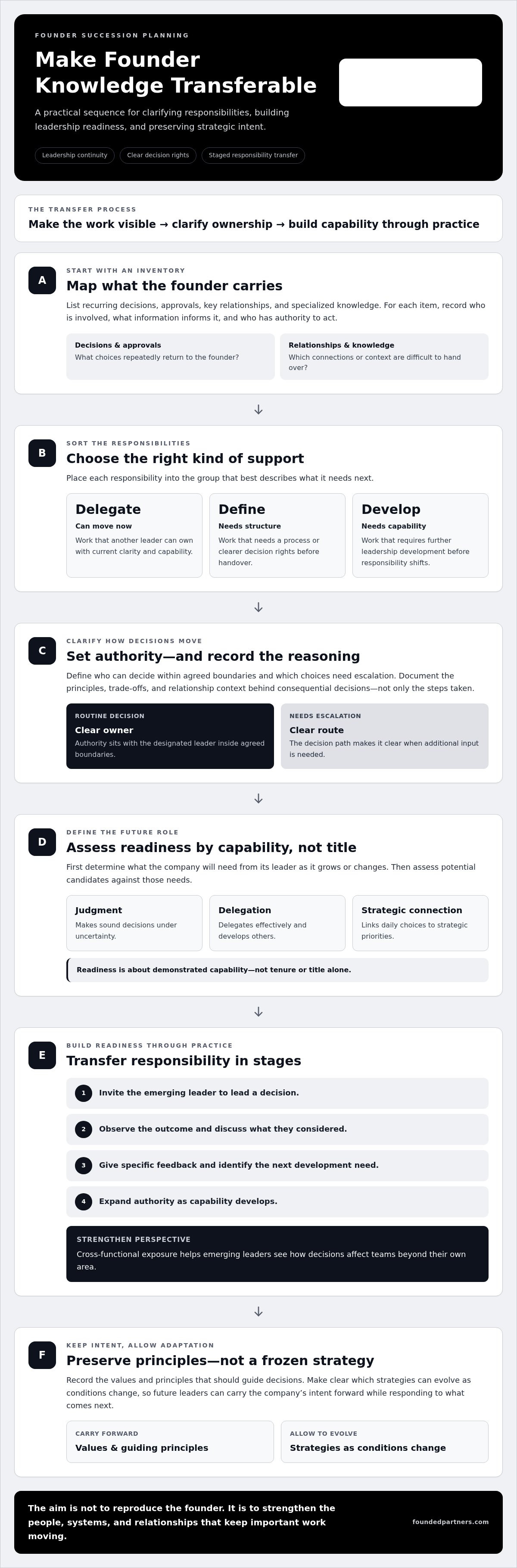
Leadership continuity is built through deliberate transfer, not a last-minute handoff. A practical founder succession planning process starts by making the founder’s work visible, then gives future leaders clear responsibilities and opportunities to exercise judgment. The aim isn’t to reproduce the founder. It’s to help the next leaders understand the principles behind past decisions and apply them to what comes next.
Map the founder's responsibilities and decision rights
Begin with an inventory of recurring decisions, approvals, key relationships, and specialized knowledge. For each item, note who is involved, what information informs the decision, and who has authority to act. Then sort responsibilities into three groups: work that can be delegated now, work that needs a process or clearer decision rights, and work that requires further leadership development.
This review can show where operating routines or governance would reduce reliance on one person. For example, if spending approvals routinely wait for the founder, define who can decide within agreed boundaries and which choices need escalation. Document the reasoning behind consequential decisions, not just the steps taken. A short record of guiding principles, trade-offs, and relationship context can help a future leader make sound decisions when the founder isn’t in the room.
Develop internal successors and preserve strategic intent
Define the future role before naming a successor. What will the company need from its leader as it grows or changes? Assess potential candidates against those needs, rather than treating tenure or title as proof of readiness. Look for sound judgment under uncertainty, the ability to delegate and develop others, and the capacity to connect daily choices with strategic priorities.
Readiness grows through practice. Transfer responsibility in stages: invite a candidate to lead a decision, observe the outcome, discuss what they considered, and expand their authority as capability develops. Cross-functional exposure can help an emerging leader understand how choices affect teams beyond their own area. Keep feedback specific, and distinguish a skill gap that can be developed from a role requirement that may need a different solution.
Preserving strategic intent doesn’t mean freezing the business in its current form. Record the values and principles that should guide decisions, while making clear which strategies can evolve as conditions change. Strong oversight can support this balance; see Founder Board Management Strategies for related governance considerations. Harvard Business Review’s discussion of the high cost of poor succession planning also underscores why leadership preparation deserves attention before a transition is underway.
Founded Partners’ leadership transition advisory connects leadership development with the company’s broader operating needs.
Which succession path fits: internal leader, external hire, or ownership transition?
There isn’t one succession route for every founder-led company. The right choice depends on the capabilities the next stage demands, the strength of the current leadership team, and how much continuity the organization needs to preserve. Leadership succession also doesn’t automatically mean selling the business or changing ownership. A founder can pass executive responsibilities to another leader while retaining an ownership role.
Use the comparison below to frame the strategic trade-offs. The paths can also be combined: an external executive might join alongside an internal leader, or shared leadership might bridge a gradual transition.
| Path | Continuity and readiness | Cultural fit | Founder involvement | Transition complexity |
|---|---|---|---|---|
| Internal promotion | Preserves company knowledge; readiness depends on experience and development. | Often familiar with values and working relationships. | Can transfer authority gradually. | Requires a clear development runway and role boundaries. |
| External executive | May add capabilities the current team lacks; needs time to learn the business. | Fit must be built through shared expectations and trust. | Founder can provide context and support onboarding. | Requires careful integration and knowledge transfer. |
| Shared leadership | Combines complementary strengths while capability develops. | Can work well when leaders align on priorities. | Founder may retain defined responsibilities during the bridge. | Decision rights must be explicit to avoid confusion. |
| Ownership transition | May change governance and leadership alongside ownership. | Depends on the incoming owner’s approach and priorities. | Varies with the transition structure. | Broader strategic and transaction considerations apply. |
When an internal successor may be the stronger fit
An internal leader may be well placed to step up if they understand the company’s customers and operations, have credibility with the team, and have shown they can take on broader responsibility. Familiarity alone isn’t enough. Identify gaps in strategic judgment, delegation, or cross-functional leadership, then create room to build those skills before transferring the full role. If responsibilities can be divided, shared leadership may provide a useful bridge, provided decision authority is clear.
When external leadership or an ownership change enters the discussion
An external executive may make sense when the company’s next-stage needs exceed the capabilities available internally. Hiring that leader is distinct from transferring ownership or preparing for a sale. Consider ownership questions separately, based on the founder’s goals and the company’s direction; Exit Planning for Founders offers a deeper discussion of sale-focused planning. Keep legal, tax, and transaction-specific conclusions outside this strategic comparison, and assess which pathway best supports leadership continuity.
How to build a founder succession plan in practical stages
A useful plan doesn’t need to begin with a departure date. It can start as a way to strengthen leadership and reduce reliance on the founder while they remain actively involved. Founder succession planning is an ongoing discipline: set the direction, build capability, and revisit assumptions as the company changes.
Work through these stages:
- Set objectives: Clarify what continuity means for the business, which priorities must be protected, and what role the founder wants to hold over time.
- Map exposure: Identify leadership responsibilities, decisions, relationships, and knowledge that depend on the founder.
- Choose pathways: Consider internal development, an external leader, shared leadership, or an ownership transition in light of the company’s goals.
- Develop leaders: Set practical milestones for delegation, broader responsibility, and transfer of critical relationships.
- Review progress: Reassess the plan after growth, leadership changes, entry into new markets, or a shift in the founder’s availability.
Assign someone to maintain the plan and track progress, with appropriate founder and board involvement in key decisions. Set review points so the document doesn’t sit untouched. Useful milestones might include a leader taking ownership of a recurring decision, a key customer relationship being shared, or a critical process being documented and managed by someone else.
Set review points and communicate with care
Planning isn’t a signal that the founder must leave soon or surrender control. It gives the company options and allows authority to shift deliberately, at a pace that fits its needs. Define where the founder will advise, where the successor will decide, and how disagreements will be handled.
Tailor updates to the people affected. Leaders may need detail on responsibilities and decision rights; employees, customers, and investors need clear, appropriate information about what will change, what remains stable, and how decisions will be made. Avoid promising uncertain outcomes. Consistent communication can reduce speculation and help people understand the transition as it develops.
Readiness check:
- Are future leadership roles and responsibilities clear?
- Are critical decisions and operating knowledge documented?
- Does each role have defined decision authority?
- Are important customer and strategic relationships shared?
- Is there a communication approach for affected stakeholders?
A plan is most useful when it reflects the company’s actual maturity and operating needs. Founded Partners’ strategic advisory for founder-led companies can support an assessment of leadership and transition readiness.
Turn succession planning into a stronger foundation for the company's next chapter
A well-built founder succession plan should leave the company more capable, not simply record who might take over. Its practical outputs are reduced founder dependency, leaders prepared for broader responsibility, documented decision principles, and clearer choices about how leadership may evolve. These foundations help the business respond to change while keeping its priorities and relationships in view.
Continuity depends on more than naming a successor. Repeatable processes, clear decision authority, and knowledge shared across the team make it easier for work to move forward without every question returning to the founder. Aligned leaders can maintain strategic focus while adapting as the company grows. For guidance on evaluating change, see Measuring Transformation Success for Founder-Led Firms.
Connect leadership readiness with organizational resilience
Use the plan to strengthen the operating model alongside the leadership bench. If key work still relies on informal approvals or personal memory, clarify ownership and capture the context behind important decisions. If critical relationships are held by one person, create opportunities for other leaders to build trust and understand what those relationships require. These steps preserve institutional knowledge and make continuity part of how the company operates every day.
Know when to bring in strategic transition support
Outside perspective can be valuable when leadership roles are unclear, internal readiness is uncertain, or ownership questions intersect with the company’s strategic direction. Founded Partners provides leadership advisory, business transformation, and exit planning support to founder-led organizations preparing for consequential change. This work helps leaders assess readiness and connect transition choices with the company’s operating foundation. Legal and tax implementation should remain with the appropriate professionals; the strategic task is to clarify objectives, roles, and decisions.
Succession planning isn’t a single event to complete and set aside. It’s a way to prepare the organization for its next chapter while the founder can still shape the transition thoughtfully. A measured review of responsibilities, leadership capacity, and operating dependencies can turn uncertainty into practical choices.
Discuss your company's next leadership transition.
Build continuity for the company’s next chapter
A thoughtful founder succession plan protects the business without turning leadership change into a countdown. It clarifies where the founder’s involvement is essential, develops future leaders against the company’s needs, and gives the organization more than one path forward. Strong plans also preserve the judgment and relationships that help the company stay true to its strategic intent.
Founder succession planning is an ongoing part of building a durable business. As roles and priorities evolve, revisit responsibilities, decision-making, and leadership readiness. If ownership change becomes part of the picture, connect it to the company’s broader goals rather than assuming it must accompany a leadership handoff.
Founded Partners supports founders through leadership advisory, business transformation, operations optimization, and exit planning. If your next steps involve clarifying roles or preparing for a consequential transition, discuss your company’s next leadership transition. With clear priorities and deliberate preparation, your company can move forward with greater confidence and room to thrive.
Frequently Asked Questions
When should a founder start succession planning?
Start founder succession planning when important decisions, relationships, or operating knowledge depend heavily on you, not only when departure is near. Early preparation gives you time to identify critical responsibilities, document how decisions are made, and gradually delegate work. Review the plan as the company grows, enters a new market, or changes its leadership structure. You can strengthen continuity while remaining actively involved.
Does founder succession planning mean the founder has to leave?
No. Succession planning prepares the organization for a future change in leadership or responsibilities, but it doesn’t set a departure date. You might use the process to delegate decisions, strengthen the leadership team, and reduce operational dependence while continuing in your role. The plan can evolve as you and the company clarify what the next stage should look like, including how much involvement you want to retain.
How do you choose a successor for a founder-led business?
Start with the company’s future leadership needs, then assess potential successors against them. Consider judgment, people leadership, strategic thinking, operating experience, and credibility with key stakeholders. The longest-serving executive isn’t automatically the strongest candidate. Identify development needs and give candidates opportunities to lead decisions, manage broader responsibilities, and build important relationships. A gradual transfer of responsibility helps reveal readiness before a formal appointment.
What is the difference between succession planning and business continuity planning?
Succession planning prepares for a change in leadership or ownership. Business continuity planning focuses on keeping critical operations functioning through disruption. The two overlap when the founder holds essential knowledge, relationships, or decision authority. A coordinated approach prepares people to assume roles while also making vital work less dependent on one person. For example, clarify who can make key decisions and ensure essential processes are understood by others.
Can a small founder-led business create a succession plan without naming a successor?
Yes. A first plan can map founder-dependent decisions, capture essential knowledge, clarify interim authority, and identify capabilities the company will need. These steps can improve readiness before a specific successor is chosen. The resulting picture can guide leadership development or recruitment, and help clarify whether an ownership discussion may be relevant later. Keep the plan practical, then update it as the company’s needs and available options become clearer.
What should a founder succession plan include?
Include the founder’s critical responsibilities, important relationships, decision rights, possible successor pathways, development priorities, transition milestones, and a communication approach. Note who can act if an unexpected gap arises and what changes should trigger a review. Keep the plan current as roles and business priorities evolve. Ownership, legal, and tax matters may involve separate decisions beyond strategic succession preparation, so treat them as distinct considerations.