
How to Build a Scalable Business Foundation: The Strategic Architect’s Guide

If you were to step away from your business for thirty days, would it flourish or fracture? For many founders, the honest answer is uncomfortable. You've built something significant through sheer force of will, yet you've likely realized that being the indispensable engine of your company is the very thing holding it back. It's a common paradox; the more you do, the less your business can actually grow without you. You're likely familiar with the weight of operational bottlenecks and the creeping exhaustion of founder burnout.
Learning how to build a scalable business foundation is not about adding more to your plate. It's about shifting your role from the primary operator to the strategic architect. You deserve a business that delivers consistent quality and predictable growth metrics, even when you aren't in the room. This guide provides the architectural principles needed to transition your focus toward high-level strategy and durability. We'll examine the core pillars of organizational health, from optimizing your leadership advisory to preparing your enterprise for a successful exit or capital raise. By the end, you'll have a clear roadmap to create a self-sustaining asset that holds real value for the long term.
Key Takeaways
- Shift your perspective from linear growth to exponential scale by building systems that multiply output without a proportional increase in resources.
- Master the architectural principles of how to build a scalable business foundation to ensure your enterprise remains durable and high-performing during rapid expansion.
- Transition from the role of the indispensable operator to the strategic architect, removing yourself as the primary bottleneck to unlock true organizational potential.
- Follow a structured five-step roadmap to audit operations, refine core processes, and eliminate the single points of failure that threaten service quality.
- Strengthen your foundation through specialized advisory to increase capital attractiveness and secure the long-term exit value of your firm.
Redefining Scalability: Why Your Foundation Dictates Your Ceiling
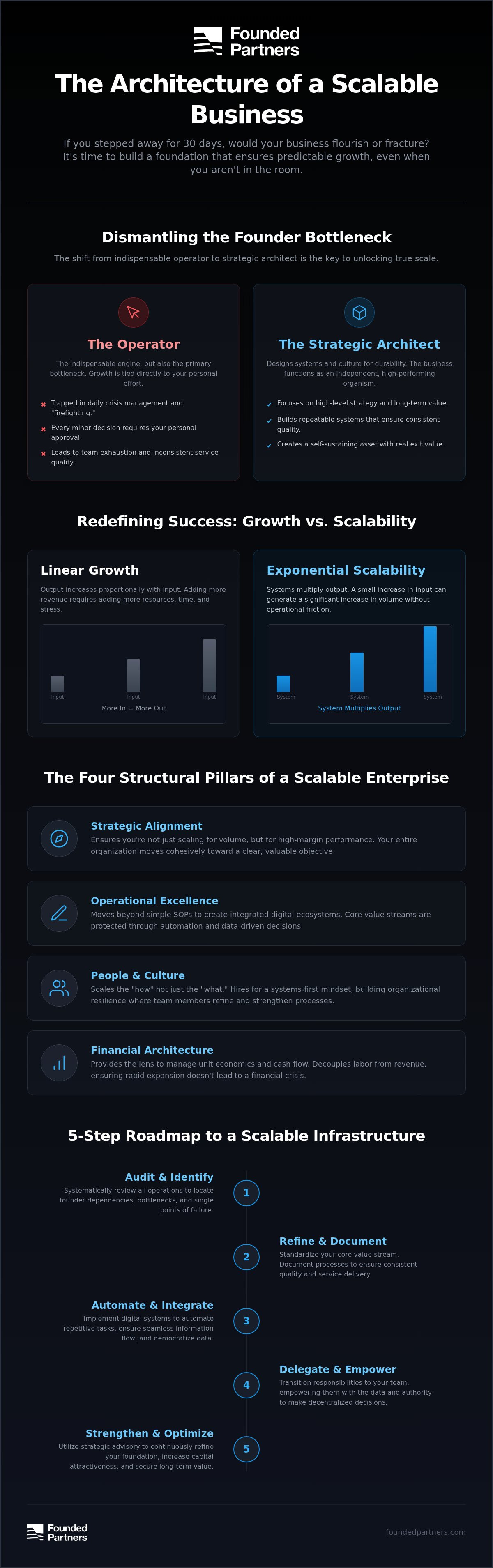
Growth is a seductive metric, but it's often a hidden trap. If your revenue doubles while your stress levels triple, you aren't scaling; you're simply working harder. Many founder-led firms confuse the act of adding resources with the art of multiplying output. True scalability occurs when your enterprise can handle a significant increase in volume without a corresponding increase in operational friction. When you focus on how to build a scalable business foundation, you're designing a system where output multiplies while your personal input remains manageable.
Without this structural integrity, companies inevitably hit a complexity ceiling. This usually happens at specific revenue markers where informal communication and founder heroics no longer suffice. At this stage, a weak foundation leads to "operational debt." Much like financial debt, this carries a high interest rate in the form of lost time, eroded margins, and team exhaustion. To move past this, you must adopt an architectural approach. This means viewing your business as a self-sustaining system rather than a collection of individual tasks that require your constant oversight.
The Scalability vs. Growth Paradox
Hiring more talent into a fractured system doesn't solve the problem; it amplifies it. You end up with more people performing tasks in more different ways, which creates chaos rather than capacity. Financial scale requires decoupling labor from revenue, ensuring that your next ten clients don't demand ten more hours of your personal time. A scalable foundation is a blueprint for redundancy. It allows the business to function as an independent organism, protecting your margins while providing the psychological security of a durable enterprise.
Signs Your Current Foundation is Cracking
You can identify a foundation under strain by looking for the "founder bottleneck." If every minor decision requires your personal approval, you've become a traffic warden instead of an architect. This dependency leads to inconsistent service quality, where the client experience fluctuates based on who is handling the account. Eventually, a firefighting culture takes hold. Strategy is sacrificed for daily crisis management, and the long-term vision is buried under the weight of immediate demands. Recognizing these signs is the first step toward refining, guiding, and strengthening your organization for the next stage of growth.
The Four Structural Pillars of a Scalable Enterprise
Building a business that outlives your daily input requires more than just a better toolset. It requires a deliberate, interconnected structure. To understand how to build a scalable business foundation, we must look at four integrated pillars: strategic alignment, operational excellence, people and culture, and financial architecture. Strategic alignment ensures you aren't just scaling for volume, but for high-margin performance. Financial architecture provides the necessary lens to manage unit economics, ensuring that rapid expansion doesn't lead to a cash flow crisis. When these pillars are balanced, the business moves from a fragile startup to a durable asset.
Operational Excellence: The Power of Repeatable Systems
Efficiency is the byproduct of intentional design. A truly scalable enterprise moves beyond simple SOPs and adopts integrated digital ecosystems where information flows without manual intervention. You must identify your core value stream, the specific sequence of events that delivers value to your client, and protect it through automation. This leads to data democratization. When your team has access to real-time metrics, they can make decentralized decisions. This reduces the need for your constant oversight and accelerates the pace of growth. If your current systems feel like a patchwork of manual workarounds, it might be time to revisit your Scalability Strategy to ensure your infrastructure can handle the load.
People and Culture: Scaling the "How" Not Just the "What"
Scaling a team is often the most significant friction point for a founder. The goal is to move from hiring hands to hiring heads. This means looking for a systems-first mindset in every candidate. You need people who don't just follow a process but look for ways to refine and strengthen it. Organizational resilience is built when the "how" of your business is as well-documented as the "what." This clarity allows you to preserve your company culture even as you delegate core responsibilities. It ensures that the soul of the business remains intact while the structure expands. By cultivating this mindset, you build a team capable of navigating the complexities of growth without relying on your personal intervention.
Finally, your financial architecture must support your ambitions. Scaling requires a deep understanding of your unit economics. You need to know exactly how much it costs to acquire a client and the lifetime value that client brings. For digital creators using platforms like Patreon, it is important to explore Platform and Transaction Fees to ensure pricing tiers remain sustainable. Without this clarity, growth can actually become a liability. A scalable foundation ensures that as your revenue grows, your margins remain healthy or even improve. This financial discipline is what separates a business that is merely busy from one that is truly profitable and ready for capital raising.
Dismantling the Founder Bottleneck: The Transition to Strategic Architect
The very traits that fuel a successful launch, such as tenacity, hands-on control, and personal intuition, eventually become the greatest obstacles to expansion. To understand how to build a scalable business foundation, you must first confront the reality that your involvement in every decision is a structural weakness. If a process requires your specific "founder magic" to succeed, it cannot be replicated by others. This dependency isn't an asset; it’s a bottleneck. Scaling requires you to move from the role of the Hero, who saves the day through sheer effort, to the Architect, who designs the system so the day doesn't need saving.
This transition from founder to CEO is a deliberate redefinition of your high-value activities. It often involves empowering a second-in-command, such as a Fractional COO or VP of Operations, to handle tactical execution. This partner acts as the bridge between your strategic vision and the team's daily output. By offloading operational management, you gain the mental bandwidth to focus on the enterprise's long-term health and capital attractiveness. It’s a shift from working in the business to working on the business.
The High-Value Activity Audit
You can't delegate what you haven't defined. Start by categorizing your current workload into three distinct tiers: strategic, managerial, and operational. Strategic work builds the future. Managerial work maintains the present. Operational work is simply the act of doing. Apply the 80/20 rule to your schedule. You likely drive 80% of your company's enterprise value through just 20% of your tasks. Radical delegation isn't about dumping work; it’s about creating an accountability framework where others own outcomes instead of just tasks. This clarity is essential for a foundation that supports exponential growth.
Building Leadership Advisory into Your Routine
Isolation is the enemy of scale. Every founder has blind spots that only an external perspective can illuminate. This is why a structured leadership advisory routine is critical during a founder's exit from daily operations. Managing this organizational change requires a steady hand and a clear communication plan to ensure the team feels secure as you step back. Mentorship shouldn't just be for you; it should extend to your entire leadership tier. By refining their decision-making skills, you build a resilient organization that thrives on shared expertise rather than a single point of failure. This disciplined approach ensures your business remains durable as it transitions into its next phase of maturity.
A 5-Step Roadmap to Implementing a Scalable Infrastructure
Transitioning from a founder-led operation to a self-sustaining enterprise requires a methodical sequence of actions. It is not enough to simply desire growth; you must engineer the capacity for it. This roadmap provides a structured approach to how to build a scalable business foundation by addressing the structural weaknesses that typically limit expansion. By following these five steps, you move away from the chaos of daily firefighting and toward the disciplined execution of a strategic architect.
The Operational Audit: Finding Your Friction
The first step in any meaningful transformation is a cold, objective look at your current state. You must map your existing workflows to uncover hidden inefficiencies that drain your team's time and energy. A critical part of this process is the "Single Point of Failure" test. For every department, ask: if this specific person or tool disappeared tomorrow, would the business stop? If the answer is yes, you've identified a bottleneck that will break under the pressure of scale. The operational audit serves as the essential diagnostic phase of organizational transformation. It allows you to see the business as a series of connected systems rather than a collection of individual efforts.
Once the audit is complete, you can proceed through the remaining steps of refinement and integration:
- Step 2: Core Process Refinement. Distill your "secret sauce" into repeatable, documented steps. If your unique value cannot be taught, it cannot be scaled.
- Step 3: Strategic Delegation. Shift your focus toward empowering owners rather than just assigning tasks. Give your leadership team the authority to own outcomes, not just follow instructions.
- Step 4: Technology Integration. Use automation to handle the routine, administrative burdens of your business. This liberates your team to focus on the creative and strategic work that drives high-margin growth.
- Step 5: Capital Alignment. Ensure your foundation is sturdy enough to attract outside investment. A business that runs without its founder is an asset; one that requires the founder is merely a job.
Capital Alignment: Preparing for Future Transactions
A scalable foundation is the primary driver of your company's valuation. When capital partners or potential buyers look at your firm, they aren't just buying your current revenue; they're buying the predictability of your future earnings. They look for "investor readiness," which is characterized by clean data, documented processes, and a leadership tier that functions independently of the founder. If you're aiming for a high-value exit or seeking to raise funds, your operational health is your strongest leverage. To ensure your organization is truly prepared for these consequential transitions, consider engaging in specialized Investor Readiness Consulting to bridge the gap between your current state and a successful transaction.
By treating your infrastructure as a product in itself, you build the durability required for long-term performance. If you're ready to refine your internal systems, our team provides expert Business Transformation Consulting to help you navigate this complex shift with confidence.
Strategic Advisory: Strengthening Your Foundation for Long-Term Value
Building a durable enterprise is an architectural feat that extends far beyond the initial launch. It requires a partner who understands the unique pressures of founder-led firms and the technical requirements of high-level strategy. Founded Partners specializes in Business Transformation and Operations Optimization, providing the steady hand needed to navigate organizational change. When you master how to build a scalable business foundation, you aren't just improving your current workflow; you're securing the long-term value of your life's work. This process is about refining your vision, guiding your team, and strengthening your infrastructure for the journey ahead.
From Operations to Exit: The Full Lifecycle Approach
A truly scalable foundation makes your business buyable at any time, regardless of whether you intend to sell tomorrow or a decade from now. Specialized advisory helps you avoid common Series A scaling traps, such as over-hiring before your systems are ready or losing service quality during rapid expansion. Many firms fail because they inject capital into a leaky bucket, where growth only accelerates internal friction. We connect operational health directly to your exit planning and capital raising efforts. This full-lifecycle approach ensures that every refinement you make today compounds into significant enterprise value during a transaction. Our leadership advisory focuses on managing these consequential transitions, ensuring the organization remains resilient as the founder's role evolves.
Partnering for Scalability Strategy
Generic frameworks and cookie-cutter templates often fail because they ignore the character and culture of your organization. We offer custom solutions that prioritize the health of the organization over vanity metrics. By acting as a Trusted Peer in your boardroom, we provide the calm expertise and objective perspective required to challenge existing bottlenecks. This boutique approach ensures you receive the intellectual rigor of a top-tier consultancy with the emotional intelligence of a seasoned mentor. We value the "how" of a process as much as the "what," focusing on durability and sustainability. If you're ready to move from operator to architect, we invite you to Schedule a Strategic Briefing with Founded Partners to discuss your specific path toward a durable, self-sustaining future.
Engineering Your Future for Durable Success
Transitioning from a founder who manages everything to an architect who designs everything is the ultimate act of leadership. You've seen that growth without structure creates operational debt, while a true foundation allows for exponential results. By focusing on how to build a scalable business foundation, you ensure your enterprise remains a high-performing asset rather than a personal burden. You now have the roadmap to audit your friction, refine your core processes, and empower a leadership tier that operates with autonomy. These steps turn a fragile startup into a durable, self-sustaining organization.
Building this architecture doesn't have to be a solitary endeavor. As strategic architects for business transformation, we provide the boutique advisory founder-led organizations need to navigate consequential transitions. Whether you're refining your operations for a capital raise or preparing for a high-value exit, our expertise in capital raising and exit planning ensures your company is ready for its next stage. It's time to step out of the daily firefighting and into your true role as a visionary leader. We're here to provide the calm expertise you need to scale with confidence.
Build a Scalable Foundation with Founded Partners
Frequently Asked Questions
What is the difference between a scalable business and a growing business?
Scalability is the ability to increase revenue without a proportional increase in costs, whereas growth often requires adding resources at a linear rate. In a growing business, you might hire one person for every ten new clients. In a scalable business, your existing systems handle that volume with minimal additional overhead. This distinction is the core reason why learning how to build a scalable business foundation is essential for long-term profitability.
At what stage should I start building my scalable foundation?
You should begin building your foundation as soon as your core product or service is validated by the market. Waiting until you are overwhelmed by operational bottlenecks often makes the transition more difficult and expensive. Implementing these systems early ensures that you don't hit a complexity ceiling that stalls your progress just as you begin to gain significant momentum. Proactive architecture is always more efficient than reactive repair.
How much does it cost to implement operations optimization?
The investment for operations optimization varies based on the size of your organization and the complexity of your current systems. Rather than a flat fee, it is best to view this as a strategic investment in your company's enterprise value. Business transformation typically pays for itself through improved margins, reduced founder burnout, and increased attractiveness to future capital partners or buyers who value predictable, durable performance.
Can a service-based business really be scalable?
Yes, service-based businesses can scale by productizing their offerings and creating repeatable delivery systems. The key is to move away from custom, bespoke work for every client and toward a standardized value stream. When you master how to build a scalable business foundation in a service context, you decouple your revenue from the hours your team works, allowing for exponential expansion without sacrificing service quality.
What is the role of a Fractional COO in building a foundation?
A Fractional COO provides the strategic execution needed to bridge the gap between a founder's vision and the team's daily output. They act as the architect of your internal systems, ensuring that processes are documented, optimized, and followed. This leadership advisory allows the founder to step back from tactical management and focus on high-level strategy, business development, and the long-term health of the organization.
How do I scale my business without losing our unique company culture?
Preserving culture during expansion requires you to document your values and decision-making principles as clearly as your operational tasks. You aren't just scaling the work; you're scaling the "how" behind the work. By hiring for a systems-first mindset and maintaining transparent communication, you ensure that your unique character remains intact even as the team grows and responsibilities are delegated to a new tier of leadership.
Does a scalable foundation increase my company valuation?
A scalable foundation significantly increases company valuation by reducing the perceived risk for investors and buyers. A business that relies heavily on its founder is seen as a fragile asset with a single point of failure. Conversely, an organization with predictable growth metrics and a self-sustaining infrastructure proves it can thrive under new ownership, which justifies a higher multiple during exit planning or capital raising.
How long does a business transformation typically take?
Business transformation is a methodical process that typically takes several months to fully implement and refine. While you can identify and fix immediate bottlenecks quickly, building deep organizational resilience requires a sustained commitment to change. This timeline ensures that new systems are properly integrated into the company's daily habits, leading to durable performance rather than a temporary fix that fades once the initial energy dissipates.