
Overcoming Resistance: A Strategic Guide for Founders

The friction you feel within your team isn't a sign of failure; it's a diagnostic signal that your organizational foundation has reached its current limit. You've likely spent months pushing against inertia, feeling the weight of "the way we've always done it" stalling your progress toward a critical funding round or a potential exit. When you find yourself exhausted by the constant effort of overcoming resistance to change, it's rarely a people problem. Instead, it's an architectural challenge. You're trying to scale a structure that wasn't designed for the load you're now asking it to carry.
It's time to stop pushing and start refining. This guide provides a strategic framework to transform organizational friction into sustainable momentum. You'll discover how to move beyond temporary fixes to build a team that's fully aligned with your long-term vision. We'll examine the steps to optimize your operations, strengthen your leadership presence, and create the efficiency required for rapid scaling. By the end, you'll have a clear path to navigate these transitions with the calm expertise that high-stakes growth demands.
Key Takeaways
- Reframe organizational friction as a diagnostic tool that reveals hidden systemic flaws rather than a personal failure of your team.
- Move beyond top-down mandates by shifting from mere compliance to deep-seated commitment through a shared strategic vision.
- Apply an architectural lens to operations optimization, ensuring your human foundation is strong enough to support rapid scaling.
- Implement a five-step framework for overcoming resistance to change, specifically designed to bridge the gap between current habits and future strategic needs.
- Prepare your organization for successful capital raising or a potential exit by establishing a steady, investor-ready leadership hand during transitions.
The Myth of the "Difficult" Team: Why Resistance is a Diagnostic Signal
Founder-led firms often misinterpret friction as a lack of loyalty or a failure of culture. This perspective is a strategic oversight. In a professional transformation context, resistance to change represents the measurable gap between your team's current operational habits and the future strategic needs of the enterprise. It isn't an act of sabotage. It's a natural protective mechanism designed to preserve the original DNA that made your company successful in the first place. When you focus on overcoming resistance to change by sheer force of will, you overlook the very data you need to scale safely.
The "Founders Friction" occurs because a CEO's vision is often focused on the horizon, while the team's focus is on the foundation. A shift in strategy that seems purely logical at the board level can feel like an existential threat to those executing the daily work. Instead of viewing this pushback as a hurdle to be cleared, treat it as a diagnostic signal. It's an opportunity to refine your operations, strengthen your leadership, and align your human capital with your long-term objectives.
The Psychology of Organizational Inertia
The status quo isn't just a habit; it's a safety net. Your team's reliance on "the way we've always done it" is actually a testament to your early-stage success. Those legacy processes were the tools that built your initial value. Status quo bias serves to protect the organization from perceived instability. However, a seasoned leader recognizes when this bias shifts from a protector to a cage. Sometimes, resistance is a valid warning that you're attempting an operational overreach without the proper scaffolding in place. It's the organization's way of saying the current structure cannot yet support the new weight.
Resistance as an Operational Metric
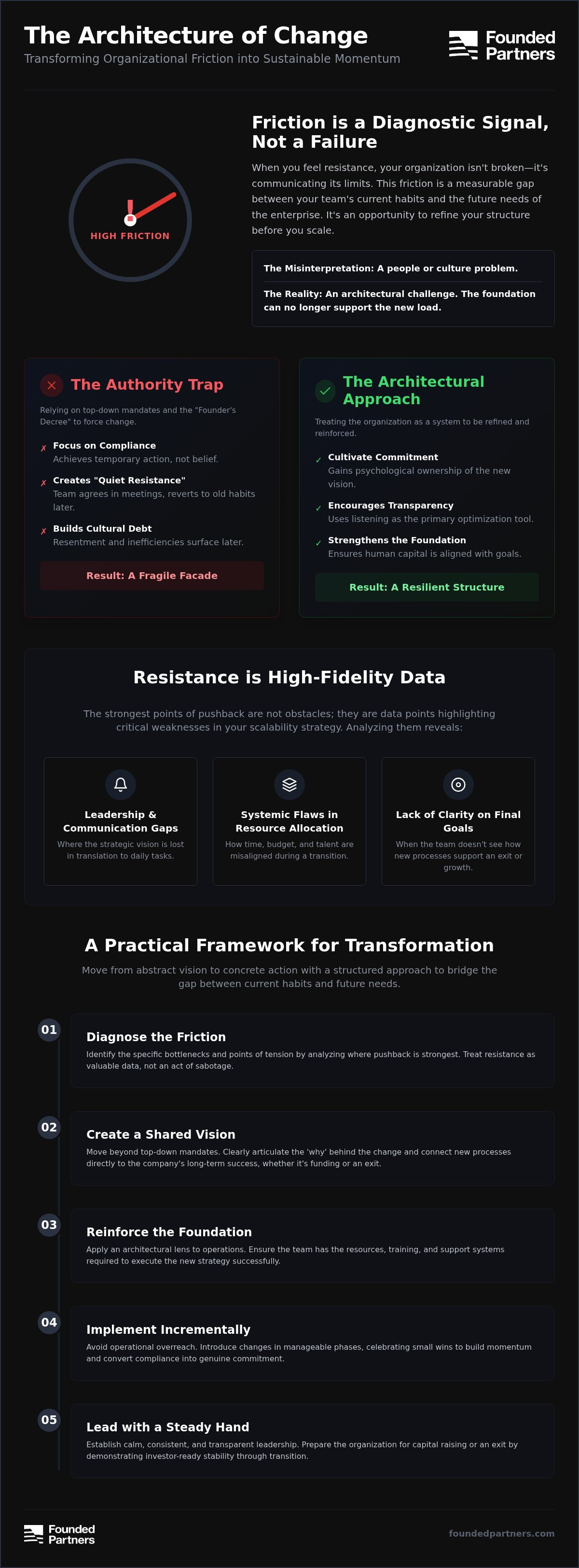
Friction provides high-fidelity data about your organizational health. By analyzing where the pushback is strongest, you can identify specific bottlenecks in your scalability strategy. These points of tension often highlight:
- Gaps in your current leadership advisory and internal communication flow.
- Systemic flaws in how resources are allocated during a transition.
- A lack of clarity regarding how new processes support the eventual exit or growth goal.
Ignoring these signals carries a heavy price. When founders push through resistance without addressing the root cause, the result is often hidden turnover, emotional exhaustion, and a stalled business transformation. By deciphering the signal instead of silencing it, you ensure that your path toward being investor-ready is built on a foundation of genuine commitment rather than fragile compliance.
Compliance vs. Commitment: The High Cost of Authority
Authority is a blunt instrument. While it can mandate action, it cannot manufacture belief. In founder-led organizations, there's a vital distinction between compliance and commitment. Compliance is the act of following instructions to avoid friction or fallout. Commitment, however, is the psychological ownership of a new strategic direction. When you focus on overcoming resistance to change through mandates, you might get immediate movement, but you sacrifice the long-term durability of the transformation. You aren't building a foundation; you're merely holding a structure in place by hand.
Relying on the "Founder's Decree" is a common reflex, yet it's often the most expensive way to lead. Top-down mandates ignore the localized expertise of your team, creating what we call "cultural technical debt." Just as rushed code creates future operational failures, forced organizational shifts create resentment and inefficiencies that will eventually demand a costly repayment. True strategic leadership requires a shift from pushing the team to refining the systems alongside them. Listening becomes your most effective tool for optimization.
The Authority Trap in Founder-Led Firms
Founders often default to a command and control style during high-stakes periods, such as capital raising or exit planning. The pressure to appear in control to external stakeholders can lead to rigid internal management. This approach erodes the very trust required for a successful transition. While the reflex to command is understandable, overcoming resistance to change in this manner is rarely sustainable. Instead of vocal pushback, you encounter Quiet Resistance. This is the dangerous state where teams nod in agreement during meetings but return to legacy habits the moment you leave the room. It creates a facade of alignment that crumbles under the scrutiny of due diligence.
Building Commitment through Transparency
To move beyond compliance, you must align the "Why" of the transformation with the personal incentives of your people. An architectural approach involves building the new operational framework with the team, not just for them. When employees see how operations optimization directly reduces their daily bottlenecks, their resistance transforms into advocacy. This ground-level buy-in is the secret to scaling. It ensures that the new strategic vision is held up by the entire organization, rather than being balanced precariously on the founder's shoulders. Transparency isn't just about sharing data. It's about demonstrating how the new path provides security and growth for every stakeholder involved.
The Architectural Approach to Business Transformation
A business is not a battlefield. It is an intricate structure of interconnected systems, human behaviors, and strategic goals. When founders view transformation as a fight to be won, they inadvertently cast their team as the opposition. This adversarial mindset is the primary barrier to overcoming resistance to change. A more effective path is to adopt the role of a Strategic Architect. Architects don't fight the materials they work with; they understand their properties, respect their limits, and design structures that work in harmony with them.
Strategic transformation relies on three foundational pillars: Stability, Scalability, and Sustainability. Stability ensures the core remains intact while the edges evolve. Scalability provides the capacity for growth without collapse. Sustainability ensures the new pace can be maintained without burnout. You cannot successfully optimize operations without first addressing the human foundation. If the people within the system feel unstable, the most sophisticated software or process in the world will fail to take root. By shifting from "fixing problems" to "refining systems," you reduce the natural friction that occurs during growth.
Refining the Core Foundation
Every organization has "load-bearing" processes. These are the legacy habits and workflows that provide the team with a sense of security and competence. If you change these too quickly, you risk a structural collapse of morale. A disciplined approach involves identifying these key areas and strengthening them before layering on new technology. This is where leadership advisory becomes essential. It provides the "calm expertise" needed to guide the team through the transition without triggering a panic response. When the foundation is reinforced, the team feels secure enough to support the weight of the new strategic vision.
Scalability Strategy as a Change Catalyst
The best systems don't require constant pushing; they naturally pull the team toward the new way of working. A well-designed scalability strategy reduces the "cognitive load" of change. When you implement thoughtful operations optimization, you're essentially removing the obstacles that make the old way of working more attractive than the new way. A clear roadmap also serves as a psychological anchor. It reduces the uncertainty that fuels resistance by showing the team exactly where they are going and how the new systems will make their professional lives more manageable. When the path is clear and the tools are superior, the "way we've always done it" loses its appeal.
Practical Framework: 5 Steps to Overcoming Resistance
Transitioning from architectural theory to practical application requires a structured sequence. You don't build a high-rise without a blueprint; similarly, you shouldn't attempt a business transformation without a framework that respects your organization's human foundation. By following a methodical approach, overcoming resistance to change becomes a manageable part of your growth strategy rather than an emotional burden. It shifts the focus from managing people to refining the systems they inhabit.
- Step 1: Diagnostic Discovery. Listen to the friction. Every point of resistance is an arrow pointing toward a systemic flaw or a lack of clarity that needs your attention.
- Step 2: Strategic Alignment. Connect every operational shift to the long-term vision. Whether you're aiming for a growth milestone or an eventual exit, the team needs to see how the change secures the firm's future.
- Step 3: Foundational Strengthening. Fix the broken legacy processes that make new work feel harder than it should. Change is far more palatable when the basic tools of the trade actually work.
- Step 4: Inclusive Iteration. Give your leadership team architectural input on the new systems. When they help design the solution, they naturally own the outcome.
- Step 5: Measured Momentum. Build trust by celebrating small operational wins. Consistency creates a sense of psychological security that fuels further transformation.
From Discovery to Alignment
Execution begins with "friction interviews." Sit with your key leadership team to understand where the current systems are failing them. This isn't a venting session. It's a strategic data-gathering exercise to inform your Transformation Brief. This document should serve as your internal compass, outlining the logic of the shift while acknowledging the emotional weight of the transition. When your team sees that these changes are a prerequisite for capital raising support and long-term stability, the resistance often melts into a shared strategic goal. They aren't just changing habits; they're increasing the value of the organization they helped build.
Iteration and Momentum
Adopting a "Beta Test" approach to operational changes reduces the fear of permanent failure. It allows the team to test new workflows in a controlled environment, providing a feedback loop that turns initial resistance into valuable refinement. This is where architectural pacing becomes critical. While the startup world often praises disruptive speed, sustainable growth relies on a steady, intentional rhythm. If you move too fast, you risk cracking the foundation. If you move with measured momentum, you build a structure that can support rapid scaling. Each small success reinforces the team's belief in the new direction, creating a virtuous cycle of commitment and operational efficiency.
Leading through Transition: The Founded Partners Perspective
Navigating the complexities of growth requires more than just a new set of rules. It demands a steady hand that can balance the immediate needs of the business with its long-term strategic health. At Founded Partners, we don't view ourselves as distant consultants. We're invested partners who provide the calm expertise necessary to guide you through consequential transitions. Our approach focuses on overcoming resistance to change by treating it as a diagnostic signal for growth rather than a hurdle to be cleared. By focusing on the architectural integrity of your firm, we help you move from a state of constant "pushing" to a state of deliberate, systemic momentum.
There's a direct synergy between successful business transformation and being investor ready. Capital partners and potential acquirers look for more than just impressive revenue numbers. They look for organizational resilience. A firm that has mastered the art of overcoming resistance to change is a firm that has effectively professionalized its core. This maturity signals to the market that your enterprise value isn't dependent solely on your presence; it's built into the very fabric of your operations. This professionalization is what turns a high-potential startup into a durable, scalable enterprise.
Strategic Advisory for the Long Game
The transition from "Founder" to "CEO" is often the most significant hurdle in a company's lifecycle. It requires a fundamental shift in how you view your role and your team. Our leadership advisory services are designed to help you manage the emotional toll that this organizational change often brings. We focus on systematic operations optimization to ensure that your business can run efficiently without your constant intervention. We value character as much as competence. We understand that building a substantial enterprise requires a foundation of trust, transparency, and shared values that can withstand the pressures of rapid growth.
Preparing for the Next Chapter
Exit planning isn't a final act. It's a continuous process of refining your organization to ensure it can stand on its own. A team that's aligned with your strategic vision and free from internal friction significantly increases your enterprise value during an exit. Investors seek organizations that can adapt and thrive in any environment. When you demonstrate that your team has moved past inertia and into a state of commitment, you prove your firm's durability. Change is the only constant in a scaling firm. Your ability to lead through it, rather than just survive it, becomes your ultimate competitive advantage.
Build your foundation with Founded Partners to ensure your organization is ready for its next stage of growth.
Architecting Your Organization's Next Chapter
The journey toward a professionalized, scalable organization isn't found in defeating your team's instincts. It's found in refining the systems that guide them. By reinterpreting friction as a diagnostic signal, you move beyond the exhaustion of constant pushing and toward a state of architectural stability. This shift from authority-led compliance to vision-led commitment is what ultimately prepares your firm for the scrutiny of capital raising or a successful exit.
True leadership doesn't demand perfection from day one. It requires a disciplined, steady hand to navigate the complexities of growth. When you prioritize operations optimization and human-centric alignment, overcoming resistance to change becomes a natural byproduct of a healthy foundation. You're no longer just managing a company; you're architecting an enterprise that can thrive independently. This maturity is the hallmark of a CEO who is ready for the next level of global competition.
Founded Partners provides boutique advisory tailored for founder-led organizations. We bring expertise in both operational health and transaction advisory, utilizing a partnership-driven approach focused on long-term enterprise value. We're here to provide the strategic clarity your transition requires.
Partner with us to transform your operations and lead with clarity.
Your vision deserves a foundation that is as strong as your ambition.
Frequently Asked Questions
What is the most common cause of resistance to change in founder-led businesses?
The most common cause is the perceived threat to a team member's sense of competence and security. In founder-led firms, legacy processes represent the tools that built the company's early success. When these are replaced, employees often fear they'll lose their value or influence within the new structure. It's rarely about the new system itself; it's about the loss of the familiar safety net that previous habits provided.
How can I tell if resistance is a sign of a bad hire or a bad process?
You can distinguish between the two by looking for systemic patterns across your leadership team. If multiple high-performing individuals are pushing back, the issue is likely a flawed process or a lack of strategic alignment. Conversely, if the resistance is isolated to a single person who fails to align with core values despite clear communication, it may be a hiring misalignment. Most friction, however, points to architectural gaps.
Does 'overcoming resistance' always mean I have to slow down my growth?
Overcoming resistance to change actually accelerates long-term growth by removing the internal friction that causes operational bottlenecks. While the initial diagnostic phase might feel like a pause, it's better described as architectural pacing. By strengthening the foundation now, you ensure the organization can handle the load of rapid scaling later without collapsing under the weight of cultural technical debt or high employee turnover.
How do I maintain our company culture while implementing major operational changes?
Maintaining culture requires you to separate your core values from your daily operational habits. Culture is the "why" and "how" of your interactions, while processes are merely the "what." By clearly communicating how new systems protect and amplify your original values, you create a sense of continuity. Transparency and inclusive iteration ensure the team feels the culture is evolving with them rather than being replaced by corporate mandates.
What is the role of a business transformation consultant in managing team friction?
A business transformation consultant acts as an objective advisor who can identify systemic flaws that a founder might be too close to see. They provide a steady hand to absorb team friction, allowing the founder to maintain their role as the visionary leader. By applying a methodical framework, they help the organization move from emotional pushback to logical refinement, ensuring that the transition is both sustainable and orderly.
How does overcoming internal resistance help with capital raising?
Overcoming resistance to change signals to potential investors that your firm has professionalized its operations and is no longer reliant solely on the founder's willpower. Investors seek organizational resilience and a team that is fully committed to a shared strategic vision. Demonstrating a friction-free transition proves that your business structure is durable, scalable, and ready for the rigors of a significant funding round or a potential exit.
Can I overcome resistance to change without hiring an outside advisor?
You can lead change internally, but it requires a high degree of emotional intelligence and a disciplined scalability strategy. The challenge for founders is that they're often seen as the source of the disruption, which can make objective diagnosis difficult. An outside advisor brings a level of calm expertise and a proven framework that can often navigate these interpersonal complexities more efficiently than a founder working in isolation.
What happens if I ignore the resistance and push through the changes anyway?
Pushing through resistance without addressing its root cause creates "Quiet Resistance" and significant cultural technical debt. While you might achieve immediate compliance, you'll likely face hidden turnover, emotional exhaustion, and a fragile alignment that crumbles during high-stakes periods. This approach makes the organization brittle; it often leads to operational failures later on that are far more costly than the time spent refining the system initially.