
How to Create a Company Operating System: A Strategic Architect’s Guide

Only 20% to 30% of businesses taken to market actually transact successfully according to the Exit Planning Institute. The primary reason for this failure isn't a lack of revenue. It's an extreme dependence on the founder that creates a significant liquidity gap. You've likely felt this tension as post-funding growth leads to operational bottlenecks and a fading sense of visibility into your team's daily output. It's a common struggle for visionaries who fear that rapid scaling will inevitably erode the unique culture they worked so hard to build.
Mastering how to create a company operating system is the strategic path to moving from a business that relies on your personal heroics to one that thrives on its own internal logic. This guide provides a bespoke framework to align your long-term vision with weekly execution, ensuring every team member remains synchronized with your core mission. We'll examine the four pillars of a resilient operating architecture, focusing on disciplined communication cadences and data-driven repeatability. By the end, you'll have a blueprint to build a scalable foundation that increases enterprise value and prepares your organization for a seamless, high-value exit.
Key Takeaways
- Learn to transcend the "Founder's Ceiling" by replacing personal hustle with a systemic architecture that aligns strategy, people, and execution.
- Discover how to create a company operating system that utilizes data transparency and strategic alignment to move beyond gut-feel decision-making.
- Evaluate the critical trade-offs between rigid off-the-shelf frameworks and bespoke operational designs to find the right fit for your organizational complexity.
- Implement a structured five-step roadmap starting with a rigorous operational audit to identify energy leaks and refine your accountability structure.
- Understand how a robust operating system functions as a primary driver of enterprise value by ensuring the business remains durable and transferable.
The Architecture of Scale: What is a Company Operating System?
A Company Operating System (COS) is the consistent, repeatable framework an organization uses to align its people, strategy, and execution. It's the invisible scaffolding that supports sustainable growth. Many founders mistakenly believe that scaling is simply a matter of hiring more people or buying more software. However, true scalability requires a shift from individual effort to systemic design. This transition is essential for overcoming the "Founder's Ceiling," the inevitable point where your personal hustle and manual oversight can no longer substitute for a robust operating model architecture.
Understanding how to create a company operating system involves distinguishing between the "how" of your business and the "tools" you use. Your tech stack, which includes your CRMs, project management apps, and communication channels, merely facilitates the work. The COS is the underlying logic that dictates how those tools are used, how decisions are made, and how accountability is enforced. When you build this system, you're creating operational durability. This durability is a core business asset that ensures the company remains stable even as market conditions or personnel change. It allows you to focus on refining your strategy, guiding your people, and strengthening your market position.
The Symptoms of a Missing System
Without a defined system, businesses often experience recurring issues that never stay solved. You might find yourself having the same argument with your leadership team for the 19th time because the underlying process was never codified. This leads to a "Hero Culture," where the founder remains the only individual capable of solving high-level problems or putting out fires. Over time, this creates strategic drift. You'll notice that the team's weekly actions no longer map to the three-year vision, leaving the organization busy but stagnant. Learning how to create a company operating system is the only way to break this cycle of reactive management.
Why 'Calm Expertise' Beats 'Startup Chaos'
The "move fast and break things" mentality often results in internal exhaustion and fragile foundations. A measured, architectural approach prioritizes long-term health over frantic energy. By implementing a COS, you provide your leadership team with the psychological security they need to take ownership and lead effectively. They no longer have to guess what "good" looks like or wait for your approval on every minor detail. A company operating system is the rhythm of the business that turns a founder's vision into a predictable, repeatable outcome.
The Four Pillars of a Resilient Operating Architecture
A resilient operating architecture isn't built on software alone. It's built on four foundational pillars that transform a collection of individuals into a synchronized enterprise. When founders explore how to create a company operating system, they often search for the right app, yet true durability comes from the dual operating system framework that balances daily execution with strategic innovation. This architecture provides the structural clarity needed to scale without losing the organization's soul.
Pillar 1: Strategic Alignment and Vision
Alignment starts with distilling a complex vision into a single page. This roadmap ensures every team member understands the company's "North Star" and their specific role in reaching it. We emphasize the "Three-Year Picture" because it creates a bridge between today's tasks and future aspirations. Without this bridge, teams often drift into tactical silos where effort is high but progress is low. If you're struggling to connect long-term goals to daily work, engaging with business scalability consulting can help define these architectural requirements early.
Pillar 2: The Scorecard and Data Integrity
Data transparency removes the ambiguity of "gut feel" management. A robust COS relies on a scorecard of 5 to 15 vital signs that indicate organizational health. While many focus on lagging indicators like revenue, a scalable system prioritizes leading indicators. These are metrics that predict future success, such as sales pipeline velocity or weekly customer satisfaction scores. Every "seat" on the accountability chart must own a specific number. This creates a culture where numbers tell the truth, allowing leaders to guide with precision rather than reacting to late-quarter surprises.
Process Durability and Meeting Cadence
Documenting the "Founded Way" ensures consistency without the founder's direct oversight. It's about capturing the core processes that drive the majority of your results, making excellence a repeatable habit rather than a lucky accident. This is supported by a disciplined meeting cadence. A rhythmic flow of daily huddles and weekly reviews identifies obstacles before they escalate into crises. Research from the Scaling Up network reveals that a rigid daily huddle can save an average of 10 minutes of operational friction for every minute spent. This level of operations optimization returns roughly 60 to 90 minutes of daily bandwidth to each manager, turning communication into a strategic pulse rather than a series of interruptions.
Custom Build vs. Off-the-Shelf: Choosing Your Framework
Every founder reaches a crossroads where they must decide whether to adopt a pre-packaged methodology or design a unique enterprise operating model framework. This choice defines your organization's future flexibility and eventual exit potential. While off-the-shelf systems offer a fast ramp-up, they can sometimes force a complex business into a simplistic box. Understanding how to create a company operating system that actually sticks requires a deep assessment of your organizational maturity and specific market challenges. The goal isn't just to follow a book; it's to build an engine that works when you aren't in the room.
The EOS® Framework: Pros and Cons
The Entrepreneurial Operating System (EOS) is the most widely adopted "off-the-shelf" solution, currently utilized by over 310,000 companies globally. Its strength lies in its simplicity. By using standardized terminology and fixed meeting agendas, it provides a common language for teams. However, this simplicity is also its primary limitation. The system is intentionally rigid, which can feel restrictive for highly specialized or rapidly evolving industries. For a founder-led business with complex operational needs, a dogmatic approach might lack the nuance required for a sophisticated transformation.
A system only survives if it has a champion. This is often the "Integrator" or fractional COO who manages the installation and enforcement of these rhythms. Without this dedicated role, organizations often fall into "System Fatigue." This occurs when a leadership team switches frameworks every 18 months in search of a silver bullet. This cycle destroys organizational trust and creates a culture of cynicism. In our experience, consistency and architectural fit are far more valuable than a perfect, yet borrowed, framework.
The Founded Partners Approach: Bespoke Business Transformation
We believe that a company's operating system should reflect its founder's unique temperament and strategic goals. Rather than forcing your business to fit a template, we prioritize a "strategic architecture" approach. This involves identifying the specific energy leaks in your current process and building custom rhythms that address them directly. By focusing on measuring business transformation success through the lens of enterprise value, we ensure the system is built for durability. This bespoke method integrates exit-readiness from day one, ensuring your operational engine is an asset that commands a premium rather than a liability that requires your constant presence.
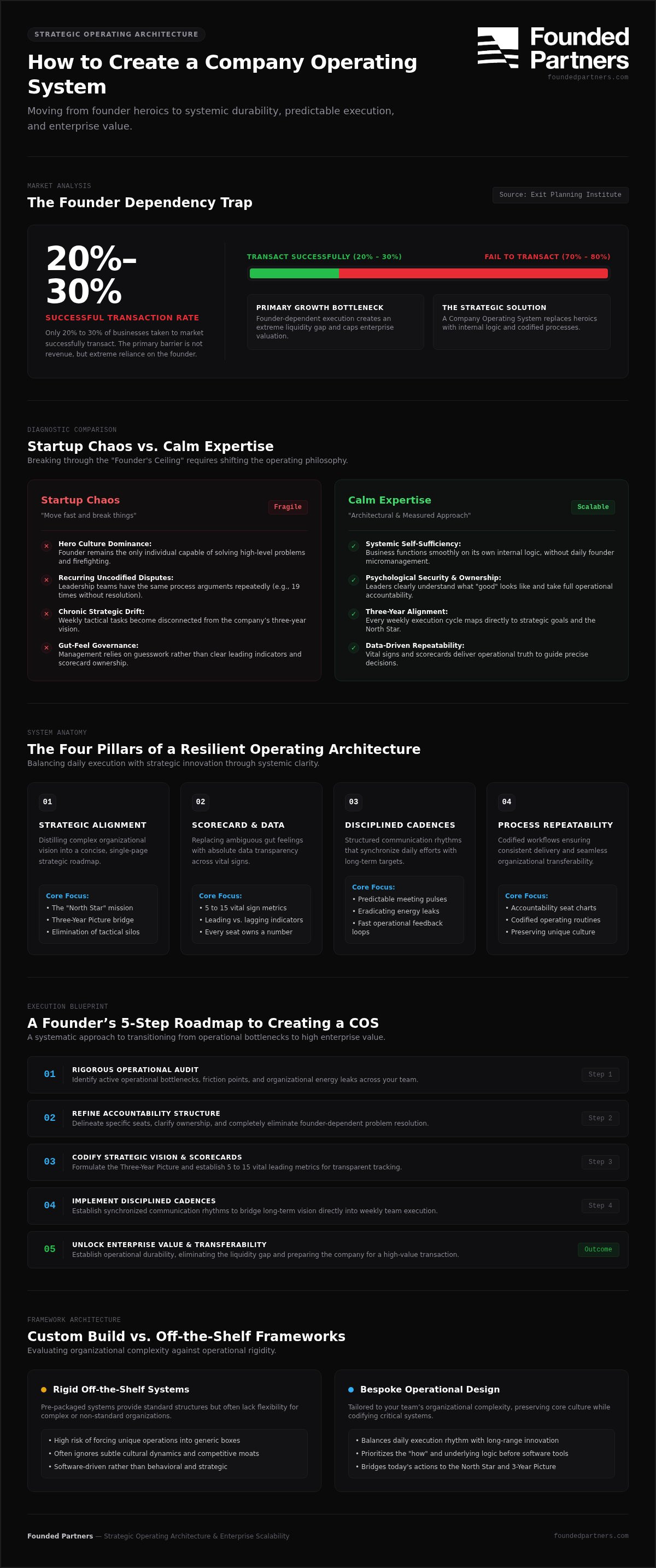
A Founder’s Roadmap: 5 Steps to Creating Your COS
Building a bespoke operational engine is a journey of refinement rather than a single event. It requires a methodical transition from a culture of heroics to a culture of systems. When you're determining how to create a company operating system, the focus must remain on architectural durability. This roadmap ensures that your business can eventually thrive independently of your daily intervention, transforming it into a transferable asset that commands a premium in the market.
Step 1: The Honest Audit
Every transformation begins with a clear-eyed assessment of current reality. You must ask the hard questions that most leaders avoid. If you stepped away for a month, what would break first? Identifying these energy leaks is the first priority. Many organizations find that operational red flags, such as decision-making bottlenecks or a lack of clear KPIs, become more pronounced after capital raising for founders. An audit reveals where your current "system" is failing to support the weight of your growth, allowing you to address the cracks before they compromise the entire structure.
Step 2: Structuring for Scale
Scaling requires moving from a traditional Org Chart to a dynamic Accountability Chart. While an Org Chart focuses on who reports to whom, an Accountability Chart defines who owns which outcome. This structure prioritizes the "seats" required for the next stage of growth, regardless of who currently occupies them. A critical part of this architecture is the Visionary and Integrator dynamic. The Visionary provides the creative spark and long-term ideas, while the Integrator harmonizes the leadership team and executes the plan. Every seat must be filled by someone who has the "GWC": they Get it, they Want it, and they have the Capacity to do it. This clarity ensures that every individual is positioned to contribute to the organization's collective success.
Once the structure is set, you must establish a rhythmic communication pulse. This often involves a "Level 10" weekly meeting, a 90-minute session designed to solve issues rather than just discuss them. From there, you document your core processes by capturing the 20% of activities that drive 80% of your results. Codifying these essentials ensures that quality remains high as you scale. Finally, the rollout begins with leadership team adoption before cascading through the rest of the organization. This iterative approach ensures the system is refined through use, making it a living part of your culture. If you're ready to design your organization's future, consider how operations optimization can accelerate your progress.
From Operational Engine to Enterprise Value
A robust COS isn't just an internal tool; it's the primary driver of enterprise value. While many founders focus on top-line growth to attract buyers, sophisticated investors prioritize the quality of the underlying engine. They look for "Systems over Stars" because individual talent can be transient, but a well-designed architecture remains. When you master how to create a company operating system, you're essentially building a business that is transferable. This transferability, the ability for the organization to thrive without your daily presence, is what ultimately bridges the liquidity gap mentioned earlier.
The impact on valuation is quantifiable. Private deal data shows that replacing personal goodwill with documented management systems and predictable rhythms can command a significant premium. For a middle-market company, this shift often elevates the EBITDA multiple by an average of 1.5x to 2.0x. This architectural transition is the ultimate preparation for exit planning for founders, turning what was once a job into a high-value asset.
The COS as a Due Diligence Asset
During due diligence, buyers scrutinize "key person risk." If the organization's knowledge exists only in your head or the heads of a few "hero" employees, the business is perceived as high-risk. A company operating system is the most significant product a founder ever builds because it codifies that knowledge into a repeatable process. Clean, transparent data from your weekly scorecards justifies your valuation by proving that your results are consistent rather than accidental. This level of operational clarity provides the psychological security a buyer needs to move forward with a high-multiple offer.
Aligning Today’s Ops with Tomorrow’s Exit
Your current meeting cadence and KPIs should reflect the specific value drivers a future acquirer will care about. This means shifting your focus from purely tactical metrics to those that demonstrate long-term sustainability and scalability. Moving from a founder-led culture to a system-led organization is a major psychological milestone. It requires a disciplined commitment to the "how" of your business as much as the "what." By refining your operational foundation today, you ensure that your eventual exit is a reward for the durability you've built rather than an escape from the chaos you've managed. Ready to design your architectural foundation? Consult with our Strategic Architects to start building for scale.
Designing Your Organization's Future
Building a company operating system isn't about adding more tasks to your plate. It's about refining the architectural foundation of your business so it can eventually thrive without your constant oversight. By shifting from a culture of founder-led heroics to a system-led engine, you ensure that every weekly task aligns with your ultimate vision. This transition separates a business that is merely growing from one that is truly scalable and exit-ready.
Understanding how to create a company operating system is the most significant strategic investment a founder can make. It transforms your operations from a source of friction into a durable asset that commands a premium multiple. As a boutique advisory specializing in business transformation and operations optimization, we help founder-led firms navigate this complex journey. Whether you're preparing for capital raising or long-term exit planning, we provide the steady hand and strategic expertise required to strengthen your organization.
Build an exit-ready foundation with Founded Partners. Your vision deserves a structure that can support its full potential. Let's build something substantial together.
Frequently Asked Questions
How long does it take to implement a company operating system?
Full organizational integration typically requires 18 to 24 months. While you can establish leadership rhythms and basic scorecards within the first 90 days, deep cultural adoption and comprehensive process documentation take longer. This steady pace ensures that the system becomes a durable part of your business's DNA rather than a temporary initiative. It's a journey of continuous refinement that builds lasting enterprise value.
What is the best software for a company operating system?
The best software is the one your team will consistently use. Dedicated platforms like Ninety.io or Bloom Growth offer structured tools for meetings and scorecards. However, many sophisticated firms utilize flexible tools like Notion or Airtable to design a bespoke system. The specific technology matters less than the underlying logic of your architecture and your team's commitment to the chosen rhythm.
Can we create a COS without hiring an outside consultant?
Learning how to create a company operating system internally is possible if you have a dedicated champion to maintain discipline. You can start by studying established frameworks to grasp the foundational principles. However, an outside advisor provides an objective perspective that identifies blind spots you might miss. Professional guidance often accelerates the transition from founder-led heroics to a truly systemic, scalable order.
How do I get my team to buy into a new operating system?
Buy-in is earned by demonstrating how the system solves their specific operational pains. Involve your leadership team in the design phase so they feel a sense of ownership. Focus on how these new rhythms reduce daily friction and provide clearer expectations for their roles. When the team sees that the system protects their time and rewards their performance, adoption follows naturally and culture strengthens.
What is the difference between EOS and Scaling Up?
EOS is designed for simplicity, focusing on six core components to help smaller firms gain traction. Scaling Up is a more complex framework that focuses on four key decisions: People, Strategy, Execution, and Cash. While EOS is excellent for businesses finding their footing, Scaling Up is often preferred by larger, mid-market organizations that require more intricate strategic tools and deeper financial planning to manage growth.
How often should we review or update our company operating system?
You should review your operating system quarterly for tactical alignment and annually for a deep strategic assessment. Weekly meetings keep the engine running, but these larger checkpoints allow you to refine the architecture itself. As your organization evolves, your system must adapt to new market realities and internal complexities. Stagnant systems eventually become bottlenecks, so regular maintenance is essential for long-term durability.
Does a small company with fewer than 10 employees need a COS?
Even a team of three benefits from a basic operating rhythm. Mastering how to create a company operating system early prevents the "Founder's Ceiling" from forming as you grow. Small teams that document core processes and establish clear accountability charts scale much faster than those relying on informal communication. It's far easier to build a strong foundation before the organizational structure becomes too large and complex.
What is the #1 reason company operating systems fail?
The primary reason these systems fail is a lack of leadership discipline. If the founder doesn't model the behaviors or abandons the rhythms when the business gets busy, the team will quickly follow suit. A company operating system requires a long-term commitment to the "how" of the business. Without a champion to enforce the pulse, even the best-designed architecture will eventually collapse back into old, inefficient habits.