
How to Fire a Key Executive and Manage the Leadership Transition

A leadership transition is decided twice: first in the boardroom, then in how the organization experiences it. A sound approach to how to fire a key executive begins with board input and approval of the separation terms, followed by a prepared, direct termination conversation and a coordinated communication plan. Inform the board before announcing the departure publicly.
Even when a decision is necessary, the uncertainty that follows can unsettle employees, customers, and other stakeholders. The transition deserves as much care as the termination itself. This guide explains how to involve the board, prepare the conversation, communicate the decision clearly, and plan interim leadership for the departing executive’s team. You’ll also learn how to sequence internal announcements and explain what happens next while protecting confidential personnel details. The goal isn’t to make a difficult decision feel easy. It’s to make it deliberate, respectful, and steady enough for the organization to keep moving.
Key Takeaways
- Bring the board into the decision early, including approval of the separation package and timing of the announcement.
- Review the executive’s agreements and prepare the transition plan before the conversation, so responsibilities and next steps are clear.
- Deliver the decision directly and respectfully, with a concise explanation rather than an extended performance review.
- Coordinate communications for employees and other stakeholders, and explain who will lead the team during the transition.
- Address applicable release and benefits requirements, including age-waiver and health-insurance considerations.
Board oversight when dismissing an executive director
Before deciding how to fire a key executive, align the CEO and board on authority, rationale, and transition responsibilities. A clear record helps the organization act consistently and communicate thoughtfully.
-
Inform the Board and Confirm Decision Authority
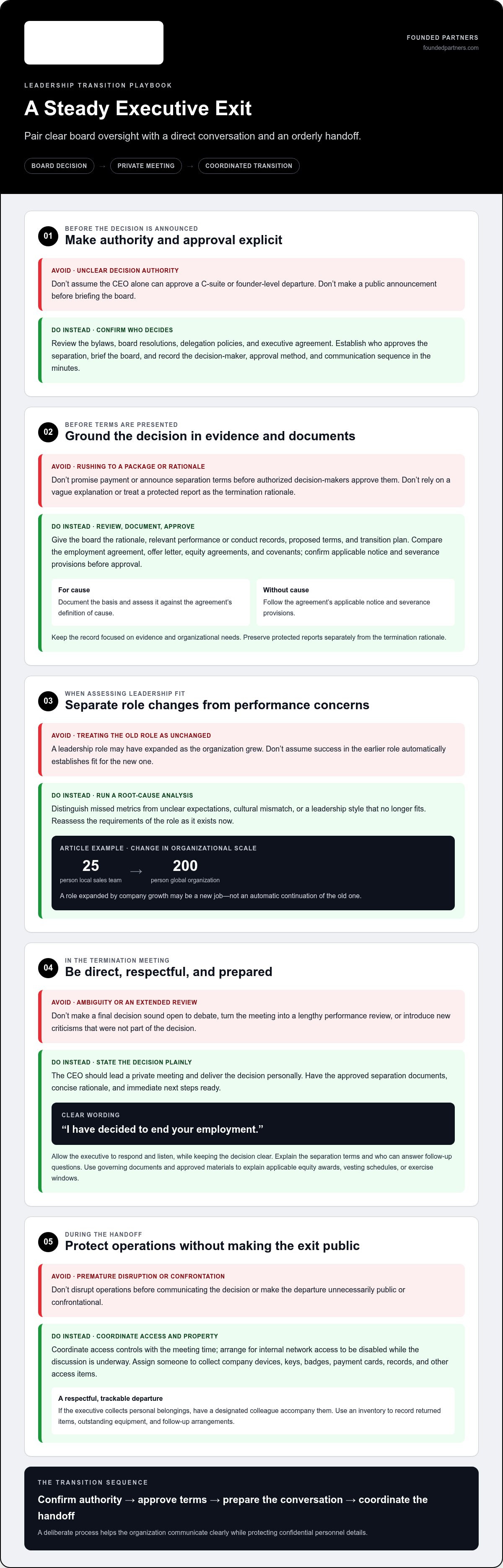
Brief the board before making a public announcement, and establish who has authority to approve the separation. Review the bylaws, board resolutions, delegation policies, and the executive’s agreement to distinguish the CEO’s role from the board’s. The CEO may lead the process, while the board retains approval authority for a C-suite or founder-level departure. Record the decision-maker, approval method, and communication sequence in the meeting minutes.
To approve an executive’s termination, give board members the rationale, relevant performance or conduct records, proposed separation terms, and transition plan. Obtain formal approval where the organization’s governing documents or established authority require it, and document the resolution. For a nonprofit executive director, account for the board’s oversight responsibilities rather than treating the decision as a routine staff matter.
Run a root-cause analysis before presenting the case. Separate missed metrics from unclear expectations, cultural mismatch, or a leadership style that no longer fits. For example, reassess whether a leader who managed a 25-person local sales team is suited to a 200-person global organization. A role expanded by company growth should be treated as a new job, not an automatic continuation of the old one.
-
Approve the Termination and Severance Terms
Secure board input and approval of the separation package before the termination conversation. Compare the proposed terms with the executive’s employment agreement, offer letter, equity agreements, and covenants. Confirm who can approve severance and notice, what the documents require, and how the decision will be recorded. Don’t announce terms or promise payment before authorized decision-makers approve them.
For termination for cause, document the conduct or performance basis and assess it against the agreement’s definition of cause. For termination without cause, follow the agreement’s applicable severance and notice provisions. This distinction affects contractual entitlements and proposed separation terms, but it doesn’t replace careful review of the documents.
Employment agreements can define the process for termination, severance, and notice, so review their exact language before the board votes. Address discrimination, retaliation, and breach-of-contract risks by documenting consistent reasons and following the agreement’s terms. Whistleblowers are protected from retaliation under the law, so keep any protected report separate from the termination rationale and preserve the decision record. Responsible decisions about how to fire a key executive take that record into account before approval of the final resolution.
Keep the board’s decision focused on evidence and organizational needs. A concise record should identify the authority exercised, the approved terms, and the executive responsible for communicating the outcome.
Planning and conducting the termination meeting
Prepare the meeting around a clear decision, a concise explanation, and an orderly handoff. The CEO should lead the conversation with the approved terms and next steps ready.
-
Plan the Termination Meeting
Schedule a private meeting with the executive and decide who will attend. The CEO should deliver the decision personally rather than delegate it to HR. Bring the approved separation documents, a concise explanation, and a clear outline of what happens immediately afterward.
State the decision plainly: “I have decided to end your employment.” Avoid “I think,” which can make a final decision sound open to debate. Explain the reason accurately and briefly, using the documented rationale. Don’t turn the conversation into a lengthy performance review or introduce new criticisms that weren’t part of the decision.
Allow the executive to respond, but keep the meeting’s purpose clear. If they dispute the rationale or negotiate, listen without suggesting the decision is undecided. Explain the separation terms and identify the right contact for follow-up questions. For example, if the executive asks about equity, distinguish the approved terms from details that require a separate written explanation.
Prepare answers about stock options, restricted stock units, performance shares, vesting schedules, and exercise windows. Explain how termination affects each applicable award using the governing documents and approved materials. Have the relevant documents ready so the executive can understand what changes and what actions may be required.
-
Secure Access, Property, and Confidential Information
Coordinate access controls with the meeting time, and avoid disrupting operations before communicating the decision. Arrange for internal network access to be disabled while the termination discussion is underway. Assign someone to collect company devices, keys, badges, payment cards, records, and other access items.
Plan the departure respectfully. If the executive needs to collect personal belongings, have a designated colleague accompany them and receive company property. Use an inventory to record returned items, outstanding equipment, and follow-up arrangements. Don’t make the process unnecessarily public or confrontational.
Before the meeting, identify which business systems, accounts, files, and physical areas require access changes. Coordinate each action with the appropriate internal administrator, and preserve company records needed for continuity. Limit access only as part of a planned process, not as a substitute for a clear conversation.
Review confidentiality obligations and the handling of sensitive information. Remind the departing executive of applicable commitments concerning company information, trade secrets, and client relationships, using the signed documents as the reference. Record the return of confidential materials and company property. For leadership changes connected to ownership transitions, exit planning can help frame the broader succession work.
Preparing for the termination conversation
Prepare for the decision by testing its rationale, evidence, and timing before the meeting. A documented process helps keep the conversation aligned with the executive’s role and the organization’s actual needs.
- Conduct a root-cause analysis before finalizing the decision. Identify whether the concern involves missed business metrics, cultural mismatch, leadership style, unclear expectations, or a role that has changed as the company has grown. Separate evidence from assumptions. For example, compare a missed sales target with the resources, targets, and responsibilities assigned to the executive.
Document the business or performance reasons in a dated record. Include relevant goals, specific outcomes, prior feedback, and the executive’s responses. Explain how each example supports the decision, and keep the rationale consistent across board materials and meeting notes. Avoid introducing new reasons during the termination conversation.
- Assess the role against the company’s current stage before treating performance as a personal failing. Define what the organization needs from the position over the next 12-24 months, then compare those needs with the executive’s demonstrated capabilities. A leader suited to a smaller operation may need reassessment as the business and team grow.
Use the same criteria for any improvement opportunity. For a new executive, documented 30-, 60-, and 90-day milestones can show whether expectations were clear and progress was measured. If leaders previously gave feedback, record its timing, substance, and the executive’s response. This creates a clearer distinction between a sustained gap and a newly raised concern.
- Decide whether the position itself is changing before selecting a successor. Treat a substantially expanded role as a new job, and assess its requirements directly. Define responsibilities around the company’s needs over the next 12-24 months, rather than hiring for an anticipated scale 3 to 5 years away.
If the role doesn’t yet require rapid growth, consider whether a candidate who can perform now is more suitable than one who may fit later. This assessment also helps clarify whether the departure reflects current performance, a changed role, or both. Keep that distinction clear in the decision record.
- Plan continuity alongside the termination decision. Line up a replacement before the departure when possible, and identify who will temporarily own key decisions, meetings, and direct reports. Urgency may outweigh a longer transition if the executive is causing harm or prompting other leaders to leave.
Use a transition checklist to record critical projects, decision rights, and relationships that need coverage. Confirm who will manage each responsibility after the meeting, and prepare a concise explanation for the executive’s team. A clear handoff connects the termination rationale to the organization’s next operating priorities.
Stakeholder communications during leadership transitions
Build the communication plan around the initial announcement and the decisions that follow. A clear sequence helps employees, customers, and other stakeholders understand what changes and what remains steady.
- Prepare one core message, then tailor the detail for each audience. Explain that the executive is leaving, identify who assumes immediate responsibilities, and tell people how to raise questions. Keep personnel details confidential. Employees need to know reporting lines and project owners, while customers need a clear contact for active work.
Frame the departure professionally in terms of the company’s needs, such as a role that has outgrown the executive’s skill set. Avoid personal criticism or speculation about the executive’s reasons for leaving. Align the wording with the board-approved decision so leaders don’t give employees, investors, or customers conflicting explanations.
- Communicate with direct reports, other staff, and then the wider company on the same day, preferably within a couple of hours. Give the executive’s team its reporting plan before broader staff messages circulate. This sequence lets managers answer immediate questions and reduces the chance that employees hear major news through rumors.
Give managers a short set of approved talking points before the announcement. Include the effective date of the change, the interim decision-maker, and where employees should direct questions. Ask managers not to guess about private matters or future personnel decisions.
- Set a firm timeline for explaining what happens next. Limit organizational uncertainty to 48-72 hours before communicating the next steps, including interim leadership, team reporting, and critical project ownership. If a permanent successor isn’t ready, name the interim leader and describe which decisions that person can make.
Give affected teams a practical handoff, not just a title change. For example, name who will chair the executive’s weekly operating meeting and approve time-sensitive decisions. Update reporting documents and meeting invitations so the stated transition matches employees’ day-to-day experience.
- Use a staff-wide memo or all-staff meeting to address concerns after the initial announcement. Explain what the decision means for current priorities and reaffirm the company’s values. Acknowledge that employees may worry the departure signals a wider staff overhaul, and clarify the scope of the change without making promises about unrelated decisions.
Leave time for questions and answer what you can share. If personnel confidentiality prevents a detailed explanation, say so plainly, then return to the team’s priorities, reporting structure, and next steps.
- Coordinate external communication with the internal announcement. Give customers, investors, and key partners a consistent point of contact and a concise explanation of operational continuity. A 41% consumer figure is associated with stopping business after negative news, including mishandled departures, so avoid silence that invites speculation.
Monitor questions after the announcement and correct conflicting information quickly. A transparent, ethical process is associated with employees being 2.5 times more likely to stay; consistent messages and visible follow-through help maintain confidence during the transition.
What legal requirements apply when terminating a key executive in the United States?
Include legal review in the termination plan before issuing a release or finalizing benefits. In the United States, the executive’s agreements and proposed separation documents shape that review.
- Review the executive’s employment contract, offer letter, equity agreements, and restrictive covenants. Identify provisions covering termination, notice, severance, stock awards, and post-employment obligations. Compare the proposed action with those terms, and document any differences before preparing final paperwork.
Distinguish termination for cause from termination without cause using the agreement’s language. The classification can affect contractual entitlements and separation terms. Keep the recorded rationale consistent with the applicable provisions, and don’t rely on a label the contract doesn’t support.
- Assess discrimination and retaliation concerns before approving the final decision. Compare the stated performance or business rationale with the supporting records, and consider whether protected complaints or other sensitive events could be relevant. For example, if the executive recently raised a whistleblower concern, keep that report distinct from the documented business rationale.
Preserve performance reviews, decision records, relevant communications, and the approved termination rationale. A consistent record helps the organization explain its decision and assess potential discrimination, retaliation, or breach-of-contract claims. Don’t alter records or add reasons after the decision to strengthen the file.
- Review release language for age-discrimination waiver issues. The Older Workers Benefit Protection Act is relevant when an executive release includes a waiver of age-discrimination claims. Prepare the release with the applicable consideration and revocation periods clearly addressed, rather than assuming the executive can sign immediately.
Explain the release process in plain language, including what the executive is being asked to waive and which periods apply. Keep the proposed consideration consistent with the approved separation package. A signed release doesn’t replace the need to follow the executive’s agreement or document the decision.
- Address health coverage and equity consequences in the separation materials. COBRA is relevant to continuing health insurance after employment ends. Explain applicable continuation information, and separately describe how termination affects stock options, restricted stock units, performance shares, vesting schedules, and exercise windows.
Coordinate the contract review, release, benefits information, and equity explanation before the meeting. Employment counsel can provide another perspective on the proposed termination and documents. This review is particularly useful when the rationale, agreement terms, or release provisions create uncertainty. Strengthen your leadership transition plan with a clear view of organizational responsibilities and next steps.
Consider consulting employment counsel for another perspective before proceeding. Include information about applicable consideration and revocation periods when preparing the release.
Founded Partners: Capital raising support
Founded Partners helps founders connect leadership changes to broader strategic direction. If a transition affects operating priorities, team structure, or growth plans, its Leadership Advisory and Business Transformation Consulting can support clearer decisions and stronger organizational alignment.
For companies whose next phase depends on investment, Founded Partners also provides capital raising support. This helps leaders shape a financing approach around strategic growth objectives. The right next step depends on the challenge: leadership alignment, business transformation, or investment readiness. These considerations are most useful once immediate responsibilities and communications are addressed and the company can focus on what to build next.
Contact Founded Partners to discuss the strategic priorities that follow your leadership transition.
Build the next chapter with intention
An executive’s departure can create room to reconsider what the organization needs next. How to fire a key executive is only one part of that decision. The next chapter also depends on the leadership structure, operating model, and strategic priorities you choose to build around.
Founded Partners supports that broader work through Business Transformation Consulting, exit planning, and capital raising support. These services can help founders align organizational change with business direction, prepare for ownership transitions, or pursue investment for strategic growth. The focus is on strengthening the company’s foundations, not simply filling a vacant role.
If your executive transition raises larger questions about the company’s direction, contact Founded Partners to discuss executive transitions. A deliberate next step can help turn a difficult change into a stronger foundation for what comes next.
Frequently Asked Questions
What severance, bonuses, equity, and benefits may an executive be entitled to after termination?
An executive’s entitlements depend on the employment agreement, incentive plans, equity documents, and separation terms. Review how each document treats severance, notice, earned bonuses, and eligibility for unpaid incentives. Equity plans may set different rules for options, restricted stock units, performance shares, vesting, and exercise windows. Continuing health coverage may involve COBRA. If a release includes an age-discrimination waiver, address applicable consideration and revocation periods.
How should a company plan the termination meeting and communicate the decision?
Prepare a meeting brief that aligns the decision, supporting rationale, approved terms, and immediate handoff. Decide who speaks, who records follow-up items, and who can answer questions about benefits or equity. The CEO should deliver the decision clearly without suggesting it remains open. For example, if the executive asks about a bonus calculation, identify the governing plan and explain how the company will provide the relevant details.
How should a company communicate an executive’s departure to employees, customers, investors, and the public?
Use one approved core message, then tailor operational details to each audience. Employees need to know who owns decisions and reporting; customers need a reliable contact for ongoing work. Investors and the public need a professional explanation that avoids confidential personnel details and speculation. Name a spokesperson for external questions, prepare concise responses to likely concerns, and keep every message consistent with the company’s stated transition plan.