
How to Improve Founder-Led Business Performance: A Strategic Framework for 2026

Your personal intensity is likely the very thing capping your company's growth. It's a frustrating paradox where the same hands-on leadership that launched the business now creates a bottleneck for every decision, leading to plateaued revenue and inconsistent operational quality. Understanding how to improve founder-led business performance in 2026 requires a fundamental shift in perspective, moving away from heroic individual effort toward a deliberate, architected system.
You've likely felt the weight of being indispensable, watching the team's momentum stall the moment you step away from the desk. We're here to show you that sustainable growth doesn't require more of your hours; it requires a more resilient model. This article provides a strategic framework to help you transition from the center of every process to the architect of a self-sustaining enterprise. We'll explore the path to refining your leadership, guiding your team, and strengthening your operations to build a business that attracts strategic capital and secures a high-value future exit.
Key Takeaways
- Identify the "Founder's Trap" where your personal involvement shifts from a growth catalyst to a primary operational bottleneck.
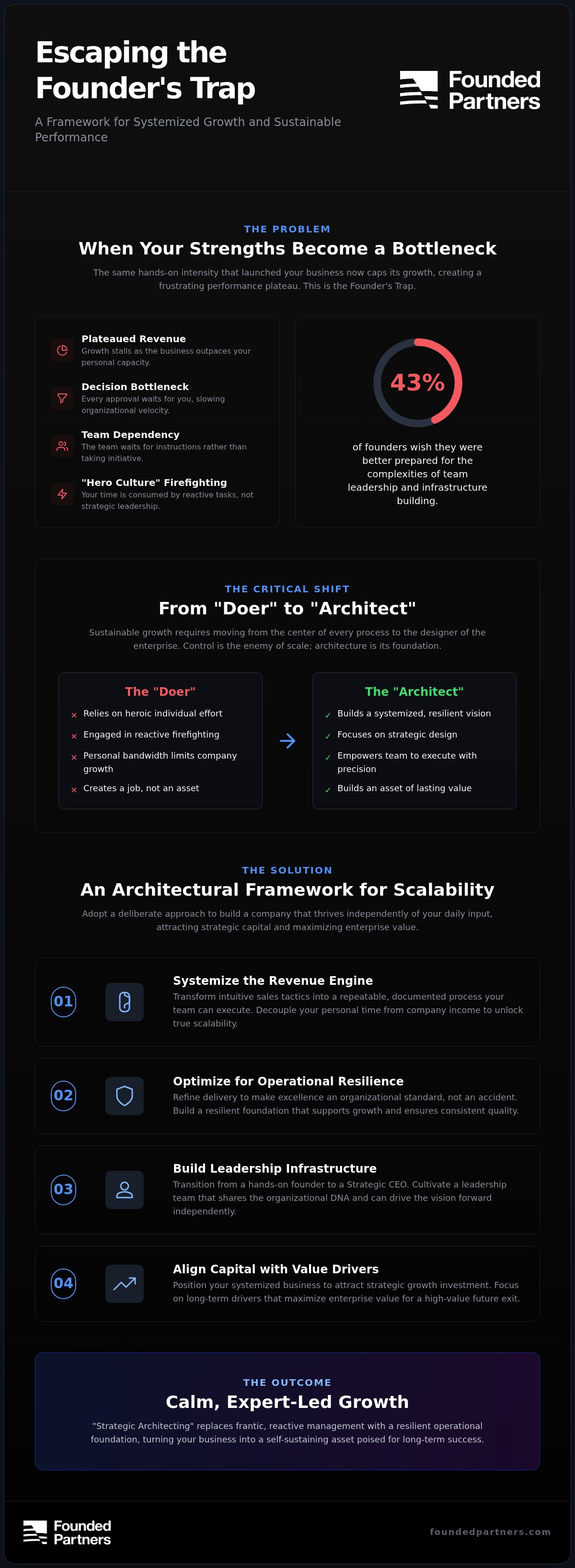
- Discover how to improve founder-led business performance by architecting a systemized revenue engine that functions independently of your daily input.
- Follow a phased roadmap to transition from a hands-on founder to a Strategic CEO, supported by a leadership team that shares your organizational DNA.
- Align your capital strategy with long-term value drivers to attract strategic growth investment and maximize enterprise value for a future exit.
- Leverage "Strategic Architecting" to replace frantic, reactive management with a resilient operational foundation and calm, expert-led growth.
The Founder’s Dilemma: Why Performance Hits a Ceiling
Growth often feels like a treadmill where you run faster, but the distance to your goals remains the same. This is the "Founder's Trap." It's the point where your personal involvement, once the spark of the company, becomes the friction slowing it down. While your intuition built the brand, that same intuition eventually becomes a bottleneck for every decision, leading to a plateau that hard work alone cannot break. Understanding how to improve founder-led business performance requires recognizing that your business is no longer a startup; it's an organization that needs architecture, not just energy.
In the 2026 market, where AI-driven automation and rapid shifts in consumer behavior happen overnight, waiting for a single person's approval is a competitive liability. Research shows that 43% of founders wish they had been better prepared for the complexities of leading a team and building an infrastructure. When every decision requires your signature, the organization’s velocity is limited by your personal bandwidth. This leads to decision fatigue, stalled innovation, and a team that waits for instructions rather than taking initiative. The transition is psychological. It's moving from the role of the primary "doer" to the "designer" of the enterprise.
Identifying Operational Bottlenecks
To break the cycle, you must audit your weekly schedule with brutal honesty. If the majority of your hours are spent "firefighting" or handling administrative tasks, you aren't leading. You're reacting. This "Hero Culture" might feel rewarding, but it creates a fragile environment where the team's performance is capped by your availability. The cost of this centralization is measurable in the delay of execution. When a team cannot move without your input, you're losing market share to leaner, more systemized competitors who empower their staff through clear processes.
The Performance vs. Control Paradox
Control is often the enemy of scale. Many founders hold on too tight, fearing that delegating will dilute the quality of their service or product. However, this grip limits the ultimate enterprise value of the company. A business that relies on a single individual is a job, not an asset. To build something of lasting value, you must adopt an architectural approach, focusing on refining the roadmap, guiding the leadership, and strengthening the foundation. Founder-Led Performance is the measurable output of a systemized vision, where the founder's intent is executed through durable architecture rather than individual effort.
Architecting Scalability: Moving Beyond Individual Effort
Scaling a business is an architectural challenge, not a test of endurance. While your personal charisma and deep industry knowledge may have secured the first million in revenue, they cannot secure the next ten million. Transitioning from founder-led sales to a systemized revenue engine is the first critical step in decoupling your time from your income. This requires turning your intuitive "gut feeling" for closing deals into a repeatable, documented process that a team can execute with precision. Without this system, your growth will always be capped by your personal bandwidth.
Operations Optimization is the discipline of building a resilient foundation that supports this growth. It involves refining the act of delivery so that excellence becomes an organizational standard rather than a lucky break. By 2026, technology has lowered the barrier to entry for many sectors, but it has also raised the bar for operational efficiency. A true scalability strategy leverages these tools to automate the mundane, allowing your team to focus on the high-value human connections that drive loyalty. This balance of digital efficiency and human-centric value is the hallmark of a modern, high-performance business.
Many leaders struggle with how to improve founder-led business performance because they fear that systemization will kill the company's soul. On the contrary, well-designed systems protect your vision by ensuring it is executed consistently, even when you aren't in the room. This shift allows you to move from being the primary engine of the company to being its strategic architect.
Business Transformation as a Scalability Lever
Business Transformation Consulting involves a comprehensive realignment of your strategy, culture, and operations. It's about ensuring that every daily task is a direct extension of your long-term vision. This alignment builds organizational resilience, allowing your company to absorb the rapid market shifts expected in 2026 without losing its core identity. By refining these foundational elements, you create a business that is prepared for consequential transitions, whether that means capital raising or a strategic exit.
Implementing High-Performance Systems
We advocate for a "Three-Pillar" approach: People, Process, and Platform. You must place the right people in the right seats, provide them with documented processes, and support them with the right technology platforms. This structure is essential for businesses looking to optimize for Series A funding and beyond. Clear KPI dashboards drive accountability, providing the real-time data you need to lead as an architect rather than a manager. If you are ready to move beyond individual effort, exploring a tailored Scalability Strategy can provide the calm expertise required to build a self-sustaining enterprise.
Leadership Infrastructure: Strengthening the Strategic Foundation
True scalability requires more than just better software or faster sales; it demands a robust leadership infrastructure. As you evaluate how to improve founder-led business performance, the most consequential shift occurs within your own role. You must move from being the primary engine of the company to becoming its strategic architect. This transition isn't an overnight event but a phased evolution that requires intentionality, discipline, and a willingness to let go of the familiar. It's about building a structure that thrives on your vision but survives without your constant intervention.
Building a senior team is a delicate balance of character and competence. You need leaders who share your core values and organizational DNA, yet possess the specialized skills you currently lack. This diversity of talent ensures the business can thrive in your absence, but it often triggers resistance within the original core team. Long-term employees may feel sidelined or fear the loss of the "scrappy" startup culture they helped build. Managing this transition requires transparency, empathy, and a clear articulation of how the new structure protects everyone’s future. By refining these internal relationships, you strengthen the foundation of the entire enterprise.
The Founder to CEO Transition
The roadmap from founder to strategic CEO typically follows three distinct stages. Stage 1 involves the delegation of tactical execution, where you stop managing the "how" of daily tasks. Stage 2 focuses on the empowerment of middle management, building the layer that translates your high-level vision into departmental action. Finally, Stage 3 sees your evolution into the "Chief Vision Officer" role. In this phase, your focus shifts entirely toward long-term health, market positioning, and maximizing enterprise value. This progression is essential for anyone seeking how to improve founder-led business performance while preparing for future growth.
Ownership Transition and Leadership Advisory
Professional Leadership Advisory plays a vital role in managing this organizational change. It provides the steady hand needed to navigate high-stakes pivots and prepares the team for the rigors of future capital rounds or a strategic exit. This partnership reduces the profound isolation often felt by founders, offering a trusted peer to stress-test ideas, refine strategy, and provide a measured perspective. By strengthening your leadership infrastructure, you ensure the business remains durable through the complexities of rapid growth. This architectural approach transforms a group of individuals into a cohesive unit capable of sustained, high-performance excellence.
Strategic Capital and Value Drivers: Performance for the Long Game
Capital strategy is often viewed as a finish line, but for the high-performance organization, it is a continuous filter for decision making. The way you fund your growth dictates the pace of your operations, the quality of your hires, and the durability of your systems. In 2026, the cost of capital remains a significant factor, with the WSJ Prime Rate holding at 6.75%. This environment demands a more disciplined approach to how to improve founder-led business performance. It requires you to align your internal metrics with the expectations of strategic investors who value architectural integrity over raw, unsustainable volume.
Bridging the gap between operational health and enterprise value is a deliberate act of design. Investors aren't just buying your current revenue; they're buying the reliability of your future earnings. If your performance relies on your personal intervention, your enterprise value suffers a "founder discount." By systemizing your vision and optimizing your operations, you transform the business from a personal project into a high-value asset. This shift in perspective ensures that every daily operational improvement also serves as a long-term value driver.
Capital Raising Support for Founders
There is a profound difference between chasing money and attracting strategic investment. Chasing money often leads to compromising on terms or partnering with investors who don't share your human-centric values. Attracting strategic investment requires preparing your business foundation long before the first pitch. This involves refining your scalability strategy, strengthening your leadership infrastructure, and ensuring your financial reporting is beyond reproach. Transaction advisory isn't just about the deal; it's about securing your legacy and ensuring the business has the resources to thrive in its next chapter.
Enhancing Enterprise Value for Exit Planning
Adopting an "Exit-Ready" mindset is a strategic advantage, even if you have no immediate plans to sell. A business that is ready to be sold is, by definition, a business that is well-run, systemized, and profitable. In 2026, the top value drivers for founder-led firms include diversified revenue streams, a robust middle-management layer, and proprietary operational processes. These elements reduce risk for a buyer and increase the multiple they are willing to pay. Starting your Exit planning for founders early allows you to identify and fix performance gaps while you still have the leverage. If you are ready to explore how a structured capital strategy can refine your organization, our team provides the Capital Raising Support necessary to navigate these consequential transitions with confidence.
Partnering for Transformation: The Founded Partners Approach
Transformation isn't a project you complete; it's a state of being you architect. While many consultants offer a list of recommendations, Founded Partners provides the calm expertise required to navigate the high-stakes shifts that define a company's legacy. We understand that your business is an extension of your character. Our approach is rooted in peership, moving away from the frantic energy of the startup world toward a measured, strategic perspective. We don't just deliver a service; we join you in the shared journey of building something substantial, durable, and truly high-performing.
Most leaders searching for how to improve founder-led business performance find themselves overwhelmed by tactical advice that doesn't account for the founder’s unique role. Our methodology, Strategic Architecting, addresses this by focusing on the organizational health of the entire enterprise. We help you identify the specific operational bottlenecks that cap your growth and replace them with resilient systems. This shift allows you to move from being the primary engine of the company to the architect of a self-sustaining model that thrives on your vision but survives without your constant intervention.
Strategic Advisory and Transaction Consulting
We serve as a deeply invested partner, not a distant observer. Our work integrates operations optimization with sophisticated capital strategy to ensure your business is prepared for its next consequential transition. Whether you're seeking to raise growth capital or planning a strategic exit, your internal systems must match your external ambitions. Through Business transformation consulting, we refine your roadmap, guide your leadership team, and strengthen your operational foundation. This holistic alignment ensures that your daily efforts are always building toward your ultimate financial and legacy goals.
Building for the Future
Durability is the ultimate performance metric. A business that relies on the heroic effort of its founder is inherently fragile. To build for 2026 and beyond, you must prioritize the health of the organization over vanity metrics or short-term gains. Assessing your current organizational health is the first step toward unlocking sustainable, scalable growth. We invite you to schedule a strategic assessment to identify your performance ceiling and begin the process of architecting a more resilient enterprise. If you're ready to move past individual effort and secure the future of your company, Partner with us for your next transition and let's build something that lasts.
Architecting Your Next Chapter
Transitioning from a founder-dependent model to a systemized enterprise is the most consequential journey a leader can take. It requires a fundamental shift from tactical firefighting to strategic architecting, ensuring your vision is durable enough to thrive without your constant intervention. By strengthening your leadership infrastructure and optimizing your operations, you move beyond the individual bottlenecks that have historically capped your growth. The path to sustainable expansion is a deliberate act of design, not a result of increased personal effort.
Understanding how to improve founder-led business performance is ultimately about building a business that functions as a high-value asset rather than a personal job. This alignment of daily operations with a long-term capital strategy creates the resilient foundation necessary for future scaling or a strategic exit. Founded Partners offers the calm expertise required to navigate these transitions. As a boutique advisory led by experienced partners, we provide a specialized focus on founder-led scaling and an integrated approach to operations and capital strategy. Secure your strategic foundation with Founded Partners and begin the transformation of your enterprise today. You've built something remarkable; now it's time to make it enduring.
Frequently Asked Questions
How do I know if my business has hit a founder-led performance ceiling?
Symptoms include persistent decision fatigue, revenue stagnation, and a team that cannot execute without your direct input. If your personal bandwidth is the primary constraint on growth, you've reached the limit of the individual effort model. Performance plateaus often signal that the business has outgrown its current heroic leadership style and requires a more architectural approach.
What is the first step in moving from a founder-led to a system-led business?
The first step is a brutal audit of your weekly schedule to separate tactical firefighting from strategic vision. You must identify which tasks can be systemized or delegated to empower your team. This shift requires moving from the role of the primary doer to the designer of the organization's architecture, allowing the business to function independently of your daily presence.
Can business transformation consulting help with capital raising?
Yes, business transformation consulting prepares your foundation by aligning operations with the expectations of strategic investors. Investors look for businesses that aren't dependent on a single individual for survival. By professionalizing your systems and leadership, you increase the attractiveness of the asset and improve your leverage during capital negotiations, ultimately securing better terms and partners.
How much time should a founder spend on operations vs. strategy?
A founder should ideally transition to spending 80% of their time on strategy and 20% on high-level operational oversight. In the early stages, this ratio is often reversed. However, to learn how to improve founder-led business performance, you must gradually delegate tactical execution to focus on long-term health, market positioning, and the overall architectural integrity of the enterprise.
What are the biggest risks when scaling a founder-led organization?
The biggest risks are cultural dilution, operational fragmentation, and the founder bottleneck where growth stops because the leader cannot keep up. Rapid scaling without documented processes leads to inconsistent quality and customer dissatisfaction. Without a strong leadership infrastructure, the organization becomes fragile and prone to burnout or failure during the rapid market shifts expected in 2026.
How does exit planning improve current business performance?
Exit planning forces you to view your business through the lens of a buyer, which highlights operational inefficiencies you might otherwise ignore. An exit-ready business is inherently well-run, systemized, and profitable. This mindset helps you discover how to improve founder-led business performance by prioritizing durability and enterprise value today, rather than waiting for a future transaction to fix gaps.
When is the right time to hire a leadership advisory firm?
The right time is when you feel the weight of being indispensable or when you're preparing for a consequential transition like a capital round. If your team is struggling with resistance to change or if you feel isolated in your decision-making, a leadership advisory firm provides the calm expertise needed to navigate these high-stakes pivots with confidence and clarity.
How do I maintain company culture while optimizing operations?
You maintain culture by ensuring your new systems are a direct extension of your core values and organizational DNA. Optimization shouldn't replace the human touch; it should automate the mundane to free your team for high-value connection. Transparency about why changes are happening helps preserve trust and commitment, ensuring the team feels guided rather than just changed.