
The Comprehensive Due Diligence Checklist for Founders in 2026

Most founders treat the data room as a defensive bunker where they hide their flaws, but in 2026, the most successful leaders treat it as a stage for their operational excellence. It's understandable to feel a sense of dread when an investor requests a deep dive into your corporate history. You've likely spent years moving fast; the fear that a hidden "skeleton" or an over-reliance on your personal involvement will derail a deal is a heavy burden to carry. This due diligence checklist for founders is designed to shift that narrative from anxiety to authority.
We'll provide you with a strategic framework that goes beyond simple document collection to protect your equity and accelerate your close. By the time you finish this guide, you'll know how to build a professional data room that minimizes friction and proves your company's durability. We're going to explore the 2026 standards for ESG reporting, the specific documentation required to handle heightened AI-sector scrutiny, and the operational proofs that drive higher valuations. This is your roadmap to transforming a stressful audit into a powerful demonstration of readiness.
Key Takeaways
- Understand why 2026 investors prioritize architectural integrity and sustainable margins over traditional "growth at all costs" metrics.
- Use this due diligence checklist for founders to perform an internal audit 6 to 12 months before your raise, ensuring your data room is a demonstration of strength.
- Learn to identify and mitigate "deal-killers" like high customer concentration and fragile technical systems before they become red flags during scrutiny.
- Master the four pillars of diligence to refine your unit economics and legal governance, moving from founder-dependency toward organizational durability.
- Discover how strategic business transformation can protect your equity and create the operational proof required for a higher valuation.
The Strategic Purpose of Due Diligence for Founder-Led Firms
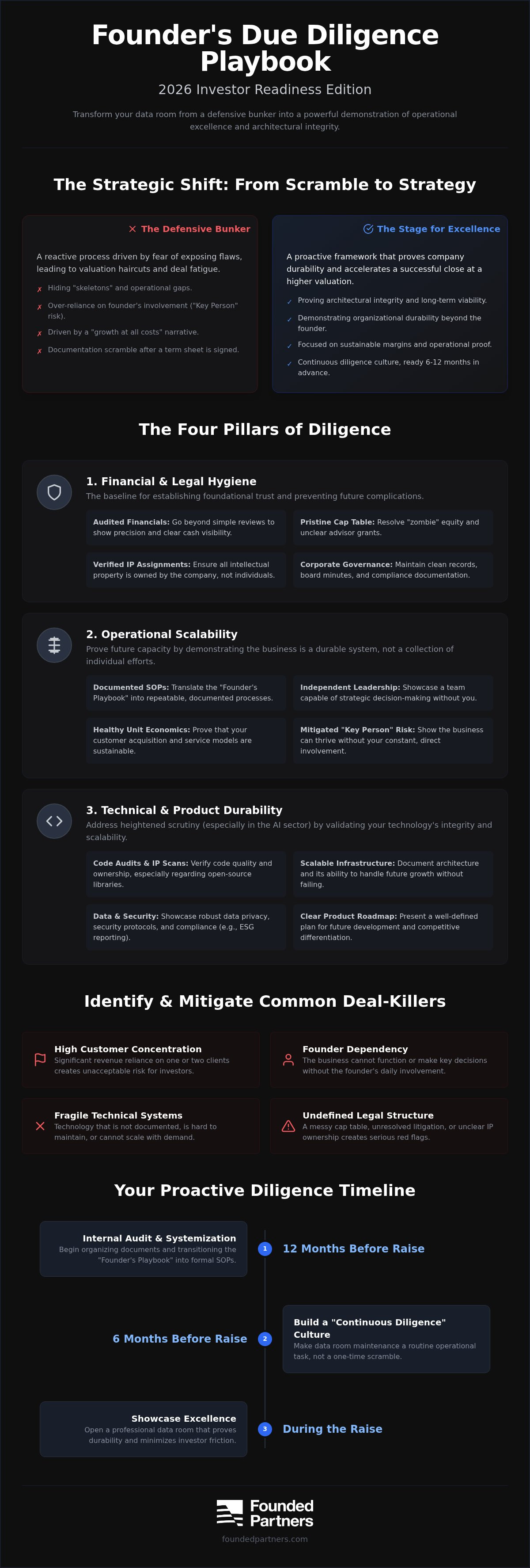
Many founders view the investigative phase of a deal as a high-stakes interrogation. They see it as a hurdle to clear rather than a strategic asset to leverage. To succeed in the current market, you must redefine what is due diligence in your own mind. It isn't a defensive audit meant to catch you in a mistake. It's a validation of your company's architectural integrity. A well-prepared due diligence checklist for founders acts as a blueprint for this validation, proving that your business is built on a foundation of durability rather than just temporary momentum.
Investors in 2026 have moved past the "growth at all costs" era. They now prioritize sustainable margins, operational proof, and long-term viability. They want to see that your unit economics are healthy and your cash visibility is clear. When you approach this process with a partner-oriented posture, you signal that you're ready for the next stage of growth. This proactive stance preserves your leverage during negotiations. It ensures you aren't forced to accept a valuation haircut because of a last-minute discovery in your records.
Shifting from Scramble to Strategy
Waiting until a term sheet is signed to organize your documentation is a recipe for deal fatigue, valuation haircuts, and lost momentum. The volume of requests can overwhelm even the most disciplined leadership teams. This frantic scramble often leads to errors that seed doubt in an investor's mind. To avoid this, you should build a "Continuous Diligence" culture. The best deals are won six months before the data room ever opens. By maintaining an updated due diligence checklist for founders as part of your monthly operations, you transform a stressful event into a routine confirmation of excellence.
Why Founder-Led Businesses Face Unique Scrutiny
Founder-led firms possess a unique energy, but they also carry specific risks that professional investors look to mitigate. The most prominent is "Key Person" risk. Investors need to know if the business can thrive without your constant, direct involvement. They're looking for evidence of:
- Documented, repeatable operational systems.
- A leadership team capable of independent decision-making.
- Clear separation between personal and corporate assets.
Character and integrity are the silent benchmarks of every transaction. While your vision gets you in the room, your disciplined operational systems keep you there. Balancing that visionary leadership with architectural rigor is how you secure a partner who values the business as much as the mission. This process is about refining your foundations, guiding your team, and strengthening your position before the first question is even asked.
The Four Pillars of Founder-Led Diligence
A comprehensive due diligence checklist for founders must extend far beyond basic tax compliance or accounting ledger reviews. While many resources focus solely on the numbers, seasoned investors look for the structural integrity of the entire organization. We categorize this architectural assessment into four distinct pillars: Financial Hygiene, Legal Governance, Operational Durability, and Strategic Alignment. Each pillar serves to prove that the company is a durable asset rather than a fragile collection of individual efforts. It's about demonstrating that the business can sustain its momentum even as it scales toward a future exit.
Financial and Legal Hygiene (The Baseline)
This is where foundational trust is established. In 2026, investors expect a high level of precision, often requiring audited financials rather than simple reviews, especially as companies navigate the 21% flat federal corporate tax rate. You must ensure your cap table is pristine. This means addressing "zombie" equity or loosely defined advisor grants that could complicate future distributions. Equally critical is the verification of intellectual property assignments. Every line of code and brand asset must be clearly owned by the corporate entity, not the individual creators. Utilizing professional due diligence tips for founders can help you identify these legal gaps before they become deal-breakers during the deep-dive phase.
Operational Scalability (The Growth Proof)
Investors aren't just buying your current revenue; they're buying your future capacity. To prove this, you must translate the "Founder's Playbook" into documented standard operating procedures (SOPs). This transition from a founder-dependent model to a process-driven one is the hallmark of a mature enterprise. You should also evaluate your supply chain and vendor resilience to mitigate third-party risks that could disrupt growth. Many leaders find that engaging in Business Transformation Consulting provides the outside perspective needed to bridge these readiness gaps and optimize internal systems for the long term.
The final pillar, Strategic Alignment, ensures your long-term vision matches the investor's expected exit horizon. It's about demonstrating that your architectural choices today support the scalability required for tomorrow. When you use a due diligence checklist for founders as a strategic tool, you aren't just checking boxes. You're building a narrative of reliability that commands a higher valuation. This methodical approach ensures that your business stands up to scrutiny because it was built to be scrutinized. By refining these four areas, you transition from a visionary leader to a disciplined CEO of a high-value enterprise.
Operational Red Flags: What Actually Kills Deals
High revenue can often act as a veil, hiding structural weaknesses that only become apparent under the microscope of a professional audit. A due diligence checklist for founders must highlight these silent deal-killers before they reach the data room. High customer concentration is a primary concern; if a single account represents 40% of your revenue, an investor sees a precarious single point of failure rather than a stable enterprise. Tech debt and manual workarounds are equally damaging. In an era where AI companies raised 57% of disclosed capital in Q1 2026, investors have little patience for fragile systems that rely on human intervention to fix basic data gaps. When your data doesn't match your narrative, you lose the trust that took years to build.
Founder Dependency: The #1 Deal Killer
The most significant operational risk is often the founder themselves. Investors look for "bottleneck" behaviors where every critical decision requires your direct approval. If your business cannot pass the "Vacation Test", staying operational and profitable for thirty days in your absence, it lacks the durability required for a high-valuation close. We utilize Leadership Advisory to help you transition from a founder-led scramble to a professionally managed organization. This shift replaces individual intuition with institutional knowledge; it proves to investors that your company's success is a result of its architecture, not just your personal stamina.
Process Fragility and Scalability Gaps
"We just figure it out" is an acceptable answer for a Seed round, but it's a non-starter for Series B or Series C diligence. Process fragility manifests as inconsistent KPIs or high employee churn, both of which signal a lack of organizational health. Investors conduct deep-dives into your "messy middle" to see if you have a strong second-in-command capable of executing the vision. We focus on Operations Optimization to turn these scalability gaps into competitive advantages. By refining your processes and strengthening your middle management, you provide the operational proof that your business can handle the weight of new capital. This methodical preparation ensures your due diligence checklist for founders reflects a company that is ready to scale, not just one that is desperate to close.
The Master Due Diligence Checklist for 2026
Generic checklists often fail founders because they treat documentation as a static inventory rather than a strategic narrative. For a complex, founder-led organization, a standard list of twenty legal documents is merely the starting point. To truly master the scrutiny of 2026 investors, you must adopt a phased approach that begins long before a term sheet is signed. This due diligence checklist for founders is structured as a chronological roadmap. It moves from internal refinement to external presentation, ensuring that every piece of data serves to validate your company's architectural integrity and growth potential.
Phase 1: The Internal Audit and Clean-up
The work begins six to twelve months before you intend to raise. During this phase, you should conduct a "mock diligence" to identify hidden liabilities that could stall a deal. This involves a rigorous review of your corporate records to resolve delinquent taxes, missing signatures on employment contracts, or expired operating permits. It is also the ideal time to engage in business transformation consulting to refine your foundation. By fixing operational gaps early, you ensure that the version of the company investors see is the most optimized and durable one possible. If you want to bridge these readiness gaps before engaging with investors, our team provides comprehensive capital raising support to ensure your foundation is unshakeable.
Phase 2: Building the Data Room Narrative
Data without context is just noise. In Phase 2, you organize your documentation into the "Four Pillars" we discussed earlier, guiding the investor's perspective through a logical flow. Your "Management Presentation" acts as the anchor for all other data, providing the strategic "why" behind the numbers. You must ensure absolute consistency between your pitch deck and the raw data in your Virtual Data Room (VDR). Discrepancies in unit economics or churn rates between your narrative and your spreadsheets are immediate red flags. This phase is about crafting a cohesive story of operational excellence that leaves no room for doubt.
Phase 3 focuses on the architecture of your Virtual Data Room. A well-structured VDR should be intuitive, secure, and progressively disclosed as interest deepens. Finally, Phase 4 covers post-term sheet execution. This is the period of intense verification where your previous preparation pays off. Because you've already addressed the "skeletons" in Phase 1, this final stage becomes a routine confirmation of facts rather than a frantic defense. This methodical progression protects your equity by preventing the "valuation drift" that occurs when founders are forced to explain away surprises during the final hours of a close.
Investor Readiness: How Founded Partners Architect Your Success
A checklist is a map, but navigating the final miles of a transaction requires a seasoned guide. While a due diligence checklist for founders provides the necessary structure for documentation, the actual work of investor readiness happens in the quiet spaces between the data points. Founded Partners doesn't just help you gather records; we help you refine the organizational architecture those records represent. We identify the "readiness gaps" in your current operations and bridge them with methodical business transformation. This ensures that when an investor evaluates your firm, they see an engine built for durability, sustainability, and scale.
Our approach moves beyond the defensive posture of surviving an audit. We focus on the act of refining, guiding, and strengthening your enterprise so that it commands the valuation it deserves. By the time you enter the data room, the "red flags" have been addressed, the narrative has been sharpened, and the operational proof is undeniable. You aren't just presenting a business; you're demonstrating a masterpiece of strategic planning.
Beyond the Checklist: Strategic Transformation
We focus deeply on the "how" of your business, not just the "what." It's not enough to have a financial statement; you must have the integrity of the systems that produced it. We work with you to:
- Refine core operations to maximize enterprise value.
- Build a scalable foundation that attracts high-tier strategic investors.
- Optimize unit economics and cash visibility to prove long-term viability.
This level of preparation turns a due diligence checklist for founders from a burden into a competitive advantage. It allows you to enter negotiations with the psychological security of knowing your house is in perfect order. Our goal is to move you from a state of frantic energy to one of calm expertise.
Partnering for the Transition
The journey from visionary founder to disciplined CEO is a profound evolution. We act as your trusted peer and mentor, providing leadership advisory that helps you navigate the psychological and operational shifts of rapid growth. Our team manages the heavy lifting of transaction advisory, which significantly reduces the burden on your internal staff during a raise. We believe in the shared journey of building something substantial. By integrating capital raising support with architectural business building, we ensure your organization thrives long after the deal is closed.
If you're ready to move from a frantic scramble to a composed, strategic close, we invite you to Schedule a Strategic Consultation with Founded Partners. Let's architect your success together.
Securing the Future of Your Enterprise
Diligence is far more than a final hurdle to clear before capital arrives. It is the definitive validation of the architectural integrity you've built into your firm. By implementing a proactive due diligence checklist for founders, you move from a position of defensive anxiety to one of strategic authority. You've learned that 2026 investors prioritize sustainable margins and operational durability over vanity metrics. They seek organizations that can thrive independently of their founder's daily intervention. This shift from a person-dependent model to a process-driven one is the key to protecting your equity.
As specialists in founder-led business transformation, Founded Partners provides the calm expertise required to navigate these high-stakes transitions. We are seasoned advisors in capital raising and exits, offering a boutique approach that prioritizes your organizational health above all else. We help you bridge readiness gaps and refine your systems so that your data room tells a story of unshakeable reliability. This methodical preparation ensures that your business stands up to scrutiny because it was built to be scrutinized.
Architect your investor readiness with Founded Partners today. The journey from founder to CEO is a shared one. With the right foundation, your next stage of growth will be your most substantial yet.
Frequently Asked Questions
When should a founder start preparing for due diligence?
You should begin your preparation at least six to twelve months before you intend to open a capital round. This timeline allows you to conduct a thorough internal audit and resolve any "skeletons" in your corporate records without the pressure of an active deal. Starting early ensures that your due diligence checklist for founders becomes a routine part of your operational rhythm rather than a frantic scramble that seeds doubt in potential investors.
What is the most common reason deals fall through during diligence?
Deals most often collapse due to a fundamental misalignment between the founder's narrative and the raw data. When an investor discovers undisclosed liabilities, high customer concentration, or inconsistent unit economics, the trust required for a partnership evaporates. It's rarely a single mistake that kills the deal; it's the perception of systemic disorganization or a lack of transparency that forces investors to walk away during the final stages of verification.
Do I need a fractional CFO or COO to manage the diligence process?
While you don't strictly need a fractional executive, you must ensure the functions of financial and operational oversight are professionally managed. If your internal team is already stretched thin, lean on specialized advisory support to bridge the "readiness gaps" in your documentation. This provides the sophisticated perspective of a seasoned peer who has navigated the transaction lifecycle before, allowing you to focus on running the business while the experts architect your data room.
How much detail should I provide about my intellectual property?
You must provide exhaustive proof of ownership for every core asset, including patent filings, trademark registrations, and IP assignment agreements from all past and present contributors. Investors in 2026 are particularly sensitive to "chain of title" issues. They'll conduct a deep dive to ensure that every line of code and brand asset is legally owned by the entity rather than individual founders or contractors, as any ambiguity here creates a significant valuation risk.
What is a Virtual Data Room (VDR) and which one should I use in 2026?
A Virtual Data Room is a secure, encrypted online repository designed specifically for the distribution and storage of sensitive corporate documents during a transaction. In 2026, the standard has shifted toward platforms that offer AI-driven indexing and granular permission controls. You should choose a VDR that provides detailed audit trails and watermarking features, ensuring that your due diligence checklist for founders is housed in an environment that reflects your commitment to security and professional integrity.
How does due diligence differ between VC and Private Equity?
Venture Capital diligence typically focuses on growth potential, market capture, and the founder's visionary leadership. In contrast, Private Equity firms conduct a much more rigorous audit of operational resilience, sustainable margins, and cash flow predictability. PE investors look for "architectural integrity" and a clear path to an exit, whereas VCs are often more willing to overlook minor operational friction if the scaling opportunity is sufficiently massive, particularly in the AI sector.
Can I still raise capital if my historical financials are messy?
You can still raise capital, but you should expect a significant "valuation haircut" and more restrictive term sheet conditions. Investors view messy financials as a proxy for poor management discipline. If you're facing this challenge, it's vital to clean up your records through business transformation before engaging with investors. Presenting a clear plan for how you've corrected past errors can help rebuild trust and protect your equity during the final negotiations.
What are the ESG requirements for diligence in 2026?
ESG reporting has become a standardized requirement for most institutional investors in 2026, moving beyond simple "feel-good" metrics to rigorous operational audits. You'll need to provide data on your carbon footprint, board diversity, and supply chain ethics. Investors now treat environmental and social governance as a risk management tool; they're looking for proof that your business is built for long-term sustainability in an increasingly regulated global market.