
Scalability Strategy for Founder-Led Businesses: Structuring Strategic Partnerships

What if the partnership meant to free a founder’s time became another relationship only they could manage? That tension sits at the heart of a scalability strategy for founder-led businesses. Growth often depends on the founder’s judgment and relationships, so adding a partner can seem like a natural way to extend reach or capability. But without clear mutual value, ownership, and decision rights, a partnership can add complexity while leaving the founder at the center of every decision.
A well-designed partnership is more than a promising introduction or handshake. It is part of the company’s operating architecture: a deliberate way to address a defined constraint while protecting focus, accountability, and strategic control. The opportunity is not simply to do more. It is to build a relationship the business can sustain without relying on the founder to manage every handoff.
This article will help you assess whether a partnership addresses a meaningful scaling challenge, define shared value and decision rights, and set responsibilities and success measures. You’ll also learn how to test, govern, and adapt the relationship as the business grows, while keeping strategic choices, operations, and leadership capacity aligned.
Key Takeaways
- Distinguish a strategic partnership from a vendor relationship, referral arrangement, acquisition, or informal network before committing resources.
- Choose a partnership model that fits the growth objective, weighing shared value against resource demands, coordination, and founder involvement.
- Set clear contributions, responsibilities, decision rights, information-sharing practices, and escalation routes so both parties know how the relationship works.
- Put your scalability strategy for founder-led businesses into practice with a bounded test, then review the evidence before expanding or revising the partnership.
- Connect partnership choices to operating priorities and leadership capacity while retaining clear strategic ownership as execution is shared.
When a Scalability Strategy for Founder-Led Businesses Needs a Strategic Partnership
A strategic partnership is a coordinated relationship in which two organizations contribute distinct strengths toward objectives that create value for both. It involves more shared intent and ongoing coordination than a routine purchase, but it doesn’t require combining the businesses. The concept of a Strategic Alliance offers a useful reference point: independent organizations work together while retaining their separate identities.
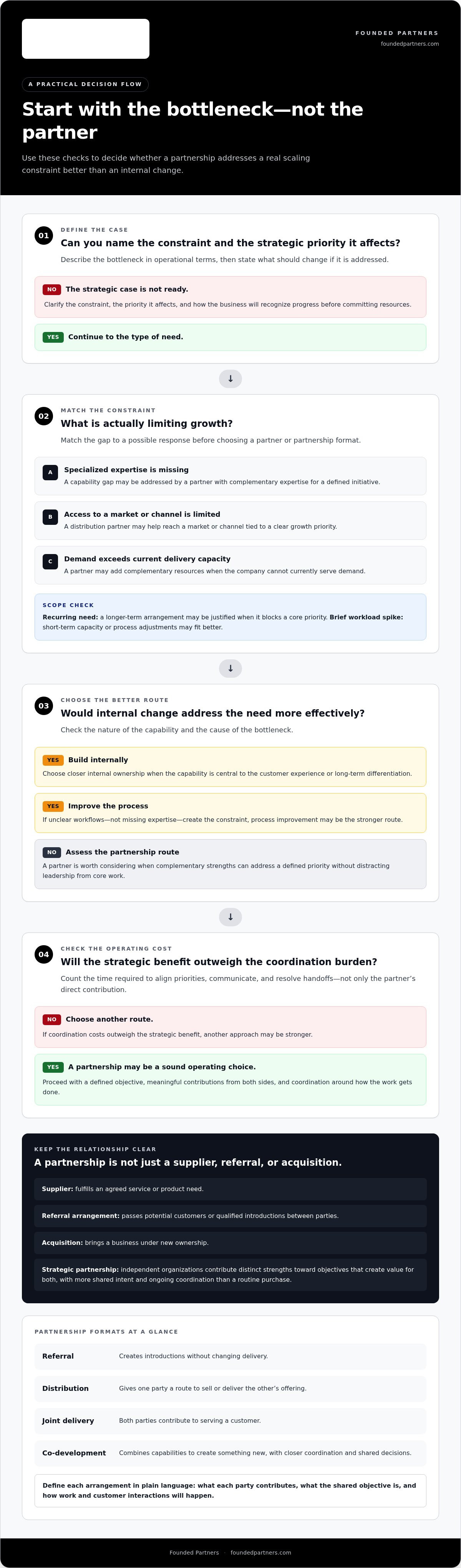
That distinction matters when you are deciding how to address a growth constraint. A vendor delivers an agreed service or product; a referral arrangement passes potential customers between parties; an acquisition brings a business under new ownership. Informal networking can build relationships, but it doesn’t necessarily involve shared commitments or measurable aims. A strategic partnership calls for a defined objective, meaningful contributions from both sides, and coordination around how the work gets done.
A supplier fulfills a defined need; a strategic partner shares responsibility for creating value neither organization could reach as effectively alone. That doesn’t make partnership the answer to every growth challenge. It is one possible response to a specific constraint, not a substitute for deciding where the company is going and what it needs to become.
Which scaling constraints might a partner address?
Start with the bottleneck, not the potential partner. Describe the constraint in operational terms, then connect it to one strategic priority. For example, if the growth plan depends on reaching a customer segment the company can’t access efficiently, a distribution partner may help. If delivery is limited by a capability the business lacks, a partner with complementary expertise may expand what it can provide. In either case, define what changes if the partnership works, such as more effective access to a channel or a clearer path to delivering the offering.
- Capability gap: A partner contributes specialized expertise the company needs for a defined initiative.
- Distribution access: A partner helps the business reach a market or channel tied to a clear growth priority.
- Delivery capacity: A partner adds complementary resources when demand exceeds the company’s current ability to serve it.
Then determine whether the gap is structural or temporary. A recurring need that blocks a core priority may justify a longer-term arrangement. A brief workload spike may be better handled through short-term capacity or process adjustments. If the founder can’t explain what the partnership is meant to unlock, or how the business will recognize progress, the strategic case isn’t ready.
When should a founder build internally instead?
Compare a partnership with hiring, improving a process, adopting suitable technology, or developing the capability within the company. The right choice depends on how enduring the need is, how central the capability is to differentiation, and whether the organization can manage the work effectively. A capability that shapes customer trust or the distinctive value of the business may merit closer internal ownership.
- Build internally when the capability is central to the customer experience or long-term differentiation.
- Improve the process when unclear workflows, rather than missing expertise, are creating the constraint.
- Partner when complementary strengths can address a defined priority without distracting leadership from core work.
Partnership has a coordination cost: time spent aligning priorities, communicating, and resolving handoffs. Account for that work alongside the direct contribution. If the coordination burden outweighs the strategic benefit, another route may be stronger. A sound scalability strategy for founder-led businesses treats partnership as a deliberate operating choice, made only when it addresses a real constraint better than internal change.
How to Choose a Partnership Model That Fits Your Growth Strategy
The right model depends on what the business needs to accomplish, not on which arrangement sounds most strategic. A referral relationship may create introductions without changing delivery. Co-development may combine expertise to create something new, but it also requires closer coordination and shared decisions. Treat each format as an operating choice with consequences for capacity, customer relationships, and leadership attention.
Labels aren’t used consistently across businesses. Define the relationship in plain language: what each party contributes, what the shared objective is, and how work and customer interactions will happen. For broader context on sustainable growth, explore this business scalability consulting guide.
What does each partnership model make possible?
Each arrangement brings a different balance of shared value and effort. Referral partnerships exchange qualified introductions; distribution arrangements give one party a route to sell or deliver the other’s offering. Joint delivery means both parties contribute to serving a customer, while co-development combines capabilities to create an offering or solution. A strategic alliance is broader, aligning organizations around an ongoing shared objective that may involve several activities.
| Model | Shared value | Resource commitment | Coordination | Founder involvement |
|---|---|---|---|---|
| Referral | Relevant introductions | Low | Low, with clear handoff expectations | Light after the relationship is established |
| Distribution | Expanded market access | Moderate; enablement and channel support | Moderate, especially around positioning and customer handoffs | Moderate during setup and review |
| Joint delivery | Combined expertise or service capacity | Moderate to high | High, with interdependent workflows | Ongoing oversight of quality and responsibilities |
| Co-development | A jointly created offering or capability | High; both parties contribute specialist time | High, including decisions about scope and direction | High at key strategic decision points |
| Strategic alliance | Progress toward a broader shared objective | Varies with the scope of collaboration | Varies; may involve multiple workstreams | Continued sponsorship and alignment |
These are relative guideposts, not fixed rules. A narrow distribution test may need little founder attention, while a referral relationship involving sensitive customer handoffs may need closer oversight. Consider the actual responsibilities and dependencies, not just the model’s label.
How should founders compare partnership options?
Compare each model against four questions: Does it advance a priority? Does it provide capabilities or access the business can’t develop as effectively right now? Is the operating effort proportionate to the value? And can the arrangement be adjusted if assumptions prove wrong? Reversibility matters: a small pilot is easier to revise than a model that embeds a partner in essential workflows.
Identify dependencies before they become structural. Consider who controls customer relationships, what information must be shared, and whether specialist knowledge sits with one party. A distribution model may deepen reliance on another organization for market access; joint delivery may make customer experience dependent on smooth coordination. The strongest choice for a scalability strategy for founder-led businesses fits the growth priority while keeping important relationships and capabilities visible to the leadership team.
When partnership choices affect operating design or leadership capacity, scalability strategy advisory can help founders assess the trade-offs and align the model with the company’s broader growth direction.
How to Structure a Strategic Partnership Around Value, Ownership, and Decisions
A promising relationship needs an operating framework. Before work begins, both parties should be able to explain the shared objective, what each will contribute, how value will be assessed, and who has authority to act. This clarity reduces reliance on assumptions, especially as the work affects customers, teams, and day-to-day operations.
Start with a short partnership brief that translates intent into commitments. For example, if one organization brings specialist expertise and the other provides access to a customer channel, describe what each contribution involves in practice. Name the people or teams responsible, the resources they’ll commit, and dependencies that could affect delivery. Replace vague promises such as “provide support” or “help generate growth” with observable actions, owners, and expected handoffs.
How should partners define mutual value and commitments?
Partners need a shared outcome, but they don’t need identical commercial interests. One party may value customer access; the other may gain a stronger offering or new expertise. Make both aims explicit, then distinguish them from the shared result the relationship is meant to create. Revisit assumptions at planned intervals and whenever a contribution, priority, or operating constraint changes. If a commitment no longer fits, discuss and revise it rather than letting it drift.
- Shared objective: State the business outcome both parties are working toward.
- Contributions: Specify people, capabilities, access, information, and operational effort from each side.
- Separate interests: Record what each organization hopes to gain, alongside the result they share.
- Review conditions: Identify what would trigger a reassessment of assumptions or commitments.
This discipline is part of scalability strategy for founder-led businesses: the partnership should strengthen the operating model, not create an informal dependency that only the founder understands.
Which decision rights and measures need clarity?
Not every choice needs joint approval. Assign an owner for routine decisions, identify which material choices require agreement from both parties, and set an escalation route when people can’t resolve an issue at the working level. Clarify how information will move between teams, including who shares updates, what needs prompt attention, and how customer-impacting issues are raised. For a deeper perspective on governance discipline, see these founder board management strategies.
Choose a small set of indicators connected to the partnership’s purpose. Measures might track progress toward the strategic outcome, operational reliability, and customer impact. A distribution relationship, for instance, could review qualified opportunities, handoff quality, and customer feedback. A joint delivery arrangement might focus on agreed milestones, responsiveness, and service consistency. Set a review cadence that fits the work and allows timely adjustment; no universal schedule or benchmark suits every arrangement.
Keep strategic and operational alignment distinct from formal legal, tax, or transaction terms. Those matters can shape obligations and risk, so have qualified specialists advise on them. The business owners can then focus on clear priorities, accountable decisions, and a partnership structure the organization can sustain.
How to Test and Govern a Strategic Partnership Without Losing Focus
A partnership should earn deeper integration through evidence, not enthusiasm. A bounded pilot lets both organizations test how the relationship works before either becomes dependent on the other for essential delivery, customer access, or expertise. The aim is not to eliminate uncertainty. It is to make assumptions visible, learn at manageable scale, and protect the company’s priorities while the relationship develops.
How can a founder run a useful partnership pilot?
Give the pilot a defined scope, accountable owners on both sides, a timeline suited to the work, and a clear learning objective. For example, a company testing a distribution relationship might limit the initial effort to a specific offering or customer segment. Before launch, record assumptions about demand, available capacity, coordination effort, and how promptly the partner can respond. Set review criteria in advance so the decision to continue isn’t based only on goodwill or early excitement.
- Align: Confirm the shared objective, the reason for testing it now, and what each party expects to learn.
- Document: Record scope, owners, responsibilities, assumptions, customer handoffs, and measures of progress.
- Test: Run the initiative within agreed boundaries and keep a record of decisions, delays, and unexpected work.
- Review: Compare observations with the original objectives and commitments, including operational and customer effects.
- Expand or revise: Decide whether to extend the scope, adjust responsibilities, run another test, or end the arrangement.
Set check-ins around the work rather than relying on informal updates. The cadence should reflect the pilot’s pace and level of interdependence. At each review, discuss delivery progress, decision speed, customer experience, and emerging friction. For a broader view of how to connect activity to outcomes, use these transformation success measures as a reference point.
What should partnership reviews surface?
A useful review looks beyond whether the initiative produced an immediate result. Compare observed performance with the agreed objective and each party’s actual contribution. If progress has stalled, identify the source: unclear ownership, duplicated effort, delayed approvals, insufficient capacity, or a customer handoff that isn’t working as intended. Keep the discussion specific. “Communication needs to improve” is less actionable than identifying which information arrived too late and what decision it delayed.
- Continue if the pilot is progressing and the operating effort remains proportionate.
- Adapt if a change to responsibilities, information flows, or decision routes could address friction.
- Expand only when the evidence supports broader reliance and both organizations can sustain the added work.
- End if the objective no longer fits or the costs to focus, delivery, or customer experience outweigh the value.
For a scalability strategy for founder-led businesses, this review discipline keeps partnership activity aligned with operating priorities rather than adding a separate management burden. Partnership strategy support can help you assess how a pilot fits your growth priorities.
Make Strategic Partnerships Part of a Durable Founder-Led Scaling Strategy
A partnership becomes durable when it strengthens how the company operates, not just what it can accomplish in the short term. Its contribution should connect to a real operating priority, fit the leadership team’s capacity, and leave the business better prepared for what comes next. Look beyond immediate reach or delivery and ask whether the relationship builds resilience or creates a new point of dependence.
Shared execution doesn’t mean shared strategic ownership. The founder and leadership team should remain clear about why the partnership exists, which priorities it serves, and what the company needs to protect. A partner may own specific work, bring specialist knowledge, or support a customer-facing process. The company still needs internal owners who understand how that work connects to the broader operating model.
How can partnerships strengthen the operating model?
Connect partner contributions to processes and accountability. If a partner supports customer delivery, for instance, define how work enters the process, who handles handoffs, and how the internal team learns from the collaboration. Document essential knowledge and keep appropriate internal capability developing, so critical work doesn’t rely on one person’s memory or a single external relationship.
Then revisit the fit as customer needs and company priorities shift. A partnership that once filled a meaningful capability gap may need a different scope as the business grows. Regularly check whether it still supports the intended outcome, whether responsibilities remain clear, and whether the relationship is helping the organization become more capable over time.
When can strategic advisory help founders move forward?
Outside perspective can be useful when partnership choices involve competing growth priorities, cross-functional change, or uncertainty about who should own decisions. Those questions often touch more than the relationship itself. They can affect operating design, leadership responsibilities, and the sequence of broader business transformation. Addressing those connections helps founders make choices that fit the organization as a whole.
Founded Partners advises founder-led organizations on transformation, operations optimization, and scalability strategy. Its strategic advisory can help leaders bring priorities, operating requirements, and leadership capacity into the same conversation as they assess partnership options. The aim is to clarify what the company needs and how a partnership fits its path forward.
A considered scalability strategy for founder-led businesses makes room for collaboration while keeping the company’s direction and accountability clear. If you’re weighing a partnership as part of your next stage of growth, discuss your growth strategy with Founded Partners.
Build the Next Stage with Intention
A partnership can also reveal what the business needs to strengthen internally. As you consider the next stage, ask what knowledge, relationships, and decision-making capacity should remain close to the company, even as you collaborate to extend its reach. That question can help turn growth from a series of founder-dependent decisions into an enduring capability.
A thoughtful scalability strategy for founder-led businesses connects partnership choices with the organization’s direction and the leadership needed to sustain it. Founded Partners advises founder-led organizations on scalability strategy, operations optimization, and business transformation, helping leaders work through connected growth priorities.
If you’re ready to consider how partnership decisions fit your company’s broader direction, explore a thoughtful growth strategy with Founded Partners. The next step is to clarify the priority the partnership should serve and how the business will remain accountable for it.
Frequently Asked Questions
Can a strategic partnership be non-equity?
Yes, many strategic partnerships are commercial collaborations without shared ownership. The parties can define each organization’s contributions, responsibilities, decision rights, and intended shared outcomes separately from any equity arrangement. For example, a company might collaborate with a distributor while retaining full ownership of its business. The appropriate structure depends on the objectives and circumstances. Ask qualified legal or tax professionals to advise on formal terms, especially where ownership, compensation, or risk allocation is involved.
How long should a strategic partnership pilot run?
There’s no universal duration for a partnership pilot. Set its length around the assumption being tested and the operating cycle needed to observe it. A referral test, for example, needs enough time to assess whether introductions become qualified conversations, not just whether contacts were exchanged. Before starting, name the review date, learning goals, accountable owners, and evidence to collect. The purpose is disciplined learning, not extending a weak arrangement by default.
What should founders do when a strategic partner misses commitments?
Start by documenting the missed commitment against the responsibility both parties agreed to, then discuss the cause directly. A delay may reflect unclear expectations, limited capacity, or an unforeseen constraint, so avoid assuming bad faith. Assess any effect on customers or operations, and agree on a corrective action, an owner, and a review point. If the problem continues, follow the escalation or exit process already agreed rather than letting the gap become normal.
How can a founder protect customer relationships in a partnership?
Clarify customer responsibilities, communications, data access, and service ownership before expanding the collaboration. Map the customer journey from first contact through ongoing support, then name accountable leads on both sides for each touchpoint. For example, specify who responds when a customer raises an issue that crosses both organizations. Monitor feedback and handoff problems as the work proceeds, and seek appropriate legal guidance on contractual terms and data-handling obligations.
Can a strategic partnership help a company scale without hiring?
A partner may give a company access to capabilities or reach without requiring it to build every capability internally, but collaboration still takes management time. Compare the full operating effort, including coordination and oversight, with hiring, process changes, or technology. In a scalability strategy for founder-led businesses, a partner may be a useful option for a defined need, but it isn’t a guaranteed substitute for employees or internal expertise the company must retain.
How often should strategic partners review their relationship?
Set review frequency according to the partnership’s pace, risk, and decision needs rather than following a universal schedule. Use operating check-ins to address immediate coordination and milestone-based strategic reviews to assess the relationship’s broader direction. Each review can examine commitments, outcomes, emerging friction, customer impact, and whether the original assumptions still hold. Record decisions, accountable owners, and next steps so that discussions lead to follow-through rather than recurring without resolution.