
Why Multitasking Is Hurting Your Leadership Team's Decisions
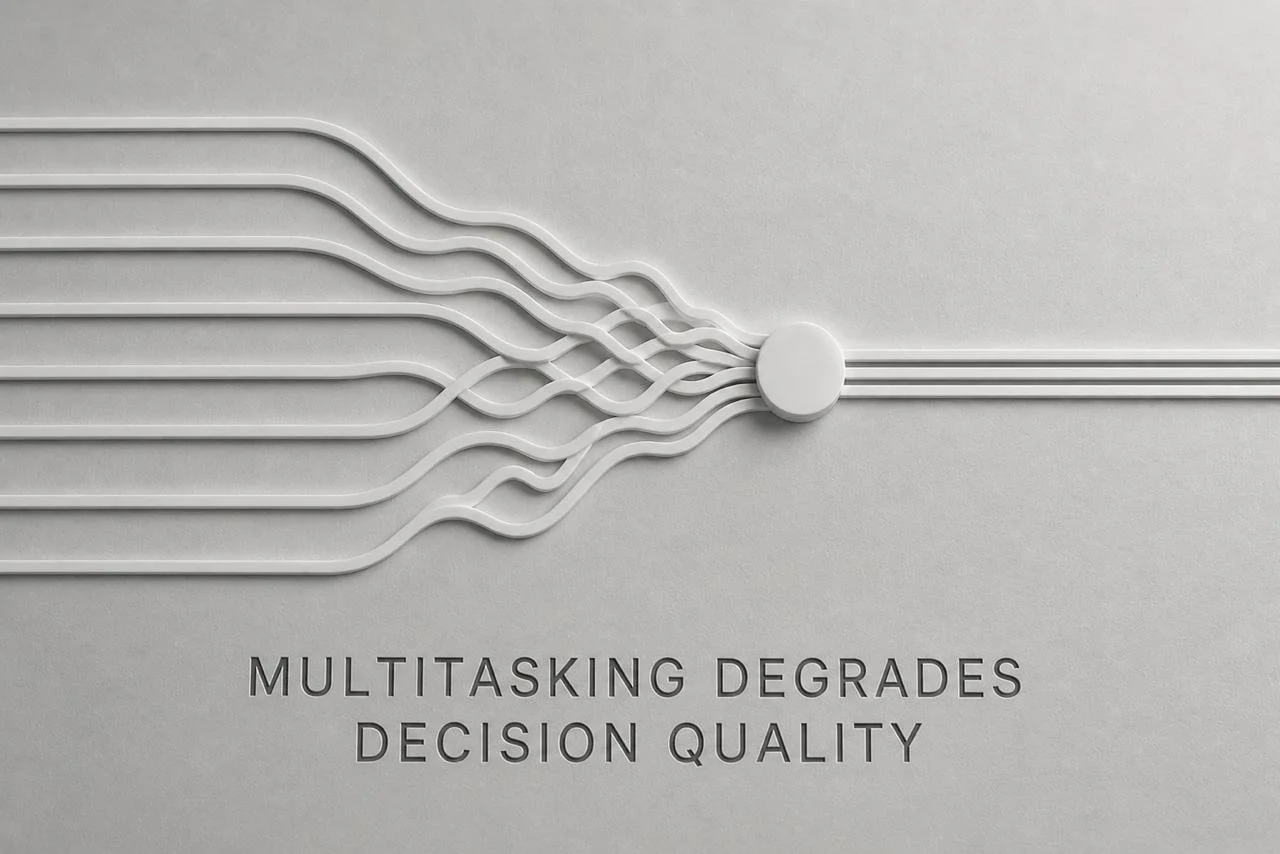
Here is something founders rarely want to hear: your leadership team is probably not missing things because they lack skill, experience, or commitment. They are missing things because their brains are being asked to do something that brains genuinely cannot do well, and the operating environment you have built is making it worse every single day.
We have sat inside enough leadership teams to know how this plays out. The weekly meeting has ten people in a room, a live dashboard up on the screen, Slack notifications coming in on laptops, someone checking email while a colleague is mid-sentence, and a side conversation happening in the corner about something that came up this morning. From the outside it looks like engagement. From the inside, cognitively speaking, it is closer to system failure.
The science behind this is cleaner than most people realize. A researcher named Christopher Wickens developed what is called the Multiple Resource Model, and the core idea is that your brain does not run on a single processor. It runs on different cognitive channels, including visual processing, language processing, and decision-making, and those channels can operate in parallel only when they are not competing with each other. The moment two tasks draw on the same channel, performance does not dip slightly. It drops sharply. So when your CFO is reading a dashboard while listening to your VP of Sales make a case for a new market entry, those two tasks are fighting for the same cognitive resources, and one of them is losing. The question is just which one, and you usually do not find out until the decision has already been made.
This would matter less if leadership work were simple. But it is not. Interpretation, judgment, trade-offs, ambiguity, risk-weighting across incomplete information: these are the tasks that sit at the top of cognitive load. Your senior leaders are already running close to capacity before the meeting even starts. Adding multitasking on top of an already full cognitive load does not slow performance down in a way that is obvious or linear. It creates gaps. Signals get partially processed. Contradictions go unnoticed. Patterns that would have been obvious in a focused conversation disappear entirely. And the decisions that come out the other side feel solid because everyone was present, everyone was engaged, and nobody realizes that half the relevant information never actually made it through.
Gloria Mark's research at UC Irvine showed that interruptions cost far more than people expect, not just in the time lost to the interruption itself but in the recovery time required to return to the depth of thinking that was in progress before it happened. In leadership contexts, that recovery rarely happens at all because the next agenda item is already underway. The compounding effect is a team that revisits the same issues, re-litigates decisions that were supposed to be closed, and moves slower than the calendar would suggest they should.
There is one more thing worth naming, and it is uncomfortable. High performers are often the most vulnerable to this. They take on more inputs because they can handle more. They sit in more rooms, receive more data, and are trusted with more simultaneous decisions. The overconfidence research is consistent here: people who believe they can multitask effectively tend to be the ones who are actually worst at it. The confidence masks the performance gap, which means the problem goes unaddressed longer precisely in the people whose judgment the company depends on most.
If your leadership team is busy in meetings but unclear on decisions afterward, if the same risks keep surfacing that should have been caught earlier, if you find yourself becoming the tie-breaker for things that should have been resolved at the leadership level, it may not be an alignment problem. It may be an attention problem. Those require very different solutions, and treating one as the other will not help.
The practical path forward is not complicated, though it does require some deliberate changes to how you run your leadership operating rhythm. Dashboards and data should be reviewed before key discussions, not during them. Devices should be closed when the conversation reaches something that actually matters. Slack, email, and other parallel inputs should be actively limited during leadership sessions, not as a soft norm but as a real structural rule. And every meeting should begin with a clear answer to three questions: what decision are we here to make, what information is required to make it, and what can legitimately wait.
Attention is a finite resource. Every founder understands that capital is finite and needs to be protected and allocated carefully. Attention works the same way, with one important difference: capital loss is visible on a balance sheet, while attention loss is invisible. It shows up only later, in slower decisions, in risks that were there all along but that nobody quite saw, in the quiet erosion of decision quality that looks from the outside like a strategy problem or a people problem or an execution problem when the real issue started in the room.
At Founded Partners, we work directly inside leadership teams rather than consulting from a distance. We have built and led companies ourselves, which means we recognize these patterns not from theory but from having lived them. We observe how decisions are actually being made, where attention is fragmenting, and what changes to operating rhythm and decision structure will reduce cognitive load at the leadership level. If any of this feels familiar, we would genuinely like to hear about what you are navigating. Reach out and let's talk.