

A founder can sell a business without losing the continuity that comes from keeping its experienced leaders in place. In a management buyout, the existing management team buys the company from its current owner, often using a combination of buyer equity, financing and, sometimes, seller financing. The management buyout process for a founder brings valuation, funding, due diligence and the transfer of ownership together in a succession plan.
It’s natural to seek a fair sale while protecting the company’s people, continuity and the legacy you’ve built. This article explains how an independent valuation can inform negotiations, what the founder and management team need to consider, and how responsibilities may shift after the sale closes. It also covers when an MBO may fit a founder’s exit goals and how planning can make the transition clearer for everyone involved.
Key Takeaways
- Understand how management, the founder and potential financiers can shape a buyout structure that fits the business.
- See how an independent valuation can inform the sale price and strengthen negotiations.
- Know what ownership transfer involves, including the gradual handover of operational knowledge and responsibility.
- Assess whether an MBO aligns with your exit goals and how succession planning can support continuity.
What is a management buyout?
A management buyout (MBO) transfers ownership to the company’s existing management team. The financing, due diligence and transaction terms determine how the founder exits and the team takes responsibility.
MBO Financing Sources and Structures
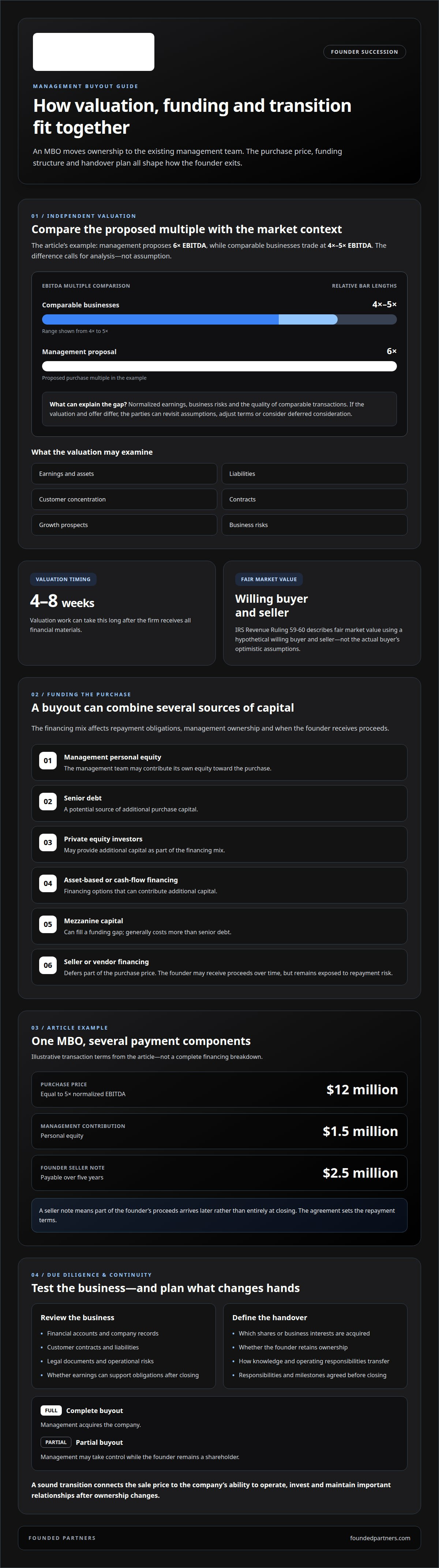
An MBO combines financing sources to fund the purchase while balancing repayment obligations, ownership and the founder’s proceeds. The management team may contribute personal equity, with senior debt, private equity investors or asset-based and cash-flow financing providing additional capital. Mezzanine capital can fill a funding gap, generally at a higher cost than senior debt. Seller or vendor financing defers part of the purchase price, with repayment terms set out in the agreement.
For example, a seller note lets the founder receive part of the sale proceeds over time rather than entirely at closing. It can bridge a gap between available financing and the agreed purchase price, but leaves the seller exposed to repayment risk. The mix of debt, equity and deferred payment affects both the team’s ownership and when the founder receives the proceeds.
Due diligence gives the management team and its financial backers access to company records. They review financial accounts, customer contracts, liabilities, legal documents and operational risks, assessing whether the business can support its obligations after closing. Depending on the transaction, preparing preacquisition financial statements of the kind outlined in SEC Rule 3-05 may also form part of the review.
Legal, Tax, and Regulatory Rules
In the U.S., legal, tax and regulatory considerations depend on the transaction structure, the company’s circumstances and the financing arrangements. The way ownership is transferred can affect the documents and tax analysis. Due diligence and transaction planning should identify relevant obligations and risks before the parties finalize terms.
MBO transaction costs and fees vary with the deal structure, financing sources, scope of due diligence and overall complexity. An independent business valuation is one cost, not a complete estimate of transaction expenses. Accounting, legal, financing and advisory work can add to the total, while deferred payment changes when the seller is paid rather than removing the seller’s exposure.
Independent business valuation
An independent business valuation gives the founder and management team a reasoned basis for discussing the purchase price. It distinguishes the company’s underlying value from either party’s expectations, helping the seller assess the offer and lenders evaluate the proposed financing. It can also help determine whether the business can support the transaction without undermining future operations.
Valuation work can take four to eight weeks after the valuation firm receives all financial materials. The analysis may consider earnings, assets, liabilities, customer concentration, contracts and growth prospects. According to the IRS, Revenue Ruling 59-60 describes fair market value using a hypothetical willing buyer and seller, rather than the actual buyer’s optimistic assumptions. That distinction matters when management already knows the business and expects more from its future than an external buyer might.
Consider a business where management proposes a 6x EBITDA purchase multiple, while comparable businesses trade at 4x to 5x EBITDA. That gap deserves analysis, not assumption. Normalized earnings, business risks and the quality of comparable transactions can help explain whether the proposed price is supportable. If valuation and offer differ, the parties can revisit assumptions, adjust terms or consider deferred consideration rather than letting a single headline figure dominate negotiations.
Valuation also helps test whether an MBO suits the company. Compare the proposed purchase obligations with the business’s earnings, cash needs and investment requirements. Then assess whether the management team can maintain customer relationships, lead employees and carry out the business plan after the ownership change. Financial due diligence can uncover issues, such as outstanding litigation, that may affect value or the team’s ability to sustain operations.
Succession planning connects the valuation to business continuity. A founder can assess which relationships, decisions and operating knowledge need to transfer before stepping away. If an MBO aligns with the founder’s goals, exit planning can help shape a transition that accounts for ownership, leadership and continuity, not just the sale price.
Ownership transfer and post-completion transition
An MBO transfers some or all ownership to the existing management team. Transaction documents and transition planning address employees, benefits and existing contracts; continuity depends on the agreed structure and terms.
Ownership Transfer and Transaction Scope
The transaction scope defines which shares or business interests the buyers acquire and whether the founder retains any ownership. In a complete buyout, management acquires the company; in a partial buyout, the team may take control while the founder remains a shareholder. Due diligence clarifies the assets, liabilities, contracts and operations involved, so the purchase documents accurately reflect what changes hands.
Price and Transition Arrangements
Price negotiations connect the agreed valuation with payment timing, retained ownership and the founder’s role after the sale. A seller note or deferred payment can make part of the purchase price payable over time, while transition terms can set out how knowledge and operational responsibilities pass to the buyers. Because the handover may take several years, founders and managers benefit from defining responsibilities and milestones before closing.
Founder Succession Transaction Example
Consider an MBO with a $12 million purchase price, equal to 5x normalized EBITDA. The management team contributes $1.5 million in personal equity, while the founder provides a $2.5 million seller note payable over five years. This example shows how the founder’s proceeds may combine closing consideration with later payments. The transaction’s ownership documents would also establish the shares transferred and any continuing role.
After closing, the founder and new owners can coordinate introductions, transfer customer and supplier knowledge, and clarify decision-making authority. A gradual handover helps the management team assume responsibility while preserving operational knowledge. Consider employee arrangements, benefits and customer contracts alongside the ownership transfer, since leadership changes can affect these relationships. Clear communication and assigned responsibilities help keep the transition orderly.
Founder exit and management succession
A founder considering retirement or a sale can use an MBO as a succession path. The existing management team already understands the company’s employees, customers, culture and operations. That familiarity can support continuity and help preserve confidentiality during the transaction. It also shifts the key question from who might buy the company to who can lead it after the founder exits.
Succession takes more than transferring shares. The management team’s proposal should explain who will lead, why the acquisition makes strategic sense, what the business aims to achieve after closing, and how the funding and deal terms support those goals. The successor needs the skills and leadership qualities to guide the company. These considerations help distinguish a workable succession plan from a change in ownership that leaves the next leaders unprepared.
For example, an owner might hire a general manager and spend two years teaching them how the business works before selling it to them. That period can build familiarity with key relationships, operating decisions and the founder’s accumulated knowledge. During the handover, the founder can clarify which responsibilities will transfer, who will assume them, and how the successor will maintain customer and employee relationships.
Capital structure also affects the founder’s exit and the successor’s authority. Management may need outside funding, and private equity investors may provide capital in exchange for a share of the company. Mezzanine financing can add another obligation. Each funding source can affect ownership, repayment demands and decision-making, so the team’s post-acquisition plan should account for both its leadership capacity and financial commitments.
A clear succession plan connects the founder’s desired exit with the company’s next operating chapter. Set out the leadership handover, key relationships and post-sale priorities alongside the transaction proposal. Build a founder exit and succession plan around the leadership transition and the business’s long-term direction.
Founded Partners
Founded Partners helps founders bring the financial, operational and leadership dimensions of an MBO into one considered plan. Turn to the firm when you’re weighing whether a management-led sale fits your exit goals, preparing the business for a change in ownership, or aligning the incoming team around its next chapter.
Through exit planning, leadership advisory, business transformation consulting and capital raising support, Founded Partners can help clarify priorities, strengthen readiness and connect the succession plan to the company’s future direction. This support is especially useful when valuation, funding needs and leadership responsibilities need to be considered together rather than as separate decisions.
If you’re considering a management buyout, contact Founded Partners to discuss the path ahead.
Shape the next chapter with intention
The next decision is not simply whether to sell. It’s how ownership, leadership and the company’s future should fit together after your exit. A thoughtful management buyout process for a founder connects those choices and gives the founder and management team a shared basis for moving forward. The goal is a transition that supports your priorities while positioning the business for its next stage.
Founded Partners can help founders consider this path through exit planning, capital raising support and Business Transformation Consulting. This perspective can be useful when a proposed transaction raises questions about funding, organizational readiness or the management team’s ability to carry the business forward. Start with a clear conversation about your aims, the company’s needs and the options available.
Contact Founded Partners to discuss your options and bring the key decisions into focus. A considered plan can help you move toward an exit with greater clarity and give the business a stronger foundation for what comes next.
Frequently Asked Questions
What are the tax implications of management rollover equity?
The tax treatment of rollover equity depends on how the transaction is structured and when the founder receives or exchanges value. Rollover equity generally means retaining or reinvesting part of the sale value in the continuing business. The relevant analysis considers the founder’s proceeds, the form of the transaction and what happens when that equity is later sold. Those details affect when tax may arise.
How Does a Management Buy Out Work?
An MBO moves through proposal, negotiation, review and closing. The management team presents its rationale, proposed terms and funding approach; the founder evaluates the offer and agrees on the transaction scope. During review, the parties assess company information and resolve issues that could affect the deal. At closing, ownership documents record the agreed transfer, and the team begins taking responsibility under the transition arrangements.
How Is an MBO Typically Financed?
An MBO commonly combines management equity with borrowed capital and, sometimes, seller financing or private equity. Management teams typically contribute 10 to 30 percent of the purchase price as equity, while senior debt is typically sized at 3x to 5x normalized EBITDA. Seller notes may represent 10 to 20 percent of seller proceeds, and mezzanine capital is priced at 12 to 18 percent.
How Is the Business Valued in an MBO?
An MBO valuation estimates the business’s worth based on evidence about its financial performance and risks. A useful analysis tests normalized earnings, including adjustments for unusual expenses or owner compensation, then examines how reasonable changes to revenue assumptions affect the result. This sensitivity analysis helps distinguish a durable earnings base from an optimistic forecast, giving the seller and buyers a clearer basis for discussing price.
How is a conflict of interest managed when management is both buyer and operator?
Manage the conflict by separating management’s operating role from its role as a buyer. Document access to company information, the basis for the offer and how material decisions will be handled during negotiations. An independent valuation and a clear review process can provide perspective on price and terms. These safeguards also help the founder assess whether the proposal reflects the company’s interests.
How is an MBO different from an LBO?
An MBO is a leveraged buyout in which the company’s existing managers acquire the business, often using significant borrowed capital. An LBO describes the broader financing approach, in which borrowed funds support an acquisition by existing managers or outside investors. The distinction is who leads the purchase, not whether it involves debt. In an MBO, the buyers already understand the company’s operations.