
Business Case for Transformation: A Founder’s Guide

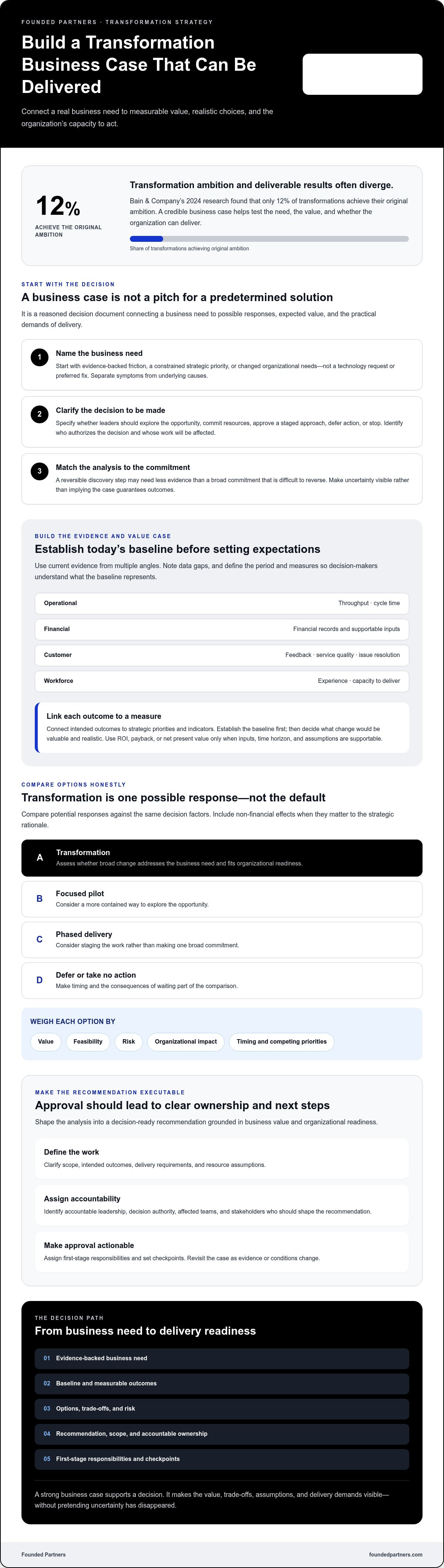
Bain & Company’s 2024 research found that only 12% of transformations achieve their original ambition. The gap between a compelling vision and a result the organization can deliver often begins in the business case. Building a business case for a transformation project means more than presenting a persuasive idea. It means showing why the change matters, what value it could create, and whether your teams have the capacity to deliver it.
If the benefits are broad, the assumptions are difficult to defend, or the timing competes with other priorities, decision-makers are right to ask hard questions. A credible case addresses those questions with evidence, clear trade-offs, and an honest view of risk.
This guide will help you connect a transformation initiative to strategic priorities and measurable outcomes, compare options, and test whether the investment and timing are realistic. You’ll also learn how to clarify scope, ownership, and execution requirements so leadership can align around a recommendation grounded in business value and organizational readiness.
Key Takeaways
- Building a business case for a transformation project starts with a clear business need, not a predetermined solution or technology request.
- Use current operational, financial, customer, and workforce evidence to establish a baseline and connect intended outcomes to measurable indicators.
- Compare transformation with alternatives such as a focused pilot, phased delivery, deferral, or no action. Weigh value, feasibility, risk, and organizational impact.
- Shape your analysis into a decision-ready recommendation with defined scope, accountable leadership, delivery requirements, and resource assumptions.
- Make approval actionable by assigning first-stage responsibilities and setting checkpoints. Revisit the case as evidence or conditions change.
Why a Transformation Project Needs a Business Case Before It Begins
Transformation should begin with a decision, not a solution looking for approval. A business case is a reasoned decision document that connects a business need to possible responses, expected value, and the practical demands of delivery. The Business case concept offers a useful foundation, but a transformation case must also assess how change fits the organization’s strategy and capacity.
That makes it different from a project pitch, which may focus on winning support for a preferred idea; a vision statement, which describes a desired future; or a technology request, which can mistake a tool for the answer. Building a business case for a transformation project means examining whether the proposed change addresses a meaningful business problem, whether another option could address it better, and whether the organization is ready to act.
For founder-led firms, these questions are closely connected. A plan to grow into new markets, for instance, may expose unclear decision rights or processes that depend too heavily on the founder. The case should connect that operational constraint to the strategic priority, then account for timing, competing commitments, and the teams expected to deliver the change. A strong case supports a decision; it neither guarantees outcomes nor removes uncertainty.
What decision should the transformation business case support?
Be explicit about what leaders are being asked to decide: whether to explore the opportunity, commit resources, approve a staged approach, defer action, or stop. Identify who can authorize the decision, whose work will be affected, and which stakeholders should shape the recommendation. Match the depth of analysis to the decision. A reversible discovery step may need less evidence than a broad commitment that is difficult to reverse.
When is a transformation case worth developing?
A case may be warranted when operational friction persists, a strategic growth objective is constrained, or the organization’s needs have changed. First, separate symptoms from causes. Repeated delays, for example, might reflect unclear ownership rather than inadequate technology. Treating the visible symptom as the root problem can lead to investment without resolving the underlying constraint.
Write the rationale in one fact-dense sentence: Because [evidence-backed business problem] is limiting [strategic priority], we should assess [proposed response] against [key delivery constraint]. For example, a founder-led firm might note that repeated approval bottlenecks are slowing a growth initiative, then examine whether decision rights, workflows, or capacity need to change. This sentence is not the whole case. It tests whether the need is clear enough to investigate with the people who will own the decision and live with its consequences.
How to Build the Evidence, Baseline, and Value Case
A persuasive value case starts with an honest picture of how the business operates today. Gather evidence that reflects the problem from more than one angle: operational data such as throughput and cycle time, financial records, customer feedback, and workforce experience. Use what’s available, note gaps, and define the period and measures clearly so decision-makers know what the baseline represents.
Next, connect each intended outcome to a strategic priority and an indicator that can show progress. If the priority is to serve customers more reliably, a relevant measure might be service quality or time to resolve an issue. If growth is constrained by a manual process, examine throughput or cycle time. Don’t invent a target to make the case look stronger. Establish the baseline first, then decide what change would be valuable and realistic.
How do you quantify the value of a transformation?
Choose measures that reflect the expected outcome, not simply the data that’s easiest to collect. ROI, payback, or net present value can help compare financial implications, but only when the inputs, time horizon, and assumptions are supportable. Include non-financial effects, such as service quality or workforce capacity, when they matter to the strategic rationale. For more on selecting outcome measures, see this guide to measuring transformation success.
Explain each measure in a self-contained sentence: “We’ll track average order-to-fulfilment time against the current baseline, using the same start and end points for both measurements.” This makes the measure easier to understand and validate.
Which assumptions and evidence belong in the case?
Separate established evidence from what still needs testing. Distinguish sourced facts, leadership estimates, delivery dependencies, and open questions. For each material assumption, name an owner and a validation step. If a dependency proves untrue, leaders can then see how the recommendation might change instead of discovering the risk after approval.
Show uncertainty through scenarios rather than presenting one forecast as certain. A conservative, central, and more favorable view can reveal which assumptions drive expected value and where delivery is most exposed. State what differs between scenarios, such as adoption pace or available team capacity, and avoid implying that any outcome is guaranteed.
Keep the value case balanced by separating one-time investment from ongoing operating implications and describing non-financial effects clearly. Validate assumptions with the people who understand the work and will be accountable for it. If your team needs support connecting strategic priorities with operational evidence, Founded Partners’ business transformation consulting may be relevant to that assessment.
How to Compare Transformation Options, Risks, and Trade-Offs
A compelling transformation vision can still be the wrong choice. Compare it with realistic alternatives before recommending a path: a focused process improvement, a narrower pilot, phased delivery, deferral, or no action. Use the same criteria for each option and record where evidence is incomplete. This makes trade-offs visible instead of letting enthusiasm for one proposal set the standard.
The comparison below is a starting point, not a scoring exercise. Assess each option against strategic fit, expected value, feasibility, organizational impact, and reversibility, using evidence your business can support.
Full transformation: May address connected constraints across the business. Compare the breadth of expected value with delivery capacity, disruption, dependencies, and how difficult it would be to reverse course. Evidence gap: which benefits rely on untested assumptions?
Process improvement: Could address a specific friction point with a narrower scope. Assess whether it advances the strategic priority or leaves root causes untouched. Evidence gap: will local improvement resolve the wider constraint?
Narrower pilot: Can test defined assumptions before a broader commitment. Assess whether the learning justifies the effort and can inform later decisions. Evidence gap: will pilot conditions reflect real operations?
Phased delivery: Sequences change and decision points. Assess whether dependencies can be managed without fragmenting the intended outcome. Evidence gap: what must be in place for each stage?
Defer or take no action: Preserves current capacity for now, but may leave the business problem unresolved or allow it to grow. Evidence gap: what is the likely consequence of waiting?
How should leaders compare a full transformation with a smaller pilot?
A pilot is useful when a critical assumption can be tested in a bounded part of the business before leaders commit to broader change. Compare both approaches by learning value, time to useful evidence, dependencies, and implementation risk. A pilot can also create fragmentation if its processes or tools don’t connect to the eventual operating model. Don’t assume it will be cheaper, faster, or more successful. Examine what it requires and what decision its findings will inform.
How should the business case make risk and uncertainty visible?
Group risks by strategic, operational, people, financial, and technology dependencies where relevant. Describe likelihood and consequence qualitatively or quantitatively, but use numbers only when the evidence supports them. For each material risk, state the mitigation, accountable owner, and remaining uncertainty alongside the expected benefit. Decision-makers should be able to see what could go wrong, how the organization would respond, and what still needs validation.
Building a business case for a transformation project means comparing a credible range of choices, not presenting uncertainty as certainty. A disciplined recommendation can still be ambitious. Its strength comes from showing why the preferred option fits the strategy, what trade-offs it carries, and what evidence would prompt leaders to reconsider.
How to Shape the Case Into an Approval-Ready Recommendation
An approval-ready case makes the decision easy to find and the reasoning easy to examine. Start with the recommendation, then show how it follows from the strategic rationale, supporting evidence, options considered, expected value, key risks, and delivery requirements. Building a business case for a transformation project isn’t about making every unknown disappear. It gives decision-makers a clear view of what they’re being asked to authorize and what the organization will need to make it work.
What should a transformation business case include?
Organize the document so readers can grasp the recommendation quickly, then examine the supporting detail. Include an executive summary, problem statement, objectives, current baseline, alternatives, and preferred option. Add expected benefits, investment and resource assumptions, dependencies, risks, governance, and the specific decision requested. Keep detailed analysis in supporting material, but make the central argument easy to find.
- Decision and rationale: State what approval is sought and how the proposal supports strategic priorities.
- Scope and sequence: Define what is included, what is not, and the major stages or decision points.
- Ownership and capacity: Identify accountable leaders, affected teams, and the resources the plan assumes.
- Evidence and conditions: Summarize expected value, material risks, dependencies, and questions that remain open.
Match the level of detail to the reader. Owners may focus on strategic direction and implications for the business. Board members may need the rationale, governance, principal trade-offs, and approval boundaries. Finance leaders will want to understand investment assumptions and how value will be assessed. Affected teams need a candid account of scope, sequencing, responsibilities, and operational impact. Tailoring the emphasis doesn’t change the facts; it makes the same case useful to each decision-maker.
How can leaders build alignment without overstating certainty?
Bring affected leaders into the review before finalizing the recommendation. Ask them to challenge assumptions, surface dependencies, and identify where the proposed sequence could strain day-to-day operations. Record unresolved questions and disagreements rather than smoothing them over. If the board has a meaningful role in the decision, these founder board management strategies can help frame engagement around governance and strategic alignment.
When evidence or organizational readiness is incomplete, recommend a staged decision. Seek approval for a defined first step, with an accountable owner and a checkpoint to review what has been learned before expanding the commitment. This gives leaders a practical way to proceed while preserving the option to adjust, pause, or stop if assumptions don’t hold.
For support refining a recommendation and aligning it with operational readiness, explore Founded Partners’ business transformation consulting.
From Approval to Action: Make the Transformation Case Executable
Approval is a decision to proceed, not proof that every assumption will hold. Turn the recommendation into a first-stage plan that names an accountable sponsor, confirms decision rights, checks team capacity, and sets near-term milestones. Validate critical dependencies before work begins, and make clear who can resolve issues or bring a material change back to leadership.
What happens after leadership approves the business case?
Before mobilization, align the sponsor and delivery owners on what the first stage must establish. Set review points to test key assumptions, track relevant indicators, and assess whether scope or expected value has shifted. If a dependency fails or operating conditions change, use those checkpoints to decide whether to continue, adapt, pause, or escalate. For broader strategic context, see this guide to business transformation consulting.
Keep the case active as the work progresses. Revisit it when new evidence challenges the original rationale, resource assumptions change, or the proposed scope expands. Record what changed and how it affects the decision, rather than treating the approved document as fixed. Building a business case for a transformation project is most useful when its logic continues to inform decisions during execution.
A business-case process also has boundaries. It helps leaders assess strategic fit, value, and readiness, but it isn’t a substitute for project delivery expertise or specialist legal, tax, or software services. Identify those needs separately and confirm the right expertise is available before relying on it in the plan.
When can an external transformation advisor help?
An outside perspective can be useful when leaders need to test assumptions, clarify strategic fit, or assess whether the organization is ready to carry the change. Founded Partners advises founder-led organizations through Business Transformation Consulting, Operations Optimization, and Leadership Advisory. That support is strategic guidance, not custom software development, legal advice, or tax compliance.
Once you’ve assessed the case, consider whether outside guidance would strengthen the next decision. Discuss transformation advisory with Founded Partners if your leadership team needs support refining the strategy and organizational readiness for change.
Turn a Sound Case Into Meaningful Change
A strong transformation case does more than make a persuasive argument. It connects a strategic priority to evidence, compares credible alternatives, and shows what the organization must be ready to deliver. Building a business case for a transformation project also means being honest about uncertainty, naming owners, and setting checkpoints to adjust course as new information emerges.
For founder-led organizations, the best recommendation balances ambition with operational capacity. A clear baseline and measurable indicators help leaders assess value, while explicit risks and trade-offs support a decision grounded in reality. Approval is a beginning; progress depends on turning the case into accountable action.
Founded Partners advises founder-led organizations on business transformation, operations optimization, and leadership. If you’re refining a recommendation or weighing your organization’s readiness for change, discuss your transformation priorities with Founded Partners.
With a clear case and the right alignment, your next step can be purposeful and achievable.
Frequently Asked Questions
What is a business case for a transformation project?
A business case for a transformation project is a decision document that explains the business problem, strategic rationale, options, expected value, risks, and resources involved. It helps leaders decide whether to proceed, stage, revise, or defer an initiative. A useful case separates evidence from estimates and makes assumptions visible, so decision-makers can assess the reasoning. It supports a choice; it doesn’t guarantee that projected benefits will be achieved.
How do you build a business case for a transformation project?
Start by defining the business problem and the decision leaders need to make. Establish a current-state baseline, connect intended outcomes to strategic priorities, and compare realistic alternatives, including doing nothing. Then document expected value, resource needs, assumptions, risks, dependencies, ownership, and the recommended decision. Validate uncertain inputs with relevant leaders and identify what still needs investigation before committing. The case should explain both why change may matter and what delivery requires.
How do you measure the value of a transformation project?
Measure value by establishing a reliable baseline and choosing indicators linked to the intended business outcomes. Depending on the initiative, useful measures might include cycle time, throughput, service quality, or operational performance. Explain the data source, calculation, review period, and accountable owner so the measure can be interpreted consistently. Use financial indicators when their inputs are credible, and describe non-financial value, such as improved service or organizational capacity, where it matters.
How do you calculate ROI for a transformation project?
Calculate ROI by defining the benefits and costs included, the assessment period, and the assumptions behind each input. A common calculation compares net benefits with investment, then expresses the result as a percentage of that investment. Separate one-time costs from ongoing operating implications, and test scenarios if estimates are uncertain. Treat ROI as one decision aid, not a complete account of strategic, operational, or organizational consequences.
What is the difference between a business case and a project plan?
A business case supports the decision to pursue an initiative. It explains why the change matters, which option is recommended, and what value, risks, and resources are involved. A project plan describes how approved work will be delivered, including activities, owners, timing, and dependencies. The two should connect: the business case establishes the rationale and boundaries, while the plan turns the recommendation into coordinated, accountable work.
Who should be involved in building a transformation business case?
Involve the executive sponsor, leaders responsible for affected operations, owners of relevant financial or operational data, and people expected to deliver or adopt the change. Bring decision-makers in early enough to test strategic fit and challenge assumptions. The right group depends on the initiative’s scope and governance. Input from affected teams can surface practical dependencies and risks that might otherwise be missed in a leadership-only discussion.
When should a company use an external transformation advisor?
An external transformation advisor may help when leaders need an independent challenge to assumptions, a cross-functional perspective, or support connecting strategy with operational readiness. First identify the gap, such as unclear scope, limited internal capacity, or difficult leadership alignment, and define the advisor’s role and decision boundaries. Founded Partners advises founder-led organizations in business transformation, operations optimization, and leadership. Legal, tax, or software-development work calls for the appropriate specialist.