
Measuring Transformation Success for Founder-Led Firms

Most transformation efforts in founder-led firms fail not because of a lack of effort, but because they mistake organizational activity for genuine progress. You've likely felt the weight of this yourself; you invest in new systems and advisory, yet the operational bottlenecks persist and the business remains tethered to your daily presence. It's difficult to communicate progress to investors when the metrics you're tracking don't reflect an increase in the actual durability of your enterprise. We recognize that measuring business transformation success requires a shift from tracking tasks to evaluating the strength of your firm’s architectural foundation.
We understand that for a founder, the goal isn't just change; it's the creation of a legacy that can scale. This guide will show you how to move beyond vanity metrics and focus on the true impact of transformation on your enterprise value and operational independence. We'll provide a clear framework for refining your foundation, guiding your team toward autonomy, and strengthening the company's position for a future exit or capital round.
Key Takeaways
- Shift your perspective from founder-dependency to organizational resilience by identifying the maturity milestones that signal a truly durable enterprise.
- Learn why measuring business transformation success requires moving beyond vanity metrics to focus on strategic outcomes that directly increase enterprise value.
- Evaluate your progress through the three pillars of transformation maturity, including operational efficiency, financial readiness, and capital attraction.
- Build a practical transformation scorecard by defining a clear "North Star" goal and identifying the specific levers required to reach it.
- Discover how a successful transformation provides the psychological security and scalability needed for the business to thrive without your constant intervention.
Beyond Technology: Defining Business Transformation Success for Founders
Transformation is not merely a software update; it's a fundamental evolution of your firm's DNA. For founder-led organizations, this journey usually begins with a sobering realization. The very energy and intuition that fueled your initial growth have become the primary barriers to your future scale. True transformation is the deliberate, strategic process of shifting from founder-dependence to organizational resilience. It's about building a business that can stand on its own two feet.
Success in this context isn't a singular destination or a "go-live" date. It's the achievement of specific maturity milestones that demonstrate your business can function, thrive, and expand without your constant intervention. We advocate for a "Calm Expertise" approach. While the startup world often celebrates frantic disruption, we believe that measured, intentional evolution creates the most durable value. When you start measuring business transformation success, you must look past the surface-level noise and focus on the architectural integrity of your operations. Every refinement you make must align with your long-term "North Star," whether that's a strategic exit or a significant capital raise.
The Difference Between Change and Transformation
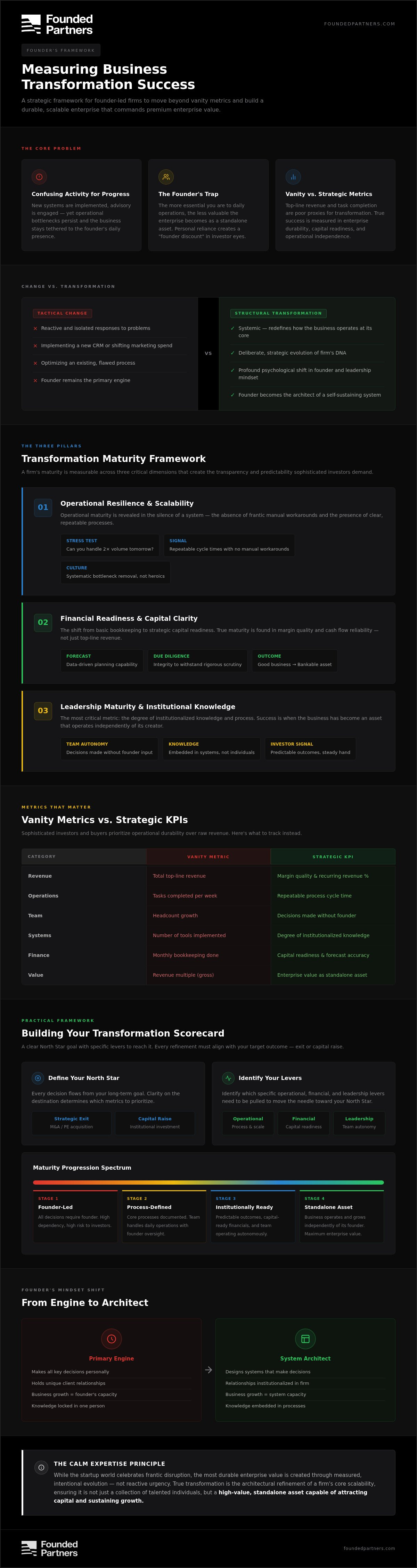
It's easy to confuse tactical change with structural transformation. Change is often reactive and isolated; it’s the implementation of a new CRM or a shift in marketing spend. Transformation is systemic. It redefines the way your business operates at its core. Many firms mistakenly believe they are transforming when they are simply optimizing an existing, flawed process. True transformation requires a profound psychological shift from the founder and the leadership team. You must transition from being the primary engine of the business to becoming the architect of a self-sustaining system.
Transformation as a Driver of Enterprise Value
Sophisticated investors and buyers prioritize operational durability over raw revenue. They look for businesses that possess a "steady hand" and predictable outcomes. If your firm relies on your personal charisma, unique relationships, or daily decision-making, it carries a "founder discount" in the eyes of the market. This is the "Founder's Trap": the more essential you are to the daily operations, the less valuable the enterprise becomes as a standalone asset.
When measuring business transformation success, the most critical metric is the degree of institutionalized knowledge and process. Business transformation is the architectural refinement of a firm's core scalability. By focusing on these structural foundations, you ensure that your firm is not just a collection of talented individuals, but a high-value asset capable of attracting capital and sustaining growth for the long term.
The Three Pillars of Transformation Maturity
A firm’s maturity is not a vague concept; it's a measurable state across three critical dimensions. To move beyond the limits of individual effort, a founder must focus on the operational, financial, and leadership pillars that define institutional strength. These pillars don't just improve daily life; they create the transparency and predictability that sophisticated investors demand. When you're measuring business transformation success, you're looking for evidence that the business has become an asset that operates independently of its creator. It’s about building durability, ensuring sustainability, and refining the architecture of the enterprise.
The financial pillar represents the shift from basic bookkeeping to strategic capital readiness. It means having the data to forecast, the clarity to allocate resources, and the integrity to withstand a rigorous due diligence process. While many firms focus on top-line revenue, true maturity is found in the quality of your margins and the reliability of your cash flow. This financial clarity is what transforms a "good business" into a "bankable asset."
Operational Resilience and Scalability
Operational maturity is often revealed in the silence of a system. It's the absence of frantic manual workarounds and the presence of clear, repeatable process cycle times. A true "Stress Test" for any founder-led firm is simple: can your current operations handle a 2x increase in volume tomorrow without collapsing? If the answer is no, the transformation is incomplete. Scalability requires a culture of continuous improvement where bottlenecks are identified and removed through systematic Operations Optimization rather than individual heroics. You're looking for a reduction in manual intervention and an increase in automated, predictable outcomes.
Leadership Maturity and the Founder Transition
The most difficult pillar to measure is often the most vital. Leadership maturity is the transition from "Founder-led" to "Management-led" decision-making. You'll know you're succeeding when your management team begins to initiate strategy, manage risk, and drive outcomes without needing your permission for every tactical move. Key indicators of a healthy team include high levels of accountability, the ability to resolve conflict internally, and a shared commitment to the firm's "North Star." Measuring business transformation success in this area involves tracking how often you, as the founder, are removed from the critical path of daily operations. This shift requires a disciplined approach to leadership advisory, ensuring that your team has the psychological security and the authority to lead with confidence.
KPIs That Matter: Moving from Vanity Metrics to Strategic Value
Metrics are a mirror. They reflect the reality of your firm's health, regardless of the narrative you share with your team or your board. For many founder-led firms, the initial stages of transformation are measured by "user adoption" or the successful rollout of new software. While these are necessary hurdles, they are not indicators of strategic success. True measuring business transformation success requires a shift from tracking activity to evaluating outcomes. If your new systems don't result in a more durable, scalable, and independent organization, the transformation has failed its primary objective.
One of the most overlooked indicators in this process is "Time-to-Value." In a well-architected transformation, the interval between identifying a bottleneck and implementing a measurable solution should decrease over time. This agility is a hallmark of a mature firm. When you align your internal KPIs with the rigorous expectations of Series A or B investors, you stop looking for comfort in busywork and start finding confidence in structural efficiency. You're no longer just "changing"; you're refining the very engine of your enterprise.
Vanity Metrics vs. Value Metrics
Founders often focus on the wrong signals during periods of rapid growth. It’s easy to feel a sense of progress when you see "New Software Logins" increasing, but this is a vanity metric. A true value metric is "Reduced Operational Overhead," which proves the technology is actually absorbing the workload. Similarly, "Headcount Growth" is often celebrated as a sign of success, yet it can mask deep-seated inefficiencies. A sophisticated leader looks instead at "Revenue per Employee." If your team is growing faster than your margins, you aren't scaling; you're simply becoming more complex and harder to manage. Transformation should make your business leaner and more potent, not just larger.
Measuring Investor and Exit Readiness
The ultimate test of a transformed business is its performance during due diligence. Investors don't just buy your revenue; they buy the reliability of your data and the cleanliness of your financial reporting. If your records require a founder's explanation to make sense, they aren't institutionalized. We view data integrity as a core transformation metric. A business that is ready for a transaction today is one where the systems provide a clear, unvarnished view of performance without manual intervention. This level of readiness is the primary goal of our Capital Raising Support. By treating your reporting as an architectural component of the firm, you build the trust and transparency required to attract high-tier capital and secure a meaningful exit.
Building Your Transformation Scorecard: A Practical Framework
A scorecard provides the structural clarity needed to turn abstract goals into operational reality. It’s the architectural blueprint for your firm's evolution. To begin measuring business transformation success effectively, you must move beyond a simple to-do list and adopt a framework that prioritizes long-term enterprise value. This isn't about tracking every minor change; it's about identifying the critical shifts that indicate a business is becoming more durable and independent.
- Step 1: Define your 'North Star' goal. Whether you're targeting an exit in 24 months or preparing for a Series A round, every metric must serve this ultimate objective. Your measurement strategy begins with the end in mind.
- Step 2: Identify 3-5 core levers. Don't dilute your focus. Choose the specific operational or financial drivers that will most significantly impact your North Star, such as founder-free sales cycles or standardized service delivery.
- Step 3: Establish baseline data. You cannot claim progress without a verified starting point. Document your current state, including bottlenecks and manual workarounds, before implementing any structural changes.
- Step 4: Set quarterly 'Maturity Milestones'. These should reflect a change in the firm's capability, such as "Management team handles all tier-one escalations," rather than just technical deadlines or software go-live dates.
- Step 5: Conduct regular 'Architecture Reviews'. Meet with a strategic advisor to assess the integrity of your foundations. These reviews ensure that the levers you're pulling are still the right ones as the market or your business evolves.
Setting Realistic Maturity Milestones
Transformation is a marathon, not a sprint. It’s easy for a team to feel overwhelmed by the magnitude of structural change, which is why maturity milestones are so effective. By focusing on organizational capability rather than just task completion, you provide your leadership team with a sense of purposeful momentum. Celebrating these small wins is vital; it builds the psychological security needed to sustain a long-term commitment to growth. When you track progress transparently, resistance to change often dissolves into a shared sense of accomplishment and clarity.
The Role of the Strategic Advisor in Measurement
Objectivity is the most difficult thing for a founder to maintain. You're often too close to the daily operations to see the subtle shifts in organizational health or the creeping return of old habits. An external perspective is vital for measuring business transformation success because it removes emotional bias from the assessment. At Founded Partners, we act as the 'Trusted Peer' in this process, providing the steady hand and calm expertise required to evaluate your progress honestly. We help you refine your foundations and ensure your scorecard remains aligned with your exit or growth strategy. If you're ready to start building a more resilient organization, explore our Business Transformation Consulting to begin your journey with a partner who values your legacy as much as your growth. We specialize in refining your firm’s architecture to ensure every transformation effort directly increases your enterprise value.
The Founder’s Path: Scaling with Purpose and Clarity
Transformation is the ultimate act of leadership. It represents the moment you decide that your firm's legacy shouldn't depend on your daily presence. For a founder, this shift is rarely about a lack of passion. Instead, it’s about the maturity required to move from being the primary engine of the business to becoming the architect of its future. Successfully measuring business transformation success ensures that you aren't just creating a job for yourself, but a valuable asset for the market.
The psychological peace of mind that comes with a transformed business is profound. When you no longer wake up to a barrage of tactical fires, you regain the capacity for high-level strategic thought. You gain the security of knowing that your team has the tools, the data, and the authority to drive outcomes. This clarity is the reward for the hard work of structural refinement. At Founded Partners, we act as the steady hand through these consequential transitions, providing the calm expertise needed to navigate the complexities of growth.
From Tactical Fixes to Strategic Architecture
Founders often spend years "fixing" problems as they arise. While this keeps the lights on, it doesn't build long-term value. To scale with purpose, you must stop fixing and start building. Professionalizing your business foundation is not a one-time project; it is a commitment to durability and sustainability. It requires a shift in focus from short-term survival to the long-term architectural integrity of the enterprise. The architectural nature of business building is the core of Founded Partners' philosophy. By treating your operations as a structured system, you create a firm that is resilient, predictable, and remarkably valuable to future investors.
Ready for the Next Stage? Let’s Build Your Foundation
A transformed business is a bankable business. When you focus on measuring business transformation success through the lens of enterprise value, you naturally prepare your firm for the next stage of its journey. Whether you're eyeing a Series A round or planning a strategic exit, the strength of your operational foundation will be the primary factor in your success. Sophisticated buyers look for the calm expertise and structural clarity that we help our partners achieve.
If you're ready to move beyond vanity metrics and build something substantial, we invite you to a strategic briefing with Adam and Matt. We’ll discuss your "North Star" goals and identify the specific levers needed to strengthen your firm’s architecture. It’s time to stop managing bottlenecks and start leading a scalable enterprise. Partner with us to transform your operations and secure the future of your legacy. Your business is an asset; it is time to measure it like one.
Architecting Your Firm's Future
True transformation is the bridge between a business that relies on your daily presence and an enterprise that possesses its own momentum. By focusing on the three pillars of maturity and moving beyond vanity metrics, you ensure that every operational refinement increases your actual enterprise value. Measuring business transformation success isn't just a reporting exercise; it's a commitment to building a firm with the architectural integrity to thrive through capital rounds or an eventual exit.
Our partners provide specialised advisory for founder-led firms, drawing on deep operational experience to guide you through these consequential shifts. We act as a trusted peer, helping you refine your foundation and navigate the path toward scalability with purpose. When you're ready to move from tactical fixes to strategic architecture, we're here to provide a steady hand. Success is within reach when you have the right blueprint.
Secure your strategic briefing with Founded Partners today. Let’s work together to ensure your firm is prepared for its next stage of growth with confidence and clarity.
Frequently Asked Questions
What is the single most important metric for business transformation success?
The reduction in founder-led decision making is the most critical indicator of success. While financial growth is important, the true goal is building a firm that functions independently of your daily intervention. When your leadership team starts initiating strategy and managing risks without your permission, you have achieved the structural maturity required for real scale.
How long does it typically take to see measurable results from transformation?
Early indicators often appear within three to six months, but structural maturity usually requires twelve to eighteen months. Transformation is a methodical process of refining, guiding, and strengthening your firm's foundation. You'll see tactical improvements in efficiency quickly, while the full impact on enterprise value becomes evident as your new organizational architecture stabilizes.
Can we measure transformation success without expensive software?
Yes, you can track progress effectively by focusing on process cycle times and the reduction of manual workarounds. Expensive tools are often secondary to the architectural integrity of your operations. Measuring business transformation success is more about the clarity of your data and the discipline of your team than the price tag of your technology stack.
How do I know if my leadership team is truly embracing the transformation?
A committed team moves from executing tasks to owning outcomes and driving institutional growth. You'll observe a shift in the internal dialogue from "how do I do this?" to "this is how we've improved the process." This transition signals that your managers have the psychological security and authority needed to lead the firm toward its next stage.
What are the early warning signs that a transformation initiative is failing?
The most common warning sign is a quick reversion to old habits during periods of high stress. If the founder is pulled back into tactical fixes or if "Time-to-Value" for new initiatives begins to stagnate, the transformation lacks deep roots. These signals suggest that the changes were merely surface-level rather than a fundamental refinement of the firm's core architecture.
How does business transformation impact my company's valuation before an exit?
Transformation removes the "founder discount" by proving that the business is a durable, standalone asset. Investors pay a premium for firms with predictable operations, clean financial reporting, and a management team that drives performance. By measuring business transformation success through these lenses, you demonstrate the institutional strength that sophisticated buyers value most.
What is the difference between operational optimisation and business transformation?
Optimisation focuses on making a specific tool or task more efficient, while transformation redefines the firm's entire way of operating. Optimisation is a tactical fix; transformation is a strategic evolution. One refines a single room, while the other strengthens the entire building's foundation to support more floors and greater weight.
How often should we review our transformation KPIs?
You should review tactical levers monthly and major maturity milestones on a quarterly basis. This rhythm ensures you remain agile enough to address immediate bottlenecks while staying focused on your long-term "North Star" goal. Regular architecture reviews with a strategic partner help maintain this balance and ensure your measurement remains objective and disciplined.