
What Is a Fractional COO? Guide for Founder-Led Firms

The vision that launched your company often becomes the ceiling that prevents it from reaching the next level. You've built a successful firm through sheer force of will, but now the internal gears are starting to grind. Growth has stalled because you're too busy managing tactical friction to actually lead. Many founders eventually find themselves asking: what is a fractional coo, and could they be the missing piece to this puzzle? A fractional COO isn't just a part-time manager. Much like the strategic guidance and execution support offered by Top7, they are a strategic architect who brings the discipline of a seasoned executive to your operations without the overhead of a permanent C-suite hire.
You likely feel the weight of every decision, from the smallest task to the highest strategy. It's exhausting to be the bottleneck in your own success. We understand that operational chaos isn't just a business problem; it's a personal one that leads to burnout and diminished enterprise value. This guide will show you how a fractional COO provides the operational architecture and calm expertise needed to scale your founder-led business. We'll explore how this partnership restores your time for strategy, builds accountability in your team, and prepares your organization for a future exit or capital raise.
Key Takeaways
- Understand what is a fractional coo and how they differ from traditional consultants by focusing on tactical execution rather than just high-level advice.
- Identify the critical inflection points, such as the "founder bottleneck" or post-funding pressure, that signal your firm is ready for senior operational leadership.
- Learn how to replace fragile, manual workflows with scalable systems that build long-term durability and increase your overall enterprise value.
- Evaluate the financial logic of fractional leadership, which provides elite strategic expertise at a fraction of the cost of a full-time C-suite executive.
- Discover how to align your daily operations with long-term exit planning to ensure your organization is structurally prepared for a future capital raise or sale.
Defining the Role: What Is a Fractional COO?
Building a business is an act of creation; scaling one is an act of architecture. Most founders reach a point where their vision outpaces their internal infrastructure. This is where the question of what is a fractional coo becomes relevant for leadership teams. A fractional COO is a seasoned operations executive who joins your firm on a part-time or contract basis to provide high-level leadership without the significant price tag of a full-time C-suite hire.
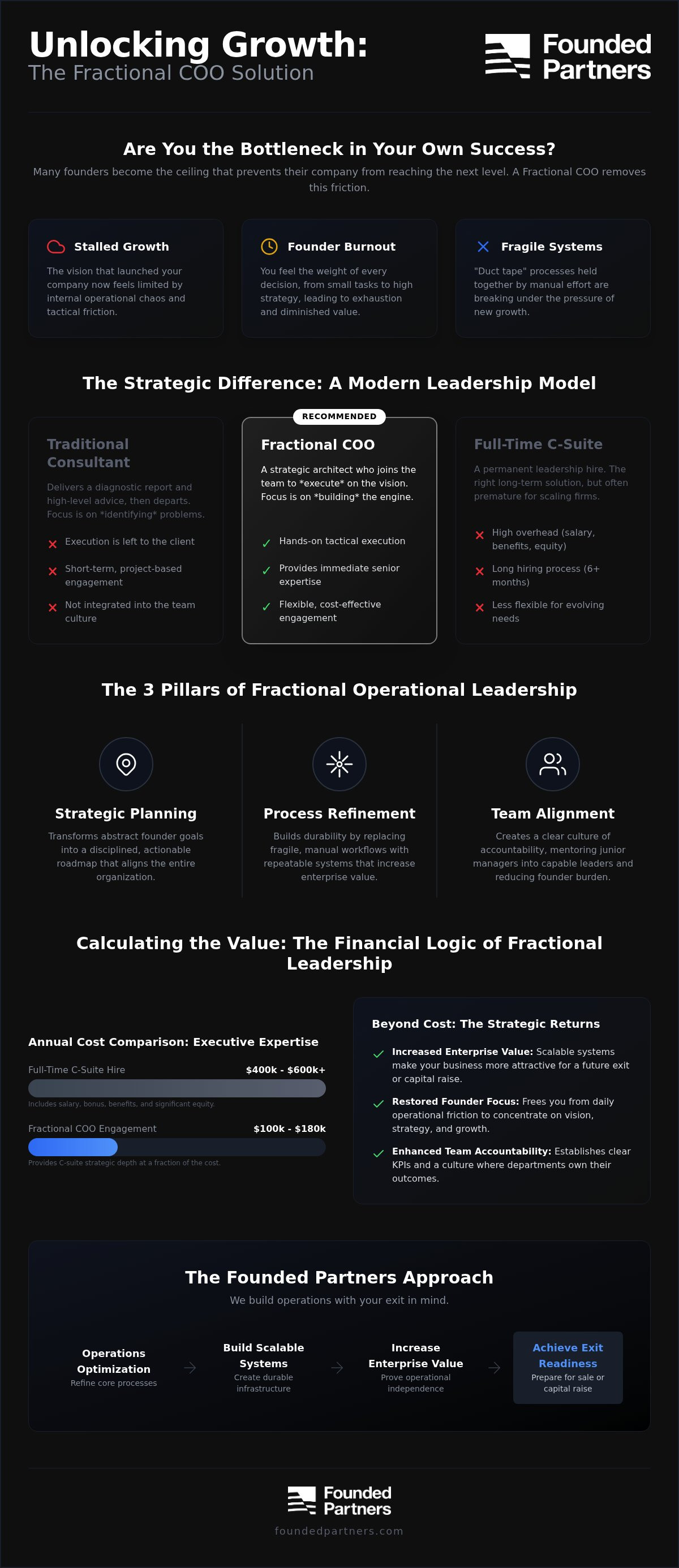
The distinction between a consultant and a fractional operator is found in the execution. While a consultant might deliver a polished diagnostic report and depart, a fractional COO remains to build the engine. They don't just identify friction; they actively remove it. This role provides a steady hand during the turbulent transitions of high-growth periods, acting as the strategic bridge between your long-term vision and the daily reality of your team. It's about bringing calm expertise to environments that often feel like they are moving too fast to control.
Fractional vs. Full-Time COO: The Strategic Difference
For founder-led firms, particularly those navigating the complexities of Series A or B growth, the search for a full-time executive can take six months or longer. A fractional engagement provides immediate access to decades of operational experience. It offers a level of flexibility that matches the inherent volatility of scaling. You gain the strategic depth of a veteran leader for a set number of hours or specific objectives. This allows you to avoid heavy permanent overhead and significant equity requirements while your organization is still maturing.
The Core Pillars of Fractional Operational Leadership
The impact of this partnership rests on three foundational pillars that drive business transformation. First, strategic planning transforms a founder's abstract goals into a disciplined, actionable roadmap. Second, process refinement builds durability into your workflows. This moves the company away from fragile, manual solutions toward repeatable systems that increase enterprise value. Finally, team alignment creates a clear culture of accountability. By ensuring every department understands their specific contribution to the mission, the fractional COO strengthens the organization's health and prepares it for future capital raising or an eventual exit.
The Impact: How a Fractional COO Refines Your Foundation
Many founders find that the systems that got them to their first major milestone are the very things preventing them from reaching the next one. It's the "duct tape" phase of business building, where processes are held together by sheer willpower and manual effort. When you explore what is a fractional coo, you're looking for a partner to replace those temporary fixes with a permanent architectural foundation. They don't just patch holes; they redesign the hull. This process involves refining internal workflows, optimizing service delivery, and ensuring that the "how" of your business is as disciplined as the "what."
Operations Optimization and Scalability
Scaling often reveals hidden bottlenecks, particularly after a successful funding round. Rapid capital infusion puts immense pressure on fragile supply chains and manual workflows that weren't designed for high volume. A fractional leader applies Operations Optimization to build durability into these systems. They move the organization toward repeatable, scalable models that can withstand high demand without breaking. This structural integrity is what eventually drives enterprise value for a future exit, as it proves the business can function independently of the founder's constant intervention.
Leadership Advisory and Team Health
Beyond the spreadsheets and flowcharts, the impact of a fractional executive is deeply human. The transition from a small, family-style startup to a professionalized organization is often culturally jarring for the original team. A fractional COO serves as a trusted peer to the founder, providing the psychological security of having a seasoned advisor in the room. They mentor junior managers, turning them into capable leaders who can own their departments with confidence. This leadership advisory ensures that accountability is woven into the fabric of the team, reducing the founder's burden and improving overall organizational health.
Clarity is the natural byproduct of well-engineered operations. By implementing robust KPIs and reporting structures, a fractional COO provides the board and investors with the transparency they require. This isn't just about tracking data; it's about building resilience. Through intentional change management, they guide the company through the inevitable friction of Business Transformation. They ensure the business remains steady and composed while it evolves into a more mature, valuable enterprise.
The Inflection Point: When Do You Need a Fractional COO?
Growth is a double-edged sword. For founder-led firms, there's a specific moment where the very passion that built the brand becomes its greatest liability. This is the inflection point where understanding what is a fractional coo moves from curiosity to necessity. It's often marked by the "Founder Bottleneck," where every operational decision, no matter how small, requires your personal approval. When you're the only one who can solve a problem, you aren't leading a company; you're managing a series of fires.
The pressure intensifies after a capital raise. Post-funding targets are often aggressive, demanding a level of operational discipline that manual processes can't support. If your team is growing but your output is lagging, you're likely experiencing cultural erosion. Rapid hiring can dilute your mission if the operational systems aren't there to reinforce it. A fractional leader steps in to protect the core values while professionalizing the delivery.
Navigating the Founder to CEO Transition
Most founders struggle to let go of tactical work because they fear a loss of quality or control. It's a common psychological barrier in business transformation. A fractional COO acts as a strategic partner to facilitate this shift, allowing you to move from being the primary operator to the visionary CEO. By building a business that thrives in your absence, you improve your organizational health and significantly increase your enterprise value for an eventual exit.
Signs Your Scaling Strategy Is Stalling
Scalability isn't just about doing more; it's about doing more with the same level of excellence. If you notice the following signs, your current strategy has likely hit its ceiling:
- High churn in your team or customer base due to internal friction.
- Inconsistent service delivery as volume increases beyond your personal oversight.
- Missing financial or operational targets repeatedly despite high market demand.
When these symptoms appear, it's a clear signal that your foundation needs refinement. This isn't a failure of vision, but a requirement for a new type of leadership. We provide the Leadership Advisory and operational expertise needed to bridge this gap, ensuring your firm remains resilient as it expands.
Calculating the Value: ROI and Cost of Fractional Leadership
The financial logic of fractional leadership is rooted in the efficient allocation of capital. A full-time COO at a founder-led firm often requires a substantial base salary, a performance bonus, and a meaningful equity stake. By contrast, a fractional model allows you to secure the same caliber of strategic depth for roughly one-fourth of the total executive cost. When evaluating what is a fractional coo in terms of value, it's helpful to view the role as an investment in durability rather than a mere line-item expense. This approach effectively mitigates the "wrong hire" risk, providing a flexible trial period before you commit to a permanent C-suite search.
Beyond the direct savings, the true ROI is found in the recovery of the founder's time. If an operational expert removes twenty hours of tactical friction from your weekly schedule, that time is redirected toward high-value activities. You can focus on refining your vision, closing major partnerships, or securing your next round of funding. This shift doesn't just improve your quality of life; it builds the "Exit Premium" that sophisticated investors look for. A business with documented, repeatable systems always commands a higher multiple than one dependent on the founder's daily presence.
Typical Engagement Models
Every organization has unique needs based on its current stage of growth. We offer several ways to integrate senior leadership into your firm. Retainer-based models provide ongoing strategic support for long-term transformation. Project-based engagements focus on specific milestones, such as implementing a new ERP or scaling a specific department. Finally, interim leadership fills the gap during a formal executive search, ensuring your momentum doesn't stall while you find a permanent fit.
Measuring Success in Fractional Partnerships
Accountability is the cornerstone of our approach to Exit Planning and operational health. Success is measured through a blend of quantitative and qualitative indicators. You should expect to see reduced operational overhead, increased profit margins, and improved employee retention as inefficiencies are stripped away. Higher internal NPS scores often signal a healthier, more professional culture. Ultimately, the goal is total readiness for the next stage of growth, whether that involves a capital raise or a strategic sale.
The Founded Partners Approach: Operations with an Exit in Mind
Operations aren't just about efficiency; they're the bedrock of enterprise value. When a founder asks what is a fractional coo, they're often searching for more than just a part-time manager. They're looking for a strategic architect. At Founded Partners, we align every process refinement with your long-term strategic growth. This ensures that the business transformation we lead today creates the durability required for a successful exit tomorrow. As a boutique firm led by partners Adam and Matt, we offer a level of commitment that goes beyond simple service delivery. We're deeply invested peers who value character as much as operational competence. We believe that the "how" of a process is just as vital as the "what."
Building for Your Next Capital Raise
Investors look past your revenue to the engine that produces it. Operational clarity is a significant signal of maturity during a capital raise. We help you prepare for "Operational Due Diligence" well before the round begins. This involves documenting workflows, establishing clear KPIs, and ensuring your team is aligned with the scaling strategy. Our role in investor readiness is to prove that your organization is a stable, sustainable asset. It must be able to thrive under the pressure of new capital. By professionalizing your operations, we help you attract investors who value long-term health over vanity metrics.
Strategic Advisory for the Long Game
Understanding what is a fractional coo is the first step toward reclaiming your time and focus. Our approach to Leadership Advisory is built on the belief that a successful exit is the result of years of disciplined business building. We don't just change things; we refine and strengthen them. By integrating fractional leadership with your exit planning, we ensure your firm is structurally prepared for its next chapter.
This is about more than just hitting targets. It's about building a legacy of excellence. We prioritize the health of the organization, focusing on the architectural nature of business building. If you're ready to move from tactical friction to strategic clarity, we're here to guide the way.
Schedule a strategy briefing with Founded Partners to begin refining your firm's operational architecture.
Architecting Your Firm’s Next Chapter
The transition from a founder-led startup to a professionalized organization is a defining moment in your company’s history. Moving from tactical friction to scalable systems doesn't just reduce burnout; it builds the durability required for your next capital raise or strategic exit. By understanding what is a fractional coo, you've taken the first step toward reclaiming your focus and increasing your firm's enterprise value. This partnership provides the operational architecture and calm expertise needed to lead your team with confidence during periods of rapid growth.
At Founded Partners, we specialize in this specific journey of business transformation. Our boutique advisory approach ensures you have a deeply invested peer in your corner who understands the complexities of exit planning and seasoned leadership. We focus on the architectural health of your business, ensuring every process refinement serves your long-term vision. It's time to move past the bottleneck and toward a future where your organization thrives independently of your constant intervention. Refine your foundation with Founded Partners today. You've built something remarkable; now let's make it sustainable.
Frequently Asked Questions
How is a fractional COO different from a business consultant?
A fractional COO focuses on tactical execution and internal leadership, whereas a business consultant typically provides high-level diagnostics and advice. While a consultant might deliver a strategic roadmap and depart, a fractional leader stays to build the engine. They integrate into your team, manage daily workflows, and own operational outcomes. This hands-on approach ensures that strategic recommendations actually become reality, moving the organization from theoretical improvement to tangible business transformation.
Does a fractional COO actually manage my team?
Yes, a fractional COO provides active management by holding your team accountable and mentoring your existing staff. They bridge the gap between your vision and the team's daily output. By establishing clear KPIs and communication rhythms, they ensure every department understands its specific role. This management relieves the founder of tactical oversight, allowing you to focus on high-level strategy while your fractional leader ensures the organization remains disciplined, professional, and productive.
How many hours a week does a fractional COO typically work?
Most engagements range from five to twenty hours per week, depending on the complexity of your operations. The focus is rarely on the total number of hours, but rather on achieving specific strategic objectives. When asking what is a fractional coo in terms of commitment, it's best to view it as a results-oriented partnership. This flexibility allows founder-led firms to scale the level of support up or down as the business matures or enters new growth phases.
Is my business too small for a fractional COO?
Your business is ready for fractional leadership when operational friction starts to stall your growth, regardless of your total revenue. If you have a small team and find yourself acting as the bottleneck for every decision, you aren't too small. The role is designed for organizations that need senior expertise to build a durable foundation but don't yet require a permanent executive. It's about your readiness for professionalization rather than just your company size.
What is the typical cost of fractional COO services in 2026?
The cost is generally structured as a monthly retainer that represents a fraction of a full-time C-suite executive's total compensation. Since a permanent COO requires a high base salary and significant equity, the fractional model offers substantial savings for founder-led firms. While rates vary based on experience and the scope of the engagement, most firms find the investment pays for itself through improved margins, reduced overhead, and the recovery of the founder's strategic time.
How do I know if I can trust a fractional executive with my vision?
Trust is built through a shared commitment to character and long-term organizational health. At Founded Partners, we operate as deeply invested peers rather than distant contractors. You should look for a leader who values your company's mission and demonstrates a "calm expertise" in high-growth environments. A successful partnership is rooted in transparency, where the fractional executive acts as a strategic architect who protects your vision while professionalizing the day-to-day execution.
What happens if we need a full-time COO later?
A fractional COO often facilitates the transition to a full-time hire when the organization reaches a sufficient level of scale. Part of their strategic value is building the systems that a permanent executive will eventually inherit. They can even assist in the recruitment and onboarding process, ensuring you find a candidate who fits your culture. This succession planning ensures that your operational momentum remains steady and composed during the leadership transition to a permanent hire.
Can a fractional COO help with exit planning?
Yes, a fractional COO is instrumental in exit planning by building the operational durability that sophisticated buyers demand. They help you prepare for "Operational Due Diligence" by documenting repeatable processes and proving the business can function without the founder's intervention. This architectural approach increases your enterprise value, as it reduces the perceived risk for investors. When considering what is a fractional coo, remember they are essential partners in preparing your firm for a strategic sale.