
Negotiating Founder Transition Terms: A Practical Guide

What if a founder’s departure date is the easiest part of the transition to agree on? The harder work is negotiating founder transition terms that clarify what comes next: the founder’s role and authority, the new leadership structure, and how ownership interests fit the company’s future. Continuity matters, but so does giving incoming leaders room to lead and recognizing the founder’s contribution. Those goals can coexist when expectations are explicit.
A workable transition agreement is more than a list of exit terms. It is an operating plan for a consequential leadership change. This guide explains how to define responsibilities and decision rights, weigh ownership and economic considerations against business objectives, and set a realistic handover timeline.
You’ll also learn how to assign knowledge-transfer responsibilities, plan for operational continuity, and create a constructive way to address disagreements. Treating the transition as a redesign of how the business operates can help founders and leadership teams replace ambiguity with a practical plan. Founded Partners advises founder-led organizations on leadership decisions and the foundations needed for their next stage.
Key Takeaways
- Treat the transition as part of the company’s leadership and operating design, not simply a departure date.
- When negotiating founder transition terms, separate business priorities from personal preferences to make trade-offs clearer.
- Compare immediate, phased, and advisory transitions by how each affects continuity, decision-making, and knowledge transfer.
- Bring essential terms, flexible points, and unresolved questions into the discussion before documenting an agreement.
- Turn agreed terms into a practical plan with clear ownership, handover milestones, and consistent stakeholder communication.
Why negotiating founder transition terms matters before roles begin to change
A founder’s influence often extends beyond a job title. As the company grows, leadership needs change, or an exit approaches, assumptions about who makes decisions, who owns what, and who handles the handover can become sources of friction. Negotiating founder transition terms early turns those assumptions into shared expectations for the founder’s role, authority, timing, ownership, and responsibilities during the transition.
A transition might involve succession to a new leader, a founder moving into a reduced operating role, a change in ownership, or a complete exit. Each path raises different questions. Without clear agreements, employees may receive conflicting direction, decisions may stall over who has authority, and important operational knowledge may remain with someone whose responsibilities are changing. Clarity is not about assigning blame. It gives the company a steadier foundation for its next stage.
What changes when a founder’s role evolves?
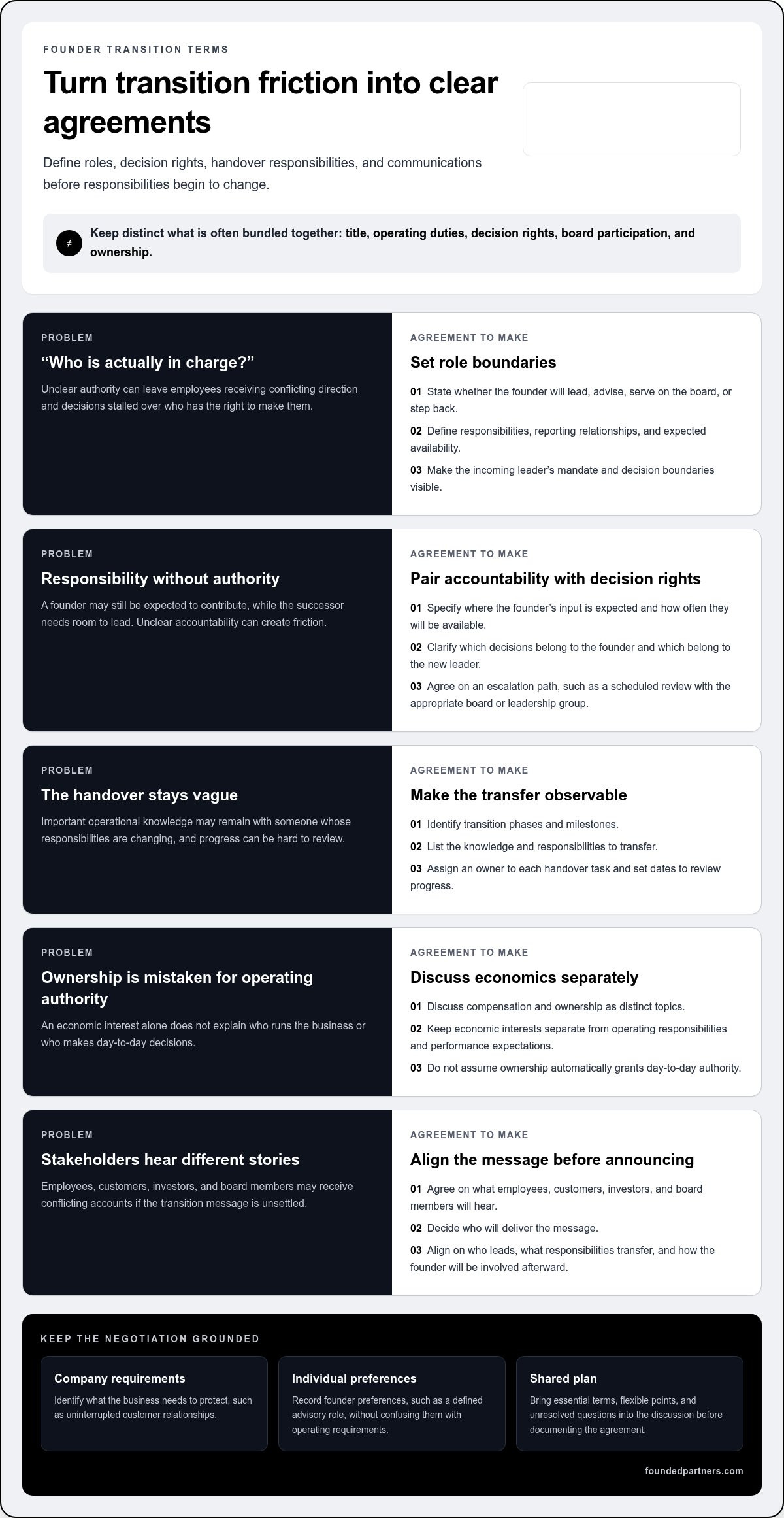
Separate the elements that are often bundled together. A founder’s title, operational duties, decision rights, board participation, and ownership are distinct. A founder might retain an ownership interest while handing day-to-day leadership to a successor, or continue advising without approving routine operating decisions. As background on the role of a founder suggests, founding a company can involve several kinds of contribution. A transition should identify which responsibilities continue and which move to others.
Ownership can carry economic interests without granting day-to-day operating authority. That distinction is central to avoiding confusion. The right arrangement depends on the company’s needs and the outcomes the parties agree to pursue, not on preserving every part of the founder’s former role by default.
Which outcomes should the negotiation protect?
A sound discussion balances business continuity, clear leadership, the founder’s dignity, and stakeholder confidence. Before announcing a transition, align on who leads the business, which decisions remain with the founder, when responsibilities transfer, how the founder will be involved afterward, and what information can be shared. If these points are unsettled, employees, customers, investors, and board members may hear different accounts of what is changing.
Early alignment gives people room to raise concerns and distinguish company priorities from personal preferences. For example, the business may need one clear operating decision-maker, while the founder may value continued involvement in a specific strategic area. Naming both interests creates a basis for a workable boundary. It also frames negotiation as forward planning: protect what the company needs, recognize the founder’s contribution, and establish a transition people can understand and carry out.
Which founder transition terms should be defined before discussions begin?
Clear discussions start with a shared agenda. Before negotiating founder transition terms, list the decisions to make and separate company requirements from individual preferences. The company may need uninterrupted customer relationships; the founder may value a defined advisory role or a predictable handover. Record both, but keep them distinct so preferences are not mistaken for operating requirements.
- Role and authority: Define the founder’s responsibilities, decision rights, reporting relationships, board participation, and expected availability.
- Timing and handover: Identify transition phases, milestones, knowledge to transfer, and dates for reviewing progress.
- Compensation and ownership: Discuss economic interests separately from operating responsibilities and performance expectations.
- Communication: Agree on what employees, customers, investors, and board members will hear, and who will deliver the message.
These topics are connected, but they are not interchangeable. As navigating founder transitions successfully involves designing a role that fits the company’s needs, consider the intended leadership structure before settling on language or titles.
How should the founder’s future role and authority be described?
State whether the founder will lead, advise, serve on the board, or step back, then define what that means in practice. For an advisor, specify the areas where input is expected and how often the founder will be available. For an incoming leader, make reporting lines and decision boundaries visible. Agree on an escalation path for unresolved issues, such as a scheduled review with the appropriate board or leadership group.
Negotiate role, authority, and accountability together: responsibility without decision rights creates friction, while authority without clear accountability creates uncertainty. A written role outline can show where the founder’s contribution remains valuable without weakening the incoming leader’s mandate.
How should timing, ownership, and economic terms be handled?
Use phases and milestones to make the handover observable. Identify what transfers, who owns each task, and when responsibilities will be reviewed. Keep compensation and ownership discussions distinct from operating authority: an economic interest alone does not explain who runs the business. Internal alignment can establish objectives and decision boundaries, while formal agreements should capture terms that require legal documentation.
Ownership changes, compensation arrangements, and exit terms can carry legal and tax implications. Have qualified legal and tax professionals review those matters rather than relying on informal notes or assumed rules. Founded Partners’ transition guidance can help structure the strategic discussion and align leadership responsibilities with business priorities.
How do immediate, phased, and advisory transitions compare?
The transition structure should match the work the company needs to transfer and the incoming leader’s readiness. Negotiating founder transition terms does not mean dismissing the founder’s contribution or automatically surrendering control. It means deciding where that contribution is most useful and setting boundaries that let the next leadership structure function.
| Structure | Continuity | Decision clarity | Knowledge transfer | Stakeholder communication |
|---|---|---|---|---|
| Immediate handover | Clear break in operating responsibility; continuity relies on preparation. | Strong when one operating leader has defined authority from the outset. | Must be captured and transferred before or alongside the handover. | Requires a coordinated announcement that identifies the new decision-maker. |
| Phased transition | Can preserve relationships and context while duties move in stages. | Depends on explicit boundaries as responsibility shifts. | Allows structured transfer of knowledge, relationships, and recurring work. | Messages should explain what changes at each milestone. |
| Advisory involvement | Retains access to founder experience for defined needs. | Clear only when advice is distinguished from approval or operating authority. | Useful for targeted context, but should not replace a documented handover. | Stakeholders need to know the founder’s scope and who leads day to day. |
No structure is universally best. The right fit depends on company needs, the incoming leader’s readiness, the founder’s desired involvement, and the objectives both parties agree to protect. The emotional dimension also deserves attention: the psychological journey of founder transitions can shape how people experience a change in identity and influence. A respectful process makes room for that reality while still establishing workable decision boundaries.
When might an immediate handover be the clearest option?
An immediate handover may fit when the company needs one clear operating owner, such as when a new leader is ready to assume responsibility and overlapping direction would create confusion. It is not automatically easier or more successful. Document key relationships, recurring responsibilities, and critical context, then communicate who owns decisions and where questions should go.
When can a phased or advisory role support continuity?
A phased approach can transfer customer or partner relationships, institutional knowledge, and responsibilities over agreed milestones. Advisory involvement can preserve access to founder insight when its scope, availability, boundaries, and review point are defined. Avoid indefinite overlap: if both leaders appear to hold authority, accountability can blur and the incoming leader’s mandate may be undermined.
How to negotiate founder transition terms step by step
A structured process keeps the discussion focused on the company’s future rather than turning each difference into a personal contest. Before negotiating founder transition terms, agree to use the company’s priorities and continuity requirements as shared reference points. Then work through the decisions in sequence, recording what is settled and what still needs attention.
How can founders prepare for a productive negotiation?
Start with a practical map of the founder’s current responsibilities: decisions they make, relationships they hold, recurring work they oversee, and knowledge that may not be documented elsewhere. Compare that map with the incoming leadership structure and the outcomes the transition needs to support. A written agenda can keep distinct topics from becoming tangled, especially role, economics, timing, and communication.
- Define desired outcomes. State what the company needs from the transition and what each party hopes to preserve. Distinguish essential terms, flexible terms, and unresolved questions.
- Map responsibilities. Identify current owners for key decisions, relationships, and operational tasks, then determine who will take each on.
- Surface constraints. Name practical limits, dependencies, and concerns early, such as leadership readiness, handover needs, or commitments that affect timing.
- Negotiate against shared priorities. Explore the interests behind each position before debating solutions. If the founder wants ongoing involvement and the incoming leader needs clear authority, define a specific advisory scope rather than relying on assumptions.
- Document decisions. Record agreed terms, open issues, decision owners, deadlines, and next steps in a decision log.
- Review and refine. Revisit the plan at agreed points, particularly when milestones are met or responsibilities shift, and capture any approved changes.
How should the parties resolve disagreements and record decisions?
When views differ, ask what each person is trying to protect. A disagreement about a title might reflect a deeper concern about recognition; a dispute over approval rights might signal uncertainty about accountability. Bring the conversation back to the operating need, then record the decision or the specific question that remains open.
A useful decision log includes the topic, current status, responsible decision-maker, follow-up date, and agreed next action. Keep informal alignment separate from formal agreements. Qualified legal and tax professionals should review formal documents and jurisdiction-specific questions; strategic discussions can clarify the intended arrangement without attempting to resolve those matters.
Founded Partners’ strategic advisory services help founder-led organizations align responsibilities with business priorities during transitions.
Turn negotiated founder transition terms into a durable operating plan
An agreement only works when people can put it into practice. After negotiating founder transition terms, translate each decision into an operating plan with named owners, handover milestones, decision boundaries, and review dates. This makes the transition visible in daily work and helps the company identify gaps before responsibilities fully move.
What belongs in a practical founder handover plan?
Build the plan around the founder’s actual work, not just the job description. Capture important relationships, recurring decisions, operational knowledge, and responsibilities that could otherwise be overlooked. For each item, name the person taking ownership, the support or context they need, and the milestone that signals the transfer is complete.
- Relationships: Identify key employees, customers, investors, board members, and partners, along with who will introduce or manage each relationship.
- Decisions and operations: Record recurring approvals, processes, and essential knowledge, then assign a new accountable owner.
- Milestones and reviews: Set checkpoints to surface missing information, clarify decision boundaries, and adjust the handover where needed.
Define how the new leadership structure will communicate decisions and accountability. Employees need to know who sets priorities; customers and investors need a consistent point of contact; board members need clarity on reporting and governance. Tailor each message to its audience while keeping the core explanation aligned: what is changing, when it changes, and who is responsible next.
If the transition forms part of a broader ownership or exit plan, connect day-to-day responsibilities with exit planning for founders. This can help the handover support the company’s longer-term direction rather than treating leadership change as an isolated event.
How can strategic guidance support a consequential transition?
Leadership decisions affect operating priorities, organizational readiness, and business continuity. A structured review can test whether the agreed role boundaries fit the company’s needs, whether the incoming leadership team has what it needs to act, and whether the handover is progressing as intended. For related governance context, see founder board management strategies.
A durable transition balances clear accountability with respect for the founder’s contribution. Founded Partners provides strategic advisory to help founder-led organizations align leadership responsibilities, business priorities, and transition planning.
Build a transition that strengthens what comes next
A founder transition is more than a change in title or departure date. Negotiating founder transition terms means aligning role, authority, ownership, timing, and handover with the company’s future needs. The right structure may be immediate, phased, or advisory, but it should give incoming leaders clear decision-making space while recognizing the founder’s contribution.
Turn the agreement into an operating plan: assign owners, set handover milestones, define decision boundaries, and schedule reviews. Consistent communication helps employees, customers, investors, and board members understand what is changing and who is accountable. These steps connect leadership decisions to continuity and the company’s broader direction.
Founded Partners advises founder-led organizations through consequential transitions and leadership decisions, including business transformation and operations optimization. Explore Founded Partners’ strategic advisory support to plan a practical path through your company’s transition.
With clear terms and a thoughtful handover, founders and leadership teams can move forward with confidence and build a strong foundation for the next stage.
Frequently Asked Questions
What terms should founders negotiate during a transition?
Founders should negotiate the future role, decision authority, responsibilities, timing, compensation, ownership considerations, knowledge transfer, and communication. When negotiating founder transition terms, connect each point to the company’s needs, identify who owns the decision, and set a review date where appropriate. Keep operating expectations distinct from formal legal or tax documents. Those documents and jurisdiction-specific questions require review by qualified professionals.
How do you negotiate a founder’s exit from day-to-day operations?
Begin by mapping the founder’s current responsibilities and assigning an incoming owner to each one. Then agree on the transition timeline, decision boundaries, handover milestones, and communications for employees and other stakeholders. If the founder will advise after stepping back, define the scope, expected availability, reporting relationship, and review date. These boundaries preserve access to useful experience without leaving the founder and incoming leader with overlapping authority.
Can a founder keep equity after stepping down?
A founder’s ownership and operating role are separate questions, so stepping away from daily responsibilities does not by itself determine what happens to their equity. Discuss ownership in light of company agreements, transaction plans, and each party’s circumstances. The appropriate arrangement can vary. Because ownership changes may carry legal and tax consequences, have formal terms reviewed by qualified professionals rather than relying on general guidance or informal assumptions.
How do you decide between an immediate and phased founder transition?
Compare leadership readiness, continuity needs, knowledge-transfer requirements, and stakeholder expectations. An immediate handover can establish one clear operating leader quickly, while a phased transition may allow more time to transfer relationships and company context. Neither structure is automatically better. Choose the approach that fits the company’s situation, then define responsibilities, milestones, communications, and a review point so everyone understands how the change will work.
What happens if founders cannot agree on transition terms?
Return to the interests behind each position and identify the company outcomes both parties want to protect. Separate settled terms from open questions, then record each unresolved issue, the person responsible for addressing it, and a follow-up date. This keeps disagreement visible and actionable. If the issue involves formal agreements or legal rights, seek appropriate professional advice, and clarify interim decision authority so daily operations are not left in limbo.
Should founder transition terms be put in writing?
Yes. Write down the agreed business expectations, including responsibilities, decision authority, milestones, review dates, and communication plans. A written operating plan gives the people involved a shared reference point and helps track unresolved items during the handover. It is distinct from formal legal documentation. The documents needed depend on the company and circumstances, so arrange appropriate professional review for formal agreements and legal or tax questions.
When should a founder start negotiating transition terms?
Start when a leadership or ownership change becomes a realistic planning consideration, before responsibilities begin shifting informally. Early discussions give the company time to identify critical knowledge, prepare incoming leaders, and plan stakeholder communication. The right timing depends on the business and its objectives. Beginning before the change becomes urgent can leave more room to resolve open questions and build a handover that supports continuity.