
Retaining Key Employees After an Acquisition: A Practical Guide

The deal can close on schedule and still lose the people who know how the business really works. Retaining key employees after an acquisition takes more than offering a bonus. Employees need credible answers about their roles, leadership, culture, and what happens next.
That uncertainty is understandable. An acquisition can reshape responsibilities and relationships before the new operating model is clear. Buyers, meanwhile, may not yet know which employees hold essential knowledge, customer trust, or capabilities the business needs to keep moving. A financial incentive can help, but it won’t resolve unclear priorities or limited prospects.
A practical retention plan starts by identifying the people and capabilities most important to continuity, then connecting their needs to the integration plan. This guide explains how to assess critical roles, align leaders on what they can communicate, and give employees timely, credible answers. It also shows how to choose incentives that support business priorities rather than stand in for them. The goal is a steadier transition, with clearer expectations for employees and stronger continuity for the business.
Key Takeaways
- Start retention planning before close, when leaders can still identify continuity risks and prepare clear communication.
- Use consistent, confidential conversations to understand what critical employees need and what could prompt them to leave.
- Match the response to the concern: incentives, role clarity, leadership access, development, recognition, and work design each serve a different purpose.
- Make retaining key employees after an acquisition part of the operating plan, with named owners for key roles, commitments, and communication milestones.
- Align leaders on integration priorities and business direction so employee commitments are consistent, credible, and grounded in the deal’s intent.
Why retaining key employees after an acquisition starts before close
Employee continuity is part of deal continuity. Retention means preserving the capabilities, relationships, and execution the business depends on as ownership changes, not simply persuading a few people to stay. A useful working definition is: Post-acquisition employee retention is the deliberate effort to keep critical knowledge and relationships in place while the business moves from one ownership structure to another.
Start before close, when leaders can identify fragile dependencies and prepare for employees’ likely questions. People may be weighing what will happen to their role, reporting line, culture, location, or priorities. If leaders don’t have a clear answer yet, they can say so and explain when they expect to know more. That is more constructive than leaving a vacuum for speculation, though employees will respond differently depending on their circumstances and confidence in leadership.
For founders preparing for a transaction, exit planning for founders offers a pre-transaction perspective on preparing the business and its leadership for change. That preparation can connect the deal’s intent to the practical work of post-merger integration, including decisions that shape employees’ day-to-day experience.
Which employees are genuinely critical to retain?
Start with the work and knowledge, not a seniority list. Map who holds important customer and supplier relationships, technical expertise, regulatory knowledge, or operational know-how. Then assess how difficult each role would be to replace, how long it would take a successor to become effective, and whether responsibilities are concentrated with one person.
A high performer isn’t automatically a continuity risk, and a less visible employee may hold knowledge that’s difficult to transfer. For example, losing a trusted customer contact could disrupt a relationship even if the organization has strong sales results overall. Distinguish an individual’s contribution from the impact their role’s vacancy could have on operations, commitments, or execution.
What changes for employees after a deal closes?
Employees may want to know who will lead the business, who they’ll report to, which priorities come first, whether location or team structures will change, and who can make decisions. Leaders won’t always have every answer at close. They can still communicate what’s known, what remains undecided, and when they’ll provide an update.
This discipline builds confidence without promising outcomes leaders can’t guarantee. Before close, identify the questions most likely to affect critical roles, align leaders on consistent responses, and make clear how employees can raise concerns. Retention planning is strongest when communication begins before uncertainty starts to define the transition.
How to identify retention risks and understand what key employees need
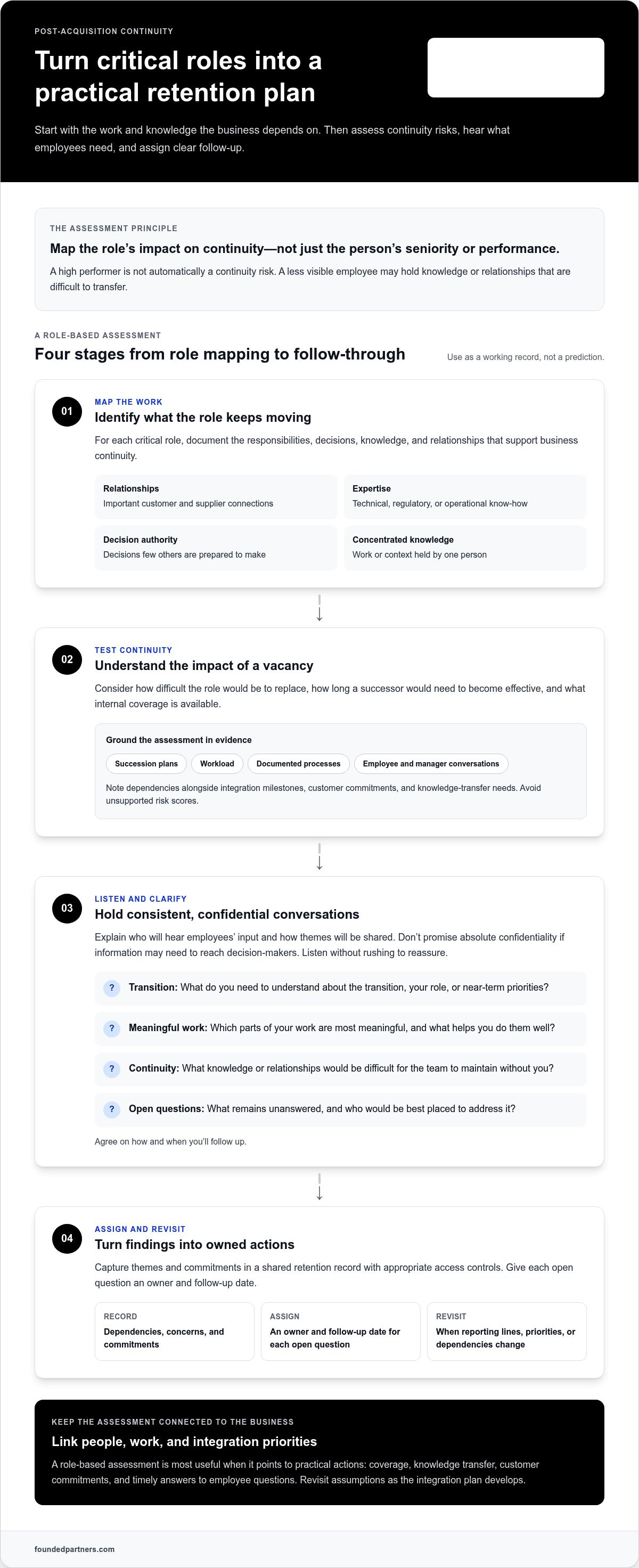
Once critical roles are visible, assess the risk behind each one. Connect the work a person owns with the knowledge, relationships, and decisions that could be hard to replace. This gives leaders a disciplined way to hear concerns, assign follow-up, and revisit assumptions as integration plans develop.
A role-based retention assessment combines responsibility mapping, succession and coverage evidence, employee perspectives, and links to business-critical dependencies. Use it as a working record, not a prediction of who will stay or leave.
How do you assess role criticality and departure risk?
For each critical role, document core responsibilities, decision authority, institutional knowledge, and external relationships. Note where a single person holds a key customer relationship, maintains specialized operational knowledge, or makes decisions few others are prepared to make. Then consider available internal coverage and what a successor would need to learn before taking on the work.
Ground the assessment in evidence, such as succession plans, workload, documented processes, and conversations with employees and managers. Avoid unsupported risk scores. Record dependencies alongside integration milestones, customer commitments, and knowledge-transfer needs so the assessment points to practical actions, not just concerns.
What should leaders ask in retention conversations?
Hold consistent, confidential conversations with employees in critical roles. Explain who will hear their input and how themes will be shared. Don’t promise absolute confidentiality if information may need to reach decision-makers. Ask open questions, listen without rushing to reassure, and agree on how and when you’ll follow up.
- What do you need to understand about the transition, your role, or near-term priorities?
- Which parts of your work are most meaningful, and what helps you do them well?
- What knowledge or relationships would be difficult for the team to maintain without you?
- What questions are still unanswered, and who would be best placed to address them?
Capture themes and commitments in a shared retention record with appropriate access controls. Assign an owner and follow-up date to each open question, then revisit the assessment when reporting lines, priorities, or integration dependencies change. This makes retaining key employees after an acquisition a continuing leadership responsibility rather than a one-time exercise.
For leaders connecting employee priorities to broader transition decisions, leadership and transformation advisory can bring people considerations into the operating plan.
Which retention approaches work after an acquisition, and what are their limits?
No single retention measure answers every employee’s concern. A financial incentive may recognize the importance of continuity, but it won’t clarify a new reporting line or create a credible development path. Match the approach to the underlying need, then make sure leaders follow through.
Consider the employee’s situation and the business need together. Someone asked to preserve a critical customer relationship through a defined transition may value a time-bound incentive. Someone uncertain about future responsibilities may need a clear role, access to decision-makers, or an honest conversation about what remains undecided. Retaining key employees after an acquisition means addressing both the practical reasons to stay and the conditions that make staying worthwhile.
Retention bonuses, equity, and other financial incentives
Financial incentives can support a specific continuity goal, such as maintaining coverage through a transition or completing a knowledge transfer. Design choices include who is eligible, when an incentive is paid, and whether it’s tied to time, milestones, or both. There’s no universal structure. Terms should reflect the role, business need, transaction context, and perceived fairness across the team.
Before communicating an offer, have qualified legal and tax professionals review the terms and their contractual, tax, and employment implications. A bonus may encourage someone to remain for a period, but it can’t by itself establish trust or long-term commitment. If expectations remain unclear or leadership is misaligned, the underlying concern remains.
Non-financial measures that build confidence
Many retention concerns are best met through day-to-day leadership. Clarify responsibilities and decision rights, provide access to leaders who can answer questions, and recognize the work that supports customers and operations. Discuss development and future opportunities in grounded terms, distinguishing what’s known from what’s still being considered.
Consistent communication matters. If leaders share different accounts of priorities or the future structure, even well-intended commitments can lose credibility. Set a regular cadence for updates and close the loop on questions, including when there’s no new decision to report.
Work design also shapes the transition. Preserve local autonomy where it helps teams serve customers or maintain effective operations, while establishing shared operating principles where coordination is needed. The right balance depends on the integration context. Incentives, clear roles, leadership access, development, recognition, and thoughtful work design are complementary tools, not substitutes for an aligned operating direction.
How to build a post-acquisition employee retention plan
A retention plan turns priorities into commitments people can see. Structure it across three phases: prepare before close, communicate during the close period, and follow through after the deal. For each critical role or risk, name an accountable leader who can make decisions, address concerns, or escalate issues they can’t resolve.
Keep the plan in a simple tracker. Record the risk or dependency, agreed action, owner, due date, and outcome at review. Include communication milestones and knowledge-transfer needs alongside people actions. Keep missed commitments and unanswered questions visible until someone closes the loop.
What should the first 90 days include?
Use the first 90 days as a planning horizon, not a rigid deadline for settling every question. Sequence leadership introductions and listening early, clarify roles as decisions are made, and communicate operating priorities before expecting teams to execute against them. Separate decisions ready to share from matters still under review, with an owner and next update for each open item.
Review retention risks regularly with the leaders responsible for affected roles. If integration decisions change workloads, customer commitments, or reporting lines, revisit the actions rather than relying on an outdated plan. This keeps the response proportionate to current business needs.
How should leaders communicate during integration?
Give managers a shared communication framework: what’s known, what remains undecided, who owns each decision, and when employees can expect an update. Consistent talking points help prevent conflicting messages, while a clear escalation route ensures managers can pass unanswered concerns to someone equipped to respond.
Measure follow-through as well as activity. Track whether promised conversations occurred, questions received an answer, critical knowledge-transfer actions progressed, and role expectations became clearer. Measuring business transformation success offers a useful perspective on connecting actions with outcomes.
For organizations translating deal intent into leadership decisions and post-close execution, align your leadership and transformation priorities with the operating plan. Founded Partners’ business transformation and leadership advisory can help connect that plan to leadership decisions, accountability, and execution.
Make retention part of the acquisition’s operating plan
Retention is more durable when it supports the work the acquisition is meant to accomplish. Connect key-person continuity to integration priorities, customer commitments, and the intended direction of the business. If a strategic goal depends on maintaining a customer relationship or specialized capability, make that dependency visible in the operating plan and assign clear accountability for protecting it.
Leadership alignment is essential. Executives need a shared understanding of what the deal is intended to achieve, which decisions are settled, and how responsibilities will shift. Otherwise, managers may give employees conflicting explanations about priorities or the future organization. Consistent communication doesn’t require every answer to be final. It requires leaders to explain what they know, identify who owns open decisions, and follow through on updates.
Align deal priorities with people and operating decisions
Translate transaction objectives into near-term priorities, decision rights, and accountable owners. Then examine how integration choices, such as consolidating responsibilities or changing customer coverage, could interrupt critical knowledge, relationships, or delivery. Where governance and oversight shape those decisions, founder board management strategies can help frame the board’s role in guiding the transition.
This connection keeps retaining key employees after an acquisition from becoming a separate HR exercise. It makes continuity part of how leaders sequence change, protect commitments, and put the business’s intended direction into practice.
When can outside strategic advisory help?
An advisory perspective can help leadership teams organize complex questions across the transaction, the people affected, and the operating model. Founded Partners provides transaction advisory for consequential transitions, leadership advisory to support alignment and accountability, and operations optimization to connect continuity needs to how work gets done. These services help leaders structure priorities and execution without implying that any adviser can guarantee who will stay.
The goal is not to remove uncertainty from a consequential change. It’s to make decisions more coherent, communicate them with care, and give critical employees a credible view of how their work fits into the business ahead.
If you’re planning an ownership or operating transition, discuss your transition priorities with Founded Partners. A focused conversation can help clarify where leadership alignment, transaction planning, and operating decisions need to come together.
Carry continuity into the next phase
Retaining key employees after an acquisition takes more than a well-timed incentive. Start by understanding which roles protect essential knowledge and relationships, listening to what employees need, and matching support to their concerns. Retention also belongs in the operating plan, where leadership priorities, customer commitments, and clear accountabilities can reinforce one another.
These steps won’t remove every uncertainty or guarantee that every employee stays. They give leaders a practical foundation for communicating consistently, following through on commitments, and keeping critical capabilities in view as integration decisions take shape.
Founded Partners provides transaction advisory for consequential ownership changes, alongside leadership advisory and business transformation consulting. If you’re preparing for an ownership or operating transition, discuss your post-acquisition priorities with Founded Partners. Thoughtful planning and aligned leadership can help your organization move into its next phase with greater clarity and confidence.
Frequently Asked Questions
How do you retain key employees after an acquisition?
Start by identifying the roles and capabilities the business needs to preserve, then speak with employees to understand their concerns and priorities. Clarify responsibilities as decisions are made, assign leaders to address retention risks, and review progress regularly. Financial incentives may support a specific continuity need, but they work best alongside credible leadership, meaningful work, and consistent follow-through. Connect employee commitments to integration priorities and business needs.
Why do key employees leave after an acquisition?
Key employees may leave when they can’t see a credible future in the organization or don’t understand how their role will change. Shifts in culture, decision-making, responsibilities, or career expectations can also influence their choices. Reasons differ by person and company, so leaders shouldn’t assume compensation is the only concern. Direct, thoughtful conversations can surface what employees need to understand and which issues leadership can address.
Do retention bonuses work after an acquisition?
Retention bonuses can support continuity for a defined period or transition need, but they don’t address every reason an employee might leave. Eligibility, timing, milestones, and conditions all affect how an offer is understood and whether it feels fair. Consider incentives alongside role clarity and consistent communication. Have qualified professionals review contractual, tax, and employment implications before finalizing terms, since requirements depend on the circumstances.
When should a company start planning employee retention for an acquisition?
Begin during transaction preparation, while respecting confidentiality and the deal process. Early planning can identify essential roles, knowledge dependencies, and who will lead employee communications. After closing, leaders can clarify responsibilities as decisions are made, listen to concerns, and revisit retention risks as integration conditions evolve. Timing and what can be communicated depend on the transaction and applicable obligations, so coordinate planning with the relevant decision-makers.
How do you identify key employees to retain after a merger or acquisition?
Assess the work and capabilities the business needs to preserve, rather than relying on seniority or performance ratings alone. Consider who holds important customer relationships, specialized knowledge, decision authority, or operational responsibilities with limited internal coverage. Evaluate replacement difficulty and succession options, then validate the picture through leaders and appropriate employee conversations. Treat the assessment as a planning tool for continuity, not a prediction that a particular person will leave.
What should leaders tell employees after an acquisition?
Share confirmed information about leadership, responsibilities, priorities, and next steps, and be candid about decisions still under review. Explain who owns open decisions and when employees can expect another update. Avoid promises that may change as integration progresses. Give managers consistent talking points and a route for escalating unanswered questions. Clear communication helps employees understand the process, while visible follow-through shows that leaders take their concerns seriously.
How can a company measure whether its retention plan is working?
Track whether critical-role conversations happen, retention risks have owners, and knowledge-transfer actions progress. Monitor departures in context by considering which roles, relationships, or capabilities are affected, rather than relying on a single overall figure. Pair these measures with employee feedback and indicators of operational continuity, such as progress on important customer commitments. Choose measures that fit the integration plan and review them regularly so leaders can adjust actions as conditions change.