
Operational Strategy: The Founder’s Guide to Scaling

The relentless hustle that ignited your company's initial success is often the same force that prevents it from reaching the next tier. Many founders find themselves trapped in a cycle of fire-fighting, where every new client feels like a burden rather than a victory. You've likely felt the weight of operational bottlenecks stalling your momentum, or perhaps you worry that rapid scaling will inevitably dilute the unique culture you've built. It's exhausting to remain the only engine driving the enterprise forward while resources seem to burn faster than they can be replenished.
Developing a sophisticated operational strategy for business growth isn't about adding more work to your plate. It's about refining your organization into a predictable, systemized engine that increases enterprise value and prepares you for a future exit. We'll guide you through the transition from founder-led chaos to a structured framework that grants you the psychological security to focus on your vision. This guide outlines the architectural steps to strengthen your foundation, optimize your resources, and build a business that thrives independently of your daily involvement.
Key Takeaways
- Understand why the manual hustle that fueled your early success becomes a liability during scaling and how to transition toward a systemized engine.
- Discover how a robust operational strategy for business growth aligns your daily workflows with long-term strategic objectives to ensure sustainable scalability.
- Learn to bridge the "Alignment Gap" by connecting founder vision to team execution through a cascading objective system that maintains clarity.
- Identify and resolve operational "red flags" using a structured audit that helps you reclaim your time and focus on high-level vision.
- Position your organization for "Investor Readiness" by refining operations to increase enterprise value and prepare for a future exit or capital raise.
Beyond the Growth Paradox: Why Operational Strategy is Your Scaling Engine
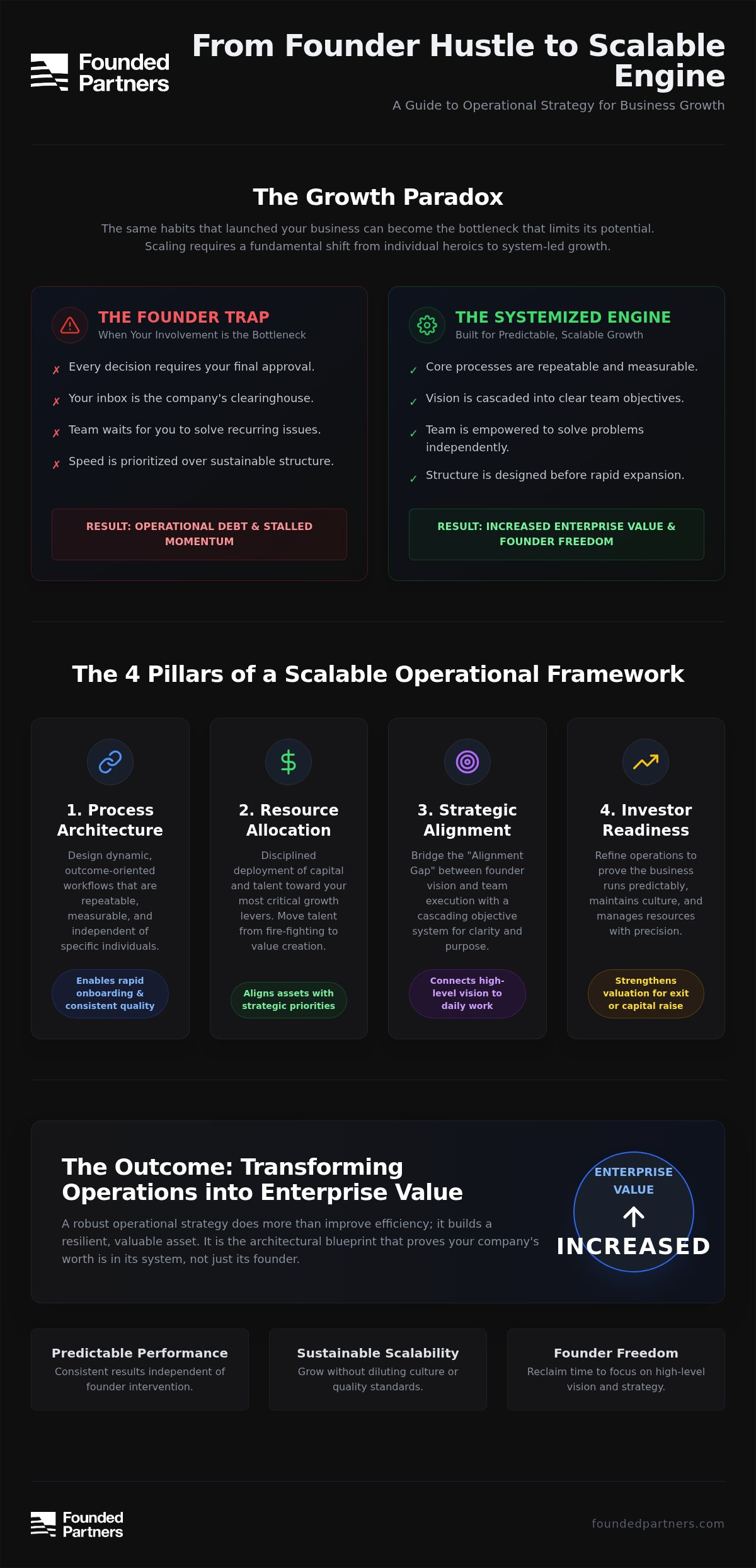
The initial phase of a business is often powered by sheer willpower. This founder-led hustle is essential for survival, yet it eventually creates an invisible ceiling. This is the Growth Paradox: the very habits that secured your first ten clients are the ones that will prevent you from reaching your next thousand. To break through, you must view your business not as a collection of tasks you oversee, but as an architectural project. Scaling requires a fundamental shift from founder-doing to system-leading, where the strength of the organization lies in its design rather than its individual heroics.
An effective operational strategy for business growth is the structural conversion of vision into enterprise value. It acts as the vital bridge between your high-level aspirations and the daily execution of your team. Without this bridge, vision remains a dream and execution remains a chaotic struggle. Modern Operations management principles suggest that efficiency isn't just about cutting costs. It's about creating a system where the business can breathe, adapt, and expand without requiring your constant intervention.
The Founder Trap: When Your Involvement Becomes a Bottleneck
You may notice specific red flags indicating you've become the bottleneck of your own enterprise. If every decision requires your final approval, if your inbox is the company's primary clearinghouse, and if team members wait for your input to solve recurring issues, you're trapped. This is the accumulation of operational debt. When you prioritize speed over structure, you're borrowing from your future scalability. Moving from a doer mindset to a strategic architect mindset is the only way to pay down this debt and reclaim your focus. It's about building a machine that operates predictably while you focus on the vision that built it.
The Strategic Value of Operations in 2026
In the current economic climate, the metrics of success have shifted significantly. Investors and buyers in 2026 are looking past top-line growth to evaluate operational resilience. They prioritize businesses that run predictably, maintain their culture under pressure, and manage resources with precision. A robust operational strategy for business growth signals investor readiness by proving that the company's value isn't tied to the presence of a single person. By refining your processes now, you aren't just making your life easier. You're actively strengthening your valuation, guiding your team toward autonomy, and securing your eventual exit.
The 4 Pillars of a Scalable Operational Framework
Scaling a founder-led business requires more than just increasing your sales volume or hiring more staff. It demands a fundamental redesign of how your organization functions. While many view operations as a series of back-office tasks, a true operational strategy for business growth serves as the architectural blueprint for your company's future. It's the difference between a business that grows through sheer effort and one that scales with elegant precision. As Michael Porter famously explored in his work What Is Strategy?, operational effectiveness is necessary but insufficient on its own. You must integrate your operational improvements into a cohesive strategic framework that creates a sustainable competitive advantage.
Process Architecture: Designing for Repeatability
Most founders mistake "documented tasks" for a scalable system. A list of instructions is static; a strategic workflow is dynamic and outcome-oriented. To build a business that runs without your constant oversight, you must identify the core processes that drive 80% of your value. These workflows should be designed to be repeatable, measurable, and entirely independent of specific individuals. When your processes are architected correctly, they become the foundation for rapid onboarding. New team members don't just learn "what to do." They understand how their actions contribute to the broader mission, allowing the organization to maintain its standards even as it expands.
Resource Allocation: Aligning Assets with Strategy
Strategic resource allocation is about more than just managing a budget. It's the disciplined act of ensuring that your capital and your best talent are deployed toward your most critical growth levers. In many scaling firms, talent is often wasted on low-leverage fire-fighting. A refined operational strategy for business growth redirects that energy toward high-impact objectives. By aligning your assets with your long-term vision, you manage your burn rate more effectively and increase your runway. This level of precision is exactly what we focus on during operations optimization, ensuring your business has the fuel it needs to reach its next milestone.
Beyond processes and resources, a scalable framework requires thoughtful technology integration and a focus on organizational health. Technology should never be added for its own sake; it must solve specific bottlenecks without introducing unnecessary complexity. Simultaneously, you must build a structure that supports the long-term performance and well-being of your team. A healthy organization is one where the culture remains intact even under the pressure of rapid growth. When these four pillars are aligned, the business ceases to be a reflection of the founder’s personal stamina and becomes a self-sustaining engine of enterprise value.
Strategic Alignment: Connecting Founder Vision to Execution
As an organization scales, the distance between the founder's vision and the team's daily actions naturally increases. This phenomenon, often called the Alignment Gap, is where the "why" of the business becomes diluted by the "what" of daily tasks. Without a deliberate operational strategy for business growth, your team may find themselves working harder on the wrong things. True alignment is not a top-down management exercise; it is an architectural commitment to ensuring that every individual understands how their specific output fuels the company's long-term enterprise value. When founders embrace the idea that Operational Innovation Can Transform Your Company, they realize that alignment is the primary mechanism for maintaining momentum during periods of rapid change.
Cascading Objectives: From Vision to Sprints
A scalable business requires a cascading system that translates board-level goals into individual sprints. This framework ensures that no task exists in a vacuum. By developing a clear line of sight from the five-year vision to this week's priorities, you create a culture of purpose and accountability. In this model, Key Performance Indicators (KPIs) serve as diagnostic tools to identify friction rather than just reporting requirements for the sake of oversight. Precise strategic alignment reduces friction in decision-making by empowering teams to act with the founder's intent without needing the founder's presence. This clarity allows for decentralized execution, where leaders can make high-stakes choices with the confidence that they are moving the needle in the right direction.
Cultural Resilience During Operational Transformation
Many founders fear that introducing formal processes will stifle the creative "magic" that defined their early days. However, the opposite is true. Well-designed systems provide the necessary structure that grants creative teams the freedom to excel without being bogged down by administrative chaos. Maintaining your "founder DNA" while implementing a robust operational strategy for business growth requires transparent communication and grounded empathy. You must address team resistance by showing how these new frameworks protect their time and amplify their impact. This transition is a consequential journey that often benefits from leadership advisory to guide the organizational change. By refining the "how" of your operations, you are not just changing the business; you are strengthening the character and durability of the entire organization.
The Operational Roadmap: A Step-by-Step Implementation Framework
Implementing a sustainable operational strategy for business growth requires a methodical approach that respects your company's current stage while preparing for its future. It isn't a one-time event but a continuous cycle of assessment, refinement, and expansion. By following a structured roadmap, you move from reactive fire-fighting to proactive leadership. This ensures that your foundation is strong enough to support the weight of your ambitions without compromising the quality or culture that defined your early success.
Phase 1: The Operational Audit
The first step is a rigorous operational audit to identify the specific friction points stalling your progress. You must pinpoint where decision-making stalls and where communication flows are fractured. This isn't just about reviewing spreadsheets; it's about observing the human systems and technology that power your daily output. You'll need to assess whether your current tools can handle a 5x or 10x increase in volume. Founders often find it helpful to use an operations optimization for startups checklist to identify the red flags that are currently siphoning away their strategic focus.
Phase 2: Building for Capital Readiness
As you refine these systems, you must build with "Investor Readiness" in mind. Sophisticated investors don't just buy your current revenue; they buy the reliability and scalability of your engine. Your operations must be structured to withstand the intense scrutiny of due diligence, which requires clean, accessible data and repeatable processes. Aligning your operational roadmap with your capital raising strategy ensures that when you step into the boardroom, you're presenting a business that is architecturally sound. This level of preparation increases your enterprise value and provides the psychological security needed for a successful round or exit.
A critical part of this journey is defining your core competencies. You should focus your internal talent on the unique value that drives your competitive advantage while outsourcing non-critical functions that others can perform more efficiently. This strategic focus prevents resource burn and allows your team to remain lean and agile. It's about ensuring your best people are working on the business's most critical growth levers rather than being lost in administrative weeds.
Finally, you must set measurable operational milestones for the next 12 to 24 months. These shouldn't be vanity metrics but structural achievements, such as reducing founder-dependent decisions or systemizing a key department. As the business reaches new levels of scale, you must iterate and refine the strategy. What works for a small team rarely works for a mid-market enterprise. If you're ready to move beyond the hustle and build a business that drives true enterprise value, our team can help you design a custom scalability strategy tailored to your long-term vision.
Transforming Operations into Enterprise Value with Founded Partners
Operations are frequently dismissed as a back-office necessity, yet they represent the primary driver of a company's terminal value. While many founders view administrative tasks as a cost center, we see them as the architectural foundation of a scalable enterprise. Moving beyond surface-level optimization requires a commitment to true business transformation. This shift ensures that your organization isn't just running faster, but is actually built to sustain the pressure of rapid expansion and the scrutiny of future buyers. At Founded Partners, we provide the calm expertise required to navigate these complex transitions, ensuring that your operational strategy for business growth serves your long-term vision rather than distracting from it.
The journey from a founder-led hustle to a systemized engine is a consequential one. It requires a fundamental evolution in leadership, moving you from the role of CEO-operator to that of CEO-strategist. In this new capacity, your value isn't found in solving daily fires but in refining the systems that prevent them. This evolution is essential for creating a business that runs predictably and independently. When operational excellence is woven into the fabric of your organization, it creates a direct link to a successful strategic exit. A business that operates without its founder is a business that commands a premium in any market.
The Strategic Architect Approach
We position ourselves as a Trusted Peer to the founders we serve. We don't believe in distant, ivory-tower consulting; we value the shared journey of building something durable. Our focus remains steadfastly on long-term organizational health rather than vanity metrics that look good on paper but fail under stress. By acting as a Strategic Architect, we help you integrate operations, capital raising, and exit planning into a single, cohesive strategy. This holistic view ensures that every process you implement today is strengthening your position for a capital round or a future sale tomorrow. We prioritize the "how" of your business as much as the "what," building deep trust through transparency and shared values.
Ready for the Next Stage of Growth?
Consequential transitions are often the most vulnerable periods in a company's lifecycle. Having a seasoned partner in your corner provides the psychological security and technical guidance needed to cross these thresholds with confidence. Whether you're preparing for a significant capital raise or designing your eventual exit, the strength of your operational foundation will determine your success. It's time to move beyond the limitations of founder-led growth and embrace a systemized approach that drives lasting enterprise value. If you're ready to start the journey toward a scalable, exit-ready business, we are here to guide the way. Partner with Founded Partners to build your operational foundation and transform your vision into a repeatable engine of success.
Architecting a Foundation for Lasting Value
Scaling a founder-led business requires a fundamental shift in perspective. It's the transition from being the engine to building the engine. By implementing a sophisticated operational strategy for business growth, you resolve the bottlenecks that stall progress and bridge the gap between your vision and your team's execution. This structural clarity doesn't just improve daily efficiency; it builds the investor readiness and organizational health necessary for a high-value exit.
Founded Partners specializes in guiding founder-led firms through these consequential transitions. We leverage decades of experience in capital raising and transaction advisory to help you move beyond the hustle. Our proven methodology for business transformation ensures that your operations are optimized for durability and scale. Refine your operational strategy with the Strategic Architects at Founded Partners. Your vision has brought you this far. Now, let's build the system that takes you the rest of the way.
Frequently Asked Questions
What is the difference between business strategy and operational strategy?
Business strategy defines your market destination and competitive position; operational strategy provides the architectural engine to reach it. While one focuses on what you want to achieve, the other focuses on how you deploy resources and workflows to make that vision a reality. It's the conversion of high level goals into a repeatable system that drives enterprise value rather than just a plan on paper.
When should a founder-led business hire an operations consultant?
You should seek advisory when your personal involvement in daily tasks prevents you from focusing on long term vision. This typically occurs during consequential transitions, such as preparing for a capital raise or managing rapid team expansion. If every decision requires your approval, your business has reached an operational ceiling that only a structured transformation can break through.
How does operational strategy impact a company’s valuation during an exit?
Operational excellence directly influences your exit multiple by reducing the perceived risk for buyers. A systemized business that operates independently of its founder is a more valuable and bankable asset. By proving that your growth is predictable and your workflows are repeatable, you transition from selling a job to selling a high performance engine that commands a premium price.
Can operational strategy help with capital raising?
Investors prioritize companies that demonstrate a clear operational strategy for business growth because it ensures capital is deployed effectively. Clean data and structured workflows provide the transparency required for successful due diligence. When you can show that your organization is built to scale, you increase investor confidence and secure better terms for your next round of funding.
How do we scale operations without losing our startup culture?
Scaling without losing culture requires you to systemize your core values into your daily workflows. Formal processes don't stifle magic; they remove the administrative chaos that often leads to team burnout. By providing a clear structure, you grant your creative talent the freedom to excel while maintaining the unique DNA that defined your company's early success.
What are the most common operational bottlenecks in growing firms?
The most frequent bottlenecks include founder dependent decision making, inefficient resource allocation, and fractured communication. These issues typically emerge when the manual hustle of the early days fails to evolve into a systemized framework. Implementing a robust operational strategy for business growth allows you to identify these red flags early and refine your organizational architecture before it stalls your momentum.
What is the role of a Strategic Architect in business growth?
A Strategic Architect serves as a trusted peer who designs the organizational systems needed for sustainable expansion. They look beyond vanity metrics to focus on long term organizational health and investor readiness. By aligning operations, capital strategy, and exit planning, they ensure the business is built to withstand the pressures of growth while maximizing its ultimate value for the founders.