
Preparing for Financial Due Diligence: A Founder’s Guide

Financial due diligence doesn’t require spotless numbers. It requires a clear, traceable story behind them. Preparing for financial due diligence can feel daunting when records live in different systems, reported results don’t tie neatly to source documents, and several people hold pieces of the picture. Those gaps don’t have to undermine trust, but unexplained ones can trigger avoidable questions.
It’s reasonable to want every figure reconciled before an investor or buyer takes a closer look. In practice, readiness is less about pretending the business has no open issues and more about organizing the evidence, explaining what needs context, and showing how performance connects to the company’s operations and plans. Diligence may also reach beyond financial statements to areas such as technology, data practices, operational resilience, and reliance on the founder.
This guide explains how to prepare a coherent financial narrative, gather and organize key supporting documents, and identify questions to address before an outside reviewer raises them. You’ll also learn how to coordinate the process without letting diligence pull the leadership team away from running the business.
Key Takeaways
- Clarify the purpose of the review, since investor, lender, acquisition, and ownership-transition diligence may focus on different questions.
- Connect each key financial metric to its source records, definition, calculation, and accountable owner.
- Address unusual items and historical corrections with consistent, well-supported explanations instead of leaving reviewers to interpret them.
- Preparing for financial due diligence is easier with a clear sequence: define scope, inventory documents, review gaps, coordinate responses, and reconcile final materials.
- Strategic preparation can link financial evidence to operating realities and transaction goals while keeping specialist accounting, audit, legal, and tax work distinct.
Financial Due Diligence for Founder-Led Companies
Financial due diligence is a structured review of a company’s financial performance, records, assumptions, and risks to help an interested party assess the business. The review varies by purpose and reviewer; there isn’t one process for every situation. A broader overview of Due diligence can help clarify how this type of review fits within the wider concept.
For a founder-led company, readiness means showing where reported figures come from, how important assumptions were formed, and what context may affect interpretation. Evidence should be organized, reconcilable, explainable, and presented consistently. That doesn’t mean every figure will be simple or every historical decision beyond question. It means the company can respond with a coherent account instead of searching across systems and people for answers.
The review’s purpose depends on the conversation. An investor may examine performance and assumptions relevant to a potential investment. A lender may focus on financial information related to credit decisions. A buyer may assess the company in the context of a potential acquisition, while an ownership transition can raise questions about financial continuity and the company’s position. These discussions may involve overlapping records, but their objectives aren’t interchangeable.
When financial due diligence typically enters a transaction
Diligence may begin after an investor, lender, or buyer expresses initial interest, and it can inform decisions before terms or a transaction are finalized. Early conversations often center on screening questions and high-level financial information. If discussions progress, a reviewer may request more detailed records, supporting documents, and explanations. Scope and timing depend on the transaction structure, reviewer priorities, and company circumstances, so don’t assume every process follows the same sequence.
Why preparation is more than assembling spreadsheets
A spreadsheet can summarize performance, but reviewers also need to trace figures to supporting records and understand who can explain them. Clear response ownership directs requests to the people closest to the relevant information, whether that’s finance, sales, or operations. Consistent reporting can make conversations more focused, but it can’t guarantee a faster close or a particular outcome.
Preparing for financial due diligence also means identifying questions early. A variance, estimate, or past correction may need further review or a clear explanation. Readiness isn’t a promise of a clean review. It’s the discipline to surface open points, support the company’s account of them, and present the financial story carefully.
Which financial records and explanations should you prepare first?
Start with the records that let a reviewer move from reported results to supporting evidence. Gather financial statements and trial balances, general ledger detail, bank statements and reconciliations, revenue support, expense schedules, and forecasts. Prioritize the periods and level of detail relevant to the review instead of collecting files without a clear purpose.
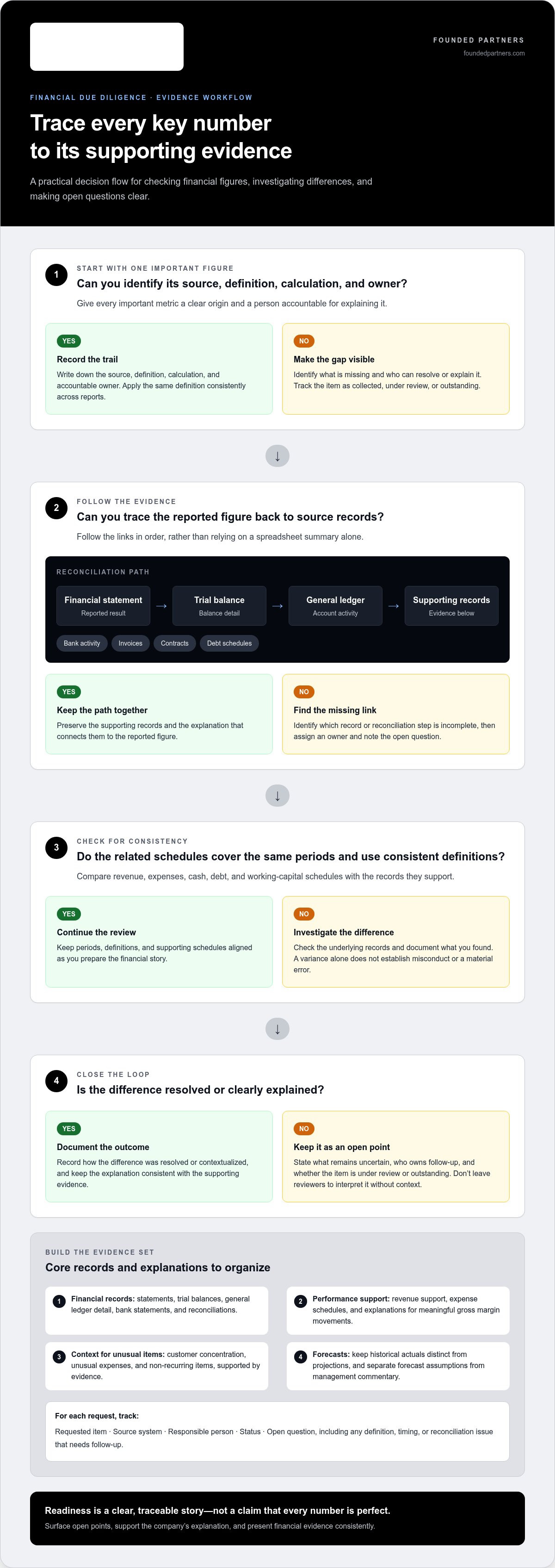
For each important metric, document its source, definition, calculation, and accountable owner. If “recurring revenue” or “gross margin” is presented in a particular way, explain how the company calculates it and apply that definition consistently across reports. This makes the number easier to interpret and gives reviewers a clear path to supporting records.
- Requested item: Monthly revenue by customer
- Source system: Billing platform, general ledger, and customer records
- Responsible person: Finance lead or designated owner
- Status: Collected, under review, or outstanding
- Open question: Note any definition, timing, or reconciliation issue that needs follow-up
Use this simple matrix to track requests, sources, ownership, and unresolved points. If the review relates to a financing process, capital raising for founders also involves aligning financial evidence with the company’s growth plans and funding objectives.
Reconcile financial statements to source records
Test key balances by tracing them from a financial statement to the trial balance, into general ledger accounts, and then to relevant support such as bank activity, invoices, contracts, or debt schedules. Check that revenue, expenses, cash, debt, and working-capital schedules cover the same periods and use consistent definitions. Investigate unexplained differences, but don’t assume a variance signals misconduct or a material error. Record what you found and how it was resolved or contextualized.
Document revenue, margins, cash flow, and forecasts
Revenue support may include customer agreements, invoices, billing records, and cash receipts, where applicable. Prepare explanations for meaningful gross margin movements, customer concentration, unusual expenses, and non-recurring items, supported by evidence. Keep historical actuals distinct from forecasts, and separate forecast assumptions from management commentary so reviewers can see what happened, what is projected, and why.
Preparing for financial due diligence is more manageable when evidence and explanations are built into the same process. An organized record set helps the team answer specific questions without losing sight of the business behind the numbers.
How to handle financial discrepancies without losing credibility
Readiness doesn’t mean a company has never made a correction, recorded an estimate, or incurred an unusual cost. The key is to identify what happened, understand its effect, and explain it consistently. An unexplained difference can raise more questions than an unusual item with clear supporting context.
As you prepare for financial due diligence, classify each issue before deciding how to describe it. A timing difference isn’t necessarily an error, and a one-time expense isn’t automatically an adjustment a reviewer will accept. Record the period, amount, evidence, treatment, and whether further review remains open. Refer material accounting, legal, and tax judgments to the company’s appropriate specialists.
| Item type | How to document it |
|---|---|
| Resolved correction | Describe the original error, period affected, correction made, supporting evidence, and resulting treatment. |
| Documented one-time item | Explain the business event, provide source support, and show how it was treated in reported results. Don’t assume it qualifies for an adjustment. |
| Estimate or judgment | State the basis, key assumptions, period, and accountable owner; note any later information that changed the estimate. |
| Open question | Describe what’s unresolved, what evidence is being gathered, who owns the follow-up, and when the response will be updated. |
Separate errors, timing differences, and legitimate one-time items
Start with the facts, not the label. A payment recorded in a different period may reflect timing; a transaction coded to the wrong account may be a classification issue; an estimate may change as new information arrives. A discrete business event may explain an unusual cost, but that alone doesn’t establish how a reviewer will treat it. Tie the explanation to records and keep it consistent across schedules and conversations.
Explain EBITDA adjustments and working-capital questions carefully
EBITDA means earnings before interest, taxes, depreciation, and amortization. It’s a measure used to discuss operating performance, but its calculation and interpretation can vary across transactions. For any proposed adjustment, show the source evidence, rationale, and consistent treatment. Distinguish reported results from management’s proposed view, and don’t present a requested adjustment as agreed or accepted.
Working capital generally concerns operating assets and liabilities needed to run the business, such as receivables, inventory, and payables where relevant. The appropriate components and interpretation depend on the company and transaction. Prepare schedules that show the periods and categories used, and surface questions about unusual balances or movements instead of relying on a universal target.
How to prepare a financial diligence process step by step
A deliberate process keeps requests moving without turning every question into a leadership-wide interruption. Start by confirming the review’s scope, periods, and request list. Assign one internal owner to track requests and coordinate responses, with subject-matter owners for finance, sales, and operations. One person can manage the process without being expected to answer every question.
- Define the scope: Confirm what the reviewer is examining, which periods are relevant, and how requests and responses will be handled.
- Inventory what exists: Match requested materials to available records, identify gaps, and flag items that need explanation or specialist review.
- Assign owners and deadlines: Give each request an accountable person and a due date, with the internal coordinator monitoring progress.
- Review before sharing: Check materials for completeness, consistency, appropriate access, and alignment with the response being provided.
- Manage follow-ups and close out: Track reviewer questions, update answers through the same process, and reconcile submitted materials against the final request list.
Build a diligence tracker and secure data room
Use a tracker with a request, owner, due date, source, status, reviewer follow-up, and approval field. Organize repository folders around the actual request list so reviewers and the internal team can locate materials consistently. Apply controlled access to sensitive information, use clear file names, and maintain version discipline. Remove duplicates and superseded drafts from active folders while keeping a clear record of what was submitted and when.
An approved document repository gives the team a central place to manage access and submissions. Avoid sending different versions of the same schedule through scattered email threads. Before sharing a file, confirm it is the reviewed version and that the appropriate people can access it.
Coordinate responses across leadership and advisors
Route each question to the person closest to the underlying information, then consolidate the response through the internal owner. Keep answers factual and consistent with the documents. If a response relies on an estimate or remains unresolved, say so clearly and track the next step. Coordinate accounting, legal, and tax questions with the company’s relevant specialists rather than treating them as work for a strategic advisor to execute.
Operational measures can also help explain the financial picture, such as how delivery activity or customer retention relates to revenue trends. For a structured way to connect those measures to business outcomes, see measuring business transformation success.
Preparing for financial due diligence calls for disciplined coordination as well as organized files. Explore strategic diligence preparation to connect the evidence, operating context, and priorities behind an investor or transaction process.
How strategic advisors can help founders move from preparation to readiness
Preparation organizes the evidence. Readiness connects that evidence to the decisions ahead. A strategic advisor can help founders relate financial performance to operating realities, growth plans, and the purpose of an upcoming financing or transaction. That broader view helps leadership explain not only what the numbers show, but how they fit the company’s direction and the choices under consideration.
The roles should remain clear. Strategic preparation can help structure priorities, frame explanations, and coordinate the financial story with business objectives. It isn’t a substitute for specialist accounting, audit, legal, or tax work. Material questions in those areas belong with the company’s appropriate specialists, while strategic advisory keeps preparation aligned with the broader business context.
Match preparation to a financing or ownership objective
For fundraising, connect historical performance and forecasts to the company’s growth strategy, operating requirements, and capital needs. This gives a financing discussion grounded context instead of presenting projections without explaining the business assumptions behind them.
If a potential sale or ownership transition is the context, consistent reporting and documented explanations can help a reviewer assess the company with a clearer understanding of its performance. Founders considering that path may also find this guide to exit planning for founders useful. Preparation can support informed review, but it can’t promise a valuation, financing, transaction outcome, or acceptance of a proposed adjustment.
Turn open questions into a focused readiness plan
Not every gap needs the same response. Prioritize open items by their significance to the business or process, the evidence available, who can make or approve a decision, and the time needed to address them. Then choose a clear path: correct an error, explain a supported judgment or historical event, monitor an item that may change, or escalate a specialist question.
A practical readiness plan names each issue, its next action, an accountable owner, and a realistic target date. It also protects leadership focus by distinguishing urgent diligence work from improvements that can be handled over time. Review the plan as new requests emerge, and keep explanations aligned with the records and the company’s operating reality.
Preparing for financial due diligence is ultimately an exercise in disciplined clarity, not perfection. Founders can begin by assessing readiness, prioritizing gaps, assigning owners, and setting a realistic preparation plan. For teams weighing a financing or ownership transition, a strategic conversation with Founded Partners can help connect the evidence to the decisions ahead.
Build readiness around a clear financial story
Preparing for financial due diligence isn’t about presenting a business with no questions or irregularities. It’s about showing how reported results connect to source records, documenting the context behind unusual items, and giving each open question a clear owner and next step.
A disciplined process helps founders organize evidence, keep explanations consistent, and focus reviewer conversations on the company’s financial and operating realities. The right preparation also depends on the goal, whether you’re exploring capital raising or considering an ownership transition.
Founded Partners advises founder-led organizations through capital raising, transaction matters, and exit planning. Strategic guidance can help connect financial evidence with business priorities and the decisions ahead, while keeping specialist accounting, legal, and tax work with the appropriate experts.
Discuss your company’s next strategic step with Founded Partners. With a clear plan, accountable owners, and a coherent story, you can approach the process with greater confidence and keep building the business.
Frequently Asked Questions
What is financial due diligence?
Financial due diligence is a structured review of a company’s financial performance, records, assumptions, and relevant risks. Investors, lenders, or buyers may use it to understand how reported results were produced and how well the evidence supports them. The scope depends on the transaction and reviewer’s priorities. It’s distinct from an audit, so clarify what the reviewer is requesting and involve appropriate specialists when questions require accounting, legal, or tax expertise.
How do I prepare for financial due diligence?
Start by confirming the review scope and periods, then inventory financial statements, ledgers, bank records, revenue support, debt information, and forecasts. Reconcile important figures to source evidence and document unusual items or open questions. Assign owners to requests and track responses in a controlled repository. Keep explanations consistent across materials, resolve significant gaps where practical, and clearly label estimates or unresolved matters rather than presenting them as settled facts.
What documents are needed for financial due diligence?
Common requests may include historical financial statements, trial balances, general ledgers, bank statements, revenue and customer schedules, expense details, debt agreements, tax materials, and budgets or forecasts. The precise list depends on the company and transaction. Track each document’s source, period, owner, and status. Coordinate sensitive accounting, legal, or tax records with the appropriate professionals, and organize files so the evidence can be traced to the figures under review.
How long does financial due diligence take?
There’s no single timeline for every company or transaction. Duration can depend on the review scope, how accessible and complete the records are, the number of follow-up questions, and the availability of decision-makers and advisors. Preparation may reduce avoidable delays, but it can’t guarantee a particular timetable. Establish owners and response routines early, then revisit the plan as requests develop and new questions affect priorities.
What happens if financial due diligence finds discrepancies?
A discrepancy typically leads to a request for clarification, supporting evidence, or further analysis. Its significance depends on the facts and transaction context. Investigate the source, document any correction or timing explanation, and make sure the result is presented consistently. Don’t conceal an item or reclassify it casually. For accounting, tax, or legal implications, involve the relevant specialist; transaction advisors can help leadership manage the broader process.
Is financial due diligence the same as an audit?
No. An audit follows a defined assurance framework and is intended to support an opinion on financial statements. Financial due diligence is generally a transaction-focused review shaped by an investor’s, lender’s, or buyer’s questions. The scope and conclusions differ. An existing audit may provide useful evidence, but it may not address every diligence request or replace a review tailored to the specific financing, lending, acquisition, or ownership-transition discussion.
Can founders prepare for financial due diligence without perfect books?
Yes. Preparation doesn’t require pretending every historical record is flawless. It does require identifying incomplete information, correcting material errors when appropriate, and supporting explanations with evidence. Separate confirmed facts from estimates and unresolved questions, and present the company’s financial history consistently. A clear account is more useful than an unsupported claim of perfection. Engage accounting specialists for technical corrections or judgments, while tracking remaining questions and their owners.