

A consultant can help when their experience and approach match the problem your business needs to solve. The right questions to ask a potential business consultant reveal whether they understand your organization, how they’ll shape the work, and how they’ll measure outcomes. Fees matter, too, but they’re easier to assess once you know what the engagement includes.
It’s reasonable to seek evidence before entrusting someone with an important business decision. Ask for relevant examples, how the consultant will learn about your goals and challenges, who will do the work, and how progress will be assessed. Then clarify the fee structure, assumptions, and process for handling work beyond the agreed scope. These questions help you assess fit, expectations, and value before deciding whether to work together.
Key Takeaways
- Ask for relevant examples that show how the consultant addressed a comparable business challenge and what changed as a result.
- Clarify who will lead the work, what your team will need to contribute, and how knowledge will be handed over.
- Agree on business-focused measures of progress, when they’ll be reviewed, and who is responsible for each one.
- Explore the consultant’s typical clients and how fees, scope, and any additional work will be handled before committing.
1. Exploring the prospect’s previous consulting experience
A useful interview starts with the business problem, not a polished biography. Ask the advisor to describe a comparable engagement: the client’s situation, the work performed, and the result. If growth has strained operations, for example, ask how they helped another organization address capacity, decision-making, or handoffs. Strong answers explain the consultant’s role and choices, not just the client’s eventual success.
Ask how closely that example matches your company’s size, pace, and sector. A process designed for a large enterprise may add unnecessary complexity for a lean team. Industry knowledge can help a consultant recognize familiar constraints, while cross-industry experience may bring useful perspectives from different operating models. Ask for an example of each, then listen for how the approach would be adapted to your situation.
Probe their track record with specific follow-ups: What was difficult? What changed during the engagement? What would the consultant do differently now? These questions help distinguish a repeatable method from a single favorable outcome. A credible advisor can explain limitations and context, and won’t prescribe a fixed answer before understanding your business.
In the United States, a consultant can demonstrate their professional background through a résumé or biography, relevant education or credentials, work history, references, and examples of past projects. Ask which experience directly relates to your needs, and request a reference who can speak to the consultant’s role and working relationship.
Review the proposed contract for scope, deliverables, fees, payment timing, termination terms, and notice requirements. Check how confidentiality is defined, how business information may be used or shared, and whether the consultant discloses conflicts of interest, such as work for another organization with competing interests.
Ask each potential business consultant the same questions, then keep a written record of the answers. Comparing evidence across candidates makes it easier to assess relevance, communication, and fit without relying on memory or confidence alone.
2. What does this look like in action?
Before hiring, ask the consultant to explain the engagement from the initial assessment through handoff. Which stages are planned, what deliverables come from each, and what falls outside the scope? A formal program might include leadership interviews, a review of operating processes, recommendations, and implementation support. Ask how the consultant will identify your biggest challenge before setting priorities. A useful response connects the diagnosis to your goals rather than to a standard package.
Clarify how decisions and changing priorities will be handled once the project begins. If customer delays reveal a deeper issue than the original brief, ask how the consultant would propose revising the plan. Who approves changes? Can your team reject a recommendation or pause an assignment? Clear boundaries establish ownership and help prevent new work from quietly expanding the engagement.
Your team’s capacity is part of the plan. Ask what access the consultant needs to business data, systems, and key employees, and how much leadership time workshops or interviews will require. For instance, a process review may depend on staff explaining how orders move between teams. Identify who will provide information, approve decisions, and own each deliverable after completion.
Ask who will lead and perform the work, and how senior advisors will participate. Then discuss knowledge transfer: will the final handoff include documentation, practical tools, staff training, or a session to explain the recommendations? If your team can’t apply the work afterward, an important part of the outcome is missing.
Client testimonials can add context to a consultant’s record. Ask for references who can describe the working relationship, difficult moments, and whether the consultant handled issues constructively. Consider whether the consultant’s communication style and personality suit your team’s way of making decisions. For a clearer sense of how priorities and outcomes can shape an engagement, clarify the work and its intended outcome before moving forward.
3. How Will Success Be Measured?
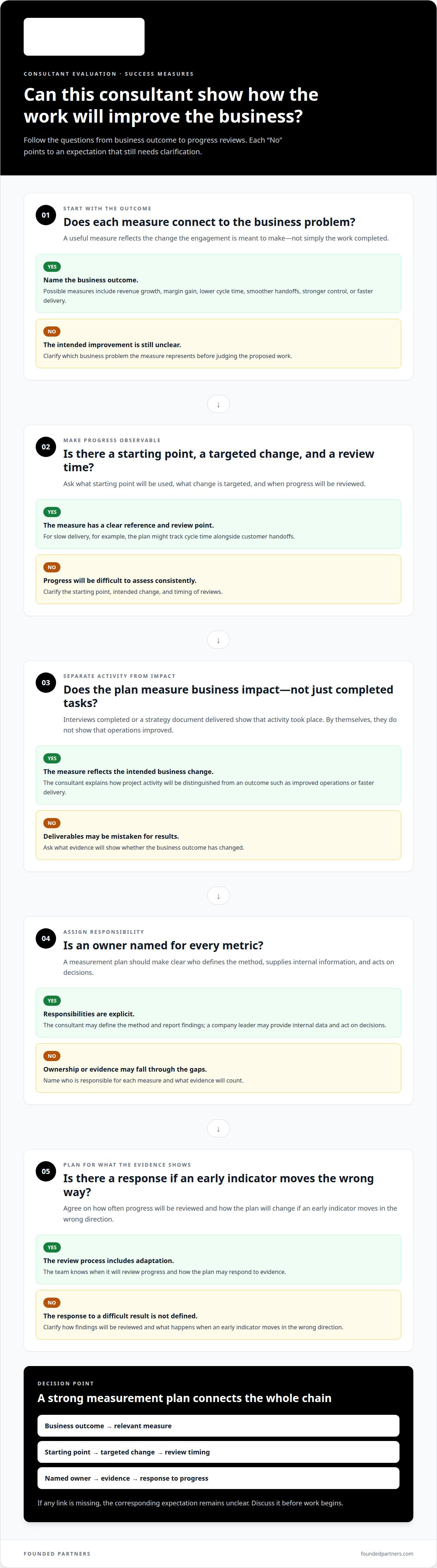
Define success before work begins, and connect each measure to the business outcome behind the engagement. Ask the candidate what starting point they’ll use, what change they’re targeting, and when progress will be reviewed. A project addressing slow delivery, for example, might track cycle time alongside customer handoffs. A metric is useful when it reflects the business problem you need to improve.
Discuss outcomes that fit the work, such as revenue growth, margin gain, lower cycle time, smoother handoffs, stronger control, or faster delivery. Ask how the consultant will distinguish project activity from business impact. Completing interviews or delivering a strategy document shows that work was done; it doesn’t, on its own, show that operations improved.
Set a measurement schedule and name an owner for every metric. The consultant may define the method and report findings, while a company leader provides internal data and acts on decisions. Agree on how often the team will review progress, what evidence will count, and how the plan will change if an early indicator moves in the wrong direction.
Ask the consultant to explain both a success and a difficult result from previous work. What conditions supported progress? Which assumptions proved wrong, and how did the advisor respond? A thoughtful account shows how the consultant learns and adapts. It also helps you assess whether their approach suits your business, rather than relying on a polished success story alone.
For leadership or career-related goals, clarify what success looks like in day-to-day management. A leadership engagement might assess clearer decision ownership or more consistent follow-through, then connect those changes to operating outcomes. Be cautious if a candidate promises a fixed result before understanding your business or avoids explaining how results will be measured. Treat guarantees carefully: ask exactly what they cover, what depends on your team, and how progress will be reported.
4. What Types of Clients Do You Work With Most Often?
A consultant’s typical clients can indicate whether their experience fits your business. Ask whether they mainly work with founder-led companies, family businesses, or larger organizations, and at which stages. Then relate the answer to your situation. A growing company preparing to expand may need different support from a business resolving unclear responsibilities between established teams.
Bring the discussion back to the project. Describe the challenge, the change you want to achieve, and the decisions the work should inform. If expansion is straining operations, for example, explain which processes are under pressure and what a better outcome would enable. Ask the consultant to summarize the desired result in their own words. Clear answers show whether you both understand the assignment in the same way.
Translate the desired outcome into a proposed scope, deliverables, and success measures in the contract. Scope describes the work and its boundaries; deliverables identify what the consultant will provide; metrics show how progress or results will be assessed. An operations project might include a process review, recommendations, and a measure tied to delivery speed. Specify what falls outside the agreement and how proposed changes will be approved.
Deadlines should reflect dependencies, not just a preferred finish date. Ask which milestones depend on leadership decisions, data access, staff interviews, or approvals. If your team must provide process information before recommendations can be finalized, identify who owns that task and when it’s due. Discuss how delays or new priorities will affect the schedule and contract.
Ask how the consultant handles a backlog of requests. If a second issue emerges during an agreed review, establish whether it replaces a priority, becomes separate work, or waits for a later phase. This keeps the project focused and helps someone on each side own decisions. To define a clear transformation project, discuss your business goals and the work needed to reach them.
Founded Partners: Business Transformation Consulting
Founded Partners provides Business Transformation Consulting for founder-led organizations working to strengthen operations, address organizational challenges, or prepare for sustainable growth. Turn to this support when your discussions with a consultant have clarified the need for a broader transformation, not just a standalone recommendation.
A consultant can help connect business priorities with practical changes to how your organization operates and scales. Founded Partners also provides Leadership Advisory, capital raising support, and exit planning for businesses with those needs. The right next step depends on the challenge you’re facing and the outcome you want to achieve.
Contact Founded Partners to discuss your business priorities and potential next steps.
Choose a partner for the work ahead
The questions to ask a potential business consultant can help you make a considered decision. Next, connect that decision to your business priorities. Consider what needs attention now, how much capacity your team has to participate, and what support could move the organization forward. A clear sense of direction makes a first conversation more useful.
Founded Partners provides Business Transformation Consulting for organizations working through change, along with capital raising support and exit planning for businesses facing those needs. The right starting point depends on your challenge and the outcome you want to pursue. Bring that context to a conversation and explore whether the work is a fit.
Contact Founded Partners to discuss your needs. A thoughtful next step can turn uncertainty into a clearer path forward.
Frequently Asked Questions
Can Business Consultants Genuinely Help?
Yes, a business consultant can help a company make progress when their expertise matches its challenge and leaders are ready to act. An advisor, for example, may help a founder identify why growth is disrupting decision-making, then guide the leadership team through practical changes. The value lies not only in recommendations, but also in clearer choices, coordinated action, and stronger internal capability.
Can You Share References, Case Examples, or Similar Work?
Yes, relevant references and case examples can help you understand how a consultant works beyond the final outcome. Ask a reference what the consultant personally contributed, how communication worked, and what the business needed to do to make progress. For a case example, ask what conditions shaped the result and which parts of the approach might apply to your company.
How Are Fees Structured and What Might Change the Price?
Consulting fees may be structured as a fixed fee, hourly or daily rate, retainer, or staged payments. The price depends on the case and is provided after a quote request; factors include the project’s scope, complexity, timeline, required expertise, and structure. Clarify the assumptions behind the proposed fee, payment schedule, and how additional or changed work will be handled.
How Do You Work With Leadership Teams During Tough Decisions?
A consultant can help leadership teams make difficult decisions by clarifying the choices, surfacing trade-offs, and keeping discussion focused on shared business priorities. If leaders disagree about delaying expansion, for example, an advisor can help define the risks, information needed, and consequences of each option. Ask how the consultant will involve relevant decision-makers and help the team turn agreement into action.
How Will Success Be Measured?
Measure success through outcomes connected to the business need, with a clear review point and an owner for each measure. A project intended to improve internal coordination, for example, might track whether decisions and responsibilities are clearer across teams. Discuss how external changes or new priorities will be considered, so the evaluation reflects the engagement’s contribution without confusing activity with business impact.
How Would You Scope This Work?
A consultant scopes work by translating the business challenge into defined activities, deliverables, boundaries, and progress measures. A project addressing inconsistent customer handoffs might begin with process discovery, then identify recommendations and implementation responsibilities. Ask how the proposed scope will handle new findings, what requires a separate decision, and which people or information your team must provide for the work to proceed.