
Scaling Your Business: A Process Documentation Guide

What happens when the person who knows how the work gets done is suddenly unavailable, or the business grows beyond their ability to guide every decision? For founder-led companies, documenting business processes for scalability isn’t about creating paperwork. It’s about making essential knowledge accessible so work can be completed consistently as the organization grows.
If the same task is handled differently across teams, or a procedure lives only in someone’s memory, documentation can seem like a time-consuming project that will soon go stale. The answer isn’t to write down everything. Start with processes where clear guidance could reduce reliance on individual knowledge, prevent avoidable rework, or make handoffs more reliable.
This guide explains how to identify those processes, create practical documentation for daily work and onboarding, and assign ownership so it stays current. You’ll also learn how to review processes as part of strengthening your operating foundations, helping your business grow with greater clarity and less dependence on any one person.
Key Takeaways
- Spot where growth is making handoffs, exceptions, or unwritten know-how harder to manage.
- Choose a format that fits the work, from a brief checklist to a process map or decision guide.
- Prioritize documenting business processes for scalability by weighing frequency, business impact, key-person dependence, and error exposure.
- Build guidance around clear steps and decision points, then test it with the people who use the process.
- Give each process an accountable owner and a review rhythm so documentation can evolve with the organization.
Documenting Business Processes for Scalability: Recognize the Signs You Have Outgrown Informal Workflows
Informal workflows can serve a small team well. People sit close to the work, ask quick questions, and rely on shared context to fill gaps. As the organization grows, those assumptions become harder to sustain. More people, handoffs, and exceptions mean that a task once guided by conversation may depend on knowledge no one has recorded.
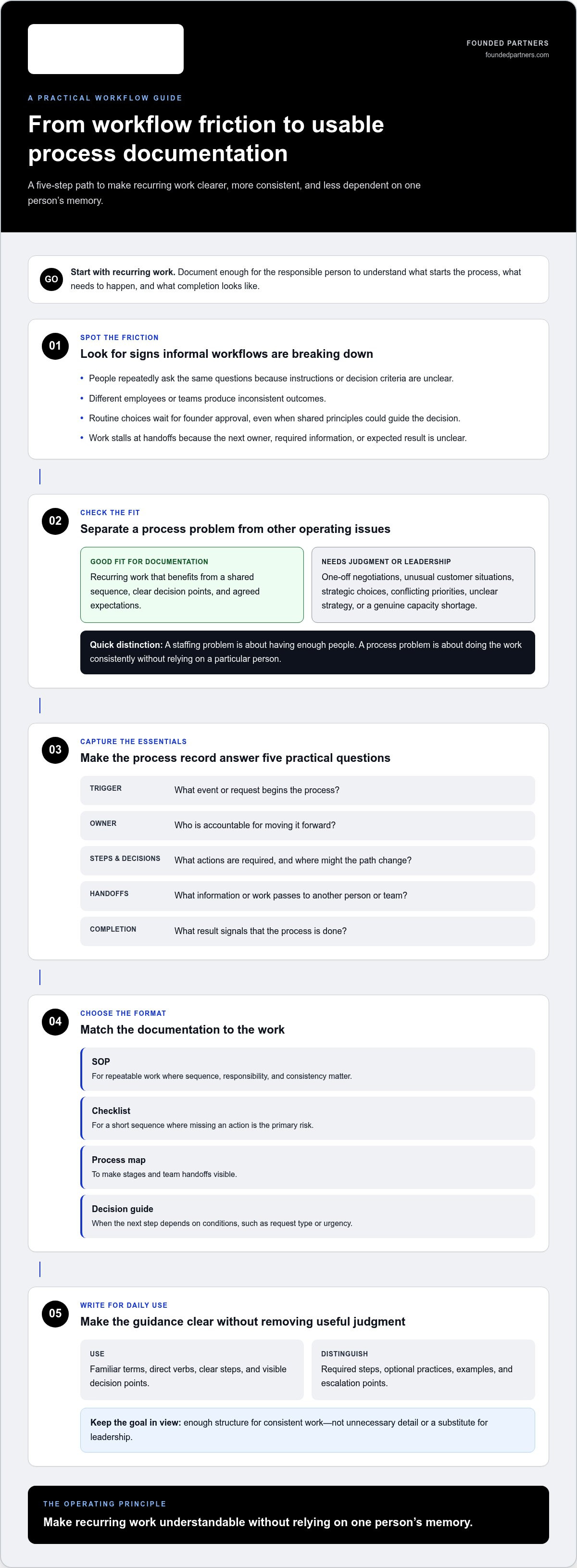
Process documentation is a clear, usable record of how recurring work gets done. It captures enough of the Business Process for someone responsible to understand what starts it, what needs to happen, and what completion looks like. The goal isn’t to record every detail of company life. It’s to make repeatable work understandable without relying on one person’s memory.
Look for patterns that point to a workflow problem:
- People repeatedly ask the same questions because instructions or decision criteria aren’t clear.
- Different employees or teams produce inconsistent outcomes while following their own versions of the process.
- Routine choices wait for founder approval, even when the work is familiar and clear principles could guide the decision.
- Work stalls at handoffs because the next owner, required information, or expected result isn’t understood.
A staffing problem is about having enough people to do the work; a process problem is about whether the work can be done consistently without relying on a particular person. This distinction helps leaders look beyond the immediate delay and identify what is actually constraining execution.
When founder knowledge becomes an operating bottleneck
As teams and responsibilities expand, small decisions can collect around the founder: which request takes priority, what information a handoff needs, or how to handle a common exception. Each question may seem reasonable on its own. Together, they interrupt the founder’s attention and slow decisions others could make with shared guidance.
Hypothetical example: A growing company’s new employee learns to prepare a customer handoff by shadowing a long-tenured colleague. The colleague remembers to include context the next team needs, but the steps aren’t written down. New hires take longer to work independently, missed details lead to rework, and customers may have a different experience depending on who handles the handoff. Documenting the trigger, required information, owner, and completion criteria makes expectations visible across the team.
Which scaling problems documentation can, and cannot, solve
Documenting business processes for scalability supports repeatability. It helps people handle recurring work using a shared sequence, clear decision points, and agreed expectations. It’s best suited to workflows that happen often enough to benefit from consistency, including those with defined exceptions.
Not every decision belongs in a procedure. A one-off negotiation, unusual customer situation, or strategic choice may depend on context and judgment that can’t be reduced to fixed steps. Documentation also can’t resolve conflicting priorities, unclear strategy, or a genuine shortage of capacity. Those issues require leadership attention, not another checklist.
Treat documentation as an operating foundation, not a substitute for leadership. It can clarify how agreed priorities translate into daily work, while leaders remain responsible for setting direction, aligning accountability, and deciding when guidance needs to change.
What Effective Process Documentation Includes, and Which Format Fits the Work
The right format makes a process easier to follow, not more impressive to look at. A short recurring task may need only a checklist, while work involving multiple teams or decision points may call for a process map and supporting instructions. The aim of documenting business processes for scalability is to give people enough structure to act consistently without burying the work in unnecessary detail.
Whatever the format, a useful record answers a few basic questions: what starts the work, who owns it, what happens next, where decisions or handoffs occur, and how someone knows the task is complete. This gives employees direction while preserving room for judgment where the work calls for it. Sam Palazzolo’s Process Documentation: The Blueprint for Sustainable Growth also discusses how clear process records can support day-to-day execution as a business grows.
- Trigger: What event or request begins the process?
- Owner: Who is accountable for moving it forward?
- Steps and decisions: What actions are required, and where might the path change?
- Handoffs: What information or work passes to another person or team?
- Completion criteria: What result signals that the process is done?
Choose between an SOP, checklist, process map, or decision guide
An SOP suits repeatable work where sequence, responsibility, and consistency matter, such as preparing a standard customer handoff. A checklist works well for a short sequence where missing an action is the primary risk. Use a process map to make stages and team handoffs visible. A decision guide is more useful when the next step depends on conditions, such as routing a request based on its type or urgency.
Make documentation clear without removing useful judgment
Write for the person doing the task. Use familiar terms, direct verbs, and clear distinctions between required steps, optional practices, examples, and escalation points. Record unusual edge cases when overlooking them could create meaningful operational risk, but don’t let rare scenarios overwhelm guidance for everyday work. Consistency should clarify decisions, not suggest every situation is identical.
Use screenshots when someone needs to locate a specific field or navigate a system, and add a brief example when it makes an abstract instruction easier to apply. Link to a related reference when readers may need more detail, but keep essential steps in the process record itself. A useful page should guide the task without sending someone searching for basic instructions.
The minimum useful process record identifies its trigger, owner, essential steps, decision points, handoffs, and definition of done. If choosing a format reveals broader questions about responsibilities or operational alignment, business transformation and operations optimization can help frame process improvements within a stronger operating foundation.
How to Decide Which Business Processes to Document First
Trying to document everything at once can turn a useful improvement effort into an administrative project. Start with work where clearer guidance could ease a meaningful constraint on growth. A founder-led organization may have dozens of recurring activities, but a strong first candidate often combines frequent repetition with significant business impact or dependence on a few people.
Use a simple low, medium, or high rating for each factor. This isn’t a precision score or a contest to identify the “worst” team. It’s a consistent way to compare candidates and explain why a process deserves attention now.
Use a simple impact-and-dependence assessment
Assess each candidate by asking how often it occurs, what a delay or error would affect, and who holds the knowledge needed to complete it. Consider customer experience, team capacity, revenue-critical work, and downstream handoffs. Rate dependence as high if progress often waits for founder input, a single experienced employee, or knowledge of unwritten exceptions. A clear pattern across these factors points to processes worth examining first.
- Frequency: Does this happen regularly, or only in unusual circumstances?
- Business impact: What work, customer, or team outcome is affected if it stalls or goes wrong?
- Key-person dependence: Does execution rely on one person’s memory, availability, or repeated decisions?
- Error exposure: Could inconsistent handling lead to rework, missed handoffs, or avoidable customer friction?
High-impact, repeatable workflows often make strong candidates, especially when a few people carry much of the knowledge. By contrast, low-frequency work that changes substantially each time may not benefit from a detailed step-by-step procedure. It may need a decision framework or a clear record of who has authority instead. Documenting business processes for scalability means choosing the right kind of guidance, not forcing every activity into the same template.
Select a first process that can demonstrate practical value
Choose recurring work with a visible source of friction and a clear beginning and end. A cross-functional handoff can be a useful pilot because it reveals where expectations differ between the people sending and receiving the work. Include both groups as you map the process; otherwise, the written version may describe only one side of the exchange.
Agree on a modest way to assess whether the documentation helps. You might track whether clarification loops become less frequent, whether required information arrives more consistently, or whether the next owner can complete the handoff with fewer interruptions. Choose a measure that reflects the friction you’re trying to reduce, rather than adding reporting for its own sake.
A successful pilot gives the team a grounded model for expanding the effort: what detail helped, where guidance felt cumbersome, and which ownership questions remain unresolved. For the broader connection between operational readiness and sustainable growth, see this business scalability consulting guide. Process priorities are strongest when they reinforce the organization’s direction, not simply produce a larger library of instructions.
How to Create, Roll Out, and Maintain Process Documentation
Useful documentation reflects how work actually happens, not how leaders assume it happens. Build it with the people closest to the process, test it in practice, and give someone clear responsibility for keeping it reliable. This sequence helps documentation support daily execution instead of becoming a file teams stop consulting.
- Observe the work. Follow the process from its starting trigger through to its expected outcome. If direct observation isn’t practical, interview the people performing the task and those receiving its output.
- Draft the real steps. Capture the inputs, actions, decisions, handoffs, and completion criteria. Note where people adapt the process, and distinguish necessary judgment from habits that create avoidable variation.
- Validate with users. Ask the people who do the work to check for missing context, unclear instructions, and exceptions. Then ask a colleague unfamiliar with the task to follow the guidance and flag points where they get stuck.
- Publish accessibly. Keep the approved version in a shared source of truth that fits the team’s existing way of working. Make it easy to find, and clearly identify the current version so employees don’t have to guess which copy to use.
- Review and refine. Name an owner, set a review rhythm, and update the record when the process changes. Use questions and friction from daily use to guide revisions.
Capture and validate the real workflow
Start with a process run, not a blank page. Ask what initiates the task, which information is needed, who acts at each stage, where decisions alter the path, and what result marks completion. A colleague unfamiliar with the work can reveal assumptions insiders overlook. If they can’t follow the instructions without repeated clarification, revise the guidance before publishing it broadly.
Build ownership, adoption, and a review rhythm
Assign one process owner to maintain accuracy, access, and review coordination. Ownership doesn’t mean that person must make every change alone: invite process users to report outdated steps, recurring exceptions, or unclear handoffs. Review the record when systems, roles, customer needs, or working practices change, and set a regular check-in so quieter changes don’t leave it behind.
Don’t measure success by the number of procedures produced. Look at whether people use the guidance, whether clarification needs decline, whether work is completed more consistently, and whether the operational outcome the process supports is improving. Choose indicators that fit the workflow, such as fewer incomplete handoffs or fewer returns for missing information. For a broader view of how to assess operational change, explore measuring business transformation success.
Strong documentation depends on aligned responsibilities and an operating model that supports the work. If maintaining processes exposes wider challenges with accountability or execution, explore strategic support for business transformation as part of strengthening the foundations for growth.
Make Process Documentation Part of a Scalable Operating Foundation
A single workflow can be improved in isolation. But if the same delays, unclear handoffs, or approval bottlenecks appear across several teams, the underlying issue may be broader than any one process. Documentation can make a workflow clearer; it can’t decide who owns a function, resolve competing priorities, or replace leadership alignment.
Pay attention to patterns. Teams may each follow a different version of a shared process, work may regularly stall between functions, or routine decisions may keep escalating despite written guidance. These are signals to examine how responsibilities, priorities, and decision rights fit together. Treating every breakdown as a separate documentation task can leave the underlying conditions unchanged.
Recognize when process issues point to a broader transformation need
Look across workflows for repeated friction. If multiple teams are unsure who makes a decision, what information they need, or which priority takes precedence, the challenge may involve the operating model as well as the procedure. Operational improvement is connected to leadership and execution: leaders set direction and accountability, and teams translate them into reliable daily work.
Documentation still matters. Clear workflows can make responsibilities visible, reduce ambiguity at handoffs, and help teams act consistently on agreed priorities. But if a well-described process continues to break down because roles conflict or capacity is missing, address those conditions rather than adding more instructions. Business transformation and operations optimization can help leaders consider changes in context.
Choose a deliberate next step for sustainable scaling
Keep the work focused: identify recurring friction, prioritize a process where clearer guidance could matter, document the real workflow, and learn from how people use it. Then decide whether the issue is resolved at the process level or points to a wider organizational constraint. This approach helps leaders build practical improvements without treating documentation as a cure-all.
Reliable workflows contribute to clearer accountability and stronger execution because people can understand what they own and how their work connects to others. Over time, that clarity supports a more durable foundation for growth. For a broader perspective on aligning operational improvements with organizational change, explore this business transformation consulting overview.
Founded Partners advises founder-led organizations on business transformation and operations optimization, bringing process improvement into the wider context of leadership, execution, and growth. If recurring workflow issues suggest a broader need to strengthen your operating foundation, explore Founded Partners’ advisory approach.
Build an Organization That Can Grow Beyond Its Founders
Growth asks more of a business than simply doing more work. It asks the organization to learn, adapt, and make sound decisions without depending on a small number of people to carry every detail. Treat documenting business processes for scalability as an ongoing leadership practice: a way to make work clearer today while creating room for the team to take on greater responsibility tomorrow.
The next step doesn’t have to be a sweeping redesign. Choose one recurring source of friction, involve the people closest to it, and pay attention to what improves and what still requires leadership attention. Those observations can help you distinguish a process that needs refinement from a wider challenge in how the organization operates.
Founded Partners works with founder-led organizations on business transformation and operations optimization, connecting operational decisions with the broader direction of the business. If you’re considering how to strengthen your organization for its next stage, explore Founded Partners’ strategic advisory approach. Progress starts with a clear next step, and your business can build from there.
Frequently Asked Questions
Is process documentation useful for a small business?
Yes, especially when recurring work affects customers, cash flow, delivery, or team capacity. For documenting business processes for scalability, start with one task that relies heavily on a founder or generates repeated questions, such as preparing a customer proposal or handling a routine order. Keep the guidance proportionate to the work. A small business needs continuity and clarity, not a manual for every activity.
Can process documentation help prepare a company for due diligence?
Yes, clear process records can help explain how important work is carried out and how responsibilities are distributed. For example, a company may be better prepared to describe how it fulfills customer orders without relying on one employee’s memory. Documentation is one part of operational readiness, alongside accurate financial and organizational information. It doesn’t guarantee a particular valuation, transaction outcome, or buyer response.
What is the difference between a process map and a standard operating procedure?
A process map shows the workflow visually, making stages, choices, and movement between roles easier to see. A standard operating procedure, or SOP, gives instructions for performing a defined task. For example, a map might show how a customer request moves from sales to delivery, while an SOP explains how to prepare the delivery handoff. Teams can use both when the overview and task-level guidance serve different needs.
Who should be responsible for documenting a business process?
The people who perform the work should help describe and test the instructions, since they can identify practical details that may be invisible to others. A designated process owner should coordinate accuracy, access, and updates. Leaders can set priorities and resolve disagreements between teams without writing every procedure themselves. For a process shared across departments, include someone who receives the work as well as someone who initiates it.
How often should a company review documented processes?
Review a process when a change could make its instructions misleading, such as a new system, revised role, changed approval path, or different customer requirement. A scheduled review can also uncover quieter changes that no one thought to flag. The right cadence depends on how quickly the work evolves. Make the owner responsible for noticing review triggers, rather than relying on team members to remember an informal reminder.
Does a growing company need special software to document processes?
No. A shared document or knowledge base can be enough if employees can locate the guidance, understand it, and maintain it. Consider specialized software only when the volume of documentation, access needs, or coordination across teams makes the current approach difficult to manage. Before choosing a tool, define the specific problem it should solve. A new platform won’t make unclear instructions useful or assign ownership on its own.