
Selling Your Founder-Led Business: 2026 Strategic Guide

Your greatest asset as a founder is often your greatest liability during an exit. The founder magic that built your enterprise is precisely what sophisticated buyers in 2026 view as a structural risk to be mitigated. It's a difficult reality to face when you're ready to sell my founder-led business; the very intuition that sparked your success can feel like a tether holding back your enterprise value. You've likely spent years nurturing a culture and a team that feels like family. It's natural to fear that the business won't survive without you or that the unique spirit you've cultivated will be lost in a corporate acquisition.
We're here to help you navigate this consequential transition with the steady hand of a strategic architect. This guide provides a clear roadmap to master the complexities of a 2026 exit while preserving your legacy and maximizing your return. You'll learn how to institutionalize your leadership and leverage current market shifts, such as the $15 million QSBS tax exclusion. We'll examine the specific steps to refine your operations, strengthen your leadership bench, and ensure your team is cared for long after the deal closes. This briefing will give you the clarity needed to transition from the center of your business to the architect of its future.
Key Takeaways
- Distinguish your personal "founder magic" from a scalable enterprise system to eliminate the valuation discounts associated with key person risk.
- Evaluate the trade-offs between strategic acquirers and private equity firms to find a partner that values both your financial goals and your cultural legacy.
- Implement a disciplined 24-month roadmap to sell my founder-led business, prioritizing leadership advisory and operational scaling well before the transaction.
- Refine your internal architecture through a comprehensive foundation audit to transform individual intuition into repeatable, high-value organizational systems.
- Navigate the psychological shift of the "Final Act" by preparing your leadership team for a resilient, autonomous future without your daily involvement.
Understanding the Strategic Value of a Founder-Led Business
The value of a founder-led business isn't found in the balance sheet alone. It resides in the "Founder Premium." This is the unique combination of vision, cultural integrity, and market intuition that sets a boutique firm apart. When you decide to sell my founder-led business, you're essentially selling a narrative of future potential. Buyers are increasingly seeking these purpose-driven organizations because they offer a level of brand loyalty and employee commitment that sterile, corporate-first entities often lack. Your influence is the catalyst, but the enterprise value is the engine.
A critical distinction exists between founder-led sales and a founder-led enterprise. Many founders believe their personal ability to close deals is their greatest asset. In reality, during an exit, this becomes a liability. A true enterprise is a collection of systems, not a series of individual heroics. If the revenue stops when you stop, your valuation will suffer a significant key person discount. Strategic buyers look for the "secret sauce" of your culture, but they must see that it's baked into the organizational structure rather than held in your head.
2026 has emerged as a landmark year for exits. With global M&A deal values reaching approximately $4.9 trillion in 2025 and an estimated $5 trillion in capital currently waiting to be deployed, the market is highly bifurcated. High-quality, well-prepared businesses are commanding premium multiples, while unprepared founders struggle to find traction. This environment rewards those who have spent time refining their internal architecture and strengthening their operational health.
The Founder’s Vision as a Market Differentiator
Your personal brand is the architectural foundation of your company's enterprise value. To maximize this value, you must translate "founder magic" into documented strategic objectives. Buyers pay a premium for a clear, enduring purpose that survives the original architect. By refining your vision into a repeatable operational framework, you ensure the business retains its competitive edge after the ownership change. It's about moving from a person-centric model to a process-centric reality.
Defining the Exit: Transaction vs. Transition
An exit is rarely a single event; it's a multi-year transition of trust and leadership. We recommend a 12 to 24 month preparation period to move from being the primary operator to a strategic advisor. This window allows for the optimization of internal systems and the strengthening of your leadership bench. Balancing financial returns with a lasting legacy requires a disciplined approach to operations optimization. It's about building a durable structure that protects your team while securing your financial future when you sell my founder-led business.
Assessing Founder Dependency and Its Impact on Valuation
Founder dependency is the degree to which your company's revenue, operations, and cultural continuity rely on your daily presence. It's the inverse of enterprise value. If you're the primary rainmaker or the only person who can solve a technical crisis, you've built a high-performing job rather than a transferable asset. When you seek to sell my founder-led business, you must prove that the entity can thrive in your absence. Buyers aren't looking for a business that needs its creator to survive; they're looking for a machine that runs on its own.
This reliance creates "Key Person Risk," a factor that triggers immediate valuation discounts. In the 2026 market, where B2B SaaS multiples range from 7.0x to 12.0x EBITDA, a high-dependency firm will consistently fall at the lower end of that spectrum. Buyers aren't just purchasing your past success; they're buying future cash flows. If those flows are tied to your personal charisma, they're considered volatile. De-risking the transaction means showing that your systems, not your personality, drive the results.
Auditing your operational bottlenecks is the first step toward de-risking. Look at your decision-making patterns. If every major client request or internal hire requires your final nod, you're the bottleneck. Our business transformation consulting helps you identify these structural weaknesses before they hit the negotiating table, ensuring you present a scalable foundation rather than a fragile one.
The Founder Dependency Scorecard
A strategic audit begins with three simple questions. First, can the business run for 30 days without your input? If the answer is no, your valuation is already leaking. Second, are your client relationships tied to the brand or your personal identity? Third, is the "how" of your business documented in a searchable system or locked in your head? Documentation turns tribal knowledge into a sellable intellectual asset that provides security to a potential acquirer.
Operational Health as a Value Driver
Moving from founder-led to system-led operations is a deliberate act of architectural refinement. It requires a leadership team that provides a steady hand, capable of managing the organization through the friction of an ownership change. This shift doesn't just protect the culture; it validates the business model for a skeptical acquirer when you finally decide to sell my founder-led business. Founder Dependency is the primary hurdle to high-multiple exits, acting as a structural ceiling on your company's ultimate valuation.
Choosing the Right Buyer: Strategic vs. Private Equity
The decision to sell my founder-led business isn't just a financial calculation; it's a choice of destination. In 2026, the M&A market is characterized by an unprecedented volume of available capital, with an estimated $5 trillion waiting to be deployed. This capital is split between corporate cash reserves and private equity "dry powder," each representing a different philosophy of ownership. Your choice of buyer will dictate the future of your team, the persistence of your culture, and your own role after the closing date.
Strategic buyers are typically competitors or firms in adjacent sectors seeking to accelerate their own growth. They are attracted to your "secret sauce," which might include your proprietary technology, specialized market share, or unique brand positioning. Because these buyers can realize immediate synergies, they often provide the highest initial valuation. However, the risk of cultural absorption is high. A strategic acquisition often involves integrating your systems into theirs, which can lead to the "culture loss" many founders fear. Protecting your trade secrets during the discovery phase requires a disciplined, methodical approach to due diligence.
Financial buyers, such as private equity firms, view your organization as a platform for future expansion. With roughly $2 trillion in PE capital currently available, these firms are searching for businesses with strong fundamentals and clear scalability potential. They aren't looking to dismantle what you've built; they're looking to refine and strengthen it. This path often allows for a "second bite of the apple," where you roll over a portion of your equity into the new entity. This structure keeps you aligned with the business's future success while providing significant liquidity today.
Strategic Acquirers: The Search for Synergy
Competitors pay for the speed of market entry. They value the "intangible assets" we discussed earlier, specifically your brand's reputation and customer trust. To manage the risk of culture clash, you must identify alignment in values early in the negotiation. A successful strategic exit is a transition of systems where your core strengths are amplified rather than erased. It requires a steady hand to ensure that the "founder magic" survives the integration process.
Financial Buyers: Scaling the Foundation
Private equity firms prioritize operations optimization and structural durability. They value a business that can grow without the founder's daily intervention, making the "system-led" transition we covered previously even more critical. Preparing for a financial buyer involves a rigorous audit of your financial health and growth levers. They are buying your future platform potential, which means they are buying the strength of your leadership team and the efficiency of your internal architecture. This is a partnership focused on refining the "how" of your business to achieve a new level of scale when you sell my founder-led business.
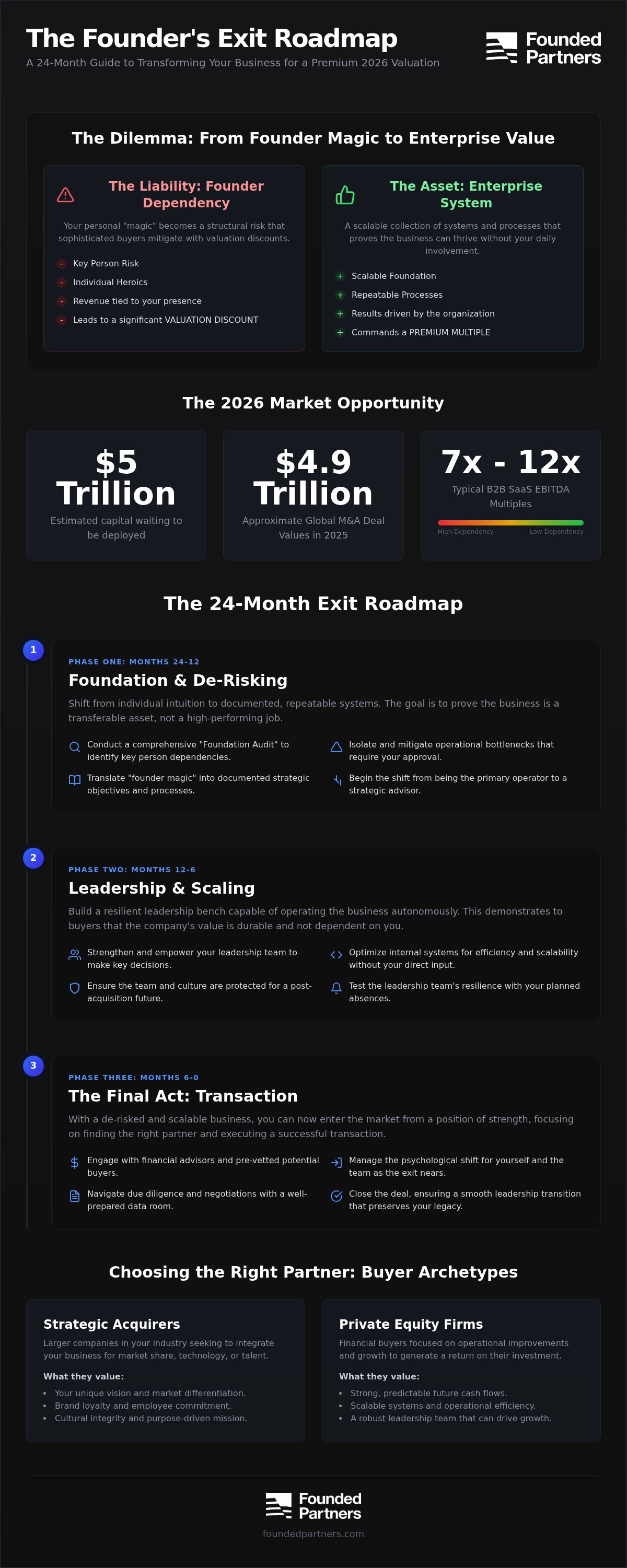
A 24-Month Roadmap to Sell Your Founder-Led Business
Timing is a tactic, but preparation is a strategy. Most founders begin their exit journey too late, often driven by exhaustion rather than a clear objective. When you decide to sell my founder-led business, a 24-month horizon is the gold standard for maximizing enterprise value. This window allows you to move from being the indispensable operator to the strategic architect of a transferable asset, ensuring that the "founder magic" is institutionalized before you ever reach the negotiating table.
Phase 1: Refine the Core (Months 1-6)
Months one through six focus on architectural integrity. You must clean up the balance sheet and optimize cash flow to ensure there are no surprises during due diligence. Identifying and fixing operational red flags, such as high client concentration or undocumented processes, prevents deal fatigue later. It's also the time to align your personal exit goals with the business's trajectory. This alignment ensures that every operational tweak serves the ultimate goal of a clean, high-value transition.
Phase 2: Operational Scaling and Leadership Empowerment (Months 7-12)
This phase centers on operational scaling and leadership advisory. This is where you empower your leadership team to take the wheel. If the business cannot thrive without your daily input, its value is capped. Our exit planning advisory helps you refine these internal structures, turning individual intuition into repeatable organizational systems. By the end of this phase, your company should operate as a "steady hand" entity that provides security to any potential buyer.
Phase 3: Building the Narrative and Investor Readiness (Months 13-18)
Months 13-18 are dedicated to capital strategy and investor readiness. You need to create a Confidential Information Memorandum (CIM) that highlights the structural strength of the firm rather than just your personal achievements. Identifying the "right capital" to attract for pre-exit growth can bolster your valuation before you go to market. Investor readiness begins long before the first meeting because the structural integrity of your business is built in the years, not the weeks, preceding a sale.
Phase 4: Transaction and Consequential Transition (Months 19-24)
This is the final act of your founder journey. It involves managing the rigorous due diligence of 2026 buyers who are more selective and analytical than ever. With global M&A activity predicted to rise 15% this year, being prepared allows you to leverage the $15 million QSBS tax exclusion effectively. The goal is a clean exit that secures your financial future and ensures the business you built continues to flourish under new stewardship when you sell my founder-led business.
The Founder's Final Act: Managing the Leadership Transition
The final stage of an exit is often the most emotionally taxing. While previous phases focused on operations and capital, this Final Act requires a profound psychological shift. You're moving from the identity of an Owner to that of an Advisor. This isn't just a title change; it's a recalibration of how you view your value within the entity you built. When you sell my founder-led business, you must navigate the friction of letting go while ensuring the organization remains resilient during the handover.
A seasoned Trusted Peer advisor is essential during these final negotiations. They provide the steady hand needed when the pressure of the deal threatens to overshadow the long-term health of the company. Founded Partners specializes in these consequential transitions, acting as the strategic architect who ensures that both the financial return and the human element are respected. We help you refine your role so that the transition feels like a graduation rather than a loss.
The Founder to CEO to Advisor Journey
Developing the next generation of leadership is the most critical component of organizational resilience. These individuals must be prepared to take the helm long before the ink is dry on the purchase agreement. Communication is equally vital. How you share the news of the sale with employees, clients, and partners will define the stability of the business in the months following the transaction. Clear, transparent messaging prevents the anxiety that often leads to talent attrition or client churn. Finally, setting firm boundaries for your post-sale involvement protects both your peace of mind and the new leadership's autonomy.
Building a Legacy Beyond the Transaction
In a final sale, character matters as much as competence. Buyers aren't just looking at your EBITDA; they're looking at the integrity of the foundation you've built. Defining success on your own terms means looking beyond the wire transfer to the next chapter of your life. Whether that involves a new venture, philanthropy, or a well-earned retirement, the clarity you gain now will dictate your satisfaction later. You've spent years building something substantial; ensure the exit reflects the quality of that work. Start your transition with a strategic briefing from Founded Partners to ensure your legacy is preserved while you sell my founder-led business.
Designing Your Consequential Transition
The journey to sell my founder-led business is a process of architectural refinement. Success in the 2026 market depends on your ability to institutionalize your vision; moving from a person-centric model to a durable, system-led enterprise. By auditing your operational bottlenecks and empowering a steady-hand leadership team, you transform your company from a personal achievement into a high-value transferable asset. Whether you choose a strategic acquirer or a private equity partner, the integrity of your exit roadmap dictates both your financial return and the preservation of your legacy.
Led by partners Adam and Matt, Founded Partners provides the strategic leadership advisory necessary to navigate these complex ownership changes. We combine a global reach with the boutique-level attention your life's work deserves. Our focus remains on strengthening your organization's health so you can exit with clarity and confidence. Book a Strategic Exit Briefing with Founded Partners to begin refining your final act. You've built something substantial; now, let's ensure it's built to last.
Frequently Asked Questions
How do I determine the valuation of my founder-led business?
What is the biggest mistake founders make when selling their company?
The most common error is failing to institutionalize "founder magic" before entering the market. If the business relies on your personal intuition to function, buyers will view it as a high-risk asset and demand a significant key person discount. Starting the transition too late often results in deal fatigue or a lower valuation. A disciplined, two-year preparation window is the best defense against these common architectural pitfalls.
How long does it typically take to sell a founder-led business?
A typical transaction takes six to twelve months from the first meeting to the final wire transfer. However, the most successful exits involve a twelve to twenty-four month preparation phase. This lead time allows you to refine your operations, strengthen your leadership team, and clean up your financial records. Rushing the process often leads to unfavorable deal structures or a failed due diligence phase during the final negotiations.
Can I sell my business if I still do most of the sales myself?
You can, but you'll likely face a compressed valuation multiple or a restrictive earn-out period. Acquirers want to see that the sales engine is a repeatable system rather than a personal talent. If you're still the primary rainmaker when you sell my founder-led business, the buyer may require you to stay on for several years to transition those relationships, delaying your full exit and financial liquidity.
What is the difference between an asset sale and a stock sale for a founder?
An asset sale involves selling individual components like equipment and customer lists, which allows buyers to step up the tax basis. A stock sale involves selling the entire legal entity, which is generally more tax-efficient for the founder. Stock sales are particularly advantageous in 2026 because they allow eligible founders to utilize the $15 million Qualified Small Business Stock tax exclusion, significantly increasing your net proceeds. To manage this newly liquid wealth effectively, many founders turn to Cornerstone Real Estate Investment Services for advice on tax-deferred real estate investment options.
How do I keep the sale of my business confidential from my employees?
Maintaining confidentiality requires a disciplined communication strategy and a limited circle of trusted advisors. Use a secure virtual data room for due diligence and ensure all potential buyers sign rigorous non-disclosure agreements before seeing sensitive information. Most founders wait until the letter of intent is signed or the deal is nearly closed before informing the broader team, ensuring that daily operations remain stable and focused.
Do I need a business transformation consultant before I sell?
While not strictly mandatory, a consultant helps you bridge the gap between a founder-centric shop and a scalable enterprise. Business transformation consulting focuses on operations optimization and leadership advisory, which are the primary levers for increasing enterprise value. By refining your internal architecture before you go to market, you ensure that you're selling a steady hand organization that commands a premium valuation from sophisticated 2026 buyers.
What happens to the company culture after the founder exits?
Culture continuity depends heavily on the type of buyer you choose and how well you've documented your values. Strategic acquirers may integrate your team into their own existing culture, while private equity firms often preserve your culture to use the company as a growth platform. Documenting your secret sauce into repeatable systems ensures that the unique spirit of your organization survives the transition of leadership and ownership under new stewardship.