
Strategic vs Financial Investors: Choosing the Right Partner for Your Founder-Led Business in 2026

The highest valuation on your term sheet is often the most expensive mistake a founder can make. It's a sobering reality in 2026, where global M&A values have climbed to 2.8 trillion dollars even as deal volumes have tightened. You've likely felt the weight of this decision, balancing the need for capital against the fear of being absorbed or pressured by unrealistic growth targets. Deciding between strategic vs financial investors is not a simple transaction; it's a foundational choice that dictates the future scalability and character of your organization.
We recognize that you want to maximize enterprise value without losing the soul of what you've built. This guide will help you navigate the critical choice between strategic and financial capital by detailing how each investor type impacts your valuation, your operations, and your long-term legacy. We'll provide a structured framework for evaluating partner fit and achieving the operational readiness required for a smooth transition. By the end, you'll have the clarity needed to choose a partner who respects your vision as much as your balance sheet.
Key Takeaways
- Contrast the core motivations of strategic vs financial investors to ensure your choice of capital aligns with your firm's architectural health and exit horizon.
- Discover how to leverage the "synergy premium" from strategic buyers or the "platform play" potential of financial partners to maximize your enterprise value.
- Prepare for the operational reality of life after the deal, balancing the deep integration of a strategic merger with the performance-driven autonomy of private equity.
- Conduct a foundation audit to identify and resolve operational red flags that could hinder your scalability or valuation during the due diligence process.
- Define your personal "North Star" to ensure the transaction serves your long-term goals for growth, legacy, and leadership rather than just a financial milestone.
Defining the Dichotomy: Strategic vs. Financial Investors
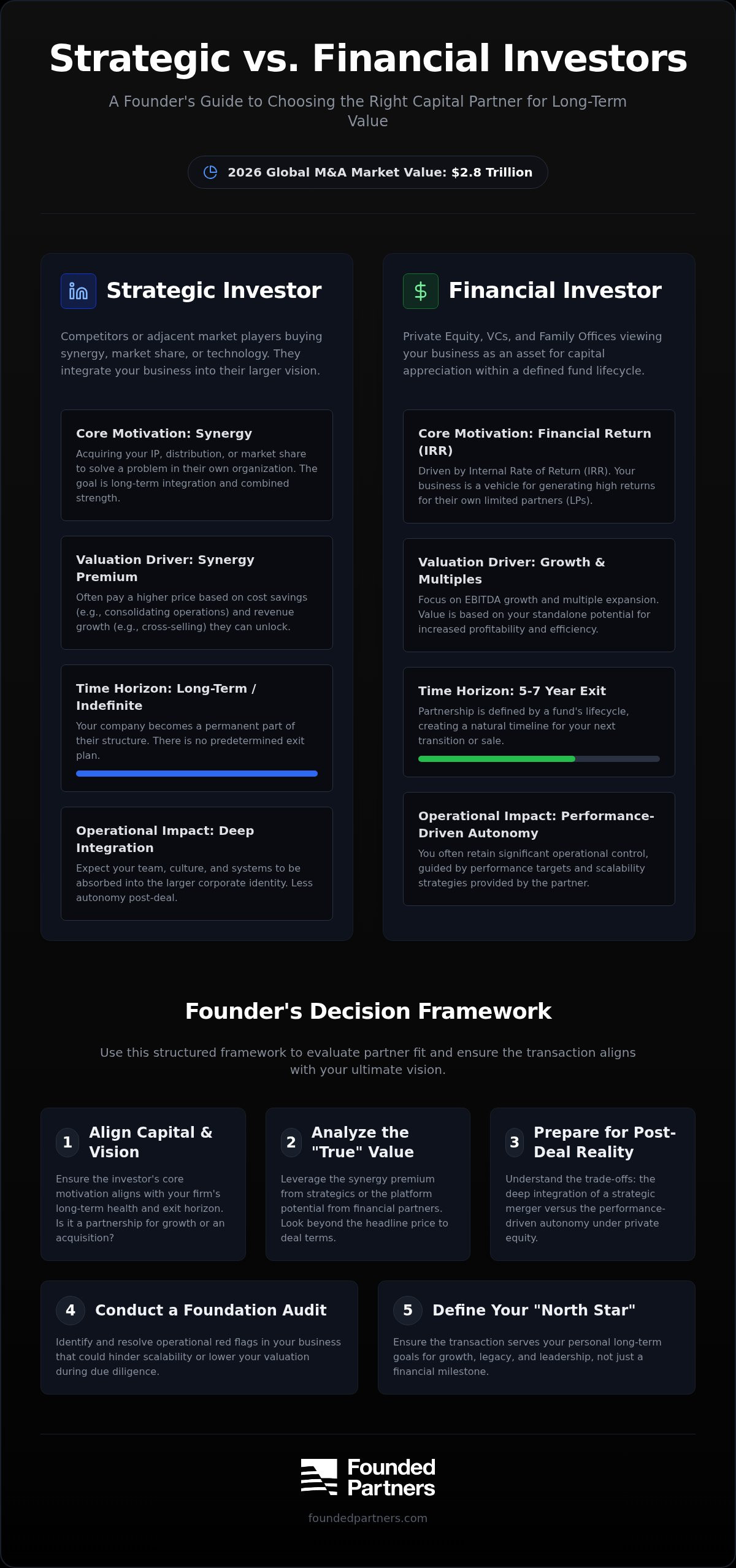
The choice between strategic vs financial investors is often framed as a simple math problem. It isn't. It is an architectural decision that defines the structural integrity of your business for years to come. In the current 2026 market, where global M&A values have reached 2.8 trillion dollars despite a 14% drop in deal volume, the environment has become increasingly selective. Understanding these two distinct investor archetypes is the first step toward ensuring your business doesn't just survive a transaction, but thrives because of it.
This decision occurs within the broader context of Mergers and acquisitions (M&A), a field that is currently characterized by heightened regulatory scrutiny and a shift toward strategic industrial support. Founders often find themselves at a crossroads. You must decide whether to seek a partner who fuels your independent growth or a home where your legacy becomes a component of a larger machine. It's a choice between autonomy and integration.
The Financial Investor Profile
Financial investors, including Private Equity firms, Venture Capitalists, and Family Offices, view your business as a vehicle for capital appreciation. They are primarily driven by Internal Rate of Return (IRR) and typically operate on a five to seven year exit horizon. While they offer a "value-add" promise through operational discipline and scalability strategy, you must respect the gravity of their fund life cycle. Their need to return capital to their own limited partners creates a natural timeline for your next transition. It is a partnership defined by performance and eventual exit.
The Strategic Investor Profile
Strategic investors are usually competitors, suppliers, or players in adjacent markets. They aren't just buying your cash flow; they are buying your intellectual property, your distribution channels, or your market share to solve a specific problem in their own organization. This is the "synergy" play. While this often leads to a higher valuation premium because they can extract more value from the combined entity, it carries significant integration risk. You must ask if your culture and team can survive being absorbed into a larger corporate identity with its own established norms.
By 2026, the lines between these categories have blurred. Many private equity firms now execute "platform plays," acquiring a primary company and then bolting on smaller competitors, behaving much like a strategic buyer. This shift requires a fundamental change in how you view the market. You aren't just selling an asset. You are choosing a peer. Moving from a "selling" mindset to a "partnering" one allows you to focus on the long-term health of the organization. Selecting between strategic vs financial investors requires looking beyond the immediate cash infusion to find a steady hand that understands the architectural nature of business building.
Valuation and Deal Terms: Who Pays the Premium?
Valuation is rarely a static number. It is a reflection of the buyer's unique perspective on your firm's future utility. When comparing strategic vs financial investors, the first point of divergence is often the "headline price." While it is tempting to chase the highest multiple, the structure of that payment-how much is cash at close versus an earn-out-determines the true value of the transaction. In a 2026 market where deal volumes have dipped 14% but total values remain high at 2.8 trillion dollars, buyers are becoming more disciplined about how they deploy capital.
Analyzing the Strategic Premium
Strategic buyers often outbid financial firms because they can justify a "synergy premium." They look at cost synergies, such as consolidating back-office operations, and revenue synergies, like cross-selling your products to their existing global database. In some cases, a strategic move is defensive; they may pay more simply to keep your intellectual property out of a competitor's hands. However, this premium usually comes with a catch. Strategic deals are frequently structured with heavy integration requirements, meaning your team must adapt to their systems immediately. The highest headline price is often a mirage if the underlying deal terms compromise your operational freedom or long-term liquidity.
The Financial Buyer’s Calculation
Financial investors, such as Private Equity firms, focus on EBITDA growth and multiple expansion. They use leverage to amplify their returns, though this has become more complex in August 2026 with the Mid-term AFR at 4.35%. Because they don't have the same immediate synergies as a corporate buyer, they often pay lower multiples unless they are executing a "Platform Play." In these scenarios, the PE firm buys your company as a foundation and then acquires smaller competitors to build scale, often paying strategic-level prices for the right architectural fit.
For many founders, a financial partner offers the "second bite of the apple." You might sell 60% of the business today and retain 40% equity, betting that the investor's operational discipline will make your remaining stake worth more in five years than 100% of the company is worth today. This path requires a close look at governance, veto rights, and liquidation preferences. If you are currently evaluating a term sheet, our capital raising support can help you look past the multiple to the architectural reality of the deal. We focus on ensuring the terms protect your legacy while providing the liquidity you've earned.
Operational Impact: Life After the Transaction
The ink on the term sheet dries quickly, but the operational reality of your choice lasts for years. While the valuation discussion focuses on the "what," the post-transaction phase is entirely about the "how." The divergence between strategic vs financial investors becomes most palpable in the Monday morning leadership meeting. One partner wants to know how you fit into their global supply chain; the other wants to know how you will double EBITDA before the next fund cycle begins.
In the selective 2026 market, where deal volume has tightened, investors are more involved in the day-to-day architectural health of their portfolio companies. This isn't necessarily "interference," but it is a fundamental shift in accountability. You are moving from founder-intuition to a framework of data-driven discipline. This transition requires a steady hand and a clear understanding of your new role within the organization you built.
Governance and Leadership Advisory
Financial partners, particularly Private Equity firms, often prefer that you remain at the helm. They are backing your leadership as much as your balance sheet. Their governance style usually involves board seats or observer roles that emphasize rigorous reporting and monthly performance reviews. In contrast, strategic buyers often have a pre-existing leadership structure. They may view your role as a transitional "Strategic Architect" whose primary task is to ensure the IP and talent successfully migrate into their ecosystem. Managing this change during the first 100 days is a high-stakes balancing act between maintaining momentum and embracing new corporate standards.
Scalability and Culture
Scaling operations without losing the "Founder’s Soul" is the primary challenge of any post-transaction period. Financial investors drive efficiency through operations optimization, focusing on professionalizing the back office so the front office can scale without breaking. They view your culture as an asset to be refined. Strategic buyers prioritize system alignment over individual autonomy. They look for vertical integration and cost synergies, which often means your internal culture must bend to accommodate their established corporate values. This shift requires proactive leadership advisory to ensure your team remains engaged while the organization evolves into its next iteration of growth.
Preparing the Foundation: Operational Readiness for Investors
Investors in 2026 are no longer buying potential; they are buying the certainty of your systems. Whether you are weighing strategic vs financial investors, the premium you command depends on the durability of your organizational architecture. A business that relies entirely on founder-intuition is a liability. A business built on repeatable, scalable systems is an asset that commands attention in a crowded marketplace. Professional buyers look for firms that can sustain momentum long after the original architect has stepped back from the day-to-day operations.
Before entering a data room, you must perform a Foundation Audit. This process involves identifying operational red flags: manual workflows that break under stress, opaque financial reporting, and deep founder-dependency. These red flags suggest a lack of durability that can lead to significant valuation haircuts or stalled deals. Your data room should not be a static repository of documents. It should be a curated narrative of durability that shows how your business has navigated challenges, optimized its resources, and prepared for future growth. Business transformation is not about changing your identity; it is about refining, guiding, and strengthening your core so that it survives the scrutiny of due diligence.
Operations Optimization as a Value Driver
Standardizing your workflows proves to a buyer that your model is repeatable and scalable. It de-risks the transaction by demonstrating that the company can thrive without your constant intervention. Operational maturity serves as a direct multiplier for your valuation, transforming a standard EBITDA figure into a premium enterprise value. By prioritizing operations optimization before the raise, you ensure that your organization is viewed as a durable platform rather than a fragile startup.
The Founder's Narrative
Your pitch must tell a story of durability that resonates with different buyer motivations. For financial buyers, emphasize how your team is prepared for the next level of scaling. For strategic buyers, highlight how your intellectual property fits their long-term architecture. Leadership advisory plays a critical role here, preparing your executive team to articulate this vision with calm expertise and confidence. This preparation ensures that when the pressure of the transaction intensifies, your team remains a steady hand on the wheel. You are not just selling a company; you are inviting a partner into a consequential transition that requires intellectual rigor and emotional intelligence.
The Path Forward: Aligning Capital with Your Legacy
The final decision is only as sound as its alignment with your personal "North Star." Are you seeking a rapid expansion of your market share, a phased exit from daily operations, or a lasting impact on your industry's landscape? Choosing between strategic vs financial investors requires a deep understanding of these internal motivations. While the financial metrics and multiples discussed in previous sections are vital, the legacy of your brand depends on the character and intent of the partner you invite into your organization. It is a choice that defines the architectural future of your life's work.
Boutique advisory firms are essential for founder-led capital raising because they prioritize the health of the organization over simple vanity metrics. Unlike distant consultancies, a boutique approach offers the psychological security of working with seasoned partners who have navigated these high-stakes transitions before. We focus on building the strategic architecture necessary to attract the right capital, ensuring your operational reality matches the rigorous expectations of sophisticated buyers in the selective 2026 market. The path forward begins with a cold, objective audit of your readiness.
Choosing Your Partner
Vetting an investor’s track record with other founders is the ultimate "Value-Add" test. You should request references and listen for specific stories of how the investor handled setbacks or operational friction, not just their successful exits. When multiple offers arrive, balancing the headline price with the long-term partnership terms becomes your primary strategic task. It is a grueling process that can take a significant psychological toll. Having a trusted peer in your corner allows you to maintain your composure and focus on the architectural integrity of the deal rather than just the immediate liquidity.
Strategic Growth with Founded Partners
Our business transformation consulting prepares your firm for the specific scrutiny of your chosen investor archetype. We bridge the gap between your current operational reality and the high standards of the capital markets. By refining your internal systems, optimizing your workflows, and strengthening your leadership team, we ensure you enter negotiations from a position of undeniable strength. This preparation de-risks the transaction for both parties and maximizes your enterprise value. Prepare your founder-led business for strategic growth with Founded Partners to ensure your next chapter is built on a durable, scalable foundation that respects your vision.
Building Your Strategic Architecture
The choice between strategic vs financial investors is one of the most consequential transitions you'll face as a founder. It's a decision that extends far beyond the immediate cash infusion; it's about the long-term health and durability of the organization you've built. By professionalizing your operations and identifying your "North Star" today, you position yourself to lead the negotiation from a place of strength rather than necessity. Success in 2026 requires looking past the valuation multiple to the architectural reality of the partnership.
You've navigated the complexities of growth with grit and intuition. Now, the next stage requires a different kind of rigor. Our boutique advisory specializes in founder-led organizational health, providing the calm expertise needed to navigate these high-stakes capital raises. We take a Strategic Architect approach to business transformation, ensuring your foundation is resilient enough for whatever partner you choose. This disciplined preparation turns a stressful transaction into a shared journey toward substantial growth.
Secure the right capital for your founder-led journey with Founded Partners. You've built something substantial. Let's ensure its future is just as durable.
Frequently Asked Questions
What is the main difference between a strategic and a financial investor?
The primary distinction lies in their core motivation and timeline. Financial investors, such as Private Equity firms, prioritize return on investment and typically operate on a five to seven year exit horizon. Strategic investors are usually corporate entities seeking synergies, market share, or vertical integration. While one focuses on capital appreciation, the other focuses on how your firm strengthens their existing architectural framework.
Do strategic investors always pay more than financial investors?
Strategic investors often pay a premium because they can extract additional value through cost or revenue synergies. They may outbid others to keep a competitor from acquiring your intellectual property. However, this isn't a universal rule. Financial buyers executing a "platform play" frequently offer competitive multiples to secure a foundation for future acquisitions, making the comparison of strategic vs financial investors more nuanced than a simple price tag.
Can a financial investor help with my business operations?
Yes, many financial investors provide significant operational support through their value-add teams. They focus on professionalizing your back office, implementing data-driven reporting, and driving efficiency through operations optimization. Their goal is to build a more durable organization that can command a higher multiple upon exit. This partnership often shifts the founder's role from intuitive management to disciplined, strategic leadership.
What are the risks of taking money from a strategic competitor?
The primary risk is the loss of your unique corporate culture and operational autonomy. When a competitor acquires you, they often prioritize system alignment over your established norms, leading to cultural friction. Additionally, sharing sensitive intellectual property during the due diligence process carries inherent risks if the deal fails to close. You must ensure that the strategic benefit outweighs the potential dilution of your brand's soul.
How long does the due diligence process take for different investor types?
Financial investors typically move faster, with due diligence often concluding within 60 to 90 days. Their processes are streamlined for capital deployment. Strategic investors often require three to six months because they involve multiple corporate departments and face higher regulatory hurdles. In 2026, extended timelines for antitrust and national security reviews have become more common, requiring founders to maintain a steady hand throughout the journey.
Should I choose a strategic investor if I want to stay as CEO?
If your goal is to remain at the helm long-term, a financial investor is often the more suitable partner. They typically back the existing leadership team and want you to continue driving growth. Strategic buyers, conversely, frequently have their own established leadership structures. They may view you as a transitional architect whose primary role is to ensure a smooth migration of assets before you eventually step away.
What is 'Smart Money' and which investor type usually provides it?
Smart money refers to capital that arrives with specific industry expertise, networks, and operational guidance. Both investor types can provide this, though the nature of the expertise differs. Strategic investors offer deep market knowledge and distribution channels. Financial investors provide expertise in scaling, capital markets, and business transformation. The right choice depends on whether your organization needs a broader market reach or a more disciplined internal architecture.
How does my choice of investor affect my company culture?
Your choice of strategic vs financial investors profoundly shapes your daily work environment. Financial partners often introduce a performance-driven culture centered on data and efficiency. It feels like a professionalization of your existing team. Strategic partners often require you to adopt their corporate values, systems, and communication styles. This can lead to a sense of being absorbed, making it critical to vet their cultural track record before signing.