
Choosing a Business Transformation Consulting Firm: A Founder’s Guide

What if the best transformation partner isn’t the biggest firm, but the one that understands what your business needs to change and can work alongside the people who’ll make it happen? Choosing a business transformation consulting firm is a consequential decision, especially when your company’s next stage depends on turning ambitious plans into lasting progress.
It’s reasonable to question whether a firm’s experience fits your company’s stage, whether its recommendations will earn leadership support, and whether its evidence of impact goes beyond broad claims. Transformation isn’t a standalone initiative. It needs a clear mandate, leadership alignment, and practical ways to track progress.
This guide offers a framework for assessing a firm’s expertise, working style, and fit with your priorities. You’ll learn how to define the transformation you need, evaluate the substance behind a firm’s claims, and set measures that connect strategic choices to day-to-day change. For founder-led organizations, the right advisory relationship can help strengthen operations and build a more durable foundation for growth.
Key Takeaways
- Start with the business problem you need to solve so the transformation mandate guides your search.
- When choosing a business transformation consulting firm, weigh its expertise against your company’s stage, leadership capacity, and scope of change.
- Use a practical scorecard to compare mandate fit, relevant experience, senior involvement, execution support, and success measures.
- Set clear outcomes, ownership, milestones, and review points to keep transformation grounded in meaningful progress.
- Look for an advisory partner that can connect stronger business foundations with scalability, leadership priorities, and lasting organizational change.
Choosing a Business Transformation Consulting Firm Starts With the Real Problem
Transformation can involve a shift in strategy, a redesign of operations, changes to organizational structure, or a new approach to leadership. These areas often overlap, but they don’t call for the same expertise or mandate. Before choosing a business transformation consulting firm, define what isn’t working, what needs to become possible, and what kind of change the organization is prepared to make.
A broad request to “improve performance” describes an ambition, not yet a transformation brief. A useful mandate connects a business challenge to the change required. For example, if growth is straining delivery, the issue may involve processes, decision rights, leadership capacity, or a combination of these. A symptom is a useful signal, but it doesn’t determine the scope or reveal the cause on its own. A foundation in understanding business transformation can help leaders recognize why organizations pursue change and the challenges it can bring.
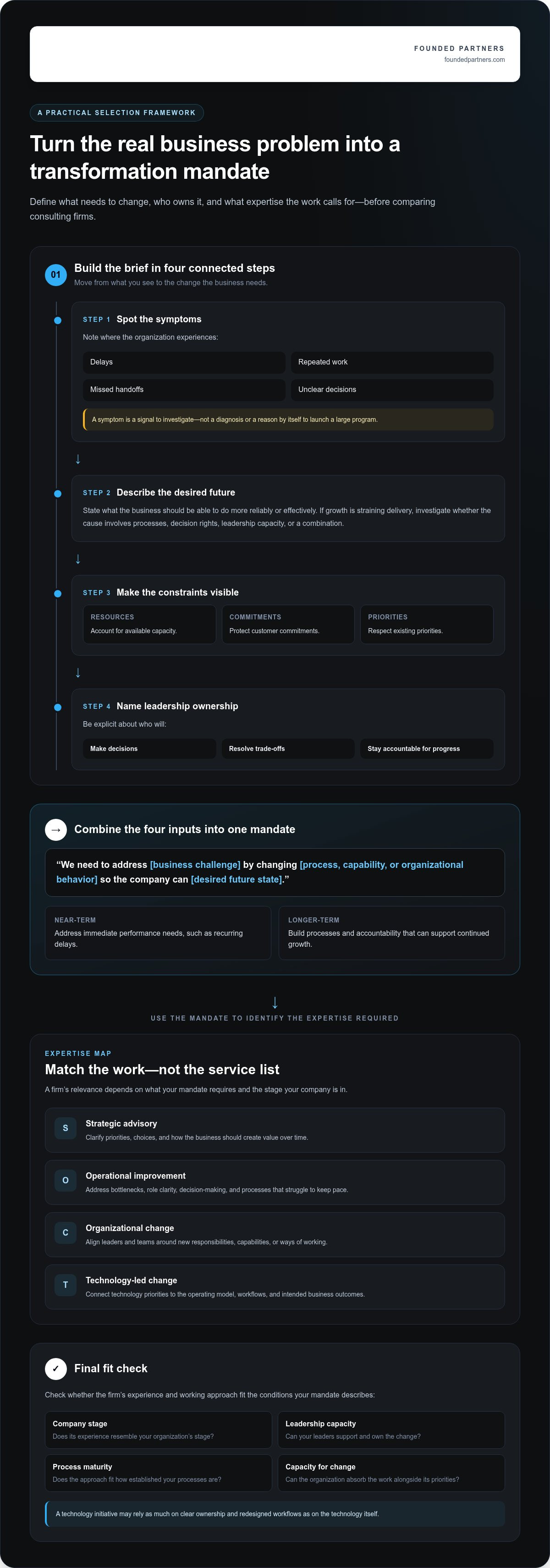
Before speaking with firms, write down four things:
- Symptoms: Where do delays, repeated work, missed handoffs, or unclear decisions show up?
- Desired future state: What should the business be able to do more reliably or effectively?
- Constraints: Which resources, customer commitments, or existing priorities must the change account for?
- Leadership ownership: Who will make decisions, resolve trade-offs, and stay accountable for progress?
Which business challenges call for transformation consulting?
Persistent operating bottlenecks, difficulty scaling established processes, and stalled strategic initiatives can all point to a need for broader change. Other signals include competing priorities across teams, unclear accountability, or a strategic shift that current ways of working can’t support. These signs warrant closer diagnosis, not an automatic decision to launch a large program. Clarify where the problem starts, who experiences it, and what evidence would show it is improving.
Consider a founder whose team keeps adding people to meet demand, yet work still gets delayed. The underlying issue may be process design or decision-making, rather than capacity alone. A firm’s role should be shaped by that diagnosis, not by the most visible symptom.
How should founders define a transformation mandate?
Start with a plain-language statement: “We need to address [business challenge] by changing [the process, capability, or organizational behavior] so the company can [desired future state].” This connects the business need to the organizational change it requires. It also gives leaders a shared reference point for comparing approaches and setting priorities.
Then separate immediate performance needs from longer-term capability building. A near-term need might be to reduce recurring delays; a longer-term ambition might be to establish processes and accountability that can support continued growth. Both matter, but they may require different decisions and measures. Make the leadership context explicit by identifying decision-makers, affected teams, and non-negotiable constraints, such as customer commitments or limited internal capacity.
A strong mandate doesn’t need to predict every step. It should make the problem, ambition, ownership, and boundaries clear enough to guide the work. That clarity helps you assess whether a firm’s expertise fits your company’s actual stage and challenge, rather than relying on a broad promise of transformation.
Match the Consulting Firm’s Expertise to Your Company’s Stage and Needs
A firm’s relevance depends on the work your mandate requires, not on how many services appear on its website. A founder-led company refining its operating model needs different support from an established organization reshaping strategy, leadership, and multiple functions. Company stage matters because it affects leadership capacity, the maturity of existing processes, and how much change the organization can absorb at once.
As you compare firms, map your mandate to the type of expertise involved:
- Strategic advisory: Clarify priorities, choices, and how the business should create value over time.
- Operational improvement: Address bottlenecks, role clarity, decision-making, and processes that struggle to keep pace with the business.
- Organizational change: Align leaders and teams around new responsibilities, capabilities, or ways of working.
- Technology-led change: Connect technology priorities to the operating model, workflows, and business outcomes they are intended to support.
These needs can overlap. A technology initiative, for instance, may depend as much on clear ownership and redesigned workflows as on the technology itself. BCG's perspective on business transformation also connects transformation to performance and value creation. It’s a useful reminder to assess how a firm links strategic aims to organizational and operational decisions.
What capabilities should a transformation partner bring?
Look for a clear connection between strategic priorities and execution: how choices affect the operating model, which capabilities need strengthening, and how leaders and teams will work differently. Relevant experience should resemble your challenge in meaningful ways, such as company stage, leadership context, or complexity, rather than simply share an industry label. In early discussions, listen for questions that test assumptions and clarify dependencies. When choosing a business transformation consulting firm, the ability to connect your mandate to its practical implications can matter more than a broad service catalogue.
When might a boutique firm suit a founder-led company?
A focused advisory relationship may appeal when founders want to concentrate on a defined set of business priorities. A larger firm may suit a broader, more complex scope that requires multiple areas of expertise. Neither model is inherently better. Compare the work required, the people who will lead it, and how the working relationship fits your leadership team. Firm size alone doesn’t establish quality or predict results.
If growth is exposing limits in capacity, process, or accountability, consider whether Founded Partners’ advisory approach aligns with your priorities. Founded Partners works with founder-led organizations on business transformation, operations optimization, and scalability strategy. A practical business scalability consulting guide can also help clarify whether the central need is growth planning, stronger operating foundations, or both.
Compare Business Transformation Consulting Firms With a Practical Scorecard
A polished proposal can make very different firms sound alike. Use the same scorecard for each conversation and judge answers against the mandate you’ve already defined. Record evidence, not just impressions. For each criterion, note what the firm says, what supports the claim, and whether the answer fits your leadership team’s needs.
| Criterion | What to assess | Evidence to record |
|---|---|---|
| Mandate fit | Does the proposed work address your specific challenge and priorities? | A clear connection between the brief, recommended scope, and intended outcomes. |
| Relevant experience | Has the firm worked through comparable challenges and organizational contexts? | Specific examples that explain the situation, the firm’s role, and what changed. |
| Senior involvement | Who will lead the work and engage with your decision-makers? | Named roles, expected access to senior people, and clear decision points. |
| Execution support | How will recommendations become operating decisions and accountable work? | Practical plans for ownership, coordination, and addressing obstacles. |
| Success measures | How will the team assess progress and business or organizational outcomes? | Measures tied to the mandate, with a way to review and adjust them. |
| Collaboration and knowledge transfer | How will leaders and teams participate, learn, and carry the work forward? | Clear communication expectations and an approach to sharing knowledge. |
Use a simple rating such as strong, partial, or unclear, but keep the written evidence beside it. A claim like “we help companies scale” is broad. A more useful example explains the original challenge, the firm’s specific contribution, and how the work relates to your circumstances. Treat impressive numbers cautiously unless the firm attributes and dates them and explains what they measure. A result without context may not tell you whether the experience applies to your mandate.
How can you assess a firm’s experience and working style?
Ask how a relevant engagement compares with your challenge, where the circumstances differ, and what the firm learned. Clarify who will attend leadership discussions, how often you’ll communicate, and how decisions or concerns will be raised. The aim isn’t to find a perfect match on paper. It’s to understand whether the firm can apply its experience thoughtfully and work constructively with your people.
Which questions reveal whether the engagement will be practical?
Ask how the firm moves from strategic priorities to changes in operating decisions, roles, and accountable work. Find out how leaders and affected teams will shape the change, how progress will be reviewed, and what happens when evidence points to a needed adjustment. Clarify how knowledge will be transferred so your team can sustain new practices. Answers should make the working relationship tangible, not simply restate the proposed deliverables.
For founders, the scorecard can reveal whether an advisory partner will bring clarity while working alongside leadership, rather than leaving the organization with recommendations detached from daily decisions. If that approach suits your mandate, explore Founded Partners’ advisory approach as you compare potential fits.
Set Success Measures and Leadership Conditions Before Transformation Begins
Recommendations create value when they shape decisions and practices after the planning conversations end. Before transformation begins, agree on what progress should look like, who owns the work, and how leaders will respond when circumstances or evidence change. These conditions keep the effort connected to the business challenge instead of treating activity as a result.
Use a simple sequence to establish the foundations:
- Define outcomes. Choose a small set of changes that would address the original challenge, such as more reliable delivery or clearer decision-making.
- Establish ownership. Name the executive sponsor, decision-makers, and people responsible for moving each workstream forward.
- Set milestones. Identify meaningful checkpoints that show whether key decisions and changes are taking hold.
- Review progress. Agree how often leaders will examine evidence, surface barriers, and adjust the approach.
Distinguish activity measures from outcomes. Meetings held, processes reviewed, or recommendations delivered can show that work is underway. They don’t establish whether performance or organizational capability has changed. Pair relevant activity indicators with measures tied to the mandate, such as the reliability of a key process or whether teams can make decisions at the appropriate level. A useful guide to measuring transformation success for founder-led firms can help leaders think through these distinctions. The measures themselves should reflect the company’s starting point and ambitions.
How should leaders define transformation success?
Begin with the original business challenge, then select a few indicators that can show whether the intended change is taking hold. Where relevant, include both operational performance and organizational capability, such as clearer ownership or stronger team ability to carry out a process. Record a baseline before work begins and set a review cadence. There is no universal benchmark that fits every company or mandate.
What leadership conditions help transformation take hold?
Visible executive sponsorship gives the work direction, while clear decision ownership prevents unresolved trade-offs from stalling progress. Leaders also need to explain what is changing and why, and create ways for affected teams to contribute practical insight. Feedback can reveal where a process is difficult to use or where responsibilities remain unclear. Use that evidence to refine implementation rather than assuming the initial plan will fit every situation.
For example, a new operating process may be documented while teams continue escalating routine decisions. In that case, completing the documentation is only an activity measure. Leaders can review who is making those decisions, identify what remains ambiguous, and adjust responsibilities or communication. The aim is to learn as the work unfolds, not to treat the original plan as fixed.
Thoughtful measurement won’t guarantee a particular result, but it can help leaders recognize progress, address obstacles, and keep the effort accountable. If your founder-led organization is preparing for consequential change, explore Founded Partners’ business transformation advisory to consider how leadership priorities and operating foundations can guide the work.
How Founded Partners Supports Founder-Led Business Transformation
For a founder-led company, transformation is rarely separate from the decisions that shape its next stage. Changes to operations can affect how leaders set priorities, how teams work together, and whether the business has foundations that can support growth. Founded Partners advises founder-led organizations on business transformation and operations optimization, helping leaders address consequential business change.
The firm’s work connects operational foundations with scalability strategy and leadership priorities. That connection matters when the challenge isn’t simply to improve one process, but to strengthen how the organization functions as it grows. Leadership advisory can also support a transformation mandate when founders and senior leaders need to clarify responsibilities, align around decisions, or guide organizational change. The goal is to consider how these elements relate to the company’s direction, rather than treating them as isolated initiatives.
A transformation partner for founder-led organizations
Founded Partners is a privately owned boutique consultancy led by partners Adam and Matt. The firm advises founder-led organizations on business transformation, operations optimization, scalability, and leadership transitions. As you consider choosing a business transformation consulting firm, assess whether its work can connect your strategic priorities to the operational and leadership conditions needed to act on them.
For example, growth may expose friction across processes, decision-making, and accountability at the same time. Addressing only one visible issue may leave underlying constraints in place. A transformation partner can help leaders consider how business foundations, operating needs, and the organization’s ambitions fit together, while keeping the work grounded in the mandate.
What to do before taking the next step
Before starting a conversation, prepare a concise view of what your company needs from transformation. This doesn’t need to be a polished plan. It should give leaders and an advisory partner a shared starting point:
- Mandate: State the core business challenge and the change you believe it requires.
- Desired outcomes: Describe what the company should be able to do more effectively or sustainably.
- Constraints: Note the commitments, capacity limits, or priorities the work must account for.
- Leadership stakeholders: Identify who will make decisions and which teams will be affected.
Use the scorecard from the previous section to clarify what you value in a partner: relevant experience, senior involvement, practical support, clear measures, and a collaborative working relationship. These criteria help you explain not only what the business needs, but how you want to work through the change.
If your organization is considering a consequential shift, start a conversation with Founded Partners about your transformation priorities. A clear discussion of your company’s needs and ambitions can establish a useful starting point for the work ahead.
Turn Your Transformation Priorities Into a Clear Next Step
The choice of an advisory partner can shape more than a single initiative. It can influence how your leadership team makes decisions, how your organization adapts, and how well the business is positioned for its next chapter. Choosing a business transformation consulting firm is an opportunity to be deliberate about the partnership your company needs, not just the work it wants to begin.
Before moving forward, consider what you want the next conversation to clarify: the challenge with the greatest consequence, the changes your team is ready to undertake, or the leadership alignment needed to move ahead. You don’t need every answer in place. A thoughtful discussion can help bring priorities into focus and identify where to begin.
Founded Partners works with founder-led organizations on business transformation and operations optimization. To discuss how its advisory services fit your company’s priorities, talk with Founded Partners about your business transformation priorities. A clear first step can help create direction for the work ahead.
Frequently Asked Questions
What does a business transformation consulting firm do?
A business transformation consulting firm helps an organization address strategic or operational challenges by shaping and supporting changes to how the business works. Depending on the mandate, this may involve refining priorities, improving operations, strengthening leadership alignment, or building capabilities for growth. The work should connect recommendations to practical business decisions. Founded Partners focuses on business transformation and operations optimization for founder-led organizations.
How do I know if my company needs transformation consulting?
Consider consulting support if recurring problems are connected across teams or continue despite local fixes. For example, missed handoffs may stem from unclear decision rights, while difficulty handling new demand may reflect processes that no longer fit the company’s scale. Before seeking outside support, identify what has been tried, where progress stalls, and what your internal team can realistically lead alongside its existing responsibilities.
What should I look for when choosing a business transformation consulting firm?
Look for a firm that can explain how its experience relates to your specific challenge, not just offer a broad list of capabilities. Clarify who will work directly with your leaders, how recommendations connect to implementation, and how your team will build the understanding to sustain changes. Ask for relevant examples with enough context to assess the firm’s role, the business situation, and the lessons that may apply to your organization.
How long does a business transformation consulting engagement take?
There’s no single timeline that fits every engagement. The duration depends on the scope of the challenge, how many parts of the organization are affected, the decisions required, and whether the work includes implementation support. A focused operational issue may call for a different sequence from a broader strategic and organizational shift. Discuss phases, decision points, leadership availability, and what would signal readiness to move from one phase to the next.
How much does business transformation consulting cost?
Consulting fees depend on the engagement’s scope, the expertise and senior involvement required, and the form of support involved. Rather than relying on a generic industry figure, ask for a clear explanation of the proposed work, its assumptions, and what is included in the engagement. Comparing proposals against the same mandate can help you understand differences in scope and support without treating unlike offers as equivalent.
Can a transformation consulting firm help a founder-led business scale?
Yes. A transformation partner can help founders examine whether operations, decision-making, and leadership capacity can support the company’s growth ambitions. If increasing demand is stretching teams, for instance, the question may be how to strengthen the business’s operating foundations, not simply how to add more activity. Founded Partners advises founder-led organizations on scalability strategy alongside business transformation and operations optimization.
What should I prepare before speaking with a transformation consultant?
Bring a concise picture of the issue and its effects. Examples of recurring delays, workarounds, or decisions that get stuck can make the discussion more concrete. If available, gather relevant process documents, existing performance reports, and notes on previous improvement efforts. You don’t need a complete diagnosis. A few specific observations and an honest view of your team’s capacity can help focus the initial conversation.